Insulated Panel Production Line
Publication Date: Oct 6, 2026
The insulated panel production line is an automated integrated manufacturing system for composite thermal insulation panels. It unifies raw material processing, composite molding, curing and finishing, delivering high-efficiency, consistent production of panels for construction and industrial thermal insulation applications.
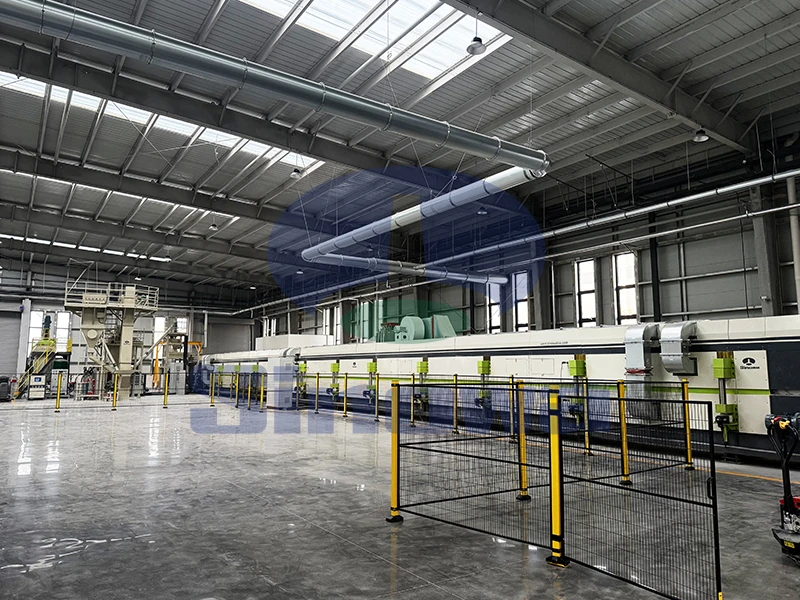
The insulated panel production line serves as a core automated manufacturing system dedicated to the mass production of composite insulated panels, which are widely adopted in modern building envelopes, cold storage facilities, industrial enclosures and energy-saving architectural projects. Different from scattered single processing equipment, this integrated production system realizes continuous and seamless operation of all manufacturing procedures, eliminating manual intervention gaps and greatly improving production stability and efficiency. The entire production workflow covers full-process processing from raw material pretreatment to finished product shaping, with every functional module operating in precise synchronization. It is designed to adapt to diverse insulation core materials and surface sheet specifications, enabling flexible production of insulated panels with different structural characteristics and functional attributes. The automated control logic embedded in the line effectively unifies production parameters, avoiding product performance fluctuations caused by manual operation differences, and lays a solid foundation for the consistent quality of finished insulated panels in batch production.
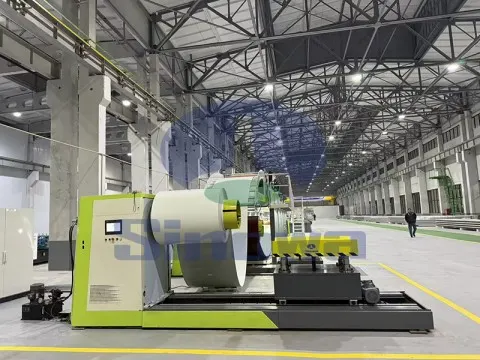
Raw material pretreatment is the initial and foundational procedure of the entire insulated panel production process, which directly determines the bonding quality and surface finish of finished panels. The main raw materials involved include metal surface sheets and various insulation core materials, each requiring targeted pretreatment operations. For metal coil materials, the system first completes automatic uncoiling and precise leveling to eliminate surface wrinkles, deformation and internal stress generated during coil storage and transportation. Meanwhile, professional surface cleaning devices remove dust, oil stains and oxide layers on the metal surface, creating a clean and dry bonding interface for subsequent gluing and composite processing. For porous and fibrous insulation core materials, the pretreatment process includes sorting, trimming and surface flattening to ensure uniform thickness and complete structural integrity of core materials. Some production lines are also equipped with preheating modules to adjust the temperature of surface sheets and core materials to the optimal bonding range, which can significantly enhance the adhesion effect between different materials and avoid hollowing or delamination of panels in later use.
Automatic batching and mixing is a key link that guarantees the internal structural performance of foam-based insulated panels, focusing on the precise proportioning and uniform blending of chemical raw materials for thermal insulation cores. The production line adopts a fully automatic metering system to control the dosage of various raw materials accurately, avoiding performance deviations caused by manual proportioning errors. All raw materials are transported to a high-speed mixing device through closed pipelines, where they undergo rapid and uniform stirring to form a stable composite foaming material. The system can dynamically adjust mixing speed, stirring time and material flow according to real-time production speed and ambient conditions, ensuring that the mixed materials have consistent foaming activity and fluidity. Uniform mixing enables the foaming material to form a fine and closed-cell structure after molding, which effectively improves the thermal insulation, sound insulation and structural compression resistance of the panel core. In addition, the closed mixing and conveying design reduces material waste and avoids environmental pollution caused by raw material volatilization, realizing green and efficient production operation.
Surface sheet roll forming is an essential process to shape the outer protective structure of insulated panels, endowing metal surface sheets with stable geometric dimensions and structural rigidity. After pretreatment, the flat metal sheets are continuously sent to the multi-group roller forming unit of the production line, which consists of dozens of precision arranged forming rollers with different shapes and sizes. Through gradual rolling and extrusion, the flat metal sheets are processed into flat or corrugated structural shapes required for insulated panels, and the overall flatness and edge straightness of the sheets are strictly controlled during the forming process. The roller forming unit supports flexible adjustment of forming specifications, which can adapt to different panel width and thickness requirements. The whole forming process is continuous and uninterrupted, with automatic deviation correction devices installed in the conveying path to avoid sheet offset and deformation. Reasonable roll forming processing makes the metal surface sheet have excellent load-bearing capacity and weather resistance, which can effectively protect the internal insulation core from external environmental erosion and mechanical damage, and improve the overall service life of insulated panels.
Automatic gluing and core material laying procedures determine the composite firmness and overall uniformity of insulated panels, being the core steps of panel composite molding. The production line is equipped with high-precision automatic gluing systems, which can evenly coat structural adhesive on the inner surfaces of upper and lower metal sheets through roller coating or spraying modes. The system can accurately control the glue application amount and coating range according to panel specifications, ensuring full coverage of the bonding area without excess glue accumulation or local missing coating. After gluing is completed, the automatic laying device uniformly arranges the processed insulation core materials between the two glued metal sheets, realizing precise alignment of the core and surface sheets. For foam core materials, the system completes synchronous foaming and filling while laying, making the core material closely fit with the surface sheets. The integrated operation of gluing and laying avoids manual misalignment and uneven bonding problems, ensuring that each position of the panel forms a tight composite structure and improving the overall structural integrity of the product.
Continuous lamination and pressing is a crucial procedure to realize integral molding of insulated panels, which shapes the stable composite structure of surface sheets and insulation cores. The laid semi-finished panels are continuously sent to the constant-pressure lamination unit composed of upper and lower circulating conveyor belts. The conveyor belts maintain a fixed and adjustable gap according to the preset panel thickness, realizing precise control of panel dimensional accuracy. During the pressing process, the system applies uniform and stable pressure on the panel surface, which can squeeze out residual air between layers and promote full penetration and bonding of structural adhesives. Meanwhile, the circulating conveyor belts ensure consistent pressure bearing on the entire panel surface, avoiding local bulging, depression or uneven thickness. The continuous pressing mode realizes uninterrupted production, greatly improving production efficiency compared with intermittent pressing equipment. After lamination and pressing, the preliminary composite structure of the insulated panel is basically formed, with stable bonding strength and uniform overall structure, laying a foundation for subsequent curing and finishing processing.
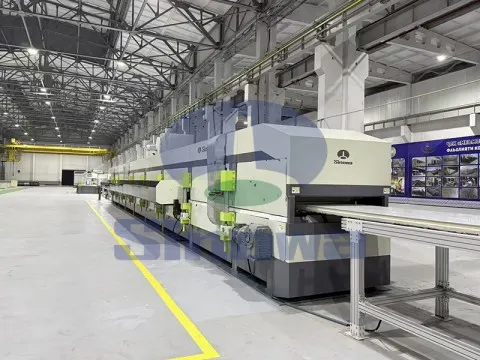
Constant-temperature curing is a key process to stabilize the physical and chemical properties of insulated panels and enhance structural durability. The pressed semi-finished panels enter the independent constant-temperature curing channel of the production line, where a stable and uniform temperature environment is maintained through intelligent temperature control systems. The curing process enables the structural adhesive to complete full cross-linking reaction and the foam core material to finish complete foaming and solidification, so that the bonding force between layers reaches the optimal state and the internal cell structure of the core material becomes more compact and stable. The production line can adjust the curing temperature and conveying speed according to different core material types and panel thicknesses, matching the optimal curing cycle for each product. Sufficient constant-temperature curing effectively improves the mechanical strength, thermal insulation stability and delamination resistance of insulated panels, avoiding structural loosening or performance attenuation in long-term use. The closed curing channel also ensures consistent curing effects of all products in batch production, realizing unified product quality standards.
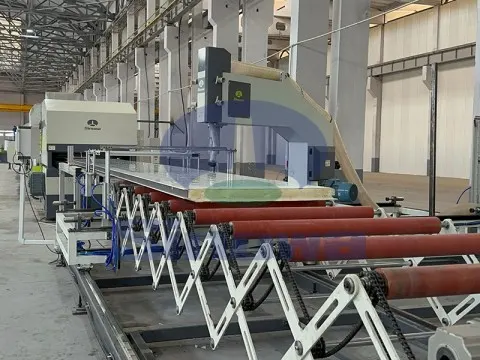
Precision cutting and shaping is the finishing procedure to standardize the dimensional specifications of finished insulated panels. After curing and shaping, the continuous long-strip panel is conveyed to the servo flying cutting unit of the production line, which adopts high-precision servo positioning and automatic cutting technology. The system can set arbitrary cutting lengths according to customer demand, and complete fixed-length cutting in the moving state of the panel, ensuring no pause in the production process and maintaining continuous production efficiency. The cutting tool adopts high-hardness precision blades, which can realize smooth and burr-free cutting of metal surface sheets and insulation cores, avoiding edge cracking and core material shedding. After cutting, the edge trimming device automatically polishes and trims the panel edges to optimize the overall appearance and dimensional accuracy of the product. The intelligent cutting system has automatic counting and parameter storage functions, which can quickly switch production specifications and meet the customized production needs of different dimensional panels while ensuring batch consistency.
Surface finishing and defect detection further optimizes the product quality and appearance of insulated panels, serving as the final quality control link before finished product output. The production line is equipped with automatic surface finishing devices, which clean residual glue, dust and debris on the panel surface, and perform fine polishing treatment on the cutting edges and surfaces to make the product appearance flat and smooth. At the same time, the online detection system conducts real-time inspection on the thickness flatness, surface integrity and bonding compactness of each panel. It can automatically identify and mark defective products such as surface scratches, local delamination and uneven thickness, realizing effective screening of qualified products. This real-time detection mode avoids the outflow of defective products and reduces subsequent quality rework costs. The standardized finishing and detection process ensures that all finished panels have stable performance and uniform appearance quality, meeting the application requirements of different engineering scenarios.
Automatic stacking and packaging is the final link of the insulated panel production line, realizing standardized storage and transportation of finished products. The qualified insulated panels after detection are automatically conveyed to the stacking platform, where the intelligent stacking device completes orderly stacking according to fixed layers and specifications, ensuring neat and stable stacking without panel extrusion and damage. The system can adjust stacking quantity and arrangement mode according to product specifications and packaging requirements. After stacking is completed, the automatic packaging mechanism wraps and seals the stacked panels with protective materials, which can effectively prevent surface scratching, dust pollution and moisture erosion during transportation and storage. The integrated stacking and packaging process replaces manual operation, greatly improving packaging efficiency and standardizing product packaging specifications. It also facilitates subsequent handling, transportation and on-site use of products, realizing full-process automated production from raw material input to finished product output.
Gallery of Insulated Panel Production Line
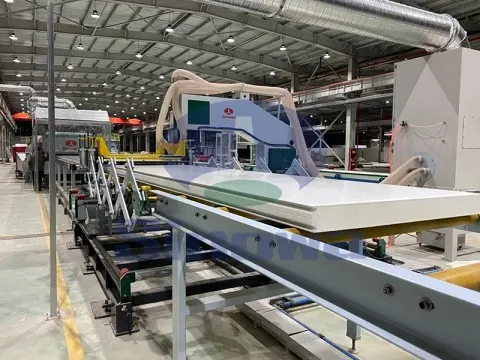
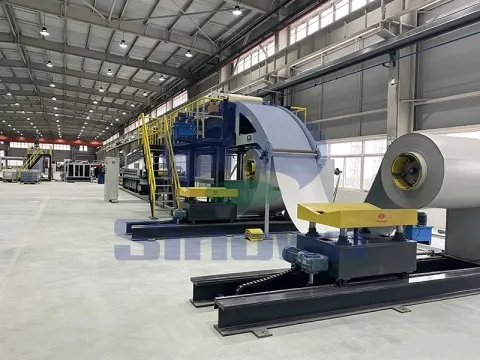
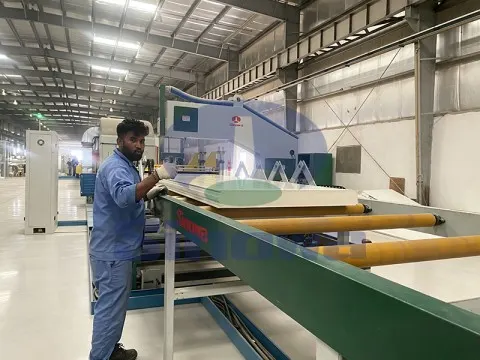
Tags: insulated panel production line, insulated panel production line manufacturer, insulated panel production line supplier, china insulated panel production line, insulated panel production line for sale
https://www.sandwichpanelmachinery.com/tags/insulated-panel-production-line.html