Composite Sandwich Panel Machinery
High-efficiency composite sandwich panel machinery for automatic continuous production of PU, PIR, rock wool insulated panels. Stable performance, full automation, custom production lines for construction & cold room industry.
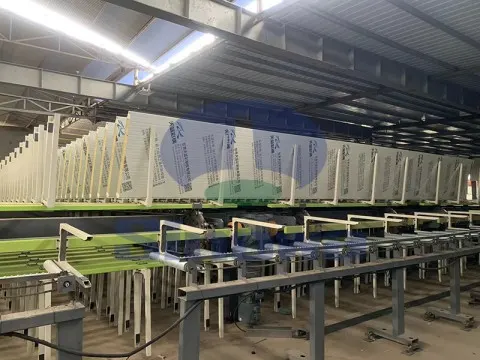
Composite sandwich panel machinery refers to a comprehensive automated production system dedicated to the integrated manufacturing of multi-layer composite sandwich panels, integrating multiple mechanical processing units and intelligent control technologies into a streamlined linear production layout. This sophisticated equipment is engineered to complete the entire panel forming process from raw material pretreatment to finished product output, covering material unwinding, surface layer shaping, adhesive coating, core material positioning, composite pressing, thermal curing, fixed-length cutting and finished product conveying. Different from traditional discrete processing equipment, modern composite sandwich panel line features modular structural design and synchronous linkage operation, effectively solving the problems of low efficiency, unstable product consistency and high manual intervention in traditional panel production. It adapts to various combinations of surface metal materials and lightweight core materials, enabling the mass production of high-performance composite panels that integrate structural stability, thermal insulation, sound insulation and fire resistance, serving as core production equipment for modern construction, industrial enclosure and cold chain facility manufacturing industries.
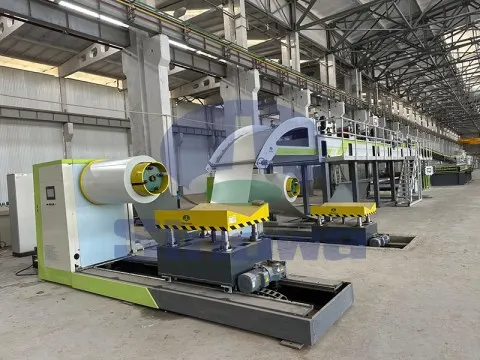
The structural composition of composite sandwich panel production machinery follows a scientific linear production logic, with each functional module closely connected to form an uninterrupted production workflow. The front-end part of the equipment is equipped with automatic unwinding and deviation correction units, which are responsible for stably releasing coiled surface materials such as color-coated metal sheets and aluminum plates, while real-time deviation correction ensures the flatness and linearity of material feeding to avoid positional errors in subsequent processing procedures. Followed by the surface layer roll forming module, this unit adopts multi-group roller pressing structures to carry out precise leveling and profiling of metal sheets, eliminating material wrinkles and structural deformation caused by coiling and stretching, and customizing diverse surface molding effects according to different panel design requirements. Each roller group is equipped with independent fine-tuning mechanisms to adjust pressing clearance and forming radian, ensuring the dimensional uniformity of surface materials in long-distance continuous production. The modular design of the front-end feeding and forming system greatly improves the equipment’s adaptability to different material specifications, laying a solid foundation for standardized composite panel production.
Adhesive coating and bonding pretreatment constitute the core link that determines the bonding performance of composite sandwich panels, and the corresponding mechanical units are precisely optimized for uniform glue application and efficient infiltration. The automatic gluing system of composite sandwich panel machinery adopts quantitative spraying and roller coating dual modes, which can flexibly switch according to different core material characteristics and production process requirements. The composite sandwich panel production equipment is equipped with high-precision glue supply metering components to control the glue output per unit area accurately, avoiding excessive glue overflow or insufficient coating that affects bonding firmness. Before formal gluing, the system supports automatic surface cleaning and micro-roughening treatment of surface materials, removing surface dust, oil stains and oxide layers to enhance the adhesion between adhesive and base materials. Meanwhile, the constant-temperature glue storage device maintains the optimal viscosity of the adhesive at all times, preventing glue solidification or fluidity instability caused by temperature changes. This refined gluing process ensures that the interface between the surface layer and core material achieves full-area uniform bonding, effectively improving the overall structural integrity and service durability of finished panels.
Core material conveying and positioning machinery units are specially designed for the stable laying and precise alignment of various lightweight core materials, which is key to ensuring the structural uniformity of composite panels. This composite sandwich panel equipment module is compatible with multiple mainstream core materials including foamed polymer materials, rock wool and other inorganic thermal insulation materials, and can adapt to core materials of different thicknesses and densities through simple parameter adjustment. The automatic conveying mechanism adopts variable-frequency speed regulation to match the operating speed of the front-end surface material forming system, realizing synchronous feeding of surface and core materials and avoiding material dislocation and layering deviation. The positioning system is equipped with multi-directional limit and correction structures, which can accurately limit the horizontal and longitudinal positions of core materials during high-speed conveying, ensuring that the core layer is completely covered by the surface material without offset or exposed edges. In addition, the core material pre-flattening device can eliminate the loose and uneven state of partial core materials, make the overall structure of the composite layer more compact, and further optimize the flatness and structural stability of the final sandwich panel products.
Constant-pressure composite pressing system is the core functional unit for the integrated molding of composite sandwich panels, undertaking the task of tightly laminating surface materials and core materials into an integral structure. This mechanical system adopts multi-stage balanced pressing structure, with the pressing force evenly distributed over the entire processing width through precision mechanical transmission components, realizing uniform pressure lamination of the whole panel surface. Different from single-stage pressing equipment, the multi-stage pressing design can complete gradual compression and shaping of composite materials, effectively avoiding core material crushing, adhesive extrusion excess or local hollowing problems caused by one-time high-pressure extrusion. The pressing clearance can be electrically adjusted in real time according to the preset panel thickness parameters, achieving rapid switching of production specifications and improving the equipment’s flexible production capacity. The internal pressure sensing components monitor the pressing state in real time and feed back data to the central control system, which automatically fine-tunes the pressure value to ensure consistent pressing effect in continuous production, so that each batch of composite panels maintains stable structural thickness and bonding compactness.
Constant-temperature curing and shaping equipment is an indispensable part of composite sandwich panel making machinery, responsible for accelerating adhesive curing and finalizing the integral structure of composite panels. The curing system adopts fully enclosed thermal circulation design, with internal temperature distribution uniform and stable, providing a constant and suitable curing environment for different types of adhesives. The equipment can adjust the curing temperature and thermal circulation speed according to the characteristics of adhesive materials and production line speed, realizing efficient curing while avoiding material aging or structural deformation caused by excessive temperature. The extended curing channel design ensures that the composite panels have sufficient time to complete adhesive cross-linking and solidification during continuous conveying, thoroughly solving the problem of incomplete curing and easy delamination of semi-finished products in high-speed production. Meanwhile, the heat insulation structure of the curing equipment reduces internal and external heat exchange, not only improving curing efficiency but also reducing energy consumption in the production process, realizing energy-saving and stable operation of the production line.
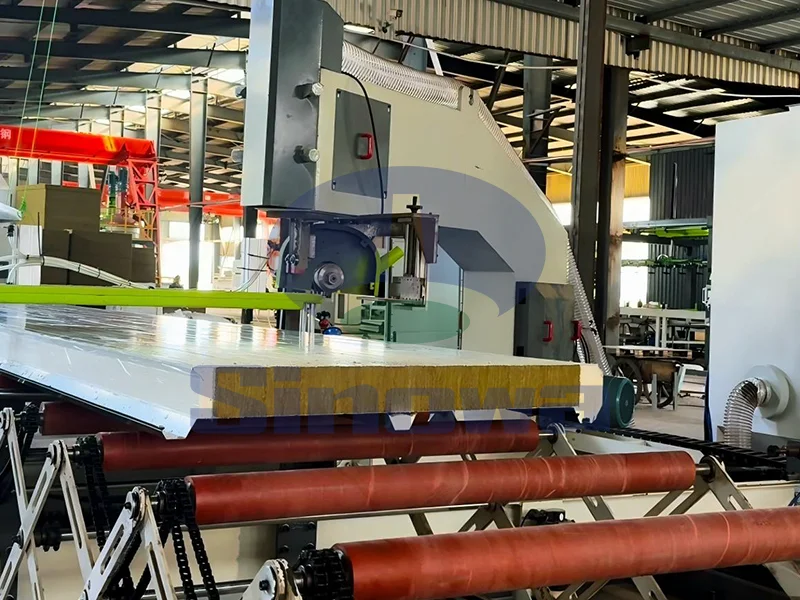
Precision fixed-length cutting and trimming machinery units realize the final sizing and finishing of composite sandwich panels, ensuring that finished products meet dimensional accuracy and appearance quality requirements. The flying saw cutting system adopted by modern equipment supports dynamic follow-up cutting in the running state of the composite sandwich panel manufacturing equipment, avoiding production pause caused by fixed-point cutting and greatly improving continuous production efficiency. The cutting mechanism is equipped with high-precision positioning and sensing devices, which can automatically identify the production length of panels and complete fixed-length cutting accurately according to preset parameters, with extremely low dimensional error of finished products. The edge trimming unit can automatically trim the redundant edges of composite panels formed by material alignment errors, making the edges of panels smooth and flat without burrs or uneven gaps. In addition, the cutting and trimming process adopts mechanical cold cutting technology, which will not cause thermal deformation or material damage to the composite panel structure, effectively protecting the integrity of the surface coating and the internal thermal insulation structure of the panels.
Intelligent central control and linkage system is the brain of composite sandwich panel manufacturing line, realizing unified scheduling and synchronous control of all functional modules of the production line. The system adopts integrated programmable control technology, with a human-machine interactive operation interface that intuitively displays the operating status, operating speed, processing parameters and equipment fault information of each unit. Operators can complete one-click setting of production parameters such as panel thickness, cutting length and production speed through the interface, and the system will automatically adjust the operating state of each mechanical module to realize automatic switching of production specifications. The built-in synchronous linkage program ensures that the feeding, forming, gluing, pressing, curing and cutting processes operate in precise coordination, avoiding production defects such as material accumulation and process mismatch caused by asynchronous operation. At the same time, the system has automatic fault detection and early warning functions, which can timely identify abnormal conditions such as equipment jamming, parameter deviation and material shortage, and realize automatic protection and shutdown reminder, effectively reducing equipment failure rate and production loss.
Finished product conveying and automatic stacking machinery units optimize the post-processing efficiency of composite sandwich panel production and realize automated collection and arrangement of finished products. The conveying system adopts anti-slip and anti-scratch conveying structure, which can stably transport cured and cut composite panels without causing surface coating wear or panel displacement. The variable-frequency speed regulation of the conveying mechanism matches the production rhythm of the front-end process, realizing seamless docking of the whole production line. The automatic stacking device can accurately stack finished panels according to preset stacking height and arrangement rules, with neat stacking and stable placement, avoiding panel collision and damage during stacking. This automated post-processing mode completely replaces manual carrying and stacking, greatly reducing labor investment in the production link, improving the overall production efficiency of the production line, and ensuring the uniformity of finished product stacking specifications, which is convenient for subsequent packaging, transportation and storage of products.
The performance advantages of composite sandwich panel production line are fully reflected in production stability, product diversity and operational economy. In terms of production stability, the fully automated modular linkage design reduces manual operation links, avoids product quality fluctuations caused by human factors, and ensures that the structural performance, dimensional accuracy and appearance quality of each batch of composite panels remain highly consistent. In terms of product diversity, the equipment can adapt to the composite molding of different surface materials and core materials, and can produce multi-specification and multi-functional composite panels to meet the application needs of different scenarios such as building enclosure, industrial workshop partition and cold storage thermal insulation. In terms of operational economy, the equipment realizes continuous uninterrupted production, with high single-line output and low unit energy consumption. The precise metering control of raw materials reduces material waste, and the intelligent fault diagnosis function reduces equipment maintenance costs and downtime loss, bringing stable economic benefits to long-term production operations.
With the continuous upgrading of industrial manufacturing and building energy-saving requirements, composite sandwich panel line is constantly evolving towards higher intelligence, higher efficiency and stronger environmental adaptability. The latest equipment optimization focuses on intelligent parameter self-adaptation technology, which can automatically identify material characteristics and match optimal production parameters, further reducing the technical threshold of equipment operation. At the same time, the equipment optimizes the mechanical transmission structure and thermal circulation system, further improving production speed and energy utilization efficiency while ensuring product quality. The modular assembly design of the equipment also facilitates later maintenance, transformation and function expansion, enabling the production line to keep pace with the iterative upgrading of composite panel products. As a key equipment in the field of new building materials manufacturing, composite sandwich panel machinery will continue to promote the standardized and large-scale development of composite panel production, and provide efficient and reliable technical support for the innovation and application of lightweight and energy-saving building materials.
The application value and market adaptability of composite sandwich panel manufacturing machinery continue to expand with the development of downstream industries. The composite panels produced by this equipment have the advantages of light weight, high strength, good thermal insulation and sound insulation performance, and convenient construction, and are widely used in prefabricated buildings, industrial factory buildings, logistics cold chains, municipal engineering and other fields. The flexible production capacity of the equipment can meet the personalized customization needs of different customers for panel specifications, material combinations and surface effects, breaking through the limitations of traditional single fixed production mode. In addition, the environmentally friendly production process of modern composite sandwich panel machinery reduces the emission of waste materials and pollutants in the production process, conforming to the development trend of green manufacturing. With the continuous growth of the demand for energy-saving and lightweight building materials in the market, this type of professional production machinery will maintain a broad application prospect and become an important driving force for the high-quality development of the new building materials industry.
Tags: composite sandwich panel machinery, composite sandwich panel machinery manufacturer, composite sandwich panel machinery supplier, china composite sandwich panel machinery, composite sandwich panel machinery for sale
Related Informations
PU Composite Panel Production Line