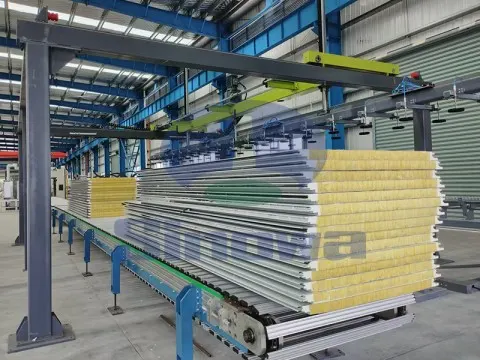
Roof Sandwich Panel Machinery
Roof Sandwich Panel Machinery manufacturer. Fully automatic roof sandwich panel production line for insulated building panels. Support custom profiles & thickness.
Roof sandwich panel machinery is a highly integrated and automated production system designed for the streamlined manufacturing of high-performance roof sandwich panels, a core building material widely adopted in modern architectural construction. Unlike traditional single-functional metal processing equipment, this roof sandwich panel line integrates feeding, roll forming, core material compounding, bonding, pressing, curing, and fixed-length cutting into one continuous production workflow, eliminating fragmented manual operations and intermittent production gaps. It is engineered to process diverse metal surface materials and lightweight insulating core materials, producing roof panels with uniform thickness, stable structural integrity, excellent thermal insulation, and outstanding weather resistance. As a pivotal piece of equipment in the prefabricated construction industry, it bridges the gap between standardized industrial production and on-site construction demands, effectively improving the overall manufacturing efficiency of building enclosure components. Its flexible production performance and stable operational output make it adaptable to various modern construction scenarios, supporting the large-scale promotion of energy-saving, lightweight, and fast-installation building solutions across the global construction sector.
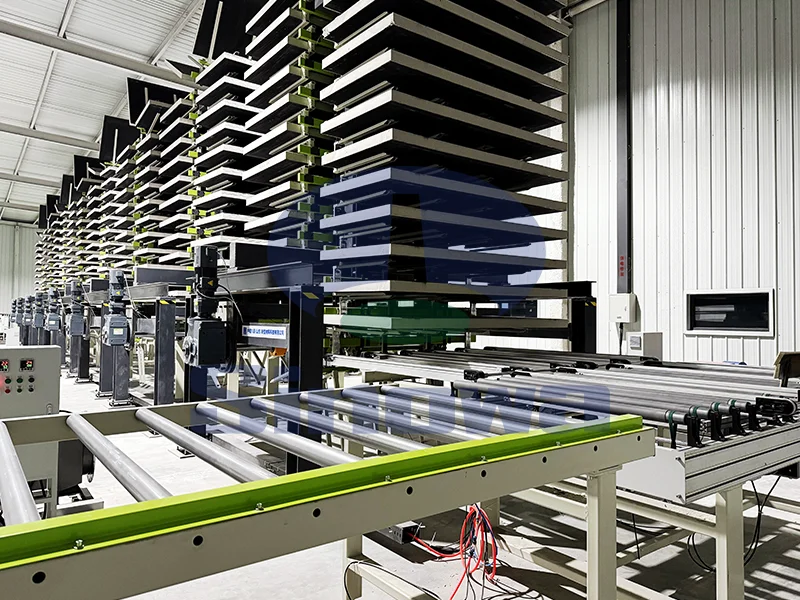
The core structural composition of roof sandwich panel manufacturing machinery consists of multiple interconnected functional units, each playing an irreplaceable role in ensuring continuous and standardized production. The raw material feeding unit serves as the starting point of the entire production line, equipped with automatic unwinding and guiding devices that stably deliver coiled metal sheets and roll-shaped core insulating materials to the subsequent processing links. This unit effectively avoids material deviation and tension unevenness, which are common in manual feeding processes, laying a foundation for consistent product specifications. Following the feeding system is the roll forming unit, composed of precision-arranged roller groups that gradually bend and shape flat metal sheets into standardized roof panel profiles with precise dimensional accuracy. Each roller is calibrated to ensure gradual deformation of the metal material, preventing surface wrinkles, deformation, or structural damage that may affect the panel’s waterproof and load-bearing performance. The middle compounding and gluing unit is the key to forming the sandwich structure, where uniform adhesive coating is applied to the inner surfaces of the metal sheets, ensuring tight bonding between the metal surface layer and the insulating core layer. At the end of the production line, the automatic cutting unit realizes fixed-length cutting according to preset parameters, completing the full-process manufacturing of finished roof panels. All functional units operate in synchronous coordination, forming a highly efficient streamlined production mode that adapts to long-term continuous industrial operation.
The working principle of roof sandwich panel production machine revolves around synchronous material processing and composite molding, relying on mechanical transmission and automatic control to achieve integrated panel manufacturing. The entire production process starts with automatic material unwinding, where metal coils and core materials are conveyed at a constant speed under the control of the servo transmission system to maintain consistent feeding rhythm. After entering the roll forming area, the flat metal sheets undergo multi-pass rolling and contouring, transforming into the curved or trapezoidal profiles required for roof panels, which enhance the structural rigidity and drainage performance of the final product. Subsequently, the formed upper and lower metal sheets enter the compounding station, where precision gluing systems evenly spray high-performance adhesive on the inner contact surfaces. The insulating core material is then accurately laid between the two metal layers, and the integrated pressing device applies uniform and stable pressure to bond the three layers tightly together. This mechanical pressure-assisted bonding method eliminates hollow gaps and delamination problems, ensuring the overall structural compactness of the sandwich panel. After compound molding, the panels pass through a constant-temperature curing section to accelerate adhesive solidification, stabilizing the composite structure. Finally, the intelligent cutting system completes precise fixed-length segmentation, producing finished roof panels with neat edges and consistent specifications.
Roof sandwich panel making machine supports the processing of a wide range of raw materials, endowing the produced roof panels with diversified performance characteristics to meet different construction environment requirements. In terms of surface metal materials, the equipment is compatible with various lightweight and high-strength metal coils with good weather resistance and plasticity. These metal materials provide excellent surface protection for the panels, resisting external wind, rain, and ultraviolet erosion, while maintaining long-term structural stability and surface flatness. For the core insulating materials, the machinery can adapt to multiple mainstream insulating substrates with low thermal conductivity and lightweight properties. These core materials deliver superior thermal insulation and heat preservation effects, effectively blocking indoor and outdoor heat exchange and reducing building energy consumption. The equipment’s adjustable feeding and pressing structure can adapt to core materials of different thicknesses and densities, realizing flexible switching of panel thermal insulation grades. In addition, the machinery matches high-performance environmental adhesives with strong bonding force and aging resistance. These adhesives can maintain stable bonding performance in different temperature and humidity environments, avoiding degumming and layer separation caused by long-term external environmental changes. The compatibility with diverse raw materials enables the equipment to produce customized roof panels for different climatic regions and building functional needs.
Automation and intelligent control are the most prominent technical advantages of modern roof sandwich panel production machinery, greatly reducing manual dependence and improving production standardization. The entire production line is equipped with a centralized intelligent control system, which integrates parameter setting, operation monitoring, fault detection, and data statistics functions. Operators only need to input preset parameters such as panel thickness, length, and production speed on the control terminal, and the equipment can automatically complete the whole production process without real-time manual intervention. The system supports parameter memory function, which can store production parameters of different panel specifications and realize one-key switching during batch production of different products, effectively shortening parameter adjustment time and improving production flexibility. Equipped with high-precision servo transmission and sensing devices, the machinery can monitor feeding speed, pressing pressure, and cutting dimensions in real time, automatically fine-tuning operational parameters to ensure consistent product accuracy. Meanwhile, the intelligent fault diagnosis system can automatically identify abnormal conditions such as material jams and equipment operation deviations, trigger early warning prompts, and suspend operation in time to avoid defective products and equipment damage. This intelligent operation mode not only reduces the technical threshold of equipment operation but also stabilizes production quality and improves overall operational safety.
The production efficiency of roof sandwich panel manufacturing equipment far exceeds that of traditional semi-automatic and manual panel manufacturing methods, creating significant value for large-scale building material production. Traditional panel processing relies on manual material matching, gluing, and cutting, with discontinuous production processes, low output, and long single-piece processing cycles, making it difficult to meet the demand for large-volume panel supply in engineering projects. In contrast, the fully continuous streamlined operation of roof sandwich panel machinery realizes uninterrupted feeding, compounding, molding, and cutting, achieving efficient batch production. The synchronous operation of each functional unit eliminates intermediate waiting and handling links, greatly compressing the overall production cycle of a single panel. In addition, the equipment’s stable continuous operation capacity supports long-hour uninterrupted production, effectively improving daily and annual output. The high-precision automatic processing also reduces the rate of defective products caused by human operation errors, lowering material waste and rework costs. While improving production speed, the equipment maintains consistent product specifications and performance, avoiding quality fluctuations common in manual production. This high-efficiency and low-loss production feature enables manufacturers to quickly respond to market and project order demands, shortening production cycles and improving market competitiveness.
The product quality stability achieved by roof sandwich panel production equipment lays a solid foundation for the safe and durable application of roof panels in construction projects. The standardized mechanical processing mode completely avoids the inconsistencies in manual operation, such as uneven gluing, inconsistent pressing pressure, and inaccurate cutting dimensions, which are the main causes of poor panel quality. The precision gluing system of the equipment can control the adhesive coating amount and range accurately, ensuring uniform bonding force on the entire contact surface between the metal layer and the core material, effectively preventing local delamination and hollowing of the panels. The constant-pressure composite pressing technology ensures that each panel receives uniform pressure during molding, making the internal structure compact and stable, with consistent overall thickness and flatness. The panels produced by this machinery have excellent overall structural rigidity, with strong load-bearing capacity and wind resistance, adapting to complex outdoor building environments. In terms of appearance quality, mechanical rolling and molding ensure smooth and neat panel surfaces, uniform profiles, and neat cutting edges, reducing subsequent finishing processing procedures. Moreover, the stable curing process enables the adhesive to fully solidify, enhancing the aging resistance and structural stability of the composite panel, ensuring that the panels maintain excellent use performance during long-term outdoor service.
Roof sandwich panel equipment features flexible production performance, enabling customized manufacturing to meet the differentiated needs of diverse construction projects. Different architectural scenarios have distinct requirements for roof panel specifications, appearance profiles, and functional performance, and traditional fixed-mode production equipment is difficult to adapt to such diversified demands. Modern roof sandwich panel machinery adopts a modular adjustable structure, where key components such as rolling roller groups, feeding spacing, and pressing gaps can be finely adjusted according to production needs. This adjustability allows the equipment to produce roof panels of different thicknesses, lengths, and widths, as well as various profile shapes suitable for different roof designs. In addition, the equipment can switch freely between different core materials and surface metal materials, producing panels with different thermal insulation, waterproof, and wind resistance performance to adapt to various climatic conditions and building functional requirements. Whether it is thin lightweight panels for temporary buildings or thick high-insulation panels for industrial plants and cold storage buildings, the equipment can complete targeted production through parameter adjustment. This flexible customization capability breaks the limitations of single-product production, enables manufacturers to provide personalized supporting products for different construction projects, and expands the application scope and market adaptability of roof sandwich panels.
Energy saving and environmental protection are important inherent advantages of roof sandwich panel line, conforming to the development trend of green construction and sustainable manufacturing. The equipment adopts high-efficiency transmission motors and optimized mechanical structure design, which effectively reduces energy consumption during operation compared with traditional bulky and high-energy-consuming processing equipment. The precise material feeding and gluing control system minimizes the waste of metal sheets, core materials, and adhesives during production, improving the utilization rate of raw materials and reducing production waste. All production processes are carried out in a closed and orderly mechanical operation mode, avoiding dust pollution and adhesive volatilization leakage caused by scattered manual operations, optimizing the on-site production environment. In addition, the panels produced by this machinery are typical green building materials with lightweight characteristics, which can reduce the overall load of buildings and lower the energy consumption of building foundation construction. The excellent thermal insulation performance of the finished panels also reduces the energy consumption of building heating and cooling in long-term use, realizing energy conservation throughout the building life cycle. Meanwhile, the equipment has low noise operation performance during normal production, avoiding excessive noise pollution to the production workshop and surrounding environment, meeting the environmental protection requirements of modern industrial production.
The operational stability and maintenance convenience of roof sandwich panel manufacturing line ensure long-term and reliable industrial production operation. The equipment adopts high-strength steel frame structure and precision processing components, with good structural rigidity and wear resistance, able to withstand long-term continuous high-load operation without structural deformation and component damage. The transmission parts are equipped with protective and lubrication devices, which reduce mechanical friction loss and extend the service life of core components. The overall mechanical layout is reasonable and compact, with orderly arrangement of functional units, which not only saves workshop space but also avoids operational failures caused by structural disorder. In terms of daily maintenance, the modular design of the equipment enables independent disassembly, inspection, and replacement of each functional unit, making regular maintenance and fault troubleshooting more convenient. The intelligent monitoring system can record the operation status and running data of key components in real time, helping staff grasp the equipment’s operating condition in advance and carry out predictive maintenance, effectively reducing sudden equipment failures and downtime loss. In addition, the equipment is equipped with perfect safety protection devices, including emergency stop mechanisms and anti-jamming protection systems, which can effectively avoid safety accidents during operation, ensuring the safety of operators and production equipment.
Roof sandwich panel production line plays a vital role in promoting the development of prefabricated and modular construction industries. Prefabricated construction relies on factory standardized prefabrication of building components and on-site rapid assembly, which greatly improves construction efficiency and reduces on-site construction pollution and labor input. As special equipment for factory prefabrication of roof enclosure components, roof sandwich panel machinery provides stable and standardized panel products for prefabricated buildings. The high-efficiency batch production capacity of the equipment meets the large-scale component supply needs of prefabricated construction projects, while the diversified customized production capability adapts to the personalized design needs of different prefabricated buildings. The lightweight and high-performance panels produced by the machinery are highly compatible with modular building structures, realizing rapid assembly and installation of building roofs, shortening project construction cycles significantly. With the continuous upgrading of the construction industry towards greening, industrialization, and intelligence, the market demand for high-quality prefabricated building components is increasing, and roof sandwich panel machinery, as a core supporting equipment, is constantly driving the technological iteration and industrial upgrading of the building material manufacturing industry, promoting the standardized and intelligent development of the entire construction field.
The future development of roof sandwich panel making machinery will focus on intelligent upgrading, functional diversification, and green low-carbon optimization to adapt to the evolving needs of the construction industry. With the continuous progress of industrial intelligent technology, future equipment will realize more advanced automatic production functions, including automatic material identification, intelligent parameter matching, and unmanned continuous operation, further reducing manual intervention and improving production intelligence. The equipment will also integrate more precise detection technologies to realize real-time online detection of panel flatness, bonding tightness, and dimensional accuracy, achieving full-process quality control. In terms of functional expansion, the machinery will develop multi-functional composite production capabilities, enabling the integrated processing of roof panels with waterproof, fireproof, and antibacterial composite functions to meet the higher functional requirements of modern buildings. In terms of green manufacturing, future equipment will further optimize energy-saving structures and material utilization technologies, reduce production energy consumption and waste discharge, and develop low-carbon and environmentally friendly production modes. Continuous technological innovation and structural optimization will make roof sandwich panel machinery more efficient, intelligent, and environmentally friendly, providing stronger technical support for the high-quality development of the modern construction and building material industries.
Tags: roof sandwich panel machinery, roof sandwich panel machinery manufacturer, roof sandwich panel machinery supplier, china roof sandwich panel machinery, roof sandwich panel machinery for sale
https://www.sandwichpanelmachinery.com/sandwich-panel-machineries/roof-sandwich-panel-machinery.html
Related Informations
Soundproof Sandwich Panel Machine
Waterproof Sandwich Panel Machine