
PU sandwich panel production lines are versatile industrial manufacturing systems that can fully produce both roof and wall panels for construction use.
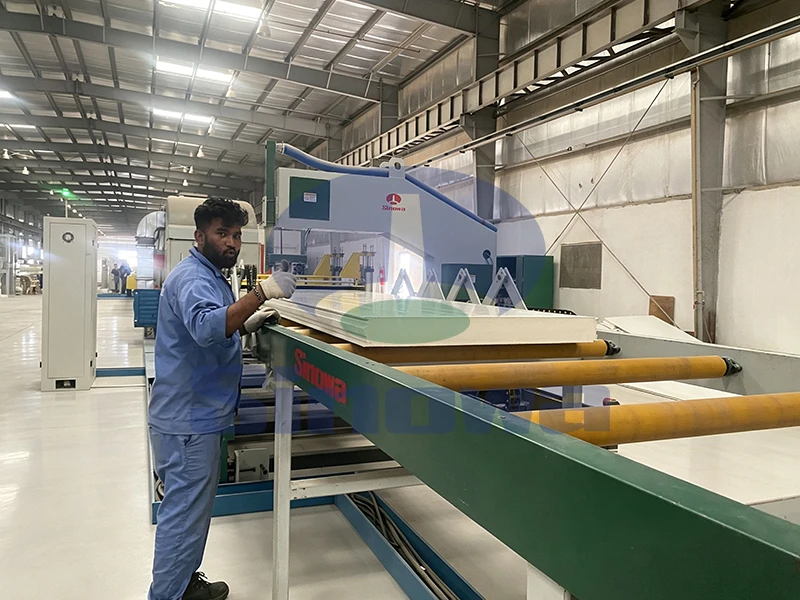
PU sandwich panel production lines are inherently designed with multi-functional manufacturing capabilities, enabling them to fabricate both roof and wall panels without core equipment replacement or major structural modifications. The core working principle of the line centers on continuous lamination, foaming and composite molding of polyurethane foam and metal surface materials, a process that fits the production demands of both building panel categories perfectly. The basic configuration of the production line, including feeding systems, continuous foaming units, pressing and shaping devices, and cutting systems, is universal for roof and wall panel manufacturing. Operators only need to adjust simple production parameters and replace partial auxiliary molds to switch between the two panel production modes. This inherent flexibility makes the PU sandwich panel line a cost-effective and high-efficiency solution for modern construction material manufacturing, eliminating the need for separate production equipment for different building panels and greatly optimizing factory production layouts and operational workflows.
The structural differences between roof panels and wall panels are the key reason why production line parameter adjustment is required during switching production, and these differences are fully adaptable to standard PU sandwich panel lines. Roof panels need stronger waterproofing, wind resistance and load-bearing performance to cope with outdoor harsh environments, so they usually adopt special corrugated surface designs and thicker core foam layers. In contrast, wall panels prioritize flatness, sound insulation and aesthetic performance, with smooth or finely textured surfaces and relatively standardized core thickness. The PU production line can precisely adjust the foam foaming density, panel overall thickness and surface profiling pressure through its intelligent control system. The line’s adjustable pressing roller group can switch between flat pressing and corrugated pressing states, accurately molding the distinct surface structures of wall and roof panels while maintaining the integrity and bonding strength of the composite layer throughout the continuous production process.
Material feeding matching is another critical advantage that allows PU sandwich panel lines to produce both roof and wall panels efficiently. The production line supports multiple types of metal surface materials commonly used for building panels, including color steel plates, aluminum alloy plates and galvanized steel sheets, which can be applied to both roof and wall products according to usage scenarios. For roof panels that require enhanced weather resistance, the line can realize uniform coating and composite bonding of high-performance anti-corrosion and waterproof surface materials during the continuous production process. For wall panels focusing on interior and exterior decoration, the equipment can complete precise feeding and flat composite molding of thin and smooth surface plates. Meanwhile, the polyurethane foaming system of the line can adjust the expansion ratio and curing speed of foam materials in real time, ensuring that the core materials of roof panels meet high mechanical strength requirements and the core materials of wall panels achieve balanced sound insulation and thermal insulation effects.
The continuous molding process of PU sandwich panel lines ensures stable production quality for both roof and wall panels in mass manufacturing. The entire production process from material feeding, foam filling, hot pressing composite to fixed-length cutting is automated and continuous, avoiding manual operation errors that affect panel performance. When producing roof panels, the line’s hot pressing temperature and transmission speed are fine-tuned to make the polyurethane core closely bond with the corrugated metal surface, preventing delamination or deformation under long-term outdoor wind and rain erosion. For wall panel production, the equipment optimizes the flat pressing process to ensure the panel surface is smooth and flat without wrinkles or uneven bonding, meeting the assembly and aesthetic requirements of building walls. The unified automated process standard guarantees consistent product quality of both panel types, suitable for large-scale construction engineering supporting needs.
Auxiliary functional units of the PU sandwich panel line further expand its dual production capacity for roof and wall panels. The line is equipped with adjustable edge trimming and sealing devices, which can process different edge structures for the two types of panels according to installation requirements. Roof panels need special groove and bite edge designs to enhance the overall waterproof and lap joint performance after installation, and the trimming unit can accurately cut and mold special joint structures. Wall panels usually adopt flat or simple buckle edges to facilitate rapid assembly of wall bodies, and the equipment can quickly switch trimming modes to meet such demands. In addition, the automatic cutting system can set different fixed-length sizes and width specifications, flexibly producing short and long panels for wall assembly and ultra-long integral panels for roof laying, adapting to diverse building structural design needs.
Performance customization capabilities of the production line enable manufactured roof and wall panels to adapt to different construction scenarios. In industrial factory buildings, warehouses and large public buildings, roof panels need excellent thermal insulation, pressure resistance and wind load resistance. The PU line can increase the foam core density and overall panel thickness through parameter adjustment to enhance the outdoor environmental adaptability of roof panels. For interior and exterior wall panels of residential buildings, office buildings and commercial spaces, the line can produce lightweight panels with moderate thermal insulation and superior sound insulation performance by reducing partial core density and optimizing surface flatness. This targeted performance adjustment without equipment replacement greatly improves the product diversification capability of the production line and enriches the application scope of finished panels.
Operational simplicity of mode switching is an important feature of the PU sandwich panel line’s dual production function. The entire switching process between roof panel and wall panel production does not involve complex equipment disassembly and assembly. Professional operators only need to modify the parameter data on the intelligent control terminal, adjust the height of the pressing rollers, replace the corresponding surface profiling molds, and complete simple debugging of the trimming system, and the production line can complete mode conversion in a short time. The simple and efficient switching operation reduces production downtime caused by product replacement, improves the overall production efficiency of the factory, and enables manufacturers to flexibly respond to different customer order demands for roof and wall panels in the construction market.
The finished product yield and structural stability of roof and wall panels produced by PU sandwich panel lines reach excellent levels. Benefiting from the precise foaming and uniform hot pressing process of the equipment, the polyurethane core of both panels has uniform pore structure, no hollow or uneven density problems, ensuring stable thermal insulation and mechanical properties for a long time. The composite interface between the core material and the metal surface is tightly bonded, with strong peeling resistance, which can avoid cracking and delamination during panel transportation, installation and long-term use. Whether it is the corrugated anti-pressure structure of roof panels or the flat decorative structure of wall panels, the finished products have high dimensional accuracy, which can perfectly match the installation accessories and construction processes of modern building enclosure systems.
In practical industrial production applications, PU sandwich panel lines have been widely used for centralized manufacturing of supporting roof and wall panels for various building projects. Many building material manufacturers rely on this single production line to complete the supporting supply of enclosure panels for factory buildings, stadiums, logistics warehouses and prefabricated buildings. The line can realize batch production of roof and wall panels alternately according to project progress and order demand, effectively saving factory equipment investment and production site costs. Its strong product compatibility makes it a mainstream production equipment in the field of prefabricated building materials, fully verifying its reliable dual production capacity for roof and wall panels.
In conclusion, the standard PU sandwich panel production line has complete and mature capabilities to produce both roof and wall panels. Relying on adjustable production parameters, versatile structural design, flexible material adaptation and efficient mode switching functions, the line can stably manufacture high-quality roof panels suitable for outdoor enclosure and wall panels for building interior and exterior decoration. With outstanding production flexibility and cost performance, it remains an essential core equipment for the production of modern prefabricated building enclosure materials, providing strong technical and production support for the development of the construction industry.