PU Sandwich Panel Production Line
Publication Date: Sep 30, 2026
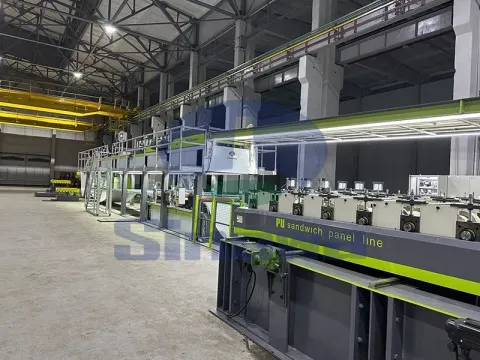
The PU sandwich panel production line is a fully automated integrated manufacturing system for composite insulation panels. It integrates raw material processing, foaming, laminating and shaping procedures to produce lightweight, heat-insulating panels widely used in modern construction and industrial fields.
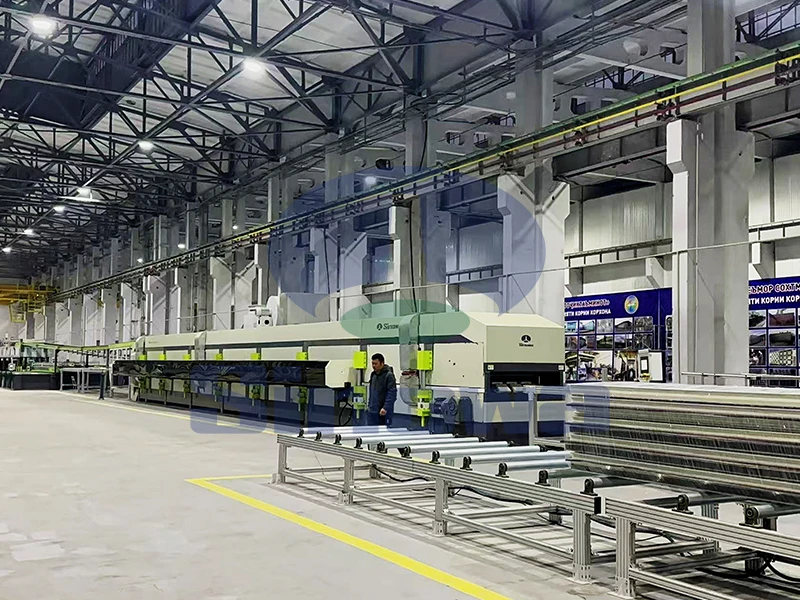
The PU sandwich panel production line stands as a sophisticated and integrated manufacturing system dedicated to the continuous production of high-performance composite panels with polyurethane foam cores. Unlike traditional discrete processing equipment, this production line unifies mechanical transmission, chemical foaming reaction, constant-temperature curing and precise composite forming into a seamless production workflow, realizing one-piece molding of layered composite structures. The core design logic of the equipment is to perfectly combine rigid surface facing materials and flexible polyurethane foam cores, endowing the final panels with dual advantages of structural stability and thermal insulation performance. In the context of growing demand for energy-saving and lightweight building materials, this automated production mode effectively solves the problems of low efficiency, inconsistent product quality and unstable bonding strength existing in traditional manual and semi-automatic panel manufacturing. Each functional module of the production line is precisely matched in operating speed and working parameters, ensuring that the whole production process runs stably and continuously, and laying a solid foundation for large-scale and standardized production of PU sandwich panels.
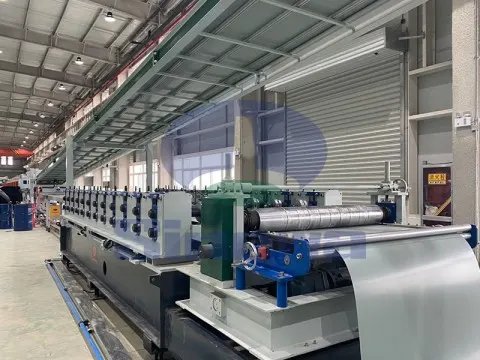
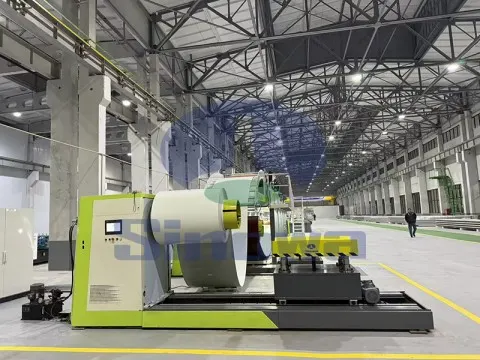
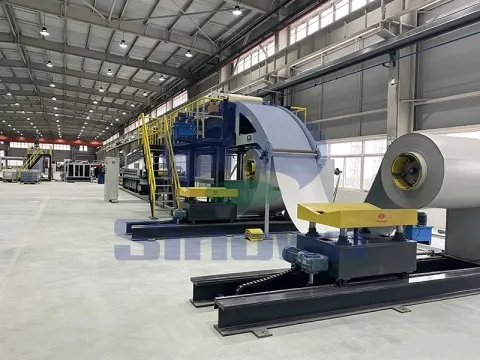
Raw material feeding and pretreatment serve as the initial and foundational link of the entire PU sandwich panel production line, determining the basic quality and production continuity of finished panels. This part of the system mainly consists of automatic uncoiling devices and surface material pretreatment mechanisms, which are responsible for releasing and straightening coiled surface materials such as color-coated steel plates and aluminum plates. Equipped with automatic deviation correction and tension control functions, the feeding system can maintain constant material tension during high-speed operation, effectively avoiding material wrinkling, deviation and stretching deformation. Meanwhile, the built-in cleaning and leveling components remove surface dust, impurities and oil stains from the facing materials, ensuring a clean and flat bonding interface for subsequent foaming and laminating processes. The production line supports uninterrupted material switching, realizing non-stop coil replacement through matched material storage and docking structures, which greatly improves the overall production efficiency and avoids production stagnation caused by raw material replacement. The stable operation of the pretreatment link eliminates most surface defects of raw materials from the source, providing reliable preconditions for the tight bonding and uniform structure of subsequent composite panels.
The roll forming system is a key functional module that shapes the surface materials of PU sandwich panels, undertaking the task of converting flat metal coils into standardized profiled sheets. This system adopts multi-group continuous rolling structures with precisely arranged roller sets, which gradually press and bend the flat raw materials into various required plate profiles through step-by-step rolling deformation. The roller spacing and forming angle of the equipment can be flexibly adjusted according to different panel specifications, meeting the production requirements of wall panels, roof panels and other different types of sandwich panels. The whole forming process is completed through mechanical cold pressing, which will not damage the surface coating and structural performance of the materials, and can ensure the consistency of plate shape and size of each batch of products. In addition, the roll forming system is linked with the front-end feeding device and the back-end foaming system in real time, realizing synchronous speed matching. The intelligent induction device can monitor the forming state of materials in real time, automatically adjust the operating parameters of the roller set when abnormal deformation occurs, and effectively control the dimensional error of formed plates within a tiny range, ensuring the structural uniformity of subsequent composite molding.
The high-pressure PU foaming and mixing system constitutes the core functional unit of the entire production line, directly determining the thermal insulation performance and internal structural uniformity of sandwich panels. This system is mainly responsible for the precise proportioning, high-speed mixing and uniform pouring of polyurethane raw materials. Different polyurethane raw material components are transported to the mixing chamber through independent pipelines, and the system adopts accurate flow control technology to ensure the precise proportion of each component, which is the key to triggering stable foaming reaction. Under set pressure and temperature conditions, multiple raw materials are fully mixed in the closed mixing cavity to form a uniform liquid mixture, which is then evenly injected between the upper and lower formed surface plates. The optimized pouring and foaming process enables the liquid polyurethane material to expand slowly and evenly in the closed space, filling every gap between the surface plates without generating hollow holes, bubbles or uneven density areas. The system can adjust the foaming amount and expansion ratio according to different panel thickness specifications, ensuring that the foam core layer has uniform density and stable internal structure, and endows the panel with excellent and consistent thermal insulation and shock absorption performance.
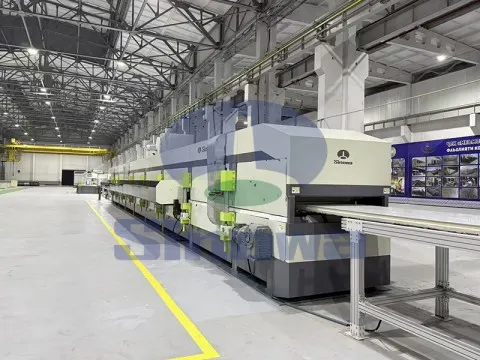
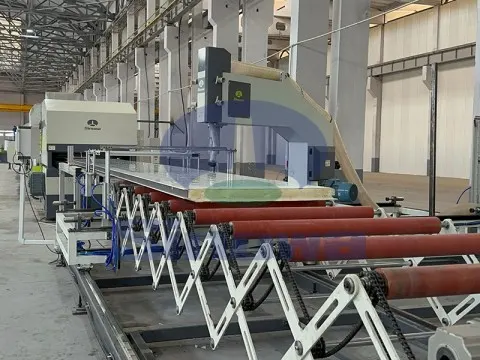
The double-belt laminating and curing system is a key module for realizing composite bonding and fixed-size forming of PU sandwich panels, completing the integration of surface plates and foam cores. This system is composed of upper and lower high-strength conveyor belts with excellent pressure resistance and temperature resistance, forming a closed and stable molding cavity. The gap between the upper and lower belts can be accurately adjusted according to the preset panel thickness, so as to control the overall specification of the finished panel. After the foamed raw materials and surface plates enter the laminating system, the conveyor belts apply uniform and stable pressure on the whole panel surface, and cooperate with the constant-temperature curing environment inside the equipment to accelerate the curing and molding of polyurethane foam. In the closed constant-temperature and constant-pressure environment, the foam material completes expansion, curing and bonding integration, forming a tight composite structure with the upper and lower surface plates. The long-distance laminating and curing section ensures that the foam core is fully cured, avoiding incomplete curing and unstable bonding caused by insufficient reaction time. The synchronous operation of the upper and lower belts effectively prevents the relative displacement of the surface plates and core materials, ensuring the overall flatness and structural integrity of the panel.
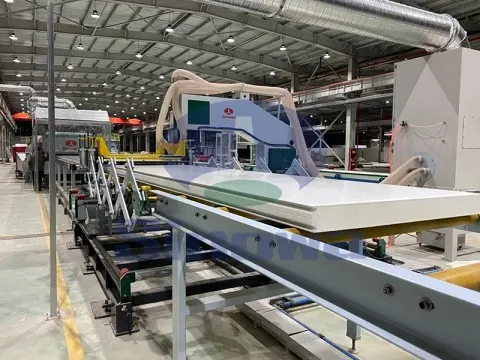
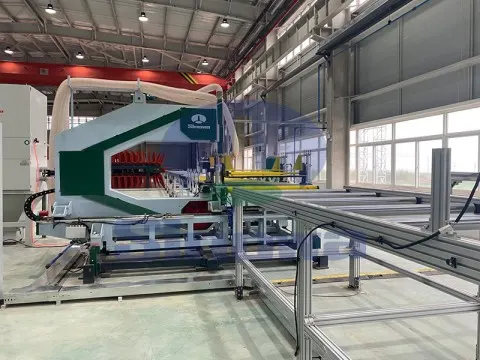
The fixed-length cutting and trimming system undertakes the task of finishing and sizing continuous molded panels, realizing the conversion from continuous strip materials to single finished panels. After the composite cured panels are transported out of the laminating system, they enter the cutting unit in a continuous state. The system adopts automatic tracking and fixed-length cutting technology, which can accurately identify the preset panel length specifications and complete fast and smooth cutting through high-precision cutting tools. In addition to fixed-length cutting, the equipment is also equipped with an automatic trimming function, which can trim the irregular edges on both sides of the panel to ensure consistent width and neat edges of each panel. The cutting and trimming process is completed efficiently without causing extrusion deformation, edge cracking or coating damage to the panel. The intelligent control system can automatically adjust the cutting parameters according to different panel thicknesses and material hardness, adapting to the production of various specifications of PU sandwich panels. The precise sizing treatment makes the dimensional accuracy of finished panels reach a high level, which is convenient for subsequent transportation, storage and on-site assembly and construction.
The cooling and shaping system is an indispensable post-processing link to stabilize the structural performance of finished PU sandwich panels. The newly cut panels still retain residual curing temperature and internal stress, and the internal foam structure is not completely stable, which may cause slight deformation or warping if directly stacked. The cooling system adopts natural air circulation and auxiliary uniform heat dissipation structure, which can evenly dissipate the internal heat of the panel in a continuous conveying state. Through graded slow cooling, the system effectively releases the internal stress generated during the foaming and laminating process, making the molecular structure of the polyurethane foam core more stable and the bonding interface between the core layer and the surface plate firmer. The whole cooling process follows the principle of gradual heat dissipation, avoiding panel cracking and bonding layer separation caused by rapid temperature change. After cooling and shaping, the flatness, hardness and structural stability of the panel are further improved, and the product performance tends to be stable, which effectively reduces the probability of quality problems such as later deformation and degumming.
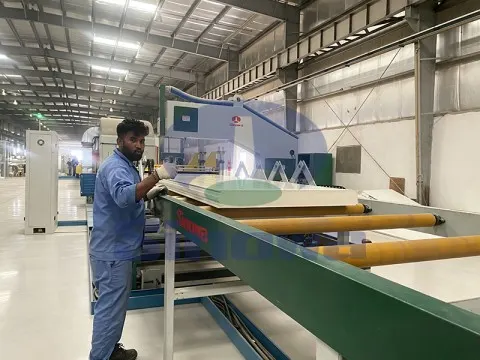
The automatic stacking and discharging system realizes intelligent finishing and orderly output of finished panels, improving the overall automation level of the production line. After cooling and shaping, the qualified panels are automatically transported to the stacking station through the conveying device. The stacking system is equipped with precise positioning and lifting mechanisms, which can stably and neatly stack single panels according to the set number and spacing. The intelligent induction device can identify the stacking state in real time, automatically stop stacking when reaching the set height, and send a prompt for material handling. The whole stacking process is completed mechanically, replacing manual handling, which not only avoids panel surface scratches, collisions and damage caused by manual operation, but also greatly improves stacking neatness and efficiency. The matched discharging and conveying structure can quickly output stacked finished products, realizing seamless docking with subsequent packaging and storage links. This fully automatic processing mode reduces manual intervention, lowers labor costs, and ensures the neat and uniform state of finished products after molding, which is convenient for standardized packaging and transportation.
The intelligent control and linkage system serves as the brain of the entire PU sandwich panel production line, coordinating the synchronous and stable operation of all functional modules. The system adopts integrated programmable control technology, which can uniformly adjust and monitor the operating parameters of feeding, forming, foaming, laminating, cutting, cooling and stacking links. Operators can set panel specifications, production speed, foaming parameters and other data through the intuitive operation interface, and the system will automatically match the operating state of each module to realize synchronous linkage operation. The built-in real-time monitoring function can track the operating status, production progress and product quality data of each equipment in real time, and automatically alarm and adjust when parameter deviation or equipment abnormality occurs. The intelligent linkage design avoids the production defects caused by inconsistent speed and parameter mismatch between front and rear processes. Meanwhile, the system has self-diagnosis and parameter memory functions, which can quickly call mature production parameters when switching product specifications, effectively improving production efficiency and product qualification rate, and realizing intelligent and refined production management.
The PU sandwich panel production line has prominent technical and application advantages, supporting efficient and high-quality production of composite panels for multiple scenarios. The fully continuous automated production mode greatly shortens the production cycle of single panels and realizes large-scale batch production. The precise parameter control and integrated processing technology ensure that the produced panels have uniform thickness, stable structure, excellent thermal insulation, sound insulation and compression resistance. The production line has strong compatibility and can adapt to the production of panels with different surface materials and different core layer thicknesses, covering the production needs of building thermal insulation, industrial plant enclosure, cold storage insulation and other fields. In addition, the optimized structural design of the equipment reduces material waste in the production process, improves the utilization rate of raw materials, and has good energy-saving and consumption-reducing effects. The stable and reliable production performance of the entire line not only reduces the failure rate and maintenance cost of equipment operation, but also ensures the long-term stable supply of high-quality PU sandwich panels, providing efficient and reliable manufacturing support for the development of modern energy-saving building and industrial composite material industries.
Gallery of PU Sandwich Panel Production Line
Tags: pu sandwich panel production line, pu sandwich panel production line manufacturer, pu sandwich panel production line supplier, china pu sandwich panel production line, pu sandwich panel production line for sale
https://www.sandwichpanelmachinery.com/tags/pu-sandwich-panel-production-line.html
Related Informations
Why Does PU Sandwich Panel Production Line Have Unstable Pouring Speed?
How To Adjust Mixing Ratio Of PU Sandwich Panel Production Line To Improve Bonding Strength?