
Post-installation debugging is critical for PU sandwich panel production lines to ensure stable operation, qualified product quality and smooth mass production.
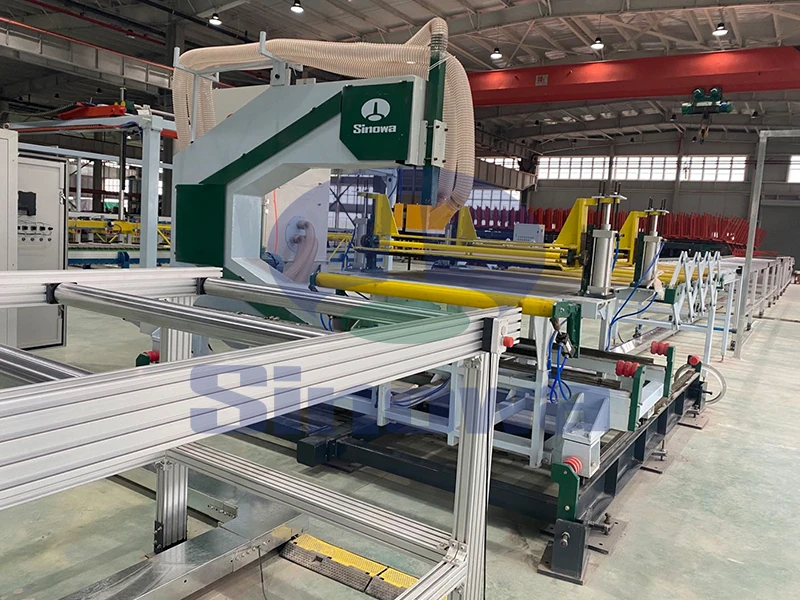
The first step of post-installation debugging for the PU sandwich panel production line is comprehensive visual inspection and mechanical calibration of all equipment components. Operators need to carefully check the overall installation status of the entire production line, including the flatness of the equipment base, the tightness of all connecting bolts and the alignment of transmission parts. Any loose fasteners, uneven supports or misaligned rollers should be corrected immediately to avoid mechanical jitter and operational deviation during subsequent running. Meanwhile, it is necessary to verify the assembly accuracy of core components such as the PU foaming unit, panel feeding mechanism and pressing molding device. Minor assembly deviations left during installation will gradually expand in continuous operation, leading to panel surface unevenness and inconsistent thickness. This preliminary mechanical calibration lays a solid foundation for subsequent electrical and functional debugging, ensuring all mechanical parts can operate within a stable and standardized range.
After completing mechanical calibration, electrical system debugging becomes the core next procedure to guarantee safe and controllable line operation. Operators and electricians need to conduct a full inspection of the entire circuit system, including power line connection, control circuit wiring, sensor installation and switch sensitivity. It is essential to check for hidden dangers such as loose wiring, short circuits and poor contact, and fix all abnormal electrical connections in a timely manner. Then, test the independent operation of each electrical control unit, verify the response speed of the control panel, the accuracy of parameter signal transmission and the normal start-stop function of individual equipment. In addition, all safety protection devices including emergency stop switches, overheating protection and overload protection need to be tested repeatedly to ensure they can trigger effectively in abnormal conditions. Stable electrical system operation is the premise of automated production, which can effectively avoid equipment failure and safety accidents during formal production.
The third debugging link focuses on the feeding system, which directly affects the continuity and uniformity of PU sandwich panel production. The feeding system covers upper and lower metal panel feeding and PU raw material conveying, and both parts need targeted debugging. For the metal panel feeding mechanism, adjust the feeding speed, roller clamping force and guiding position to ensure the panels are fed smoothly without deviation, wrinkling or scratching. The feeding gap should be finely tuned according to the preset panel specifications to guarantee consistent feeding accuracy. For the PU raw material conveying system, check the smoothness of material pipelines, adjust the conveying pressure and flow rate, and eliminate pipeline blockages or material leakage problems. It is also necessary to test the synchronization of panel feeding and raw material conveying to ensure PU materials can be evenly covered between upper and lower panels in the subsequent foaming process, avoiding material accumulation or insufficient filling caused by unsynchronized feeding speed.
Foaming system debugging is the most critical step that determines the thermal insulation performance and structural quality of PU sandwich panels. The core of this process is to optimize the mixing ratio, temperature and spraying state of PU foaming raw materials. Operators need to adjust the proportion of different raw materials in the foaming unit through repeated debugging to ensure sufficient chemical reaction and stable foaming effect. Meanwhile, finely tune the working temperature of the foaming machine, as excessive or insufficient temperature will lead to incomplete foaming, hollow core layers or excessive bubble gaps inside the panels. In addition, test the spraying range and uniformity of the foaming nozzle, adjust the nozzle angle and spraying pressure to make PU foam fill the entire interlayer evenly without dead corners or uneven thickness. Multiple trial foaming tests are required in this link, and raw material parameters should be adjusted timely according to the foaming effect to achieve dense and uniform foam structure.
Molding and pressing system debugging aims to ensure the dimensional accuracy and surface flatness of finished PU sandwich panels. After the foaming process, the pressing molding device undertakes the task of shaping the panels, so its operating parameters need precise adjustment. First, calibrate the flatness and parallelism of upper and lower pressing rollers to avoid panel thickness deviation caused by uneven pressing gaps. Then, adjust the pressing pressure and running speed according to the panel thickness specifications, ensuring moderate pressure to neither cause panel surface indentation due to excessive pressure nor incomplete bonding and loose structure due to insufficient pressure. It is also necessary to debug the constant temperature system of the pressing section to maintain a stable molding temperature environment, which helps the PU foam complete solidification and bonding stably. Through multiple trial pressing and size detection, gradually optimize pressing parameters to ensure the dimensional consistency of molded panels and firm bonding between panels and foam layers.
Cutting and finishing system debugging focuses on improving the cutting precision and edge quality of finished sandwich panels. This link mainly debugs the automatic cutting device and edge trimming mechanism of the production line. First, calibrate the cutting position and cutting length precision of the cutting machine to eliminate errors in panel sizing, ensuring each finished panel meets the preset dimensional requirements. Then, adjust the cutting speed and blade tightness to avoid burrs, edge collapse and uneven cuts on panel sections. For the edge trimming mechanism, debug the trimming range and operating stability to ensure smooth and neat panel edges without residual foam or metal burrs. In addition, test the synchronization between the cutting system and the front-end molding system to ensure orderly cutting operation without material accumulation or delayed cutting. Stable operation of the finishing system can effectively improve the appearance quality and assembly adaptability of finished panels.
Operational synchronization debugging of the whole production line is essential to realize continuous and automated production. After the independent debugging of each single equipment unit, it is necessary to conduct joint debugging of the entire line to optimize the matching operation of all links including feeding, foaming, pressing, curing and cutting. Operators need to adjust the operating speed of each equipment module to form a unified and coordinated production rhythm, avoiding production stagnation caused by fast-front and slow-back operation or material stacking caused by speed mismatch. During the joint debugging process, simulate continuous production status, observe the operation coordination of each link in real time, and record abnormal jitter, pause and delay problems. Targeted parameter optimization and mechanical fine-tuning should be carried out for all unsynchronized links to ensure the entire production line runs smoothly and continuously without intermittent faults, laying the foundation for high-efficiency mass production.
Product quality inspection and parameter optimization debugging are key links to verify the effectiveness of overall debugging. After the whole line runs stably, continuous trial production of sample panels is required, and comprehensive quality detection is carried out on trial-produced products. The detection items include panel thickness uniformity, surface flatness, foam compactness, bonding firmness and overall dimensional accuracy. For unqualified problems such as partial hollowing, uneven thickness and weak bonding appearing on sample panels, trace the corresponding production links and adjust the relevant equipment parameters pertinently. For example, optimize foaming flow rate for hollow core layers, adjust pressing gap for uneven thickness, and modify feeding synchronization for offset panels. Through repeated trial production, detection and parameter adjustment, gradually eliminate product quality defects and stabilize product qualification rate.
Equipment operation stability test and fault simulation debugging help improve the anti-interference ability and reliability of the production line. After the basic debugging is completed, the production line needs to be operated continuously for a long time to test its stable operation performance under long-term working conditions. Observe whether there are abnormal noise, overheating, parameter drift and mechanical wear during continuous operation, and timely adjust and maintain problematic parts. Meanwhile, conduct targeted fault simulation tests, including sudden power fluctuation, raw material supply interruption and minor equipment jitter, to verify the response speed and self-protection ability of the control system. Summarize corresponding fault handling schemes for common abnormal conditions to help operators quickly respond to and eliminate faults in subsequent formal production, reducing production downtime caused by equipment failures.
The final link of post-installation debugging is system sorting, parameter recording and operator operation confirmation. After all debugging items are completed and the production line runs stably with qualified product quality, sort out all optimized equipment operating parameters, including foaming parameters, pressing pressure, operating speed and temperature settings, and form standardized operation parameter files. Conduct secondary inspection and fastening of all equipment parts and electrical circuits to ensure no hidden installation faults remain. Meanwhile, organize on-site operators to conduct practical operation training based on the debugging process, familiarize them with standardized operation procedures, parameter adjustment methods and common fault handling measures. Complete the handover of debugging records and operation specifications to ensure the production line can maintain long-term stable, efficient and standardized formal production operation.