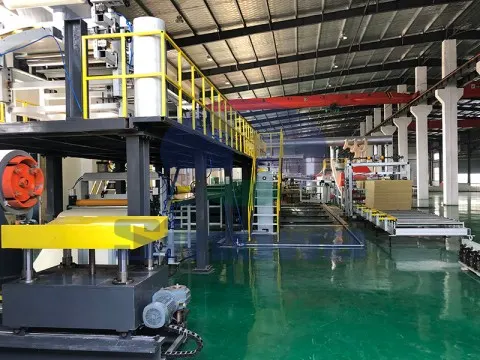
Rock Wool Sandwich Panel Machinery
Full automatic rock wool sandwich panel machinery for high-efficiency production of fireproof, thermal insulated wall and roof panels. Stable performance, easy operation, customized sizes for construction & prefab building projects.
Rock wool sandwich panel machinery refers to a fully integrated automated production system dedicated to manufacturing high-performance rock wool composite sandwich panels, which are widely utilized in modern architectural insulation, fireproof partitioning, and industrial building enclosure projects. This sophisticated production equipment combines precision mechanical transmission, intelligent automatic control, environmental protection material processing, and constant-temperature composite molding technologies to achieve continuous, standardized, and high-efficiency panel production. Unlike ordinary foam sandwich panel production equipment, this machinery is specially optimized for the fibrous and rigid characteristics of rock wool core materials, solving the technical difficulties of uneven core laying, insufficient bonding strength, and structural deformation that often occur in traditional production processes. The complete rockwool sandwich panel production line consists of multiple interconnected functional units that operate synchronously, covering raw material pretreatment, core material arrangement, glue application, composite pressing, heating curing, fixed-length cutting, and automatic stacking. With stable operational performance and flexible production adaptability, the machinery effectively improves the consistency and comprehensive quality of finished panels, meeting the growing market demand for durable, fire-resistant, and thermally insulated building composite materials in the construction industry.
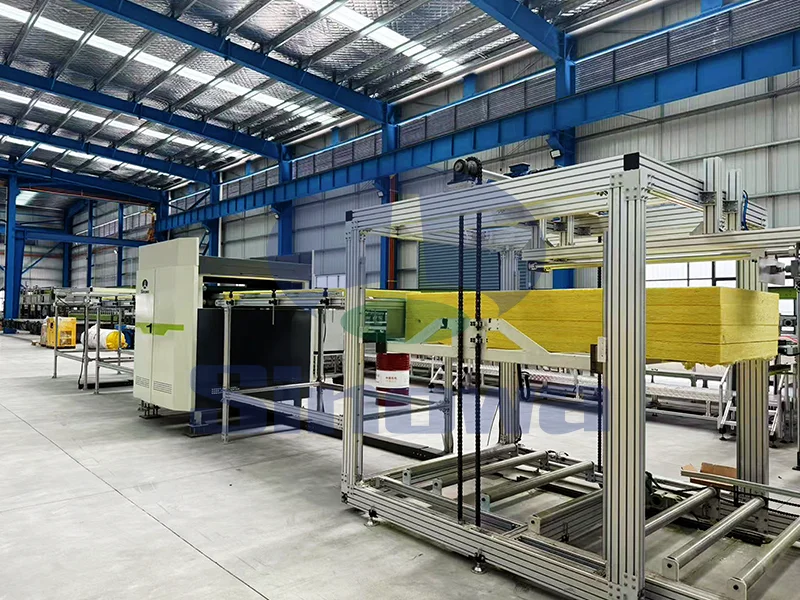
The overall structural design of rock wool sandwich panel making machinery is based on integrated modularization, which lays a solid foundation for stable operation and convenient daily maintenance. The entire production line adopts an integral rigid frame structure, which greatly reduces equipment vibration and displacement during high-speed continuous operation, avoiding dimensional errors and surface flaws of finished panels caused by mechanical jitter. Each functional module is independently designed and reasonably distributed according to the production process sequence, including metal plate processing units, rock wool core material processing units, composite molding units, and finished product sorting units. This modular layout not only simplifies the overall mechanical transmission path but also facilitates targeted maintenance and partial component replacement in later use, effectively reducing equipment failure rates and maintenance costs. In addition, the rockwool panel production line is equipped with a closed dust removal structure near the rock wool processing area, which can effectively collect scattered fine fibers generated during material cutting and laying. This design not only keeps the production workshop clean and tidy but also prevents fiber impurities from adhering to mechanical parts and affecting the precision and service life of the equipment, realizing environmentally friendly and stable production operation.
The metal plate unwinding and leveling unit serves as the starting link of the entire production process, determining the flatness and dimensional accuracy of the panel’s outer protective layer. This unit is equipped with a high-precision automatic unwinding mechanism with a constant tension control system, which can dynamically adjust the feeding speed and tension according to the production rhythm. It effectively avoids stretching, wrinkling, and deviation of metal coils during continuous feeding, ensuring stable and orderly supply of raw metal plates. After unwinding, the metal plate will pass through multiple groups of precision leveling rollers, which can completely eliminate the internal stress generated during coil winding and rolling. This process corrects tiny deformations and uneven surfaces of the metal plate, making the plate surface smooth and flat before subsequent molding and composite processing. Meanwhile, the unit is equipped with an automatic trimming function to cut off irregular edges on both sides of the metal plate, ensuring consistent width of the plate and providing qualified raw materials for the subsequent roll forming and composite bonding processes.
Roll forming technology is the core process to shape the outer metal shell of rock wool sandwich panels, and the corresponding mechanical unit realizes one-time continuous molding of metal plates. The forming unit is composed of dozens of groups of precision profiled rollers arranged in an orderly gradient, which gradually bends and shapes the flat metal plate according to the preset panel structural parameters. The gradient rolling design avoids excessive instantaneous force on the metal plate, preventing surface cracking and internal structural damage while ensuring accurate molding size. All rolling rollers are made of high-hardness and wear-resistant materials with anti-corrosion treatment, which can maintain long-term molding precision and reduce wear loss during long-term high-frequency operation. The equipment supports flexible adjustment of molding parameters, enabling it to adapt to metal plates of different thicknesses and process panels with various edge bending structures. After roll forming, the metal plate forms a stable three-dimensional shell structure, which can perfectly wrap the rock wool core material in the subsequent composite process and enhance the overall structural firmness of the finished panel.
The rock wool core material sorting and paving unit is a unique functional part that distinguishes rock wool sandwich panel manufacturing machinery from other composite panel production equipment, directly affecting the fire resistance and thermal insulation performance of finished products. Different from liquid foam core materials, rock wool is a rigid fibrous block material, which requires professional mechanical arrangement to achieve uniform and dense paving. This unit is equipped with an automatic material sorting and conveying system, which can neatly arrange scattered rock wool blocks in an orderly manner and adjust the fiber orientation of rock wool through a special vertical fiber guiding mechanism. This optimized fiber arrangement structure significantly improves the overall compression resistance and structural stability of the panel, avoiding core material hollowing and loose layering in finished products. The equipment can automatically adjust the paving thickness and density of rock wool according to production requirements, realizing uniform thickness distribution of the core layer of each panel. At the same time, the automatic deviation correction device ensures that the rock wool core material is always aligned with the upper and lower metal plates during paving, avoiding offset layering and ensuring consistent product quality.
The automatic glue spraying and composite bonding system is a key unit to ensure the bonding firmness between the metal shell and rock wool core material, which determines the overall structural durability of sandwich panels. The rockwool board production line is equipped with a high-precision intelligent glue spraying device, which can evenly spray environmentally friendly high-performance polymer adhesive on the inner surface of the formed metal plate. The system adopts quantitative glue spraying control technology, which can automatically adjust the glue spraying amount and spraying range according to the plate area and production speed, avoiding excessive glue waste or insufficient local glue amount that affects bonding effect. Before formal composite pressing, the equipment is equipped with a pre-bonding positioning process to preliminarily fix the rock wool core material and metal plate to prevent relative displacement during pressing. The subsequent double-belt composite pressing mechanism applies uniform and stable pressure to the composite plate body, making the adhesive fully infiltrate the gap between the metal plate and rock wool fibers. This process forms a tight integrated bonding structure, effectively improving the peeling resistance and shear resistance of the panel and preventing delamination and cracking during long-term use.
The constant-temperature heating curing and cooling shaping unit undertakes the important task of stabilizing the bonding structure and finalizing the panel shape, which is an indispensable link to ensure product molding quality. After composite pressing, the semi-finished panel enters the closed constant-temperature curing furnace, where the internal temperature is precisely controlled in a stable range through an intelligent temperature control system. The uniform heating environment accelerates the rapid curing and molding of the polymer adhesive, enabling the glue layer to form a high-strength stable structure in a short time. The furnace body adopts a multi-stage temperature zone design, which can adjust the heating intensity in different stages according to the curing characteristics of the adhesive, avoiding local overheating that causes panel surface deformation or insufficient curing that affects bonding strength. After high-temperature curing, the panel automatically enters the circulating cooling system for gradual cooling and shaping. The slow cooling process effectively eliminates the internal thermal stress generated during heating, preventing the finished panel from warping and deforming after leaving the factory and ensuring flat and stable overall structure.
The fixed-length cutting and precise sizing unit realizes accurate segmentation of continuous composite panels to meet different specification requirements of end products. This mechanical unit adopts high-precision hydraulic cutting technology and intelligent length counting system, which can automatically identify and cut the panel according to the preset length parameters. The cutting tool is made of high-strength wear-resistant alloy material, with sharp cutting performance and long service life, which can complete smooth cutting of composite panels with metal outer layer and rock wool inner layer without burrs, collapses, or fiber scattering. The rock wool sandwich panel production equipment is equipped with a real-time deviation detection function, which can automatically correct tiny displacement errors during panel conveying, ensuring that the cutting size error is controlled within a very small range. In addition, the unit supports flexible switching of cutting parameters, which can adapt to the production of panels with different lengths and widths. The automatic cutting process replaces traditional manual cutting, greatly improves production efficiency, and ensures the uniformity and standardization of the size of each finished panel.
The intelligent centralized control system is the core brain of the entire rock wool sandwich panel production line, realizing unified scheduling and synchronous operation of all functional units. The equipment is equipped with an intuitive human-machine interaction interface, through which operators can set production parameters such as feeding speed, glue spraying volume, curing temperature, cutting size, and paving density in real time. The system adopts frequency conversion vector control technology, which can intelligently adjust the operating speed of each module according to the production load, realizing synchronous coordination of the whole line. It effectively avoids the problem of production stagnation or quality fluctuation caused by inconsistent operation rhythm of each unit. Meanwhile, the control system has automatic fault detection and early warning functions, which can real-time monitor the operating status of key components such as motors, bearings, and temperature control modules. Once abnormal parameters or potential faults are detected, the system will send out early warning prompts and automatically adjust the operating state to protect the equipment, greatly improving the safety and stability of production operation.
The automatic conveying and stacking unit realizes the automatic collection and arrangement of finished panels, completing the final link of automated production. After cutting and shaping, the qualified finished panels are stably conveyed to the sorting platform through the multi-stage conveying system. The rockwool sandwich panel line is equipped with a panel turnover and deviation prevention device, which can adjust the placement direction of panels and correct conveying deviation, ensuring that each panel is neatly positioned. The intelligent stacking mechanism adopts mechanical arm positioning and stacking technology, which can automatically stack panels according to the preset number and arrangement mode. The stacking process is stable and orderly, avoiding surface scratches, corner collisions, and panel tilting caused by manual stacking. This fully automatic stacking mode not only greatly improves production efficiency and reduces manual labor intensity but also ensures neat and uniform stacking of finished products, which is convenient for subsequent packaging, transportation, and storage. In addition, the unit is equipped with a buffer protection structure to reduce the vibration impact during panel conveying and stacking and protect the surface integrity of finished panels.
Rock wool sandwich panel manufacturing line has significant technical and performance advantages compared with traditional manual and semi-automatic production equipment, bringing comprehensive upgrades to panel production quality and efficiency. First of all, the fully automated integrated production mode realizes uninterrupted continuous operation from raw material feeding to finished product stacking, which greatly improves production efficiency and effectively shortens the production cycle of a single panel. Secondly, the precise mechanical operation and intelligent parameter control eliminate the quality instability caused by manual operation, making the bonding strength, structural flatness, dimensional accuracy and core material uniformity of finished panels reach a high consistent level. In addition, the equipment is optimized for the physical characteristics of rock wool materials, effectively solving common quality problems such as core material hollowing, delamination, and uneven density in traditional production. Meanwhile, the environmentally friendly structural design reduces fiber dust pollution and material waste, realizing energy-saving and green production, which is more in line with the development trend of modern building material manufacturing.
With the continuous upgrading of modern construction technology and the increasing demand for high-performance building insulation and fireproof materials, rock wool sandwich panel production machinery has broad application prospects and continuous development potential. The equipment can adapt to the production needs of various architectural scenarios, including factory workshops, clean rooms, public building partitions, and thermal insulation enclosure structures, providing high-quality supporting equipment for the building material manufacturing industry. In the future, with the continuous progress of intelligent manufacturing technology, rock wool sandwich panel machinery will develop towards higher automation, smarter operation, more precise control and more energy-saving environmental protection. The continuous optimization of modular structure, intelligent sensing technology and remote monitoring function will further improve the operational stability and production flexibility of the equipment, reduce operation and maintenance costs, and continuously meet the increasingly diversified and high-standard market demand for high-performance rock wool sandwich panels in the construction field.
Tags: rock wool sandwich panel machinery, rock wool sandwich panel machinery manufacturer, rock wool sandwich panel machinery supplier, china rock wool sandwich panel machinery, rock wool sandwich panel machinery for sale
Related Informations
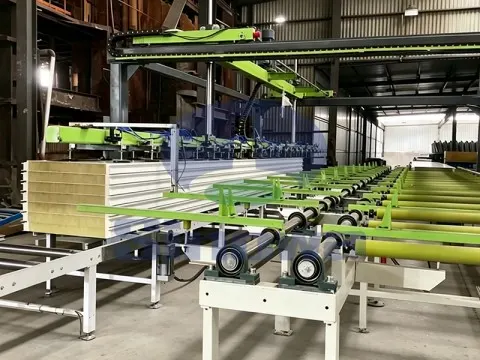
Rock Wool Panel Making Machine
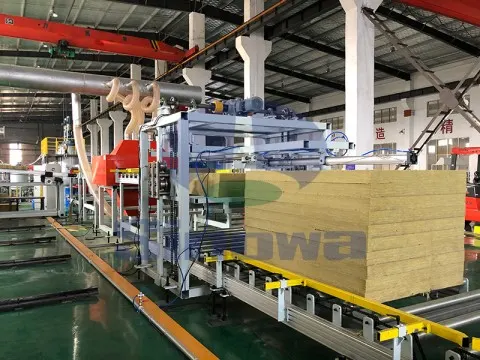
Exterior Wall Rockwool Panel Production Line