
Modern integrated sandwich panel machines can simultaneously produce PU and rockwool panels via modular adjustable structures. This flexible equipment adapts to different core materials, switching production modes efficiently to meet diverse insulation and construction panel manufacturing demands.
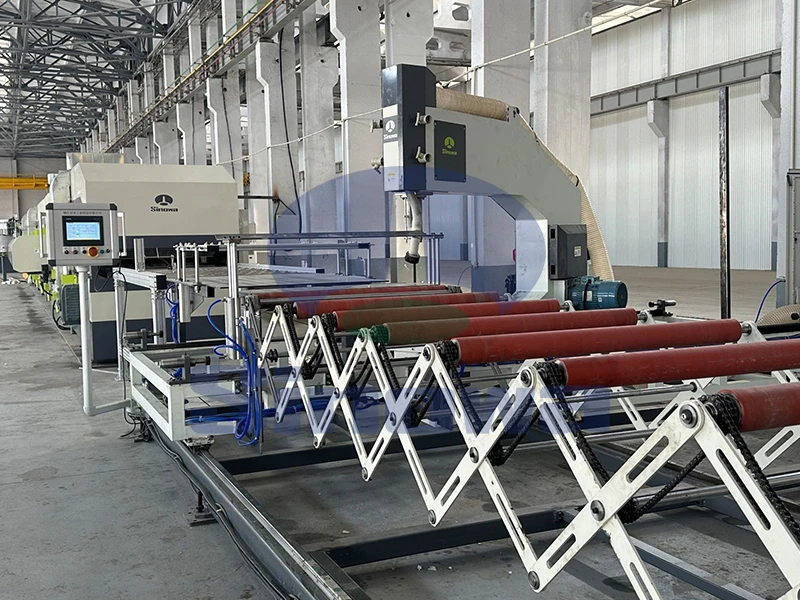
The versatility of contemporary sandwich panel production lines has redefined the efficiency of insulation panel manufacturing, breaking the traditional limitation of single-core material production. Unlike early single-function machines that could only process either polyurethane foam or rockwool cores separately, upgraded integrated models adopt a modular and adjustable structural design. The core advantage lies in their adaptable feeding, foaming, pressing and curing systems, which can be fine-tuned to match the physical characteristics of PU and rockwool materials respectively. PU is a lightweight, foamable synthetic material requiring precise high-pressure foaming and rapid curing, while rockwool is a rigid, fibrous mineral core material that needs neat arrangement and stable composite pressing. Modern machines integrate dual processing modules to handle both materials without complete equipment replacement, laying a solid foundation for mixed production of two types of panels on one single line.
To realize the co-production of PU and rockwool panels, the feeding system of the sandwich panel machine undergoes targeted optimized design. For PU panel production, the equipment is equipped with a precise high-pressure pouring and foeding unit that quantitatively delivers PU raw materials, ensuring uniform foaming density and consistent core thickness. When switching to rockwool panel production, the system can quickly activate the automatic rockwool arranging and laying module, which neatly arranges loose rockwool fiber materials to avoid uneven density and gaps inside the panel. The universal metal coil feeding part remains applicable for both production modes, realizing continuous supply of upper and lower metal surface plates. This shared feeding framework with switchable core material units greatly shortens the mode switching time and ensures uninterrupted continuous production of two different panels.
The composite pressing and curing system is the key component that enables dual-material production for sandwich panel machines. PU materials rely on chemical foaming and thermal curing to form an integral rigid core, so the machine’s pressing platform maintains constant temperature and pressure to promote full foaming and solidification of PU raw materials, ensuring strong bonding between PU core and metal plates. For rockwool panels, the curing system adjusts temperature and pressure parameters to adapt to the physical composite process of fibrous rockwool. It applies uniform gentle pressure to compact rockwool layers without crushing the fiber structure, and realizes tight adhesion between rockwool core and surface plates through auxiliary adhesive coating. The intelligent parameter adjustment system can store independent production programs for PU and rockwool panels, enabling one-click switching of curing conditions.
Many industrial users doubt whether co-production will affect the quality stability of finished panels, but modern integrated machines effectively avoid quality fluctuations through refined structural optimization. In PU panel production, the sealed foaming environment prevents external air interference, ensuring stable foam porosity and excellent thermal insulation performance of finished panels. During rockwool panel processing, the optimized positioning and pressing structure prevents rockwool displacement and layering, maintaining the overall rigidity and fire resistance of the panels. The integrated cutting and sizing unit is compatible with both soft foam PU cores and rigid rockwool cores, achieving precise fixed-length cutting without burrs or deformation. This unified post-processing system guarantees consistent dimensional accuracy and surface flatness for both types of panels.
The production flexibility brought by dual-material co-production greatly improves the operational value of sandwich panel machines for manufacturing enterprises. In actual production scenarios, construction and insulation projects often require both PU panels with superior thermal insulation and lightweight advantages and rockwool panels with outstanding fireproof performance. Single-function equipment forces factories to deploy two independent production lines, occupying more workshop space and increasing equipment investment and maintenance costs. The integrated machine can flexibly switch production types according to market and order demands, realizing small-batch and multi-variety alternating production. It effectively improves equipment utilization rate and production flexibility, helping manufacturers respond quickly to diverse customer order requirements.
The intelligent control system is the core support for stable co-production of PU and rockwool panels. Modern sandwich panel machines are equipped with centralized intelligent operating systems that integrate independent production logic for two core materials. Operators can select the corresponding panel production mode through the human-machine interface, and the system will automatically adjust the operating parameters of feeding speed, foaming pressure, curing temperature, pressing time and cutting precision. The system also has real-time monitoring functions for production status, which can identify abnormal parameters such as uneven PU foaming or loose rockwool laying in real time and make automatic fine adjustments. This intelligent automatic adjustment avoids manual parameter setting errors and ensures the stability and consistency of each batch of PU and rockwool panels.
Although the same machine can produce two types of panels, there are essential differences in the production process details of PU and rockwool cores, which the integrated equipment fully adapts to. PU panel production is a chemical forming process, where liquid PU raw materials undergo mixing, high-pressure spraying, in-situ foaming and curing inside the equipment to form an integral seamless core layer. In contrast, rockwool panel production is a physical composite process, which directly uses formed rockwool fiber boards as the core material, completing arrangement, gluing, pressing and shaping through the production line. The dual-mode machine perfectly distinguishes and matches these two process logics, realizing seamless switching between chemical foaming molding and physical composite molding without process conflicts or mutual interference.
Equipment maintenance and operation convenience are fully considered in the dual-material sandwich panel machine design. The modular structural design enables independent inspection and maintenance of PU foaming modules and rockwool laying modules. When one module is in standby, it will not affect the normal operation of the other module, reducing daily maintenance difficulty and downtime loss. The wearing parts suitable for two production modes are unified in specification as much as possible, reducing spare parts reserve pressure for enterprises. In addition, the standardized operation process simplifies the mode switching steps, and professional training can make operators proficient in switching and producing two types of panels, greatly reducing the technical threshold of multi-variety production.
From the perspective of production efficiency, the integrated co-production machine has obvious advantages over traditional single-function equipment. A single integrated line can complete the production tasks that originally required two independent production lines, saving workshop layout space and simplifying production management procedures. In the case of alternating production of PU and rockwool panels, the intelligent parameter storage function avoids repeated debugging work, greatly shortening the production preparation time. The continuous automated production process reduces manual intervention links, realizing efficient and uninterrupted output of both panels. This efficient production mode effectively improves the overall production capacity of the factory and optimizes the production operation cost structure.
In conclusion, professional integrated sandwich panel machines can fully realize the co-production of PU and rockwool panels through modular design, intelligent parameter adjustment and dual-process adaptation technology. This multi-functional equipment breaks the production boundary of single-core materials, balances production flexibility and product quality, and meets the diversified demand for insulation and fireproof panels in the modern construction industry. With the continuous upgrading of manufacturing technology, such dual-mode production equipment will become the mainstream choice for medium and large panel manufacturing enterprises, bringing more flexible and efficient production solutions to the industry.