Fully Automatic Sandwich Panel Line
Publication Date: Oct 12, 2026
Fully automatic sandwich panel lines produce PU, phenolic, PIR, rock wool, mineral wool and glass wool insulated panels for roofing, wall cladding and cold storage, with continuous laminating, cutting and stacking.
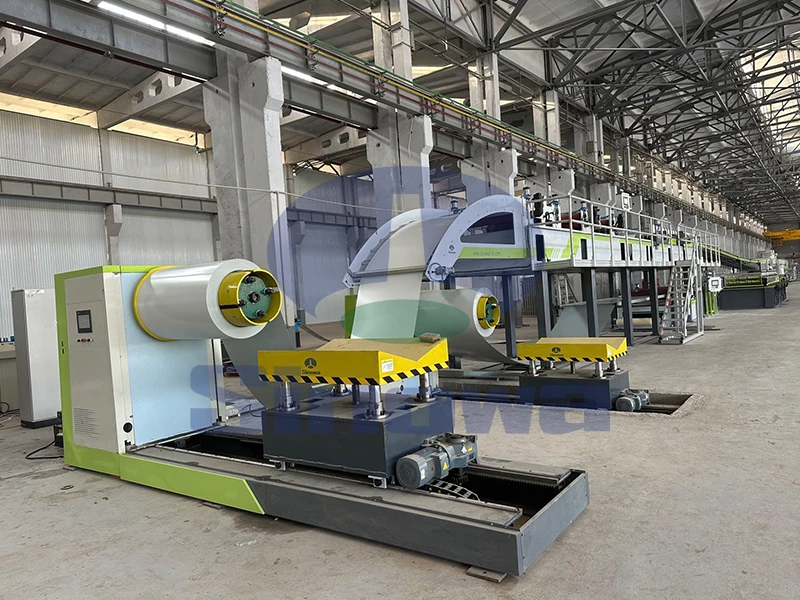
A fully automatic sandwich panel production line is a continuous, integrated manufacturing system that bonds two thin metal or non-metal facing sheets to a rigid insulating core, then forms, cuts and stacks the finished panels at industrial speeds. The line typically begins with a pair of decoilers that feed top and bottom coils—often pre-painted steel, galvalume, aluminum, or stainless steel—through a series of roll-forming stations that shape the facing into the desired profile, whether flat, micro-ribbed, trapezoidal, or a concealed-fixing seam. As the facings travel forward, the core material is introduced between them: either a liquid foam system that reacts and expands in place, or a pre-formed mineral or glass wool blanket that is glued and pressed. A double-belt laminating oven, heated to a precisely controlled temperature, consolidates the sandwich and ensures the adhesive or foam bonds uniformly across the entire panel face. After curing, a flying cutoff saw trims the panel to the exact customer-specified length, and an automatic stacker collects finished panels in neat bundles ready for packaging. What distinguishes a fully automatic line from a semi-automatic or discontinuous press is continuity and control. Every station—coil feed, profile forming, core dosing, oven temperature, belt speed, cutting length, and stacking—is coordinated through a central programmable logic controller. Operators load recipes into the human-machine interface, and the line self-adjusts to maintain panel thickness, density, and dimensional tolerance within narrow bands. This consistency directly translates into fewer rejected panels, lower labor dependency, and higher throughput per shift. Modern lines also incorporate automatic coil changeovers, edge-trim collection systems, and online thickness measurement, so that production runs can be switched between different panel thicknesses and core types with minimal manual intervention.
Polyurethane sandwich panel equipment is centered on a high-pressure foaming system that mixes liquid polyol and isocyanate components and injects the reactive mixture between two moving metal facings. The core of the line is the metering and mixing unit: precision pumps deliver the two chemicals in a fixed ratio, while a high-pressure impingement mixing head sprays the expanding foam onto the bottom facing as it passes through the laminating section. Because polyurethane reacts within seconds, the timing and distribution of the chemical shot must be synchronized exactly with line speed, so that the foam rises and cures just as the panel reaches the exit of the heated oven. PU-equipped lines typically include a temperature-controlled laminating tunnel, where the top and bottom belts maintain uniform pressure and heat to ensure the foam expands evenly and bonds strongly to both facings. The density of the foam core can be adjusted by varying chemical flow rate and belt speed, allowing producers to balance insulation performance against material cost. Edge dosing devices ensure that the side edges of the panel are fully filled, preventing hollow corners that would compromise thermal performance and structural rigidity. The output of a PU line is valued for its very low thermal conductivity, light weight, and seamless, adhesive-free bond between core and facing. These properties make PU-cored panels a natural fit for cold storage rooms, refrigerated warehouses, clean environments, and any building envelope where minimizing heat transfer is the primary design driver. Because PU foam adheres chemically to the metal skins, the resulting panel behaves as a composite structural element, capable of spanning moderate distances between supports. Operators must pay close attention to chemical storage temperatures, mix-head cleaning, and waste-gas ventilation, since the reactive chemicals are sensitive to temperature and require routine maintenance of the dosing system.
Phenolic sandwich panel equipment is designed around the controlled expansion of phenolic foam, derived from thermosetting phenolic resin combined with a blowing agent and a catalyst. Compared with polyurethane, phenolic foam is prized for its exceptionally low thermal conductivity and its favorable behavior when exposed to direct flame, making it a preferred core in projects where fire safety and low smoke emission are primary concerns. The production process, however, demands tighter control of temperature and chemical ratios, because phenolic resin cures through an exothermic reaction that must be managed within a narrow window. On a phenolic line, the resin and catalyst are metered separately and mixed through a specialized dispensing head before being deposited onto the bottom metal facing. The wet resin then enters a long laminating oven, where heat triggers foaming and cross-linking. Because phenolic foam expands and cures more slowly than PU, the oven section is typically longer, and belt speed is adjusted to give the chemical reaction enough residence time to reach full structural integrity. The double belts must maintain even pressure across the panel width to prevent uneven foam rise, which would show up as surface waves or variable density. Phenolic-cored panels find their main application in high-rise facades, ceiling systems, transportation interiors, and any environment where smoke development and flame spread are design-critical. The panels are also well suited to clean rooms and food-processing areas, because the closed-cell foam does not support fungal growth and is easy to wipe clean. Equipment for phenolic lines typically includes enhanced ventilation and fume-extraction at the dispensing and oven sections, since the curing process releases trace volatile compounds. Regular calibration of the metering pumps and periodic replacement of the mixing-head nozzles are essential to maintain the consistent resin-to-catalyst ratio on which both foam quality and surface finish depend.
Polyisocyanurate, commonly abbreviated PIR, is a chemically upgraded form of polyurethane in which the isocyanate component is used at a substantially higher ratio, prompting a trimerization reaction that forms a more thermally stable, cross-linked polymer network. PIR sandwich panel equipment therefore shares much of its hardware with a standard PU line—high-pressure metering units, impingement mix head, laminating oven, and double-band press—but the recipe and thermal profile are tuned for the different reaction chemistry. The catalyst system is modified to favor trimer formation over standard polyurethane polymerization, and the oven temperatures are often set somewhat higher to drive the more demanding cross-linking reaction to completion. The practical benefit for the end user is a core that retains its insulating properties at higher service temperatures than ordinary PU and that exhibits improved resistance to flame and heat degradation. This makes PIR-cored panels a common choice for industrial roofing and wall systems, food-processing plants, and cold storage facilities where the panel may be exposed to intermittent high temperatures or where a broader temperature operating range is desired. On the production floor, the main operational difference is that PIR chemistry is less forgiving of imprecise dosing, so the metering pumps must be held to tighter tolerances and the mix-head must be flushed more frequently to avoid buildup of the harder, more cross-linked residue. A well-designed PIR line can often switch between conventional PU and PIR recipes simply by loading a different program on the HMI and swapping the catalyst and blowing-agent tanks, which gives panel producers valuable flexibility within a single production asset. The downstream roll forming, flying cut, and stacking sections are identical to those used on PU lines, so adding PIR capability to an existing PU-oriented line usually requires changes only in the chemical handling and oven-temperature zones. This modularity has made PIR a popular upgrade path for producers who want to broaden their product range without investing in an entirely separate line.
Rock wool sandwich panel equipment processes a fibrous, mineral-based core rather than a liquid foam. The raw material—typically basalt or other volcanic rock—is melted at very high temperatures in a cupola or electric furnace and then spun into fine fibers by centrifuging spinners, producing a wool blanket that arrives at the panel line in roll form or is fed directly from a continuous fiberization unit. On the line itself, the rock wool mat is unrolled, opened up, and sprayed with a thermosetting binder resin that will later fuse the fibers into a rigid slab under heat and pressure. A defining feature of rock wool panel lines is the means by which the fiber orientation is controlled. In many industrial panels, the wool fibers are oriented perpendicular to the panel faces—often by means of a special fiber-laying or curtain-forming device—so that the panel achieves higher compressive strength and better point-loading resistance. The binder-sprayed wool then passes through a curing oven, where hot air activates the resin and consolidates the mat to the target thickness. At the exit, the top and bottom metal facings, pre-rolled to the desired profile, are brought into contact with the wool core in a double-band laminating press, and adhesive on the facings bonds the composite together as it cools. Because rock wool is inherently non-combustible and offers excellent acoustic absorption, panels produced on this equipment are widely used for exterior wall cladding, roofing systems, fire-resistant partitions, and industrial sheds where fire performance is a major design consideration. The line must handle the relatively abrasive nature of mineral fibers, so conveyor belts, guide rails, and cutting blades are built from wear-resistant materials, and dust extraction is installed at every point where the wool is handled. Density uniformity across the panel width is the key quality parameter; producers monitor it by adjusting binder spray rate, oven air flow, and press pressure, and they regularly inspect the wool mat for gaps or clumps that would cause weak spots in the finished panel.
Mineral wool sandwich panel equipment is closely related to rock wool machinery, because both cores are produced from fibrous, silicate-based raw materials. The principal difference lies in the feedstock: mineral wool is typically manufactured from iron- or steel-making slag, a by-product of metallurgical processes, rather than from natural basalt. The fiberization, binder application, curing, and laminating steps are essentially the same as those described for rock wool, and in fact many production lines are engineered as dual-purpose assets that can process either material simply by changing raw material rolls and adjusting the oven-temperature profile. On the shop floor, the practical distinctions show up in the handling and finishing characteristics of the wool. Slag-based mineral wool tends to produce fibers with a somewhat different diameter distribution and a slightly different feel, which can affect how the mat opens up on the feed conveyor and how it interacts with the adhesive on the metal facings. Line operators compensate by fine-tuning the mat-opening rollers, the binder spray gun traverse speed, and the laminating-press pressure so that the final panel density and surface flatness remain within the target range. Because the two raw materials are so similar, the auxiliary systems—dust extraction, edge trimming, scrap collection, and fiber waste recycling—are shared, which lowers the incremental cost of running both products on one line. Mineral wool-cored panels are commonly specified for interior partition walls, suspended ceilings, equipment enclosures, and acoustic wall systems, where the combination of thermal insulation, sound absorption, and non-combustibility is valued. They are also used in lightweight exterior cladding applications where the somewhat lighter weight of a slag-based wool can reduce structural loads. For panel producers, the strategic advantage of mineral wool equipment is that it broadens the product portfolio into acoustic and interior panels without requiring a separate foaming line, and it offers an alternative raw material supply route that can be more economical depending on local availability of slag and basalt.
Glass wool sandwich panel equipment handles the lightest of the common mineral-fiber cores. The raw material is molten glass, fiberized into very fine, curly filaments that are then collected into a soft, flexible blanket and bonded with a phenolic resin binder. On the panel line, the glass wool blanket is unrolled from a large coil, split or layered to the required thickness, and sprayed with additional adhesive before being sandwiched between the top and bottom metal facings. A laminating press then consolidates the composite under controlled heat and pressure, curing the binder and bonding the core to the facings. Glass wool panels are distinguished by their very low weight and outstanding acoustic dampening. Because the fibers are finer and more curled than rock or mineral wool, the mat traps air effectively and absorbs sound across a broad frequency range. The equipment itself is generally lighter-duty than rock wool lines, since the lower-density wool exerts less pressure in the press and wears less on the conveyors. The laminating oven can also be shorter, because the binder cures quickly and there is no chemical foaming reaction to wait for. Typical end uses for glass wool sandwich panels include interior wall partitions, ceiling cassettes, HVAC duct enclosures, and lightweight roof panels where dead load on the supporting structure must be minimized. They are also popular in modular and prefabricated construction, where panels must be handled repeatedly on site and where light weight accelerates installation. For producers, the main operational considerations are controlling the loft and layering of the wool mat to achieve uniform thickness, ensuring the adhesive is spread evenly across the panel width, and managing the fine glass fiber dust that is generated during unrolling and cutting. Because glass wool is more delicate than denser rock wool, the flying cutoff saw and the stacker must be adjusted to avoid crushing the edges of the panel, and protective film is often applied to the face sheets during production to prevent abrasion before installation.
The same core-handling section of a sandwich panel line can be configured to produce both roof panels and wall panels, because the difference between the two products lies mainly in the roll-forming profiles and the joint geometry rather than in the core material. Upstream, the decoilers feed the metal coils; downstream, a series of roll-forming stands progressively bend the flat sheet into the required shape. For roof panels, the profiles are usually trapezoidal or corrugated, with high ribs and lateral overlaps that shed rainwater and resist wind uplift. The panel lengths are often substantial, running to several meters, because roof panels typically span from eave to ridge without intermediate joints. The line must therefore be equipped with a long runout table, a high-speed flying cutoff saw, and a stacker that can handle long, rigid bundles without deflection. Wall panels, by contrast, are often produced with a smooth or finely ribbed face designed for visual cleanliness. Many modern wall systems use a concealed-fixing joint, where the fasteners are hidden behind an interlocking side seam rather than drilled through the face. This requires the roll former to shape precise male and female edge profiles that click together and hold the panel securely to the substructure. Wall panels are generally shorter than roof panels, and they may be produced in a wider range of colors and finishes, including textured films, micro-ribs, and decorative embossing, because wall surfaces are closer to the eye. To switch between roof and wall profiles on the same line, producers change the sets of roll-forming cassettes, adjust the cutoff program for the new panel length, and reload the corresponding recipe on the HMI. Modern lines are designed with quick-change cassette systems that reduce this tooling changeover from hours to minutes. The choice of coil material—pre-painted steel, aluminum, stainless steel, or even coated paper for interior boards—also influences the downstream handling. Roof panels often use thicker gauges and tougher coatings to withstand foot traffic and weather, while wall panels can use lighter gauges and more decorative finishes. The result is that a single well-equipped line can serve both the roofing and cladding segments, giving producers the flexibility to follow demand across two related but distinct markets.
Cold storage panels are among the most demanding products a sandwich panel line can make, because they must deliver extremely low thermal transmission over the lifetime of the building while maintaining airtight joints that prevent warm, moist air from seeping into refrigerated spaces. As a result, cold room panels are almost always produced with PU or PIR foam cores, since these closed-cell foams combine the lowest thermal conductivity with the best dimensional stability at very low temperatures. Rock wool, mineral wool, and glass wool cores are rarely used for the freezer envelope itself, although they may appear in adjacent walls or ceilings where insulation requirements are less severe. The key equipment feature that distinguishes a cold storage panel line is the precision edge-profiling section. Refrigerated rooms rely on interlocking joints—typically a tongue-and-groove or a cam-lock connection—complemented by an embedded rubber or silicone gasket that compresses when the panel is joined. The roll formers must therefore shape the side edges to very tight tolerances, so that every panel mates snugly with the next and the gasket compresses evenly along the entire joint. The line also typically produces corner panels, door surrounds, and transition pieces that require custom edge profiles, which means the tooling library must be extensive and the changeover system must support frequent short runs. Thickness ranges for cold storage panels are generally wider than for conventional building panels, because the design temperature and the energy budget of the refrigeration system drive the insulation thickness. A line configured for cold storage must be able to run panels of varying thicknesses on the fly, adjusting the laminating belt gap, the foam dosing volume, and the oven speed without stopping production. Dimensional accuracy is monitored online, because even a small deviation in panel width or edge angle can compromise the joint seal. For producers, investing in cold storage capability means entering a niche with strong technical barriers and loyal repeat customers, but it also requires meticulous process control, careful training of operators, and a quality assurance regime that checks every panel for flatness, edge geometry, and foam density before it leaves the plant.
Selecting and operating a fully automatic sandwich panel line is ultimately a decision about product strategy rather than about machinery alone. The six core materials—polyurethane, phenolic, PIR, rock wool, mineral wool, and glass wool—each open doors to different customer segments, building applications, and margin profiles, and few producers need to master all six on a single asset. Most successful operations start with one or two core technologies that match their local market, then add capability over time. A producer near a construction boom may begin with rock or mineral wool lines for exterior walls; a supplier to the cold chain may invest first in a PU or PIR foaming line; a workshop focused on interior fit-out may find glass wool the most economical entry point. The value of full automation becomes most visible once the line is running at steady state. Recipe-driven changeovers, automatic thickness control, online measurement, and remote diagnostics reduce the skill gap between experienced and new operators, which matters in an industry where qualified technicians are in short supply. Energy consumption per panel, scrap rate, and downtime are tracked automatically, giving managers a real-time view of cost efficiency that was impossible with older, manually operated equipment. Many modern lines also integrate upstream coil handling and downstream packaging and strapping, so that a nearly continuous material flow runs from raw coil to wrapped bundle with minimal manual touchpoints. Looking ahead, the industry is moving toward more flexible multi-purpose lines that can switch between foamed and fibrous cores, between roof and wall profiles, and between standard and cold-storage edge systems, all under a single control platform. Environmental considerations are also reshaping equipment design, with improved oven insulation, waste-heat recovery, and reduced chemical emissions becoming standard features rather than optional extras. For any producer considering an investment, the most useful exercise is to map out the intended product portfolio for the next several years—roofing, wall cladding, cold storage, interior partitions, or a mix—and then size the line, the tooling library, and the support infrastructure to match that portfolio, rather than buying a generic machine and hoping it will fit whatever demand appears later.
Gallery of Fully Automatic Sandwich Panel Line






Tags: fully automatic sandwich panel line, fully automatic sandwich panel line manufacturer, fully automatic sandwich panel line supplier, china fully automatic sandwich panel line, fully automatic sandwich panel line for sale
https://www.sandwichpanelmachinery.com/tags/fully-automatic-sandwich-panel-line.html
-

The PU sandwich panel line is a core production setup for making high-performance building insulation panels. This professional PU sandwich panel production line features automated operation to streamline the whole manufacturing process efficiently. Every component of the polyurethane sandwich panel line is precisely calibrated to ensure consistent panel thickness and structural stability. A well-maintained polyurethane sandwich panel production line can greatly boost production efficiency while reducing manual operation errors. The continuous PU sandwich panel line adapts to diverse production demands for different panel sizes and surface styles. With advanced molding technology, the PIR sandwich panel line produces panels with excellent heat preservation and sound insulation properties. Stable running of the PIR sandwich panel production line guarantees reliable product quality for various construction and industrial application scenarios.
-

A phenolic insulation board production line serves as the core equipment for manufacturing high-performance thermal insulation building materials. This phenolic insulation panel production line integrates material mixing, foaming, molding and cutting processes to ensure continuous and stable production efficiency. Every operational link of the insulation board production line is precisely calibrated to produce uniform and durable insulation boards. The automated design of the insulation panel production line effectively reduces manual intervention and improves product consistency. Proper maintenance of the phenolic board production line can greatly extend its service life and maintain steady production output. With optimized structural design, the phenolic panel production line adapts to various production demands and delivers high-quality finished products for thermal insulation engineering applications.
-

A professional rockwool sandwich panel line serves as the core equipment for producing high-performance building panels. This rockwool sandwich panel production line integrates feeding, laminating and forming processes to ensure stable and efficient production. The well-structured rock wool sandwich panel line can process raw rockwool materials into panels with excellent thermal and sound insulation properties. Operators can adjust the running parameters of the rock wool sandwich panel production line to manufacture panels of different thicknesses and specifications. The automated design of the mineral wool sandwich panel production line greatly reduces manual operation errors and improves product consistency. Regular maintenance of the mineral wool sandwich panel line is essential to sustain long-term operational efficiency and guarantee qualified finished panels for diverse construction applications.