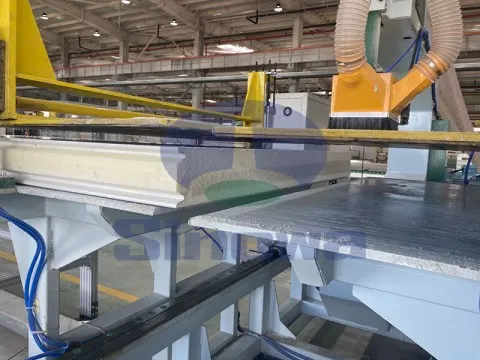
Foaming Sandwich Panel Machinery
Foaming Sandwich Panel Machinery. Automatic continuous PU/PIR/Phenolic/Rockwool foam sandwich panel production line for wall & roof insulated panels. Stable operation, custom line available.
Foaming sandwich panel machinery is a sophisticated integrated production system designed for the automated manufacturing of composite foam sandwich panels, which are widely applied in modern construction, industrial insulation, and lightweight structural engineering. This professional equipment integrates multiple core functional units to realize a continuous, streamlined production process from raw material feeding to finished product output, effectively combining surface layer substrates and foam core materials through precise chemical foaming and mechanical composite molding. Replacing traditional semi-manual and intermittent production modes, the foaming sandwich panel line minimizes manual intervention, stabilizes product structural consistency, and significantly boosts production efficiency. It can adapt to diverse foam formulations and surface material types, producing panels with excellent thermal insulation, sound insulation, and pressure resistance. As a key piece of equipment in the new energy-saving building material industry, it supports large-scale, standardized, and customized production, meeting the growing market demand for high-performance lightweight composite panels across various industrial and civil scenarios.
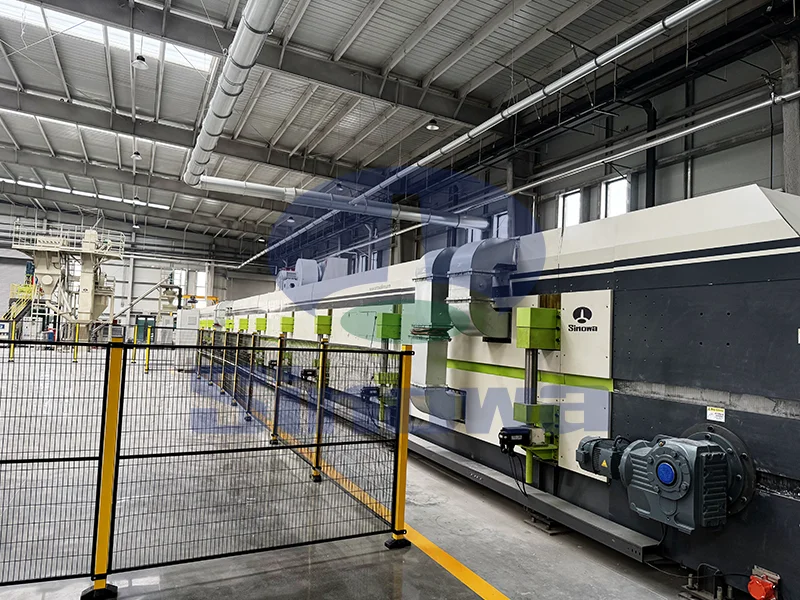
The overall operational framework of foaming sandwich panel manufacturing machinery relies on the synchronous coordination of multiple interconnected functional modules, each performing specialized tasks while maintaining unified operational rhythm through intelligent centralized control. The entire production workflow follows a linear and seamless sequence, eliminating the intermittent shutdowns and operational discontinuities that plague traditional segmented production equipment. The core operational process starts with automatic raw material feeding and surface material pretreatment, where surface substrates are leveled, cleaned, and tension-adjusted to ensure flat and stable feeding status, laying a foundation for subsequent composite bonding. Next comes the precision proportioning and high-speed mixing of foam raw materials, a critical step that determines the uniformity and structural density of the foam core layer. After full mixing, the liquid foam materials are evenly sprayed and injected between the upper and lower surface layers, initiating a controlled chemical foaming reaction. The materials then undergo composite lamination, constant-temperature curing, shaping, fixed-size cutting, and final automatic stacking, forming complete finished sandwich panels. Every link is equipped with adaptive adjustment functions to cope with different production parameters, ensuring the continuity and stability of mass production and avoiding quality fluctuations caused by inconsistent manual operation.
Raw material processing and feeding systems constitute the basic functional foundation of foaming sandwich panel making machinery, directly affecting the smooth progress of subsequent foaming and composite processes. This system is engineered to support the stable feeding of multiple types of surface substrates and foam raw materials, with professional tension control devices installed for coiled surface materials to prevent wrinkles, deviations, and stretching deformation during continuous conveying. The pretreatment unit in the feeding section can remove surface dust and impurities from substrates and adjust the flatness of materials, enhancing the bonding tightness between surface layers and foam cores. For foam raw materials, the feeding module adopts a sealed and quantitative conveying design to avoid raw material waste and environmental pollution caused by leakage. Meanwhile, the system is equipped with material state monitoring components to track feeding speed and material dosage in real time, automatically fine-tuning feeding parameters according to the operating speed of the whole production line. This highly automated feeding and processing mode eliminates the instability of manual material placement, ensures consistent material supply status in each production cycle, and creates standardized preconditions for uniform foaming and reliable composite molding of sandwich panels.
Precision proportioning and mixing units are the core functional components that determine the internal quality of foam sandwich panels, serving as the key to distinguishing high-end automated machinery from traditional simple production equipment. Foam core formation depends on accurate chemical reactions and physical foaming effects of multiple raw material components, and tiny deviations in proportioning ratios will directly lead to defects such as uneven foam density, hollow cavities, and insufficient structural strength in finished panels. The proportioning system of professional foaming sandwich panel machinery adopts high-precision metering devices to realize quantitative output of various raw materials, with adjustable proportioning ranges to adapt to different foam material formulas and product performance requirements. After accurate proportioning, raw materials enter the high-speed stirring and mixing chamber, where professional stirring structures ensure full and uniform fusion of different components in a short time. The mixing process is dynamically monitored in real time, with stirring speed and time automatically adjusted according to raw material viscosity and ambient conditions. This precise processing mode ensures that the foaming reaction proceeds stably and fully, enabling the formed foam core to achieve uniform pore structure, stable density, and excellent overall structural performance.
The automatic foaming and spraying system is the key functional link that realizes the integral molding of sandwich panel cores, undertaking the core task of converting liquid raw materials into solid foam structures. After being fully mixed, the homogeneous liquid foam materials are transported to the quantitative spraying mechanism, which features a wide-range and uniform spraying design to cover the entire width of the continuously moving lower surface substrate. The spraying thickness and coverage density can be accurately preset and intelligently adjusted according to the designed thickness and performance requirements of the sandwich panel, effectively avoiding local excessive or insufficient foaming. During the foaming process, real-time temperature and pressure sensing elements inside the equipment monitor the foaming reaction state and material expansion progress at all times. When abnormal fluctuations in the foaming environment are detected, the system automatically adjusts internal temperature, pressure, and material output parameters to maintain a stable foaming environment. This closed-loop control mode effectively prevents common quality problems such as foaming unevenness, core layer hollowing, and surface bulging, ensuring that the foam core forms a dense, uniform, and structurally stable intermediate layer that can be tightly combined with upper and lower surface materials.
Composite lamination and shaping systems are responsible for realizing the tight bonding and integral molding of surface layers and foam cores, determining the overall flatness and structural firmness of finished sandwich panels. After the liquid foam materials complete initial foaming and form preliminary supporting strength, the upper and lower surface substrates and the intermediate foam core enter the lamination unit synchronously. The lamination system adopts multi-group pressing roller structures with adjustable pressure and spacing, which can apply uniform and stable pressing force on the composite materials according to different panel thickness specifications. The pressing rollers operate at a synchronous speed with the production line to avoid material displacement and layer deviation during the lamination process. Meanwhile, the shaping structure calibrates the overall dimension and flatness of the preliminary composite panels, trimming irregular edges and correcting minor structural deformations generated during foaming and lamination. Through mechanical constraint and pressure shaping, the surface layers and foam core achieve seamless fitting and firm bonding, effectively improving the overall structural integrity of the panel and preventing delamination and cracking in subsequent use. This precision shaping process ensures that each finished panel has consistent flatness and dimensional accuracy.
Constant-temperature curing systems play an irreplaceable role in stabilizing the physical performance and structural durability of foaming sandwich panels, serving as a key link to solidify the molding effect. After composite lamination and preliminary shaping, the sandwich panel is in a semi-cured state, where the internal foaming reaction is not completely finished and the bonding strength between layers has not reached the standard state. The constant-temperature curing unit of the machinery provides a stable and controllable temperature environment for the continuous curing of panels, with internal temperature distributed evenly through professional air circulation structures. The system can adjust curing temperature and conveying speed according to foam material characteristics and panel thickness, ensuring that the internal foaming reaction is fully completed and the molecular bonding structure of the composite layer is fully stabilized. Sufficient constant-temperature curing eliminates residual internal stress inside the panel, avoiding later deformation, warping, and layer separation caused by incomplete curing. Panels treated by standardized curing process have more stable thermal insulation performance, stronger structural adhesion, and better weather resistance, laying a solid foundation for long-term service in complex application environments.
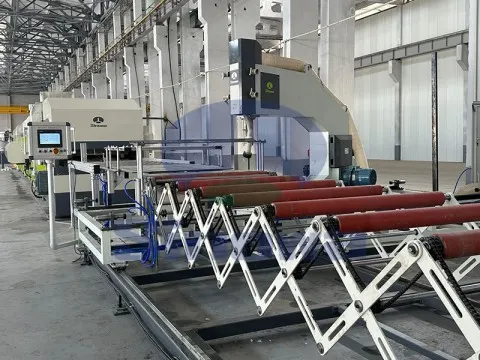
Precision cutting and finishing units realize the fixed-size molding and surface optimization of finished sandwich panels, completing the final standardized processing of products. After full curing and shaping, the continuous long-strip panel enters the cutting unit, which adopts high-precision servo cutting systems to achieve fixed-length cutting according to customized size requirements. The cutting mechanism features fast response and high cutting accuracy, ensuring smooth and flat cutting sections without burrs, cracks, or material deformation. The equipment supports flexible switching of cutting sizes, which can quickly adapt to different product specification requirements without complicated mechanical adjustment. Meanwhile, the finishing unit is equipped with edge trimming and surface cleaning functions to remove residual foam scraps and edge burrs generated during cutting, further optimizing the appearance quality and dimensional uniformity of panels. In addition, the system can complete simple surface sorting and defect screening through real-time detection, preliminarily eliminating products with obvious appearance defects. This integrated cutting and finishing process greatly improves the dimensional consistency and appearance quality of finished products, meeting the high-precision size requirements of various engineering applications.
Automatic stacking and output systems realize the intelligent collection and orderly arrangement of finished panels, improving the overall automation level and production efficiency of the entire line. After cutting and finishing, qualified sandwich panels are automatically transported to the stacking station through the conveying system. The stacking mechanism adopts flexible grabbing and placing structures, which can stably pick up and stack panels of different thicknesses and sizes without causing surface scratches, indentations, or structural damage. The system supports automatic counting, layered stacking, and orderly arrangement of finished products, with adjustable stacking height and spacing to facilitate subsequent packaging, transportation, and storage. Unlike manual stacking, which is inefficient and prone to messy arrangement and panel damage, the automatic stacking mode ensures neat and uniform placement of each batch of products, reduces manual handling links, and lowers the risk of product damage in the final production stage. This intelligent output and stacking method realizes seamless connection from production to finished product collection, greatly saving labor costs and improving the overall operational efficiency of the production line.
Intelligent control and fault diagnosis systems are the core brain of modern foaming sandwich panel manufacturing line, realizing precise control and stable operation of the entire production process. The equipment is equipped with an integrated intelligent operating platform, which centralizes controls for all functional modules including feeding, proportioning, foaming, lamination, curing, and cutting. Operators can set production parameters such as panel thickness, size, and production speed through a simple human-computer interface, and the system will automatically complete synchronous adjustment of each link. The real-time data monitoring function tracks key operational indicators such as material proportioning, foaming temperature, pressing pressure, and running speed throughout the process, and displays operational status intuitively. Meanwhile, the built-in fault diagnosis program can automatically identify abnormal operating states such as material blockage, parameter deviation, and component failure, trigger early warning prompts, and provide targeted fault processing suggestions. This intelligent control mode simplifies operation procedures, reduces reliance on professional operating experience, and effectively avoids equipment downtime and quality problems caused by human misoperation, ensuring long-term stable and efficient operation of the equipment.
The performance advantages of foaming sandwich panel production line are fully reflected in production stability, product diversity, and operational economy, making it the preferred equipment for large-scale production of foam composite panels. In terms of production stability, the fully automated continuous production mode avoids quality fluctuations caused by manual operation differences, ensuring that each batch of finished panels has consistent density, thickness, bonding strength, and thermal insulation performance, greatly improving product qualification rate. In terms of product diversity, the equipment can adapt to different foam materials and surface layer substrates, supporting the production of multi-functional panels suitable for thermal insulation, sound insulation, fire prevention, and lightweight structural purposes, covering the diverse needs of construction, industrial manufacturing, and cold chain engineering. In terms of operational economy, the precise material proportioning and sealed conveying structure effectively reduce raw material waste, while the high-efficiency continuous production greatly improves output per unit time. In addition, the integrated modular design of the equipment facilitates daily maintenance and component replacement, reducing later operation and maintenance costs and improving the comprehensive economic benefits of production.
With the continuous upgrading of new building material technology and the growing demand for energy-saving and lightweight structural materials in various industries, foaming sandwich panel production machinery is constantly evolving toward higher automation, stronger intelligence, and more diversified production capabilities. Modern equipment is continuously optimized in structural design and functional configuration, with more flexible parameter adjustment functions and stronger compatibility with new materials and new processes. The upgraded intelligent monitoring system can realize more refined process control, further improving the precision and stability of foaming composite molding. At the same time, the equipment pays more attention to energy conservation and environmental protection in the operational process, optimizing the reaction and conveying structure to reduce energy consumption and material waste during production. As the market’s requirements for the performance, precision, and diversity of sandwich panels continue to improve, foaming sandwich panel machinery will continue to iterate and upgrade, providing more efficient, stable, and flexible production solutions for the manufacturing of high-performance composite building materials and promoting the innovative development of the entire new energy-saving material industry.
Tags: foaming sandwich panel machinery, foaming sandwich panel machinery manufacturer, foaming sandwich panel machinery supplier, china foaming sandwich panel machinery, foaming sandwich panel machinery for sale
Related Informations
Why Does Polyurethane Sandwich Panel Production Machinery Have Foaming Overflow Phenomenon?
Phenolic Foam Board Making Machine