Sandwich Panel Roll Forming Machine
Publication Date: Oct 7, 2026
Sandwich panel roll forming machine is an integrated automated production device for manufacturing composite building panels. It integrates multiple processing procedures to combine metal sheets and core insulation materials, delivering high-efficiency, uniform, and high-quality panel products for modern construction industries.
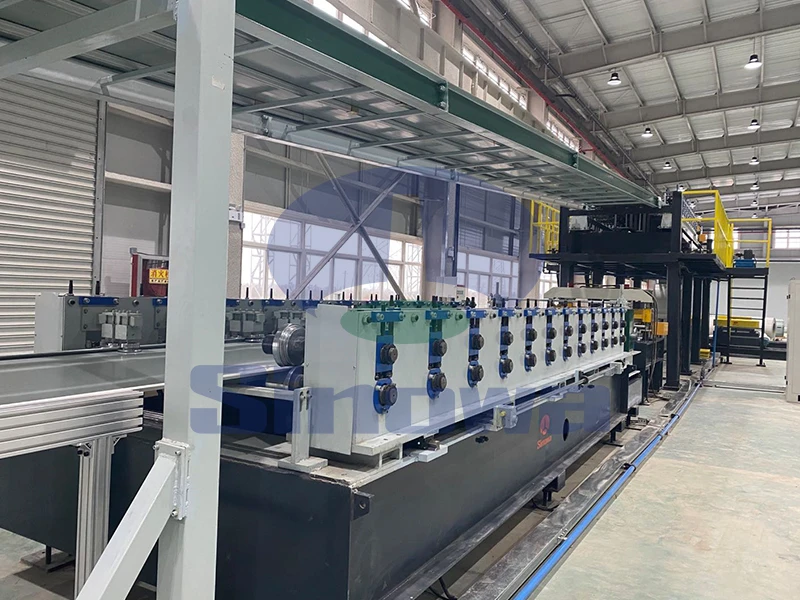
Sandwich panel roll forming machines serve as the backbone of modern lightweight composite building material production, revolutionizing the traditional manufacturing mode of insulation and structural panels. Unlike discrete manual or semi-automatic processing equipment, this integrated mechanical system realizes continuous, streamlined production from raw material input to finished panel output, covering uncoiling, sheet forming, core material compounding, pressing, curing and fixed-length cutting in one complete workflow. The core design concept of the equipment is to integrate independent processing units into a coordinated operating system, which eliminates the efficiency loss and quality deviation caused by material transfer between separate machines. It is specially developed to meet the market’s growing demand for standardized, high-performance, and cost-effective building panels, which are widely applied in industrial plants, commercial buildings, temporary construction facilities and energy-saving renovation projects. By adopting progressive cold roll forming technology, the machine avoids the structural damage and surface deformation caused by one-time stamping, ensuring the overall structural stability and surface flatness of finished panels while maintaining high production efficiency. This equipment has become an indispensable core facility in the field of modern building material manufacturing, supporting the rapid development of energy-saving and lightweight construction industries.
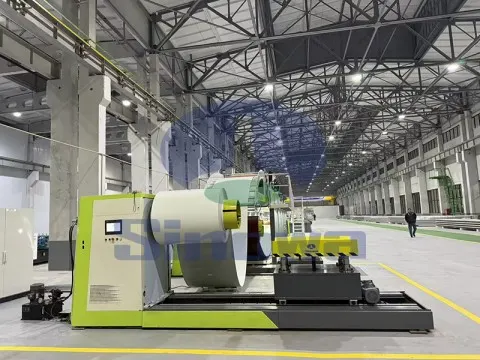
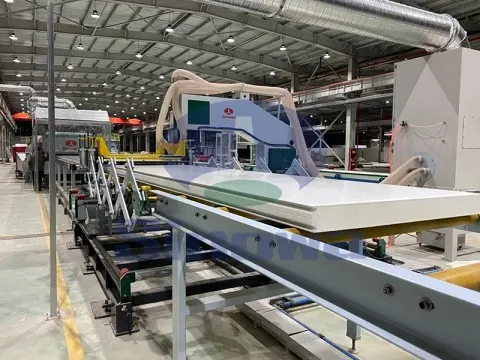
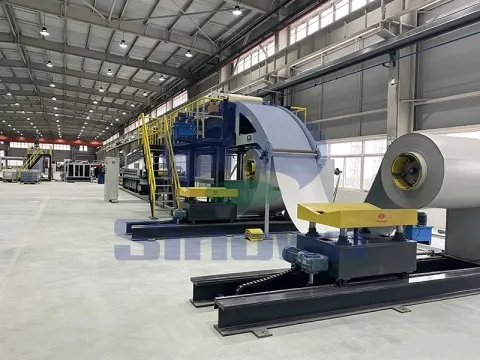
The overall structural composition of a sandwich panel roll forming machine is sophisticated and modular, with each functional unit designed for precise coordination and independent maintenance. The entire equipment system mainly includes raw material uncoiling units, precision roll forming systems, core material feeding and laying devices, composite pressing units, constant-temperature curing systems, fixed-length cutting mechanisms and finished product conveying systems. The main frame of the machine is fabricated with high-strength structural materials, which can withstand long-term continuous operation pressure and mechanical vibration, ensuring overall structural stability and service life. Each functional module is arranged in a linear streamlined layout according to the production sequence, which optimizes the material transmission path and reduces production space occupation. The uncoiling unit at the front end is responsible for stably releasing metal coil raw materials, equipped with adjustable tension control components to prevent sheet deviation and wrinkling during feeding. The middle roll forming system is composed of dozens of gradiently arranged precision roller sets, which shape flat metal sheets into various preset profile structures through step-by-step micro-bending and compression. The subsequent composite and curing units complete the bonding and shaping of metal sheets and core materials, while the tail cutting and conveying units realize standardized finishing and output of finished products. This modular structural design not only improves production continuity but also facilitates daily maintenance, component replacement and equipment parameter adjustment.
The working principle of sandwich panel roll forming machines is based on progressive cold roll forming and continuous composite bonding technology, realizing efficient and stable panel manufacturing through coordinated operation of mechanical, electrical and pneumatic systems. The entire production process starts with the feeding of metal coil raw materials. The uncoiling system releases flat metal sheets at a constant and controllable speed, and the sheet surface is pre-leveled and cleaned to remove impurities and surface tension, laying a foundation for subsequent precise forming. Then the metal sheets enter the multi-station roll forming area, where each group of customized contour rollers applies gradual micro-pressure deformation to the flat sheet. Through repeated and ordered rolling of multiple roller stations, the flat metal sheet is slowly shaped into trapezoidal, corrugated, ribbed or flat edge-sealed profiles without damaging the metal material structure. After the metal surface sheets are formed, the equipment automatically feeds lightweight core insulation materials between the upper and lower metal sheets, ensuring uniform laying and seamless fitting. The composite pressing unit applies stable and uniform pressure to the layered structure of metal sheet and core material to realize preliminary bonding. Finally, the semi-finished panels pass through the constant-temperature curing area to accelerate the solidification of bonding materials, and complete fixed-length cutting and shaping according to preset specifications, producing integrated sandwich panels with stable structure and uniform size.
The roll forming system is the core functional component that determines the forming quality and structural diversity of sandwich panels, featuring high precision and adjustable flexibility. This system consists of multiple groups of high-precision alloy rollers arranged in gradient sequence, and each roller set is professionally customized according to different panel profile requirements. Different from traditional one-time forming equipment, the progressive rolling mode adopted by the system disperses the forming force on the metal sheet through multiple micro-deformations, which effectively avoids metal cracking, surface scratch and internal structural stress concentration. The spacing, angle and gap of each roller can be finely adjusted, enabling the equipment to switch production of different panel profiles and specifications flexibly. The rollers are processed with high-precision machining technology and special surface treatment, which improves wear resistance and corrosion resistance, ensuring long-term stable forming accuracy. In the working process, the synchronous operating mechanism ensures consistent rotating speed of all roller sets, keeping uniform feeding speed and stable sheet forming state. The system is also equipped with automatic deviation correction devices, which can real-time monitor the sheet feeding track and fine-tune the roller operating state to avoid lateral deviation of sheets. This high-precision roll forming design ensures that the finished metal surface has smooth lines, accurate size and consistent structural performance, providing reliable structural support for the subsequent composite processing of sandwich panels.
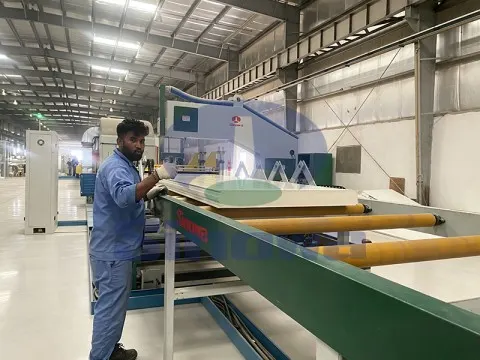
Core material feeding and composite pressing systems are key units that determine the thermal insulation and structural integration performance of finished sandwich panels. The core material feeding device is designed for adaptive feeding of various lightweight insulation materials, realizing automatic cutting, rotating and uniform laying of core materials. It can accurately control the feeding amount and laying thickness of core materials according to the preset panel specifications, ensuring consistent thickness and uniform distribution of the internal insulation layer of each panel. After the core material is laid between the upper and lower formed metal sheets, the composite pressing system starts to work. The system adopts double-belt uniform pressure pressing technology, which can form stable and balanced pressure on the entire panel surface. This uniform pressing mode enables the metal sheets and core materials to fit closely without gaps, effectively improving the bonding strength and overall compactness of the composite structure. Meanwhile, the pressing speed and pressure can be intelligently adjusted according to different core material characteristics and panel thickness requirements, adapting to the processing needs of various composite panels. The integrated design of feeding and pressing avoids manual intervention errors, ensures the consistency of composite quality of each batch of products, and significantly improves the overall structural firmness and service stability of sandwich panels.
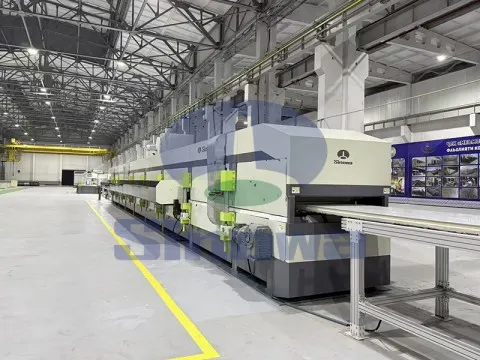
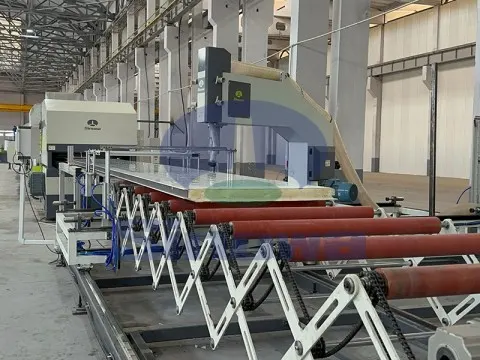
Constant-temperature curing and fixed-length cutting systems guarantee the final forming quality and specification standardization of sandwich panels, playing a vital role in product finishing processing. The curing system creates a stable constant-temperature working environment through intelligent temperature control components, which can accurately adjust the internal temperature according to the curing characteristics of different bonding materials. A reasonable curing temperature and time can accelerate the solidification reaction of the adhesive between metal sheets and core materials, greatly improving the bonding firmness and structural stability of the composite panel, and avoiding panel delamination or deformation in subsequent use. The curing area is designed with a long-distance conveying track, which ensures that each panel can obtain sufficient curing time and uniform temperature action. After curing, the panels enter the fixed-length cutting unit, which adopts high-precision automatic cutting technology. The system can identify the panel length in real time and complete fast and smooth cutting according to preset size parameters. The cutting mechanism is equipped with wear-resistant and high-precision cutting tools, which can ensure flat and neat cutting sections without burrs or deformation. The intelligent cutting control system can realize continuous fixed-length cutting of different specifications, effectively improving the dimensional accuracy and appearance quality of finished panels.
Automatic control and intelligent regulation systems are the intelligent core of modern sandwich panel roll forming machines, realizing unmanned and precise production management. The entire equipment is equipped with an integrated electrical control system that centrally controls all functional units such as feeding, forming, pressing, curing and cutting. Operators can set panel specifications, production speed, curing temperature and other parameters through the human-machine operation interface, and the system will automatically complete the whole production process according to the preset program. The frequency conversion speed regulation technology is adopted in the feeding and conveying links, which can realize stepless speed adjustment, adapt to different production efficiency requirements, and ensure the synchronization and coordination of each processing link. The system is also equipped with real-time monitoring and fault self-diagnosis functions, which can dynamically monitor the operating state of each component, material feeding status and product processing quality. Once abnormal conditions such as sheet deviation, equipment jitter or parameter deviation occur, the system will automatically trigger early warning and perform adaptive adjustment or emergency shutdown to avoid production faults and defective products. The intelligent control system not only simplifies the operation process and reduces manual operation errors, but also greatly improves production stability and product qualification rate.
Sandwich panel roll forming machines have prominent performance advantages in production efficiency, product quality and application flexibility, making them superior to traditional panel manufacturing equipment. In terms of production efficiency, the integrated continuous production mode realizes one-time forming from raw materials to finished products, eliminating intermediate material handling and waiting links, and greatly improving continuous production capacity. The equipment can maintain stable high-speed operation for a long time, realizing mass standardized production. In terms of product quality, the precise mechanical forming and intelligent parameter control ensure consistent size, flat surface and stable internal structure of each panel. The uniform composite pressing and constant-temperature curing process effectively avoid common quality problems such as delamination, bulging and uneven thickness of traditional panels. In terms of flexibility, the equipment can adapt to the production of panels with different profiles, thicknesses and core materials by adjusting roller parameters and feeding procedures, covering the production needs of wall panels, roof panels and other types of building panels. In addition, the equipment runs stably with low mechanical failure rate, reduces production energy consumption and maintenance cost, and has excellent cost-performance in long-term industrial production.
The application scope of products manufactured by sandwich panel roll forming machines covers multiple fields of modern construction and industrial manufacturing, with strong market adaptability. The produced sandwich panels integrate lightweight, heat insulation, sound insulation, fire resistance and structural stability, and are widely used in the construction of industrial workshops, warehouse buildings, logistics parks and large industrial supporting facilities, providing efficient and energy-saving enclosure and partition materials for industrial buildings. In commercial construction fields such as shopping malls, exhibition halls and office buildings, the panels are favored for their beautiful appearance, convenient installation and excellent thermal insulation performance, which can effectively reduce building energy consumption and shorten construction cycle. Meanwhile, the panels are also widely applied in temporary engineering facilities such as prefabricated houses, construction site dormitories and emergency rescue buildings, due to their light weight, easy transportation and rapid assembly characteristics. In addition, they are used in special fields such as cold storage insulation, clean workshop purification and agricultural greenhouse thermal insulation, providing customized lightweight composite building materials for different functional building scenarios.
With the continuous upgrading of modern building energy-saving and lightweight construction concepts, sandwich panel roll forming machines are constantly evolving in technological innovation and functional optimization. The current development trend of the equipment focuses on higher intelligence, higher production precision and stronger environmental protection performance. New-generation equipment is gradually equipped with more precise sensor monitoring systems and remote intelligent control functions, realizing real-time data collection, production parameter optimization and remote equipment operation and maintenance. In terms of structural optimization, the equipment is developing towards modularization and miniaturization, which reduces floor space while improving equipment flexibility and convenience of maintenance. In terms of environmental protection and energy saving, the optimized transmission structure and intelligent energy-saving control system effectively reduce production energy consumption and noise pollution, and the closed production process avoids material waste and dust emission. With the continuous expansion of the application market of energy-saving composite building materials, sandwich panel roll forming machines will continue to iterate and upgrade, providing more efficient, environmentally friendly and intelligent production solutions for the modern building material industry, and promoting the sustainable development of lightweight and energy-saving construction.
Gallery of Sandwich Panel Roll Forming Machine
Tags: sandwich panel roll forming machine, sandwich panel roll forming machine manufacturer, sandwich panel roll forming machine supplier, china sandwich panel roll forming machine, sandwich panel roll forming machine for sale
https://www.sandwichpanelmachinery.com/tags/sandwich-panel-roll-forming-machine.html
-
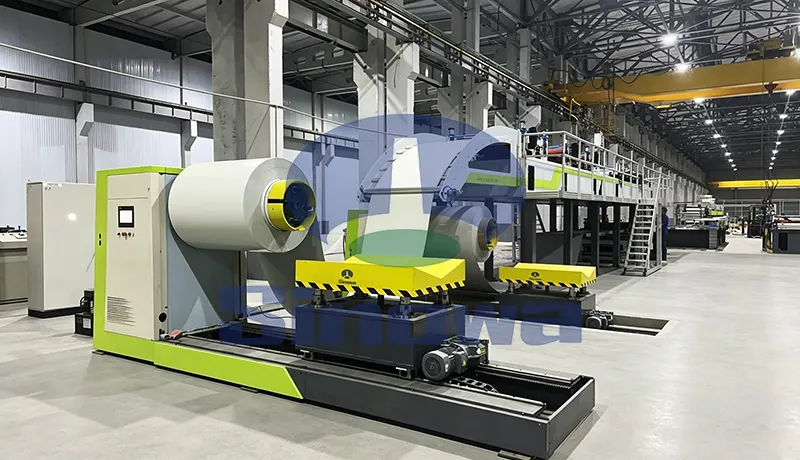
The PU sandwich panel line is a core production setup for making high-performance building insulation panels. This professional PU sandwich panel production line features automated operation to streamline the whole manufacturing process efficiently. Every component of the polyurethane sandwich panel line is precisely calibrated to ensure consistent panel thickness and structural stability. A well-maintained polyurethane sandwich panel production line can greatly boost production efficiency while reducing manual operation errors. The continuous PU sandwich panel line adapts to diverse production demands for different panel sizes and surface styles. With advanced molding technology, the PIR sandwich panel line produces panels with excellent heat preservation and sound insulation properties. Stable running of the PIR sandwich panel production line guarantees reliable product quality for various construction and industrial application scenarios.
-
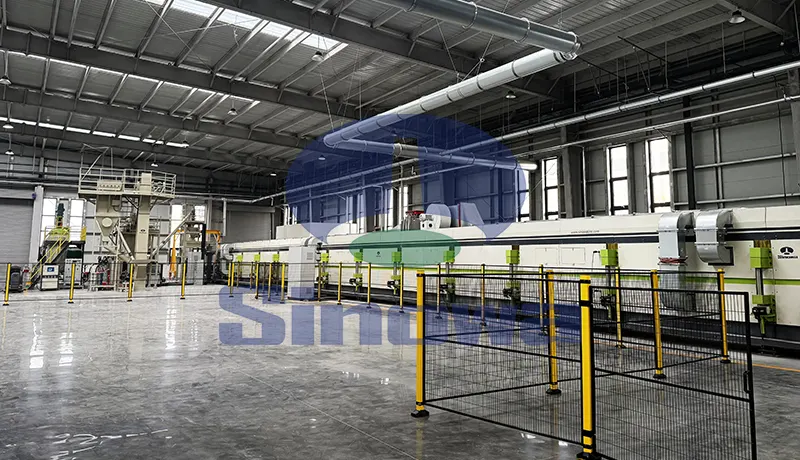
A phenolic insulation board production line serves as the core equipment for manufacturing high-performance thermal insulation building materials. This phenolic insulation panel production line integrates material mixing, foaming, molding and cutting processes to ensure continuous and stable production efficiency. Every operational link of the insulation board production line is precisely calibrated to produce uniform and durable insulation boards. The automated design of the insulation panel production line effectively reduces manual intervention and improves product consistency. Proper maintenance of the phenolic board production line can greatly extend its service life and maintain steady production output. With optimized structural design, the phenolic panel production line adapts to various production demands and delivers high-quality finished products for thermal insulation engineering applications.
-
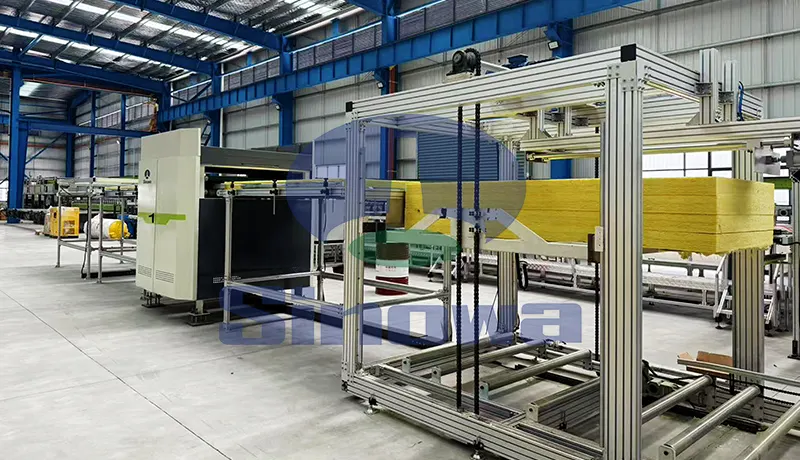
A professional rockwool sandwich panel line serves as the core equipment for producing high-performance building panels. This rockwool sandwich panel production line integrates feeding, laminating and forming processes to ensure stable and efficient production. The well-structured rock wool sandwich panel line can process raw rockwool materials into panels with excellent thermal and sound insulation properties. Operators can adjust the running parameters of the rock wool sandwich panel production line to manufacture panels of different thicknesses and specifications. The automated design of the mineral wool sandwich panel production line greatly reduces manual operation errors and improves product consistency. Regular maintenance of the mineral wool sandwich panel line is essential to sustain long-term operational efficiency and guarantee qualified finished panels for diverse construction applications.