
Sandwich panel machinery production speed refers to the operational rate of automated lines manufacturing insulated composite panels. It varies greatly by equipment type, core materials and process settings, directly determining factory output and operational efficiency in construction material production.
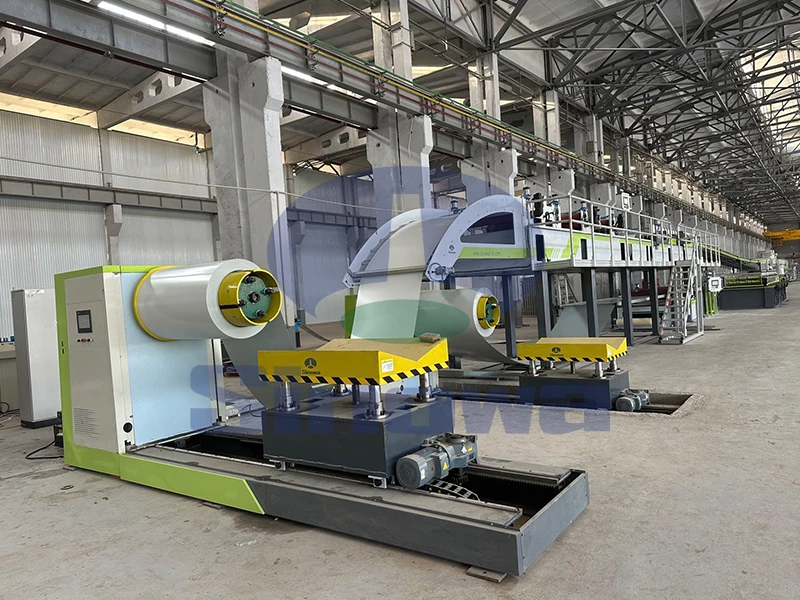
The production speed of sandwich panel machinery is primarily defined by the linear meter output per minute, a core operational metric that reflects the overall efficiency of the entire automated production line. Unlike simple mechanical speed indicators, this parameter integrates the coordination of all upstream and downstream production units, including material feeding, forming, laminating, curing and cutting systems. Modern sandwich panel production equipment is mainly divided into continuous and discontinuous production modes, and their speed gaps are extremely prominent in actual operation. Continuous production lines feature uninterrupted material operation, with stable running speeds ranging from 3 to 20 meters per minute in conventional configurations, while discontinuous batch equipment relies on cyclic pressing and molding, resulting in much lower overall operational speeds. Understanding these basic speed differences is the foundation for factories to select matching equipment and formulate scientific production schedules, as it directly affects daily and annual production capacity planning.
Core insulation materials are one of the most critical factors restricting and adjusting the production speed of sandwich panel machinery. Different core materials have distinct physical and chemical curing characteristics, which determine the minimum processing time required for molding and bonding. Polyurethane and polyisocyanurate core materials feature fast foaming and curing reactions, allowing continuous production lines to maintain relatively high operating speeds. Under standard processing conditions, such equipment can run steadily at 8 to 15 meters per minute, supporting efficient mass production of lightweight insulation panels. In contrast, mineral wool core materials have poorer adhesive bonding efficiency and require longer pressing and compounding time to ensure structural firmness. Even optimized continuous mineral wool production lines can only maintain a speed of 3 to 6 meters per minute. EPS core materials strike a balance between speed and stability, with most professional lines operating at 4 to 10 meters per minute, adapting to most conventional building panel production needs.
Panel thickness and structural specifications exert a direct and intuitive impact on the operating speed of sandwich panel machinery. Thicker panels require more core material filling, longer heat conduction time and sufficient curing cycles to ensure uniform internal structure and stable bonding performance, which inevitably reduces the operating speed of the production line. For thin panels with a thickness below 50 millimeters, most automated production lines can operate at their upper speed limits, realizing efficient and rapid continuous production. As the panel thickness increases to 100 millimeters or more, the equipment needs to slow down appropriately to extend the foaming, laminating and curing time, avoiding quality defects such as incomplete core material curing and uneven bonding. For ultra-thick special panels, the production speed may drop to nearly half of the conventional thin-panel production speed. Meanwhile, special structural designs such as customized edge sealing and grooving will also slightly reduce the continuous operating speed due to increased process steps.
The structural configuration and automation level of sandwich panel machinery fundamentally determine its adjustable range and stable operation capability of production speed. High-end fully automated production lines are equipped with integrated frequency conversion and servo control systems, which support stepless speed regulation and real-time dynamic adjustment according to production conditions. These systems can automatically match the optimal operating speed for different materials and panel specifications during continuous operation, maintaining stable high-efficiency production. In addition, integrated feeding, foaming and cutting modules reduce intermediate material transfer delays and mechanical pause time, effectively improving the average effective production speed. In comparison, semi-automatic or conventional low-end equipment has single speed regulation modes and poor mechanical synchronization accuracy. Frequent fine-tuning and manual intervention are required during operation, leading to unstable speed and low average production efficiency, even if the theoretical maximum speed is similar to that of high-end equipment.
Production process parameters including temperature, pressure and adhesive status play a decisive role in the stable operation speed of sandwich panel machinery. The curing reaction of composite panels is highly sensitive to temperature changes; insufficient equipment operating temperature will slow down the foaming and bonding reaction speed, requiring the production line to reduce operating speed to ensure product quality. Excessively high temperature may cause local material aging and quality problems, which also needs speed matching adjustment. The molding pressure of the laminating section also affects production efficiency. Stable and appropriate pressure can accelerate the composite bonding of surface plates and core materials, supporting high-speed operation, while unstable pressure will force the equipment to slow down to avoid panel deformation and degumming. Moreover, the activity of adhesive materials will change with long-term operation, and professional equipment will automatically adjust the line speed according to real-time material activity data to maintain consistent product quality and qualified rate.
There are obvious operational differences in production speed between continuous and discontinuous sandwich panel machinery systems, which suit completely different production scenarios. Continuous production lines adopt uninterrupted linear operation, with all process links operating synchronously, and their speed is calculated by linear meters per minute. This type of equipment can maintain long-term stable high-speed operation, with a wide speed adjustment range, and is suitable for large-batch and standardized panel production. Discontinuous production equipment adopts batch cyclic processing, with each cycle including feeding, pressing, curing and discharging links. Its production efficiency is calculated by the number of panels per cycle rather than linear speed. Although the instantaneous operating speed of a single process may be high, the frequent start-stop and waiting curing time greatly reduce the overall average speed, making it only suitable for small-batch and multi-specification customized production.
Daily maintenance and equipment operation status directly affect the long-term stable production speed of sandwich panel machinery. Well-maintained equipment with smooth transmission systems, precise sensor response and stable power output can always maintain the set optimal operating speed without unnecessary speed reduction and pause. Regular lubrication of transmission components, calibration of positioning systems and cleaning of foaming and laminating modules can effectively avoid mechanical resistance and operational failures, ensuring continuous and efficient operation. In contrast, equipment with aging parts, delayed sensor feedback or accumulated internal dirt will experience unstable operation during high-speed working. Operators have to reduce the operating speed artificially to reduce failure risks, resulting in a significant drop in actual production efficiency. Minor faults that are not repaired in time will also lead to frequent temporary shutdowns, further reducing the average daily production speed.
Operator proficiency and standardized operating procedures indirectly influence the actual production speed of sandwich panel machinery. Professional and skilled operators can flexibly adjust equipment parameters according to real-time production conditions, quickly switch speed modes for different panel specifications, and handle minor operational anomalies in a timely manner, ensuring that the equipment runs at the optimal speed all the time. They can also reasonably arrange material supply and equipment operation rhythm to avoid production delays caused by material shortage and process mismatch. Inexperienced operators often adopt conservative speed settings to avoid quality problems, resulting in underutilization of equipment performance. Non-standard operations such as parameter misadjustment and irregular material placement will also cause frequent equipment debugging and pause, greatly reducing the overall effective production speed of the line.
The matching degree of production line layout and auxiliary equipment affects the stable exertion of sandwich panel machinery speed performance. A scientific and compact production layout realizes seamless connection between all process links, with coordinated operating speeds of front and rear equipment, no material accumulation or idle waiting, and maximizes the efficiency of the main machine’s high-speed operation. Complete supporting auxiliary equipment including automatic stacking, packaging and conveying devices can synchronously complete post-processing work, avoiding the need to reduce the main line speed due to lagging post-process efficiency. If the production line layout is scattered and the auxiliary equipment is mismatched or insufficient, the high-speed output of the main machine will cause material blockage and processing delays. The main equipment has to reduce speed intermittently to cooperate with subsequent processes, leading to a significant reduction in comprehensive production efficiency.
In practical industrial production, the comprehensive production speed of sandwich panel machinery is a balanced result of multiple factors rather than a fixed numerical value. Factories need to comprehensively consider core material type, panel specifications, equipment performance and production scale to set the most appropriate operating speed. Blindly pursuing ultra-high speed will lead to a decline in product qualification rate and increased failure rate, while overly conservative speed settings will waste equipment capacity and increase production costs. Only by matching the optimal speed parameters with actual production conditions can enterprises balance production efficiency and product quality, giving full play to the operational value of sandwich panel production equipment and improving overall production benefits.