
The sandwich panel production line is an automated integrated manufacturing system for composite insulation panels. It bonds metal surface sheets and core materials through continuous mechanical processing and physical curing, realizing efficient, standardized and integrated forming of building sandwich panels.
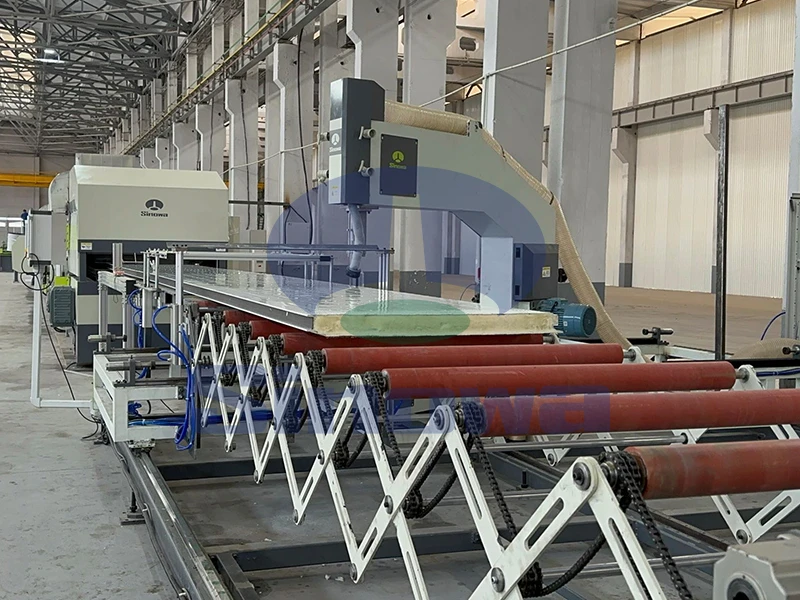
The core operational logic of the sandwich panel production line lies in continuous compound forming based on mechanical positioning, physical bonding and synchronous curing technology. The entire production process abandons scattered manual processing and adopts a streamlined automated workflow, which unifies the processing rhythm of surface material unwinding, core material laying, compound pressing and final shaping. At the initial production stage, metal coil materials for panel surfaces are fixed on automatic unwinding racks, which release sheet materials at a constant and stable speed under the control of servo drive systems. This constant-speed feeding mode ensures the flatness and dimensional stability of the surface materials, avoiding wrinkling or deviation caused by uneven feeding. Meanwhile, the auxiliary guiding and correcting devices on the production line continuously adjust the material transmission track in real time to keep the surface materials centered during movement, laying a solid foundation for subsequent precise compounding with core materials.
Material pretreatment is an indispensable basic link in the entire production process, which directly determines the bonding quality and surface finish of finished sandwich panels. After the metal surface sheets are unwound and guided, they first enter the leveling and trimming unit. Multiple groups of precision flattening rollers act on the metal sheets to eliminate internal stress generated during coil winding, completely removing tiny warps and uneven textures on the sheet surface. The trimming device then cuts off the irregular edges on both sides of the metal sheets to ensure consistent width of the surface materials. In addition, the production line is equipped with surface cleaning and dust removal modules, which use high-pressure air blowing and static removal technology to clean dust, debris and fine particles attached to the metal surface. A clean and smooth bonding surface can effectively improve the adhesion between the surface sheet and the core material, preventing degumming and separation of the composite layer in later use.
Glue coating operation is the key process to realize the composite connection between surface sheet and core material, and the uniformity and thickness of the glue layer directly affect the structural stability of sandwich panels. The automated glue coating system of the production line adopts roller-type full-surface gluing, which can evenly coat the environmental adhesive on the inner side of the metal surface sheet at a controllable thickness. Different from manual gluing, the mechanical gluing device maintains a constant glue output and coating speed throughout the process, avoiding local excessive glue or glue shortage problems. The system can also adjust the glue coating amount in real time according to different core material types and panel thickness specifications. After gluing, the preliminary leveling of the glue layer is completed through auxiliary rollers to ensure the glue layer is flat and continuous, which enables the core material to be closely attached to the surface sheet without gaps in the subsequent compounding process.
Core material laying and positioning is a critical step to ensure the internal structural uniformity of sandwich panels. Common core materials include foam, rock wool and other thermal insulation and filling materials, all of which are laid automatically by special feeding equipment on the production line. The core material feeding device transports the cut core materials to the designated composite position at a synchronous speed matching the surface sheet transmission speed. Precision positioning sensors installed on the production line monitor the laying position of the core material in real time, automatically correcting offset problems to ensure the core material is completely aligned with the upper and lower metal surface sheets. For block-shaped core materials such as rock wool, the equipment can realize seamless docking and dense laying between adjacent core materials, eliminating hollow gaps inside the panel. This accurate laying and positioning process ensures consistent thickness and uniform internal structure of each finished sandwich panel.
The primary compound pressing process integrates the surface sheet and core material into a preliminary whole structure through mechanical pressure. After the glue coating and core laying procedures are completed, the semi-finished materials enter the multi-layer pressing unit composed of high-precision pressure rollers. The pressing unit applies stable and uniform static pressure on the composite materials from the upper and lower directions. The pressure value is precisely controlled by the hydraulic system of the production line, which can be adjusted according to the hardness of different core materials and the required panel compactness. Moderate pressure can make the glue layer fully infiltrate the contact surface between the metal sheet and the core material, enhancing the bonding tightness, while avoiding core material deformation or glue overflow caused by excessive pressure. The synchronous operation of each group of pressure rollers ensures that the composite materials move forward steadily under pressure, realizing continuous preliminary composite forming.
Heating and constant-temperature curing is the core process to accelerate adhesive solidification and fix the composite structure of sandwich panels. The production line is equipped with a closed constant-temperature curing channel, which provides a stable heating environment for the preliminarily compounded semi-finished panels. The internal temperature of the curing channel is evenly distributed through circulating heating equipment, ensuring that each part of the panel receives consistent heat treatment. Under the set constant temperature condition, the adhesive coated between the surface sheet and the core material undergoes rapid chemical curing reaction, gradually changing from liquid state to solid state, and firmly bonding the two layers of materials together. The curing time is matched with the production line transmission speed to ensure that the adhesive is completely solidified when the panel exits the curing channel, forming a stable integrated composite structure and avoiding structural loosening caused by insufficient curing.
Precision shaping and calibration processes further optimize the overall dimensional accuracy and surface flatness of sandwich panels. After curing, the initially formed panels will have tiny dimensional deviations or surface irregularities due to mechanical transmission and pressure changes. The shaping unit of the production line uses multi-directional shaping rollers to carry out fine calibration on the surface, edges and overall thickness of the panels. The thickness calibration device detects the real-time thickness of the panel through high-precision sensors and fine-tunes the roller gap to ensure that the thickness error of the finished panel is controlled within a tiny range. The edge shaping process trims and straightens the panel edges to make the edges neat and vertical. This secondary shaping and calibration greatly improves the appearance quality and dimensional uniformity of the product, meeting the requirements of subsequent construction and installation.
Fixed-length cutting is the final forming process of single sandwich panel products, realizing the segmentation of continuous composite panels into finished products of specified specifications. The automated cutting system of the production line works synchronously with the transmission speed of the assembly line, adopting non-stop dynamic cutting technology to avoid production pause and improve production efficiency. The system can set arbitrary cutting lengths through the control terminal, and the high-precision measuring device tracks the panel transmission distance in real time. When the panel reaches the set length, the cutting tool acts quickly and smoothly to complete the cutting operation. The high-speed cutting tool is equipped with a buffering structure to ensure smooth and burr-free cutting sections, without damaging the surface metal layer and internal core material structure, ensuring the integrity and appearance quality of each cut finished panel.
Post-processing and stacking procedures complete the final finishing and standardized collection of finished sandwich panels. After cutting, the finished panels enter the post-processing area, where the equipment automatically removes tiny burrs and residual glue on the cutting sections, and carries out surface inspection and sorting. Qualified panels are transmitted to the automatic stacking platform, which uses a mechanical grabbing and stacking device to neatly stack the panels according to fixed specifications. The stacking equipment maintains stable lifting and placing speed to avoid collision and friction damage to the panel surface. Unqualified products screened out during inspection will be automatically sorted out separately for reprocessing. This automated post-processing and stacking process not only ensures the uniformity of finished product storage, but also greatly improves the overall production efficiency and product yield.
The overall linkage control system is the brain of the entire sandwich panel production line, realizing the synchronous coordination of all processing links. The entire production process is uniformly controlled by the central intelligent system, which integrates and adjusts the operating speed, parameter settings and equipment status of unwinding, gluing, pressing, curing, cutting and stacking units. The system can automatically identify abnormal parameters such as excessive speed deviation, insufficient glue output and abnormal curing temperature, and trigger real-time adjustment or early warning mechanisms. All production parameters can be preset and stored through the control terminal, realizing one-key switching of different product specifications. The intelligent linkage control ensures the continuity, stability and consistency of the entire production process, avoiding production errors caused by asynchronous equipment operation and realizing high-efficiency and high-quality automated production of sandwich panels.