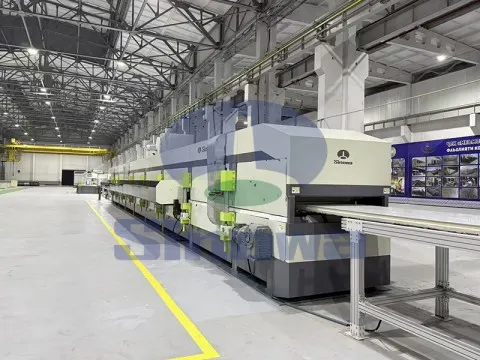
Polyurethane Sandwich Panel Machinery
High-efficiency automatic polyurethane sandwich panel machinery for continuous PU/PIR insulated panel production. Stable performance, full PLC control, customized for construction, cold storage and industrial building projects.
Polyurethane sandwich panel machinery refers to a full set of automated production equipment designed for the integrated molding of polyurethane composite sandwich panels, integrating mechanical transmission, chemical foaming, constant temperature curing, and intelligent control technologies. This advanced production system addresses the shortcomings of traditional intermittent panel manufacturing, such as low efficiency, inconsistent product quality, and excessive manual dependence, and has become core equipment for the production of high-performance building and industrial composite panels. The machinery mainly completes the continuous compounding of upper and lower surface materials and polyurethane foam core layers, realizing one-time integral molding of lightweight, heat-insulating, and high-strength sandwich panels. With the growing demand for energy-saving, environmentally friendly, and prefabricated building materials globally, this polyurethane sandwich panel line has gained widespread attention in modern construction, cold chain logistics, and industrial enclosure fields, thanks to its stable operation, flexible production, and excellent finished product performance, supporting large-scale and standardized panel production for diverse industrial applications.
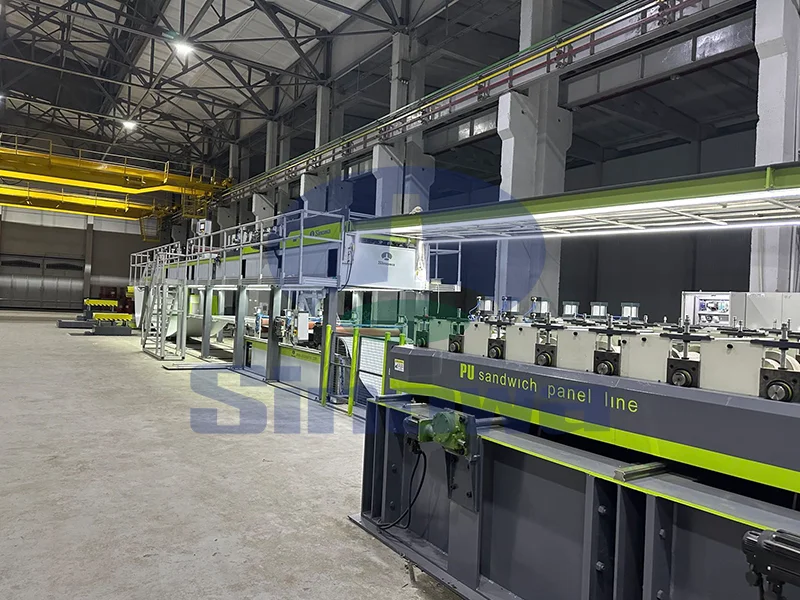
The core operational logic of polyurethane sandwich panel making machinery lies in the precise integration of physical mechanical forming and chemical polyurethane foaming reactions, which distinguishes it from ordinary composite plate processing equipment. The entire production workflow starts with the automatic feeding and leveling of surface materials, including metal sheets and various non-metal decorative plates, where the equipment’s precision transmission system ensures flat and consistent material conveying without deviation or wrinkling. Subsequently, the two-component polyurethane raw materials are accurately proportioned and high-speed mixed by professional foaming units, triggering a controlled molecular cross-linking foaming reaction. The uniformly mixed foam material is evenly sprayed between the upper and lower surface layers, followed by constant-pressure lamination and constant-temperature curing processes. Every step of the process is coordinated by linked mechanical units, ensuring that the polyurethane foam core layer forms a dense and uniform cellular structure and achieves seamless bonding with surface materials. This integrated processing mode completely avoids the defects of manual secondary bonding, such as uneven bonding gaps and easy delamination, laying a solid foundation for the overall structural stability and durability of finished panels.
Modern polyurethane sandwich panel machine features a highly modular structural design, which endows the equipment with strong production flexibility and convenient maintenance performance. The whole production line is composed of multiple independent and linked functional modules, including a raw material feeding module, precise foaming and spraying module, pressing and shaping module, constant temperature curing module, fixed-length cutting module, and finished product output module. Each module undertakes independent production tasks while maintaining synchronous linkage operation through the central control system. This modular design allows the equipment to adapt to different production needs by adjusting the operating parameters of individual modules, enabling the production of sandwich panels with different thicknesses, surface materials, and core layer densities. In addition, the modular structure greatly simplifies daily maintenance and fault troubleshooting. When a partial equipment failure occurs, maintenance personnel can quickly locate and repair the faulty module without affecting the normal operation of other units, effectively reducing equipment downtime and improving the overall continuity of production operations.
Intelligent control systems are the core support for the high-precision and stable operation of polyurethane sandwich panel production machine, realizing full-process automated regulation and intelligent management of production. Equipped with advanced human-computer interaction terminals and programmable control components, the equipment can accurately adjust key production parameters such as raw material ratio, foaming temperature, spraying volume, lamination pressure, and production line operating speed. The system has a parameter memory function that can store customized process parameters for different panel specifications, enabling rapid formula switching during batch production of diversified products and effectively shortening production debugging time. Moreover, the intelligent control system supports real-time monitoring of the entire production process, automatically identifying abnormal fluctuations in temperature, pressure, and transmission speed. When operational anomalies occur, the system will issue timely reminders and implement self-protection shutdown operations, avoiding defective product generation and equipment damage caused by parameter deviations. This intelligent control mode minimizes manual operation errors and ensures consistent product quality in long-term continuous production.
Production efficiency is a prominent advantage of polyurethane sandwich panel manufacturing machinery, making it highly suitable for large-scale industrial mass production. Different from traditional semi-automatic intermittent production equipment that requires frequent manual intervention and segmented processing, modern continuous polyurethane sandwich panel production lines can realize uninterrupted 24-hour cyclic production. The operating speed of the production line can be dynamically adjusted according to product specifications and order demand, with a stable production speed range that meets the supply requirements of large engineering projects. The integrated one-step molding process eliminates multiple intermediate links such as manual gluing, secondary pressing, and offline curing required by traditional processes, greatly compressing the single-panel production cycle. While improving production speed, the equipment maintains extremely high product yield, effectively reducing raw material waste caused by manual operation errors. The efficient production capacity not only shortens the product delivery cycle for manufacturers but also reduces unit production time costs, significantly improving the economic benefits of panel production enterprises.
The finished polyurethane sandwich panels produced by professional machinery boast superior comprehensive performance, relying on the precise process control of the equipment. The precise foaming system of the machinery ensures that the polyurethane core layer forms a uniform and closed cellular structure, which endows the panels with excellent thermal insulation and heat preservation performance, effectively blocking heat transfer and reducing energy consumption for building temperature regulation. At the same time, the high-pressure integral lamination process enhances the bonding strength between the core layer and surface layers, making the panels resistant to delamination, cracking, and deformation under conventional external force and weather conditions. In addition, the standardized production process of the equipment ensures consistent panel flatness, dimensional accuracy, and overall sealing performance. The finished panels also feature lightweight characteristics, which can reduce the overall load-bearing pressure of building structures while maintaining structural stability, bringing great convenience to transportation, handling, and on-site installation. These excellent performance indicators make the panels adaptable to complex usage environments.
Polyurethane sandwich panel manufacturing equipment has a wide range of application scenarios, covering multiple fields of modern industrial production and civil construction. In the construction industry, the equipment-produced panels are widely used as wall and roof enclosure materials for industrial workshops, logistics warehouses, public buildings, and prefabricated temporary buildings, providing efficient energy-saving and stable enclosure solutions for building projects. In the cold chain industry, the high-precision thermal insulation performance of polyurethane panels makes them ideal materials for cold storage enclosures, refrigerated vehicle compartments, and fresh-keeping storage facilities, effectively maintaining internal temperature stability and reducing cold loss. In addition, the equipment can produce antibacterial and dust-proof customized panels suitable for purification workshops, medical laboratories, and clean industrial production spaces by adjusting production parameters and matching different surface materials. The diversified production capacity enables the machinery to meet the personalized material needs of different industries and expand the market application boundary of polyurethane composite panels.
Energy conservation and environmental protection are important design concepts and operational advantages of modern polyurethane sandwich panel production equipment. The equipment adopts optimized raw material proportioning and closed foaming spraying structures, which greatly improves the utilization rate of polyurethane raw materials and reduces raw material volatilization and waste during the production process. The closed production environment effectively controls the emission of trace volatile substances generated during polyurethane foaming, avoiding environmental pollution caused by material diffusion. Meanwhile, the intelligent temperature and pressure regulation system realizes precise energy output, avoiding energy waste caused by excessive heating and pressure operation of traditional equipment. In addition, the high-performance panels produced by the equipment can significantly reduce the long-term energy consumption of buildings and cold chain facilities, forming a green and low-carbon industrial chain from equipment production to product application. Compared with traditional panel production equipment, it has more prominent environmental protection benefits and conforms to the mainstream development trend of green manufacturing in modern industry.
The operational stability and durability of polyurethane sandwich panel equipment determine its long-term production value for enterprises. The key load-bearing and transmission parts of the equipment are made of high-strength and wear-resistant materials, processed through precision manufacturing processes, which can withstand long-term continuous high-load operation without easy wear and deformation. The equipment is equipped with a perfect heat dissipation and lubrication system, which effectively reduces the operating loss of mechanical parts during continuous operation and prolongs the overall service life of the equipment. In terms of operational stability, the synchronous linkage control of each functional module avoids production jitter and parameter deviation caused by asynchronous operation, ensuring the continuity and stability of the production process. Even in long-term uninterrupted batch production, the equipment can maintain stable product dimensional accuracy and structural performance. Its reliable operational performance reduces the frequency of equipment maintenance and replacement, lowers the long-term operating cost of production enterprises, and provides stable equipment support for sustainable production operations.
With the continuous upgrading of industrial manufacturing technology, polyurethane sandwich panel manufacturing line is evolving toward higher intelligence, higher precision, and stronger customization. The latest generation of equipment is equipped with more intelligent sensing and data analysis functions, which can automatically collect and analyze production data such as raw material consumption, production output, and product qualification rate, providing data support for enterprises to optimize production schedules and control production costs. The equipment’s precision control level is further improved, enabling the production of ultra-thin and ultra-thick customized panels with higher dimensional accuracy and more stable structural performance. In addition, the equipment’s compatibility with new materials is continuously enhanced, being able to adapt to new environmentally friendly surface materials and modified polyurethane core materials, meeting the market’s increasing demand for high-performance and multifunctional composite panels. The continuous technological iteration makes the machinery always adapt to the upgrading needs of the new material industry and maintain advanced production performance.
The popularization and application of polyurethane sandwich panel production machinery have profoundly promoted the standardized and industrialized development of the composite panel manufacturing industry. In the past, the production of composite panels relied heavily on manual experience and semi-automatic equipment, resulting in uneven product quality, low production efficiency, and difficulty in forming large-scale industrial production. The emergence of fully automatic polyurethane sandwich panel production lines has unified the production process and product quality standards of composite panels, realizing large-scale standardized production. The efficient and flexible production mode of the equipment lowers the threshold for high-quality composite panel production, enabling more manufacturing enterprises to produce high-performance building and industrial panels. At the same time, the excellent performance of equipment-produced panels accelerates the replacement of traditional building materials, promotes the upgrading of the building energy-saving material industry, and plays an important role in improving the overall construction level and green development capacity of the modern building industry.
Looking ahead, polyurethane sandwich panel production line will continue to play an irreplaceable core role in the field of composite material production, with broad market development prospects. Driven by the global green building and low-carbon development strategy, the market demand for energy-saving, environmentally friendly, and high-efficiency building enclosure materials will continue to grow, which will further drive the technological innovation and market popularization of polyurethane sandwich panel production equipment. Future equipment research and development will focus on intelligent unmanned production, ultra-low energy consumption operation, and multi-material composite molding, further improving production efficiency, reducing production costs, and enriching product types. With the continuous optimization of equipment performance and the expansion of application fields, polyurethane sandwich panel machinery will continue to empower the high-quality development of the prefabricated construction, cold chain logistics, and industrial manufacturing industries, becoming an important power source for the innovation and upgrading of modern composite material manufacturing.
Tags: polyurethane sandwich panel machinery, polyurethane sandwich panel machinery manufacturer, polyurethane sandwich panel machinery supplier, china polyurethane sandwich panel machinery, polyurethane sandwich panel machinery for sale
Related Informations
Why Does Polyurethane Sandwich Panel Production Machinery Have Foaming Overflow Phenomenon?
What Leads To Panel Deformation During Polyurethane Sandwich Panel Machine Lamination Process?