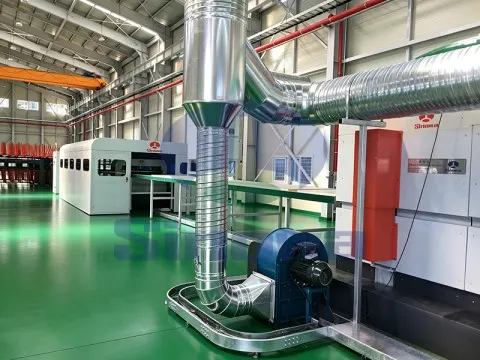
Phenolic Sandwich Panel Machinery
Fully automatic phenolic sandwich panel machinery for fireproof & thermal insulation panel production. High-efficiency, energy-saving, stable continuous production line with custom solutions for construction & duct insulation projects.
Phenolic sandwich panel machinery represents a specialized integrated automated production system designed for the continuous manufacturing of high-performance phenolic foam composite panels. As a core industrial equipment for modern thermal insulation and fireproof building material production, this machinery integrates multiple sequential processing functions to complete the whole production workflow from raw material feeding, surface material treatment, core material foaming and mixing, composite pressing, curing forming to fixed-size cutting and finished product output. Different from ordinary sandwich panel production equipment, it is uniquely optimized to adapt to the special chemical reaction characteristics of phenolic resin, ensuring stable foaming density, uniform bonding performance and consistent structural integrity of finished panels. With modular structural design and intelligent linkage control, the phenolic board production line effectively overcomes the defects of traditional intermittent production such as low efficiency, large manual error and unstable product quality, realizing large-scale, standardized and high-quality batch production. It has become indispensable core equipment in the manufacturing of energy-saving and fireproof composite building panels, supporting diverse application scenarios in construction insulation, ventilation engineering and industrial enclosure systems.
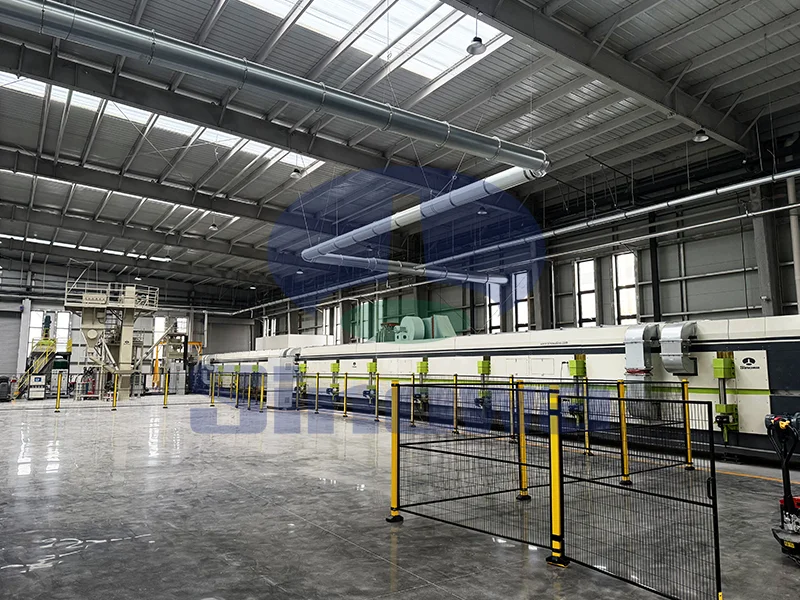
The core material mixing and foaming system is the most critical functional unit of phenolic sandwich panel making machinery, which fundamentally determines the physical and chemical performance of the phenolic foam core layer. Different from the foaming process of ordinary polyurethane sandwich panels, phenolic resin foaming features stricter reaction condition requirements due to its unique chemical cross-linking polymerization mechanism. The equipment is equipped with high-precision dynamic metering and instantaneous mixing devices, which can accurately control the feeding proportion of phenolic resin, curing agents, foaming additives and surfactants. All raw materials are conveyed to the closed mixing chamber through independent metering pumps, realizing full and uniform instantaneous blending without material stratification or uneven component distribution. The closed mixing environment effectively isolates external air and temperature interference, avoiding premature local curing or insufficient foaming reaction. After uniform mixing, the mixed materials are evenly sprayed and injected between the upper and lower surface materials through precision nozzle arrays. The uniform feeding and spraying mode ensures consistent foam thickness and density across the entire panel width, preventing local hollowing, insufficient foaming or excessive expansion. This precise foaming control technology enables the finished phenolic core layer to achieve uniform pore structure, stable thermal insulation performance and excellent fire resistance.
Composite pressing and leveling process is a key link to shape the structural stability and dimensional accuracy of phenolic sandwich panels, and the corresponding mechanical units are designed with high-precision constant-pressure control functions. After the phenolic mixed materials are injected between the surface materials, the semi-finished panels are immediately sent to the double-belt pressing unit through the conveying system. The pressing unit adopts upper and lower synchronous circulating conveyor belt structure, which can provide uniform and stable pressing force for the whole panel surface without local pressure deviation. The system supports stepless adjustment of pressing pressure and pressing speed according to different panel thickness and material characteristics, adapting to diversified production demands. During the pressing process, the mechanical leveling structure automatically corrects the offset of upper and lower surface materials to ensure the overall alignment of the composite structure. Meanwhile, the constant-pressure state maintains stable fitting between the surface materials and the foaming core material, promoting full combination of the core material and surface layers in the foaming and curing stage. Reasonable pressing parameters can effectively eliminate surface bulges, depressions and uneven thickness, ensuring the overall flatness and dimensional consistency of finished panels. The continuous pressing mode replaces traditional intermittent pressing, greatly improving production efficiency while stabilizing product quality.
Constant-temperature curing and forming system is an essential functional part for phenolic panel production line to realize stable product performance. Phenolic foam relies on chemical cross-linking reaction to complete foaming and solidification, and temperature stability is the core factor affecting reaction sufficiency and structural forming effect. The equipment is equipped with an integrated sealed constant-temperature curing channel with uniform internal temperature distribution and no local temperature difference. The intelligent temperature control system can accurately adjust the internal temperature of the curing channel in real time according to production speed and panel specifications, maintaining the optimal reaction temperature range required for phenolic resin curing. In the continuous conveying process, the semi-finished panels pass through the curing channel at a constant speed, enabling the phenolic core material to complete full foaming, cross-linking and solidification step by step. The closed curing environment avoids the influence of external temperature and humidity changes on the curing effect, preventing incomplete curing, slow forming or unstable core layer structure. Sufficient and uniform curing treatment makes the internal pore structure of phenolic foam more compact and regular, significantly improving the thermal insulation, sound insulation and structural compression resistance of the panels. At the same time, it enhances the bonding strength between the core layer and surface materials, effectively avoiding layer separation and peeling in long-term use.
Intelligent fixed-length cutting and edge trimming mechanism ensures the dimensional standardization and appearance quality of finished phenolic sandwich panels. After the cured panels are conveyed out of the forming area, they enter the automatic cutting unit for fixed-length cutting according to preset production parameters. The machinery adopts high-precision servo positioning system, which can accurately identify the conveying position of panels and realize error-free fixed-length cutting. Compared with manual cutting and traditional mechanical cutting, the servo-controlled cutting mode effectively avoids dimensional deviation caused by conveying speed fluctuation and mechanical vibration. The cutting tool is made of high-hardness wear-resistant materials, which can keep the cutting edge smooth and flat for a long time without burrs, cracks and edge warping. In addition to fixed-length cutting, the equipment is also equipped with automatic edge trimming functions on both sides, which can trim the uneven edges generated in the composite process to ensure consistent width of the whole panel. The cutting and trimming process runs synchronously with the production line conveying speed, realizing uninterrupted online processing without affecting production efficiency. The automated processing mode not only improves the dimensional accuracy and appearance finish of finished products, but also reduces material waste and manual secondary processing costs, realizing one-time forming of standard finished panels.
The intelligent control system serves as the brain of phenolic sandwich panel manufacturing machinery, realizing unified scheduling and precise control of the entire production process. The equipment adopts mature PLC linkage control technology, which integrates and manages all functional modules including feeding, mixing, pressing, curing, cutting and conveying. Operators can set various production parameters such as panel thickness, length, production speed and raw material proportion through the human-machine operation interface. The control system can automatically adjust the operating state of each module in real time according to the set parameters, realizing fully automated unattended continuous production. The built-in data monitoring function can real-time collect and display key production data such as mixing ratio, pressing pressure, curing temperature and conveying speed, facilitating operators to grasp the production status comprehensively. Once abnormal conditions such as raw material shortage, parameter deviation and mechanical failure occur, the system will automatically trigger alarm prompts and perform emergency shutdown protection to avoid defective products and equipment damage. The intelligent linkage control eliminates manual operation errors, ensures the consistency and stability of each batch of products, and greatly improves the overall automation level and production reliability of the equipment.
Energy-saving and environmental protection design is a prominent advantage of modern phenolic sandwich panel manufacturing line, which conforms to the development trend of green industrial manufacturing. The equipment optimizes the power transmission structure and thermal circulation system, effectively reducing invalid energy consumption in the production process. The constant-temperature curing channel adopts high-efficiency thermal insulation materials, which reduces heat loss and improves thermal energy utilization efficiency, thus lowering overall production energy consumption. The raw material mixing and feeding system adopts fully sealed design, which completely avoids the volatilization and leakage of phenolic resin and auxiliary additives, reducing the emission of harmful substances in the production process. Meanwhile, the equipment is equipped with a waste material recycling device, which can collect and reuse the leftover materials generated by cutting and trimming, realizing maximum utilization of raw materials and reducing production waste. In terms of mechanical operation, the optimized transmission structure reduces friction resistance and operating noise, realizing low-noise and low-loss operation. This series of energy-saving and environmental protection designs not only reduce the production operation cost for users, but also minimize the environmental impact of the production process, meeting the green production requirements of modern building material manufacturing enterprises.
Operational stability and safety protection performance are core indicators of phenolic insulation board production line in industrial application. The whole equipment undergoes rigorous mechanical calibration and load testing, with stable transmission operation and strong overload resistance, which can adapt to long-term uninterrupted high-intensity industrial production. All moving parts are equipped with protective baffles and anti-collision devices to avoid safety accidents caused by accidental contact during operation. The electrical control part adopts closed waterproof and dustproof design, which can adapt to complex industrial production environments and prevent circuit failure caused by dust and moisture invasion. The equipment is equipped with multiple safety protection mechanisms including emergency stop device, overpressure protection, over-temperature protection and overload protection. When encountering abnormal operating conditions, the system can quickly cut off the power supply and stop operation to ensure the safety of equipment and operators. In addition, the mechanical structure is designed with reasonable human-machine operation spacing, which avoids operational risks while facilitating daily maintenance and inspection. Excellent stability and comprehensive safety protection system reduce equipment failure rate and production safety hazards, ensuring the continuity and safety of industrial batch production.
The application adaptability of phenolic board production line endows it with broad market value in the field of building material manufacturing. The equipment supports flexible adjustment of production parameters, enabling it to produce phenolic sandwich panels with different thicknesses, specifications and surface materials. It can adapt to the production needs of panels with different surface layers such as metal color steel plates, aluminum foil plates and decorative composite plates, covering diversified product demands of thermal insulation, fire prevention, sound insulation and ventilation engineering. The panels produced by this machinery feature uniform foam structure, stable performance, light weight and high strength, which are widely applicable to building exterior wall insulation, roof thermal insulation, indoor partition, air duct thermal insulation and industrial plant enclosure. The flexible production performance of the equipment enables manufacturers to quickly respond to diverse market demands and realize multi-specification and multi-scenario product production. Moreover, the standardized production process ensures stable and reliable product quality, enabling the produced phenolic panels to maintain excellent comprehensive performance in complex use environments, bringing long-term economic benefits for production enterprises.
With the continuous upgrading of green building and energy-saving industry requirements, phenolic sandwich panel production machinery is constantly evolving towards higher precision, higher automation and stronger intelligence. The future development direction of the equipment focuses on intelligent parameter self-optimization, automatic fault diagnosis and remote monitoring functions, which can further reduce manual intervention and improve production accuracy and efficiency. The continuous optimization of mechanical structure and control technology will further enhance the stability of product performance and reduce production energy consumption and material loss. As the market demand for high-performance fireproof and thermal insulation building materials continues to grow, phenolic sandwich panel machinery, as the core production equipment, will continue to play an important role in promoting the standardized and intelligent development of the phenolic panel manufacturing industry. Its excellent production performance and flexible application advantages make it a key equipment to support the upgrading of modern green building materials, with broad development prospects and industrial application value.
Tags: phenolic sandwich panel machinery, phenolic sandwich panel machinery manufacturer, phenolic sandwich panel machinery supplier, china phenolic sandwich panel machinery, phenolic sandwich panel machinery for sale
Related Informations
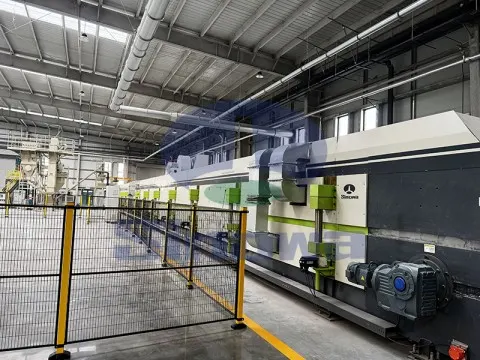
Continuous Lamination Phenolic Board Line
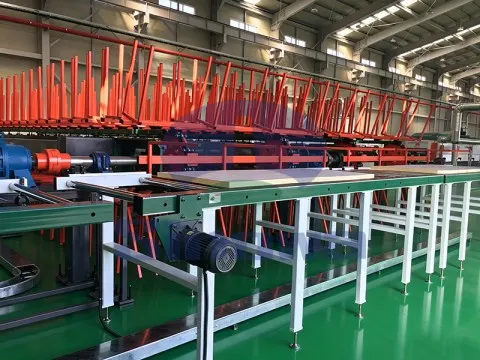
Phenolic Foam Board Making Machine