Continuous Lamination Phenolic Board Line
Publication Date: Oct 12, 2026
A continuous lamination phenolic board line manufactures resin-impregnated sheets at high speed, delivering uniform thickness, stable properties, and consistent quality for electrical and industrial use.
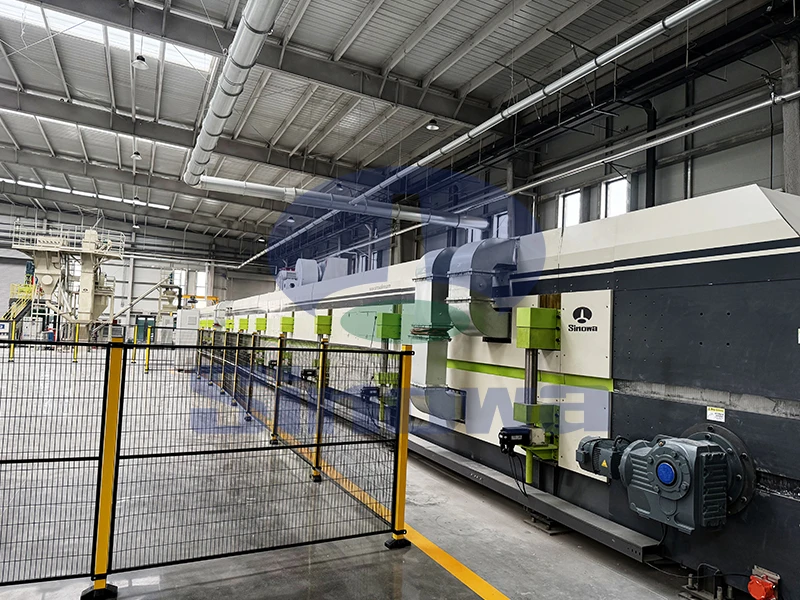
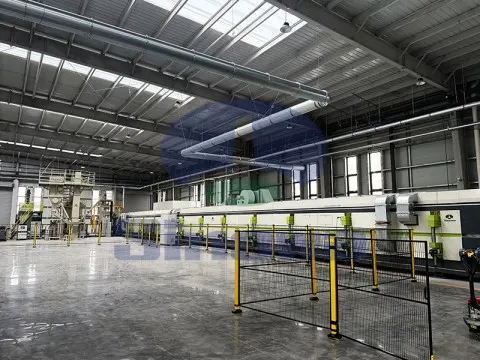
A continuous lamination phenolic board line is an integrated production system designed to convert paper or fabric webs and phenolic resin into finished laminated sheets in a single, uninterrupted flow. Unlike traditional batch pressing, where stacks of pre-dried prepreg are loaded into a multi-daylight press and cycled through heat and pressure, a continuous line feeds material through a moving band of heated, polished steel, pressing and curing the laminate as it travels. The result is a long, rigid panel that can be cut to length at the exit. This approach reshapes how composite laminate makers think about throughput, consistency, and labor, because the process no longer depends on operator-intensive loading, unloading, and press cycling. Instead, material moves steadily from one end of the line to the other, and the product exits as a finished or near-finished board ready for trimming, surface finishing, and inspection.
The core of the line begins with resin impregnation. Rolls of base material—typically kraft paper for general-purpose electrical grades or cotton fabric for higher-mechanical-performance sheets—are unwound under controlled tension and passed through a resin bath filled with phenolic resin, additives, and fillers. The web is then guided through metering blades or rollers that squeeze out excess resin and meter a precise resin pick-up. Because the downstream curing behavior depends heavily on how much resin and solvent the web carries, the impregnation station is where the recipe is actually locked in. Operators monitor web speed, bath temperature, and roller gap together, adjusting them so that every square meter of material absorbs the same amount of resin and reaches the same viscosity window before entering the drying tower.
After impregnation, the wet web rises into a vertical or horizontal drying oven, where heated air evaporates solvents and advances the resin to a B-stage—a tacky but nontacky state in which the polymer is only partially cured. The web travels through temperature zones that rise and then gently descend, preventing surface bloom, blistering, and uneven resin flow. This oven is one of the most sensitive parts of the line, because over-drying makes the prepreg brittle and difficult to laminate, while under-drying leaves trapped volatiles that cause blisters during pressing. Modern ovens use recirculating air ducts with individual zone control, exhaust extraction, and infrared or contact sensors that track solvent load and web tension in real time, so the operator can tune the B-stage without pulling the line apart.
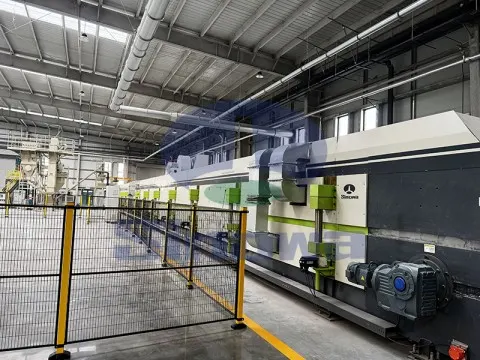
Once the dried prepreg web exits the oven, it is conveyed to the laminating and pressing section. In a continuous line, two polished, mirror-finish steel bands—one above and one below—sandwich the prepreg stack, which may consist of several plies of paper or fabric fed from separate unwind stations and aligned by precision rollers. The band assembly passes through a long series of heated platens or a thermally controlled steel-belt press, where pressure fuses the plies and heat completes the phenolic cure. Because the material never leaves the band until it has set, the board emerges with flat, glossy surfaces and tightly controlled thickness. The polished steel also transfers a mirror-like finish that reduces downstream sanding and polishing work, which is a direct saving both in abrasive consumables and in production time.
The geometry of the pressing section is what separates a true continuous line from a modified batch press. A continuous band travels at the same linear speed as the web, so there is no stop-start motion that could shear the plies or distort surface finish. Heated zones along the band first soften the resin, then hold it at a curing temperature long enough for cross-linking, and finally cool it gently before the board separates from the steel. Cooling control matters as much as heating, because phenolic laminates contract as they cure, and an abrupt temperature drop can warp the panel or introduce internal stress. Well-designed lines therefore extend the cooling run with controlled water-cooled platens or forced-air zones, allowing the board to reach handling temperature flat and dimensionally stable before it reaches the cutter.
Compared with multi-daylight batch presses, continuous lamination offers measurable advantages in thickness tolerance, surface quality, and labor intensity. In a batch process, each stack is loaded, pressed, cooled, and unloaded by operators, and variation between stacks is common because of differences in moisture, resin age, and press position. A continuous line, by contrast, treats every millimeter of board under the same temperature, pressure, and speed profile, so thickness variation across a single run is typically far tighter. There is also no recurring cycle of open and closed press platens, which reduces wear on heavy hydraulic equipment and cuts the number of operators needed per ton of output. For manufacturers running long, stable orders, these gains compound quickly, because the line can hold a recipe for hours or days without reloading press plates.
The physical and mechanical character of the finished board is directly shaped by how the line is tuned. Tight pressure control yields denser laminates with low void content, which in turn improves electrical insulation, moisture resistance, and machining behavior. Consistent resin distribution means edges can be routed, milled, or punched without delamination, and surfaces accept printing, coating, or adhesive bonding uniformly. When the line runs at the correct speed and temperature, the phenolic network cures fully, giving the board its characteristic stiffness, heat resistance, and resistance to oils and solvents. These properties are the reason phenolic laminates remain widely used in switchgear, transformer components, terminal blocks, and industrial machine parts, even as newer engineering plastics appear on the market.
Quality assurance on a modern line is built into the process rather than added at the end. Sensors along the band measure board thickness by laser or nucleonic gauges, surface temperature by infrared pyrometers, and web tension by load cells, all feeding into a central control system that compares actual values against the recipe. If thickness drifts, the system adjusts the roller gap or line speed automatically; if oven temperature deviates, zone heaters respond before the affected panel reaches the press. Boards are also inspected on exit for surface defects, blisters, and edge delamination, and sample panels are periodically cut for mechanical and electrical testing. This closed-loop approach means that a problem in impregnation or drying is detected within minutes, rather than discovered after an entire press load has been cured and scrapped.
Energy and environmental considerations have become central to continuous line design. Ovens and heated platens draw large amounts of thermal energy, so modern lines recover exhaust heat to preheat incoming air, use insulated panels to reduce losses, and modulate heating elements according to actual demand. Solvent-laden exhaust from the drying oven is treated through condensation, adsorption, or thermal oxidation before release, which both lowers emissions and recovers heat. Electrically, variable-frequency drives on every roller and fan avoid the waste of throttled valves, and standby modes lower power draw during short product changes. Over a multi-year operating life, these efficiency measures are often as consequitive as the production rate itself, because energy is one of the largest variable costs in laminate manufacturing.
Automation and digital integration are reshaping how these lines are operated. Recipes—resin type, web speed, oven profile, pressure, cooling rate—are stored in the control system and recalled by product code, so an operator can move between thin insulating sheets and thicker industrial panels without manual recalibration. Production data, including downtime, scrap rate, energy use, and sensor drift, is logged and can be reviewed over time to identify bottlenecks. Predictive maintenance alerts flag bearings, heaters, and belt surfaces before they fail, reducing unplanned stops. The combination of consistent recipe control and data-driven operation means that a skilled team can run a continuous phenolic board line at high utilization, producing flat, defect-free panels shift after shift, while the line itself reports when it needs attention and how well it is performing.
Gallery of Continuous Lamination Phenolic Board Line
Tags: continuous lamination phenolic board line, continuous lamination phenolic board line manufacturer, continuous lamination phenolic board line supplier, china continuous lamination phenolic board line, continuous lamination phenolic board line for sale
https://www.sandwichpanelmachinery.com/blog/continuous-lamination-phenolic-board-line.html
-

The PU sandwich panel line is a core production setup for making high-performance building insulation panels. This professional PU sandwich panel production line features automated operation to streamline the whole manufacturing process efficiently. Every component of the polyurethane sandwich panel line is precisely calibrated to ensure consistent panel thickness and structural stability. A well-maintained polyurethane sandwich panel production line can greatly boost production efficiency while reducing manual operation errors. The continuous PU sandwich panel line adapts to diverse production demands for different panel sizes and surface styles. With advanced molding technology, the PIR sandwich panel line produces panels with excellent heat preservation and sound insulation properties. Stable running of the PIR sandwich panel production line guarantees reliable product quality for various construction and industrial application scenarios.
-

A phenolic insulation board production line serves as the core equipment for manufacturing high-performance thermal insulation building materials. This phenolic insulation panel production line integrates material mixing, foaming, molding and cutting processes to ensure continuous and stable production efficiency. Every operational link of the insulation board production line is precisely calibrated to produce uniform and durable insulation boards. The automated design of the insulation panel production line effectively reduces manual intervention and improves product consistency. Proper maintenance of the phenolic board production line can greatly extend its service life and maintain steady production output. With optimized structural design, the phenolic panel production line adapts to various production demands and delivers high-quality finished products for thermal insulation engineering applications.
-

A professional rockwool sandwich panel line serves as the core equipment for producing high-performance building panels. This rockwool sandwich panel production line integrates feeding, laminating and forming processes to ensure stable and efficient production. The well-structured rock wool sandwich panel line can process raw rockwool materials into panels with excellent thermal and sound insulation properties. Operators can adjust the running parameters of the rock wool sandwich panel production line to manufacture panels of different thicknesses and specifications. The automated design of the mineral wool sandwich panel production line greatly reduces manual operation errors and improves product consistency. Regular maintenance of the mineral wool sandwich panel line is essential to sustain long-term operational efficiency and guarantee qualified finished panels for diverse construction applications.