What Is The Size Of Finished Sandwich Panel From The Machine?
Publication Date: Oct 6, 2026
The dimensional specifications of machine-finished sandwich panels, covering core size ranges, influencing production factors, differences between equipment types, and practical dimensional adjustment rules to clarify standard and customized panel dimensions from industrial production machines.
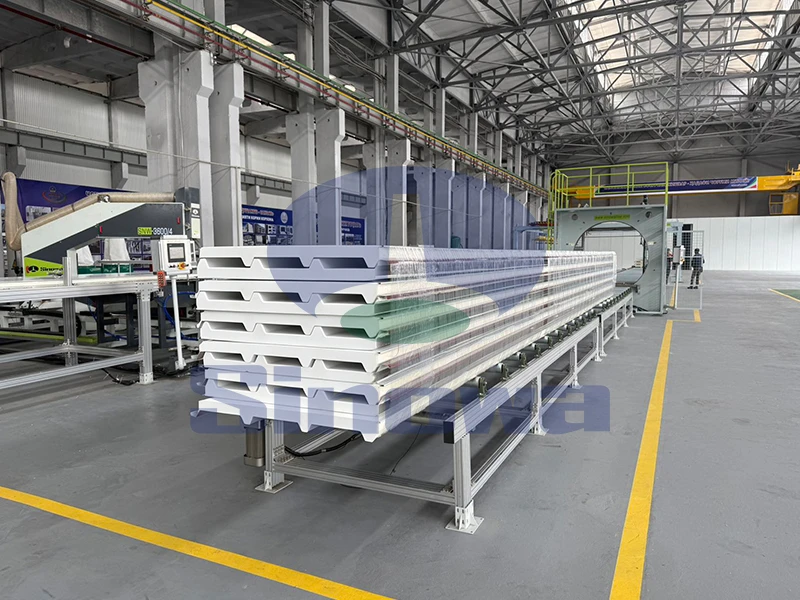
The finished size of sandwich panels manufactured by professional production machines is a core parameter that determines their application scope, installation efficiency, and structural compatibility in various construction and industrial scenarios. Unlike manually fabricated panels with unstable dimensions, machine-produced sandwich panels feature standardized and controllable sizes, with three key dimensional indicators: width, length, and thickness. These three dimensions are not fixed values but adjustable ranges defined by the structural design, operating parameters, and functional configuration of the production equipment. Most industrial sandwich panel machines are engineered to support both fixed standard sizes for mass production and flexible customized sizes for personalized project demands, balancing production efficiency and product applicability. The overall dimensional range of finished panels is constrained by the equipment’s forming cavity, cutting system, and conveying structure, forming a relatively unified industrial production boundary while allowing reasonable fine-tuning according to different core materials and surface layer specifications.
Panel width is one of the most stable dimensional parameters for machine-finished sandwich panels, with narrow adjustable ranges compared to length and thickness. Most continuous and discontinuous sandwich panel production machines are designed with fixed effective width intervals based on long-term industrial production experience. The conventional finished width of machine-made panels mainly falls between 600mm and 1200mm, which adapts to the modular installation requirements of building envelopes, partition walls, and cold storage structures. For continuous production lines, the finished panel width is basically fixed after equipment commissioning, as the width is determined by the fixed spacing of the machine’s side sealing and forming modules, avoiding dimensional deviations during high-speed continuous production. Discontinuous pressing machines offer slightly more flexibility, with a maximum producible width exceeding that of standard continuous lines to meet special wide-panel needs. This width setting not only ensures the flatness and structural uniformity of the finished panel but also simplifies on-site splicing and installation, reducing the gap and error rate between adjacent panels during construction.
The finished length of machine-produced sandwich panels boasts the highest flexibility among all dimensional parameters, enabling extensive adaptation to diverse engineering requirements. Modern sandwich panel machines are equipped with precision flying saw cutting systems or fixed-length cutting devices, which can automatically cut continuous formed panels into specified lengths during production. The minimum finished length of conventional machine-made panels is generally 2000mm, which avoids material waste caused by overly small panels and meets the basic structural stress requirements of building components. The maximum producible length varies by equipment type: standard continuous production lines can produce finished panels up to 18000mm, while discontinuous machines are limited by mold cavity length, with a maximum finished length of around 12000mm. Operators can set arbitrary fixed lengths within the machine’s effective range through the control system, and the high-precision cutting mechanism ensures minimal length deviation of finished products, guaranteeing consistent dimensions for batch-produced panels.
Panel thickness directly defines the thermal insulation, heat preservation, and structural bearing performance of finished sandwich panels, and its production range is completely determined by the mechanical adjustment structure of production equipment. The thickness of machine-finished panels is adjusted by changing the height of the machine’s middle spacer blocks and forming roller gaps, with no fixed single specification. Conventional production machines support finished panel thicknesses ranging from 30mm to 300mm, covering the needs of light decorative partitions, ordinary building exterior walls, high-insulation cold storage panels, and special industrial thermal insulation components. Thin finished panels below 50mm are mostly used for indoor partition and decorative projects, while thick panels above 150mm are widely applied in low-temperature cold storage, industrial workshop insulation, and energy-saving building exterior enclosure structures. Each adjusted thickness parameter of the machine corresponds to a stable finished product size, ensuring uniform core material filling and tight bonding between surface layers and core layers of panels with different thicknesses.
Different types of sandwich panel production machines bring obvious differences in finished panel size accuracy and adjustable ranges. Continuous sandwich panel production lines, as mainstream high-efficiency equipment, feature stable and standardized finished product sizes, with fixed width and continuous adjustable length and thickness. The full-automatic integrated forming process of continuous lines reduces manual intervention, making the dimensional error of finished panels extremely small, which is suitable for large-scale batch production of standard-sized panels. In contrast, discontinuous intermittent pressing machines have looser size restrictions for single-panel production, capable of producing wider and thicker finished panels that exceed the parameter limits of some continuous lines. However, due to the independent molding and pressing of single panels, the dimensional consistency of batch products is slightly lower than that of continuous line products. The structural differences between the two machine types determine their respective applicable finished panel size scenarios, providing diversified size solutions for different production scales and project needs.
The core material of sandwich panels also indirectly affects the final finished size range of machine-produced products, requiring corresponding parameter adjustments of production equipment. Common core materials include polyurethane, mineral wool, and cement-based composite materials, each with different forming characteristics that match different machine size settings. Polyurethane core panels have good fluidity during foaming and forming, allowing machines to stably produce finished products with thin to super-thick thicknesses and ultra-long lengths without structural deformation. Mineral wool core panels have rigid fiber structures, so the machine needs to adjust the pressing gap and conveying speed to ensure the finished panel thickness is uniform and the width edge is neat, with a slightly narrower adjustable thickness range than polyurethane panels. Cement-based sandwich panels have high material hardness, limiting the maximum length and width of machine-formed finished products to prevent panel cracking and uneven thickness during molding and curing.
Surface layer materials of sandwich panels have a subtle regulatory effect on the finished dimensional specifications of machine-processed products. Most machine-produced sandwich panels adopt metal color steel plates as surface layers, with fixed plate width and thickness specifications that cooperate with machine forming parameters to determine the final finished panel width. When using special surface materials such as aluminum alloy plates or non-metal decorative plates, the machine’s feeding and forming modules need fine adjustment to adapt to different plate thicknesses and hardnesses, ensuring the finished panel overall size meets the preset values without edge warping or dimensional deviation. In addition, the edge sealing process of the machine will affect the effective finished size of panels. Professional edge sealing mechanisms can eliminate edge bulges and gaps, making the actual usable size of finished panels completely consistent with the design size and improving the installation matching degree of products.
Production speed and operating parameters of sandwich panel machines will affect the dimensional stability of finished products, even within the standard size range. When the machine runs at a high continuous production speed, the cutting and forming system needs to maintain synchronous operation to avoid length errors of finished panels caused by asynchronous cutting. If the operating speed is too fast beyond the equipment’s matching range, local thickness unevenness of the panel may occur, affecting the overall dimensional uniformity of finished products. Conversely, a stable and matched operating speed ensures that each formed panel has consistent width, uniform thickness, and accurate cutting length. Meanwhile, the pressure parameter of the machine’s pressing system is crucial; reasonable forming pressure ensures the core material is fully filled, making the actual thickness of the finished panel consistent with the set value and avoiding size deviation caused by insufficient pressing or excessive compression.
Customized size adjustment of machine-finished sandwich panels follows fixed equipment operating logic, realizing flexible size expansion on the basis of standard specifications. For conventional size customization within the machine’s design range, operators only need to modify the length cutting data, thickness gap parameters, and width limit settings through the equipment’s intelligent control system, and the machine can stably produce qualified finished panels with personalized sizes. For special sizes exceeding conventional ranges, partial module adjustment of the machine is required, such as replacing height-adjustable spacers and upgrading cutting tools, to meet the production demand of super-long, super-wide or super-thick panels. It is worth noting that excessive size customization beyond the machine’s bearing range will reduce product flatness and structural stability, so customized finished sizes must be within the effective production capacity of the equipment.
The practical application of machine-finished sandwich panel sizes focuses on matching engineering installation and transportation conditions, which further standardizes the actual production size selection. Although the machine can produce panels with multiple length specifications, the finished panel length in actual production is usually matched with conventional transportation and construction conditions to avoid transportation difficulties and secondary cutting waste. Standard machine-finished panel sizes are optimized for on-site splicing, enabling rapid assembly and improving construction efficiency. At the same time, the unified dimensional standard of machine-produced panels ensures the interchangeability of products, facilitating later maintenance, replacement, and partial renovation of engineering projects, which is an important advantage of machine-made panels over manually processed products in dimensional standardization.
Gallery of Sandwich Panel Machine
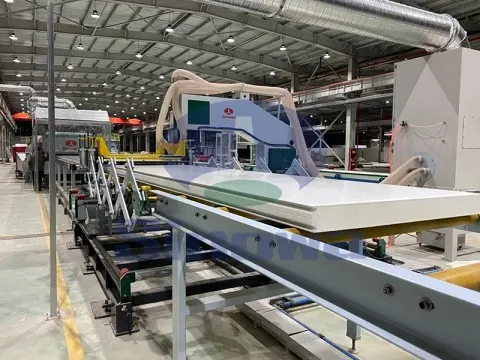
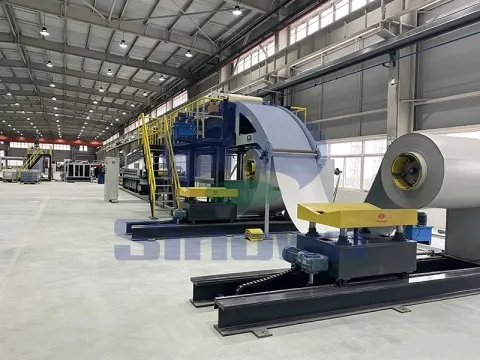
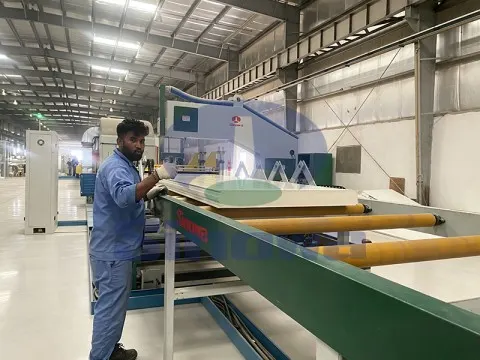
Tags: sandwich panel machine, sandwich panel machine manufacturer, sandwich panel machine supplier, china sandwich panel machine, sandwich panel machine for sale
-
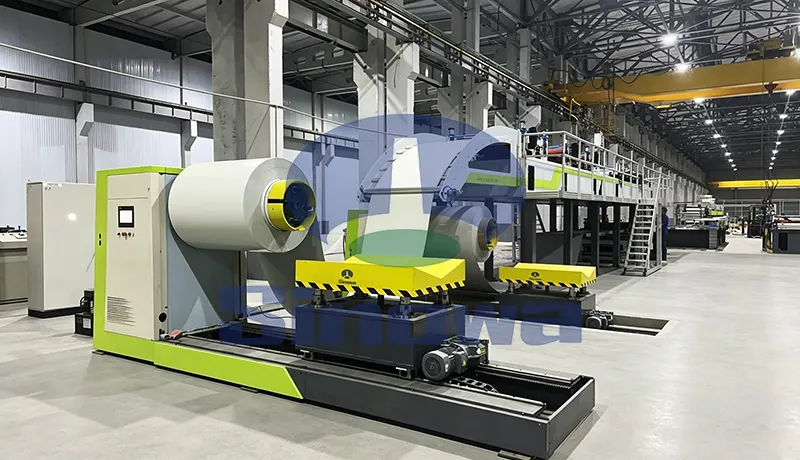
The PU sandwich panel line is a core production setup for making high-performance building insulation panels. This professional PU sandwich panel production line features automated operation to streamline the whole manufacturing process efficiently. Every component of the polyurethane sandwich panel line is precisely calibrated to ensure consistent panel thickness and structural stability. A well-maintained polyurethane sandwich panel production line can greatly boost production efficiency while reducing manual operation errors. The continuous PU sandwich panel line adapts to diverse production demands for different panel sizes and surface styles. With advanced molding technology, the PIR sandwich panel line produces panels with excellent heat preservation and sound insulation properties. Stable running of the PIR sandwich panel production line guarantees reliable product quality for various construction and industrial application scenarios.
-
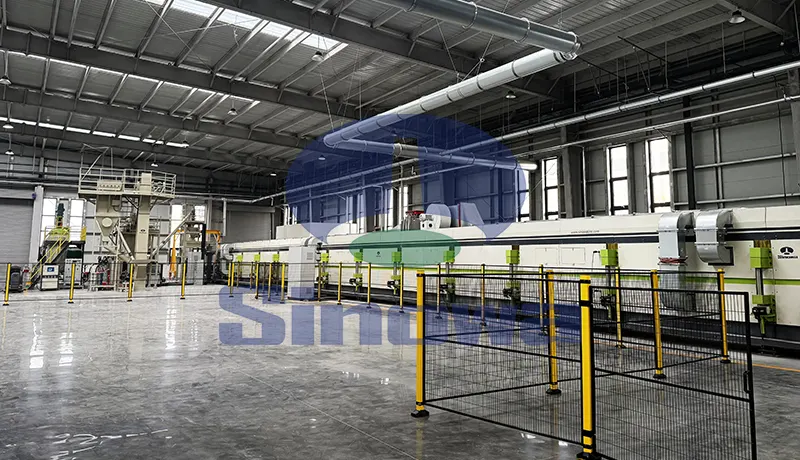
A phenolic insulation board production line serves as the core equipment for manufacturing high-performance thermal insulation building materials. This phenolic insulation panel production line integrates material mixing, foaming, molding and cutting processes to ensure continuous and stable production efficiency. Every operational link of the insulation board production line is precisely calibrated to produce uniform and durable insulation boards. The automated design of the insulation panel production line effectively reduces manual intervention and improves product consistency. Proper maintenance of the phenolic board production line can greatly extend its service life and maintain steady production output. With optimized structural design, the phenolic panel production line adapts to various production demands and delivers high-quality finished products for thermal insulation engineering applications.
-
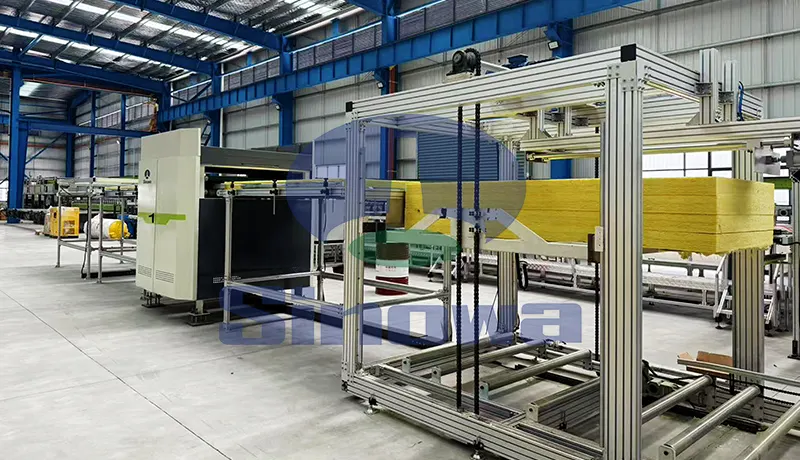
A professional rockwool sandwich panel line serves as the core equipment for producing high-performance building panels. This rockwool sandwich panel production line integrates feeding, laminating and forming processes to ensure stable and efficient production. The well-structured rock wool sandwich panel line can process raw rockwool materials into panels with excellent thermal and sound insulation properties. Operators can adjust the running parameters of the rock wool sandwich panel production line to manufacture panels of different thicknesses and specifications. The automated design of the mineral wool sandwich panel production line greatly reduces manual operation errors and improves product consistency. Regular maintenance of the mineral wool sandwich panel line is essential to sustain long-term operational efficiency and guarantee qualified finished panels for diverse construction applications.