
Sandwich panel machinery has become a core device for lightweight building material production, and its operational simplicity is a key concern for manufacturers.
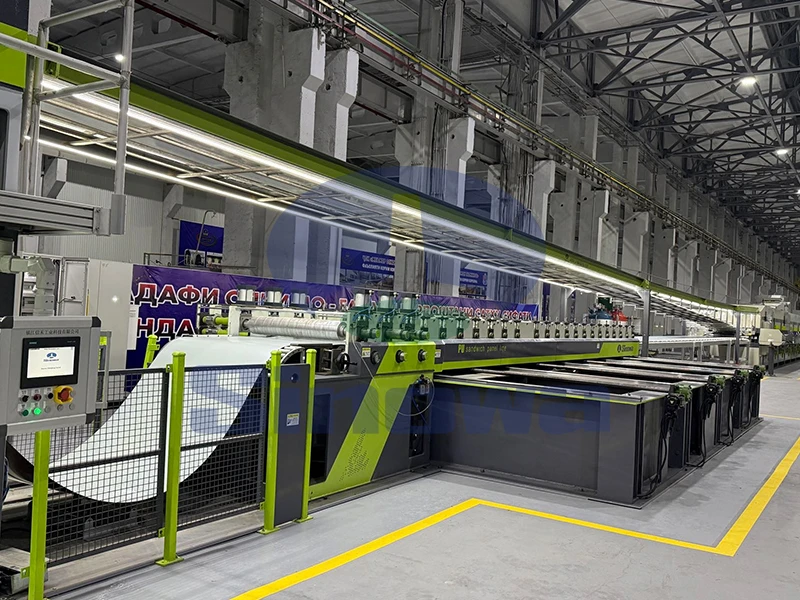
Modern sandwich panel machinery is deliberately designed with user-centric operational logic, breaking the stereotype that industrial production equipment is complicated and hard to master. Unlike traditional bulky industrial machines that require complex manual debugging and multi-step mechanical adjustment, new-generation sandwich panel production equipment integrates integrated control systems that simplify most tedious operational processes. The core operating area is concentrated on a visual human-machine interface, where operators can view real-time production status, adjust operating parameters and start or stop production processes through simple touchscreen clicks. Most mechanical linkage actions, including material feeding, laminating, pressing and cutting, are completed by automatic mechanical systems without frequent manual intervention. Even workers without long-term industrial equipment operation experience can quickly get familiar with the basic operating logic, which greatly lowers the entry threshold for daily production work in panel processing factories.
The training cycle for sandwich panel machinery operation is far shorter than that of other large-scale industrial production equipment, further proving its excellent operability. For novice operators, professional pre-job training mainly includes basic interface recognition, parameter adjustment norms, daily startup and shutdown procedures, and simple safety operation specifications. Professional technical instructors can complete systematic theoretical explanation and on-site demonstration within a short period, and most trainees can independently complete trial production operations after one to two days of hands-on practice. The equipment retains fixed operational procedure logic, with standardized steps for each production link, avoiding random and irregular operation modes. There are no overly complicated professional theories or mechanical knowledge requirements for daily operation, and operators only need to follow the established process flow to carry out stable and efficient production, eliminating the need for long-term skill accumulation and rich industry experience.
Daily routine operation of sandwich panel machinery features high standardization and low operational difficulty, suitable for long-term stable industrial production. The daily production workflow follows a fixed and simple cycle: equipment preheating inspection, parameter setting according to production demands, automatic material operation, continuous panel forming, finished product cutting and equipment shutdown sorting. The pre-production inspection work is simplified to basic item checks, including power connection, material placement and mechanical component tightness, with no need for precise professional testing. During formal production, the equipment runs automatically continuously, and operators only need to monitor the operating status in real time and handle occasional minor material jams or position deviations. Most operational adjustments are completed through digital parameter input, which is more accurate and convenient than traditional manual mechanical debugging and effectively reduces operational errors caused by manual experience differences.
Intelligent auxiliary functions greatly enhance the ease of operating sandwich panel machinery and reduce manual operation pressure. Current mainstream sandwich panel production equipment is equipped with intelligent error reminder and automatic correction functions. When minor abnormal situations such as slight material deviation or uneven feeding occur during production, the system will automatically send out prompt signals and complete self-correction within a certain range without manual shutdown adjustment. The equipment also has memory function for production parameters, which can store the parameter settings of conventional panel specifications. When producing the same type of products repeatedly, operators can directly call the saved parameters with one click, avoiding repeated debugging and parameter setting work. In addition, the system’s visual monitoring screen can display the operating speed, production progress and equipment temperature in real time, allowing operators to grasp the overall production situation at a glance and achieve precise and simple production control.
The mechanical structure optimization of sandwich panel machinery effectively reduces operational difficulty and maintenance workload in daily use. Manufacturers optimize the mechanical layout of the equipment according to ergonomic principles, concentrating all frequently used operating buttons and adjustment interfaces in a comfortable operating area, avoiding the need for operators to climb, squat or perform strenuous physical operations. The key operating components are designed with modular structures, which are not only convenient for daily observation and inspection but also make minor component replacement and maintenance simple and fast. The mechanical transmission parts are equipped with protective structures, which not only improve operation safety but also reduce the failure rate caused by external interference. Simple and reasonable structural design makes the equipment less prone to abnormal conditions during operation, and operators can maintain stable production with only daily simple cleaning and component inspection.
Many people worry that customized production of sandwich panels will increase the difficulty of equipment operation, but in fact, the equipment has strong adaptive operability for diversified production demands. When switching between different panel thicknesses, materials and structural specifications, the operation only needs to modify several core parameters on the control interface, and the equipment’s internal mechanical system will automatically complete the matching adjustment of pressure, cutting size and feeding speed. There is no need to disassemble or modify mechanical structures manually, nor does it require professional mechanical debugging technology. Even for small-batch customized production with frequent product switching, operators can complete equipment adjustment and production switching in a short time. The unified operational logic enables workers to cope with diversified production tasks proficiently, without additional learning and training for different production demands.
The safety operation setting of sandwich panel machinery further simplifies the operation process and reduces operational risks. The equipment is equipped with perfect safety protection mechanisms, including emergency stop devices, overpressure protection and overload automatic shutdown functions. In case of unexpected abnormal conditions during operation, the equipment will automatically stop running to avoid equipment damage and safety accidents, and operators do not need to master complex emergency response skills. The operation system sets locked permissions for high-risk parameter modification, limiting arbitrary adjustment of core operating data by novice operators, which avoids production failures caused by misoperation. The clear safety operation guidelines and intelligent protection mechanisms make the operation process more standardized and simpler, allowing operators to focus on production monitoring rather than complex risk control work.
Compared with traditional manual and semi-automatic panel production equipment, modern sandwich panel machinery has obvious advantages in operational simplicity. Traditional production equipment requires manual participation in multiple key links such as gluing, pressing and cutting, with cumbersome steps, high manual operation errors and long proficiency cycle. In contrast, fully automatic sandwich panel machinery integrates all production links into one system, realizing one-stop production from raw material input to finished product output. The manual operation links are greatly reduced, and the remaining operational work is simple and repetitive standardized operations. Even for newly built production lines, the team can quickly realize formal and stable production relying on the simple operability of the equipment, greatly shortening the production line commissioning and running-in cycle.
The minor difficult points in operating sandwich panel machinery are all targeted solvable problems and will not affect overall operational simplicity. The few complex operations are mainly concentrated in equipment regular maintenance and rare fault troubleshooting, which do not belong to daily conventional operation content. Daily production operation still maintains low difficulty and high simplicity. For occasional equipment faults that cannot be automatically repaired, the system will display detailed fault codes and processing prompts, and operators can complete basic troubleshooting according to the guide. Professional after-sales technical support can solve complex problems remotely, so enterprises do not need to cultivate a large number of high-skilled professional operators, which further reflects the strong practicability and easy operation characteristics of the equipment.
In conclusion, sandwich panel machinery is highly operable and suitable for various scale of building material production enterprises. Its user-friendly design, intelligent auxiliary system, standardized operation process and low training threshold make it get rid of the complexity of traditional industrial equipment. Both skilled workers and novice operators can quickly master the operation skills to complete efficient and stable panel production. With the continuous upgrading of equipment technology, the operability of sandwich panel machinery will be further improved, bringing more convenient production conditions to the building material industry.