
A complete sandwich panel production line inherently integrates a roll forming machine as its core functional component.
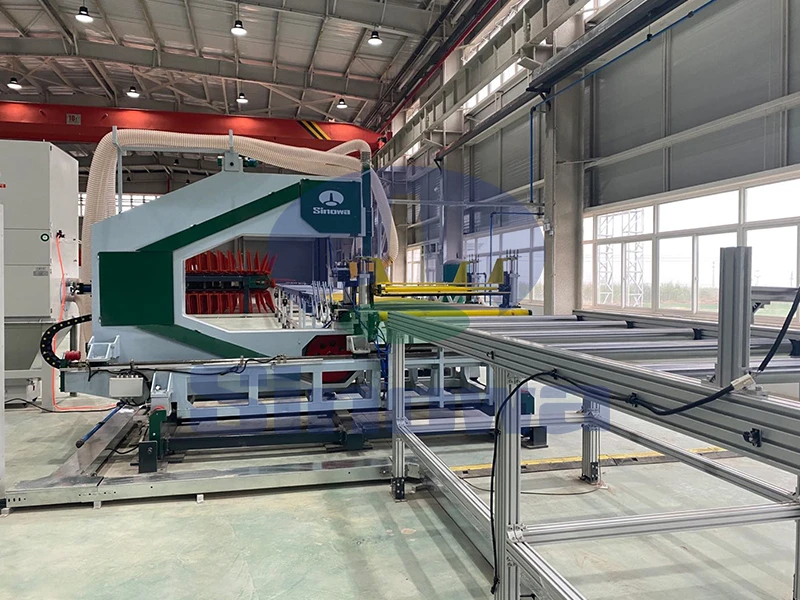
To clarify the configuration of a standard sandwich panel production line, it is essential to confirm the indispensable role of the roll forming machine in the overall production workflow. Sandwich panels are composite building materials with layered structures, consisting of metal surface layers and heat-insulating core materials, and the molding of metal surface sheets directly determines the overall quality and dimensional accuracy of finished panels. The roll forming machine undertakes the key process of flat metal coil shaping in the entire production line, converting raw metal coils with simple flat structures into profiled sheets with specific grooves, ridges and curved structures that meet sandwich panel assembly requirements. Without the participation of roll forming equipment, flat metal sheets cannot form the stable three-dimensional structure needed for composite bonding, making the mass production of qualified sandwich panels impossible. This equipment is not an optional auxiliary device but a core standard configuration matched with the sandwich panel line, adapting to the continuous and automated production mode of modern panel manufacturing.
The working logic of the roll forming machine is highly compatible with the continuous production rhythm of the sandwich panel line, realizing seamless connection between front and rear processes. Before the formal composite bonding of sandwich panels, metal raw materials are usually stored in coil form, with smooth and unshaped surfaces that lack structural strength and assembly adaptability. The roll forming machine operates through multiple groups of precision arranged rolling rollers, which gradually bend, press and shape the metal coil through step-by-step mechanical extrusion. Each group of rollers undertakes a fixed shaping task, avoiding the structural deformation and dimensional deviation caused by one-time forced molding. During the operation, the equipment cooperates with the automatic feeding system of the sandwich panel line to realize uninterrupted feeding, shaping and discharging of metal sheets. The shaped metal sheets are directly transported to the gluing and composite station of the production line, ensuring that the front-end sheet shaping process and the back-end core material bonding process are completed in one continuous line, which greatly improves the overall production efficiency and process consistency.
Many people confuse the functional boundaries of roll forming machines and other processing equipment in sandwich panel lines, but their core positioning is irreplaceable. Some auxiliary equipment in the production line is responsible for cutting, trimming, gluing and curing processing, while the roll forming machine exclusively focuses on the structural molding of metal surface layers. The metal surface of high-quality sandwich panels needs specific wave heights, groove spacings and edge folding structures, which cannot be completed by simple flattening or cutting equipment. The roll forming machine can adjust the rolling parameters and roller combinations according to different panel design requirements, flexibly producing metal sheets with diverse profile structures to adapt to different usage scenarios of sandwich panels, such as roof panels, wall panels and special-shaped enclosure panels. This personalized molding capability makes it the key equipment to realize the diversified production of sandwich panels, and no other equipment in the production line can replace its professional molding function.
The integration design of roll forming machines and sandwich panel lines focuses on automated coordination and production stability. Modern sandwich panel production lines adopt an integrated automated control system, and the operating parameters of the roll forming machine are uniformly linked with the overall production system. The equipment can automatically adjust the rolling speed and molding accuracy according to the production speed of the subsequent composite process, avoiding the problem of process mismatch caused by inconsistent front and rear operating speeds. In addition, the roll forming machine is equipped with automatic correction and deviation adjustment devices during operation, which can timely correct the position deviation of metal coils in the feeding and molding process, ensuring that each shaped metal sheet has consistent dimensional specifications. This intelligent integration effectively reduces manual intervention, lowers the error rate of manual operation, and maintains the long-term stable operation of the entire sandwich panel production line.
The structural performance of finished sandwich panels is directly affected by the molding quality of the roll forming machine. The profiled structure formed by the roll forming machine not only beautifies the appearance of the panel, but more importantly, greatly enhances the mechanical strength and structural stability of the sandwich panel. The grooves and ridges on the metal surface can effectively disperse external pressure and impact force, avoiding local deformation or damage of the panel during use. At the same time, the precisely folded edge structure formed by roll forming ensures the tightness of the splicing gap between adjacent sandwich panels during on-site installation, improving the overall sealing and heat preservation effect of the building enclosure. If the roll forming process is inaccurate, problems such as uneven panel surfaces, inconsistent sizes and loose splicing will occur in finished products, seriously affecting the service performance and installation quality of sandwich panels.
Different types of sandwich panel production lines are all equipped with matching roll forming machines with differentiated parameters. Whether it is the production of rock wool core, polyurethane core or polystyrene core sandwich panels, the metal surface layer molding links are consistent in process logic, and all need the support of roll forming equipment. The difference lies in the parameter adjustment of the roll forming machine according to the thickness and hardness of different metal raw materials. For thin and soft metal coils, the equipment adopts gentle rolling pressure and low-speed molding to avoid material damage; for thick and hard metal plates, it adjusts roller pressure and increases molding groups to ensure full shaping. This adaptive adjustment function enables the roll forming machine to be compatible with various mainstream sandwich panel production processes, meeting the production needs of different specification products in the same production line.
The role of roll forming machines in improving the industrial production efficiency of sandwich panels is prominent. In the early manual and semi-automatic production mode, metal sheet molding relied on single-piece stamping and manual correction, which was slow in speed, low in precision and high in scrap rate. After the integrated application of roll forming machines in sandwich panel lines, continuous batch molding of metal sheets is realized, and the production speed is dozens of times higher than that of traditional processing methods. Moreover, the standardized molding process greatly reduces defective products caused by human factors, improves the yield of finished panels, and reduces material waste and production costs. The continuous matching operation with the automated production line also shortens the intermediate handling and waiting links of semi-finished products, realizing streamlined and efficient production of sandwich panels.
It is worth distinguishing that the roll forming machine is a built-in component of the integrated sandwich panel line, not an independent post-processing device. Some decentralized production modes separate sheet molding and panel composite processing, but formal integrated sandwich panel production lines will integrate roll forming equipment into the overall process layout. The integrated design makes the production space layout more compact, reduces the floor area of production equipment, and avoids precision loss and secondary damage to semi-finished products caused by long-distance handling of shaped metal sheets. The integrated equipment layout also facilitates unified daily maintenance and fault detection, making the operation and management of the entire production line more standardized and efficient.
The technical upgrading of sandwich panel lines is always synchronized with the optimization of roll forming machine performance. With the continuous upgrading of building material performance requirements, the structural design of sandwich panels is more diversified, and the precision requirements for metal surface molding are increasingly strict. Modern roll forming machines equipped in new-type sandwich panel lines adopt more precise roller processing technology and intelligent parameter control systems, which can realize ultra-high-precision molding of complex special-shaped sections. At the same time, the equipment has stronger stability and longer continuous operation time, which can adapt to long-term high-intensity industrial production, and continuously meet the market's updated demand for high-performance and high-precision sandwich panels.
In conclusion, the roll forming machine is an indispensable and core component of a complete sandwich panel production line. It runs through the key front-end molding process of panel production, determines the basic quality and structural performance of finished products, and cooperates with other equipment in the production line to realize automated, efficient and standardized mass production of sandwich panels. No integrated sandwich panel production line can complete qualified product manufacturing without the support of professional roll forming equipment.