What Causes Surface Waviness Of Panels From Polyurethane Sandwich Panel Production Line?
Publication Date: Sep 30, 2026
Surface waviness is a prevalent quality defect in panels manufactured by the polyurethane sandwich panel production line, compromising flatness and usability.
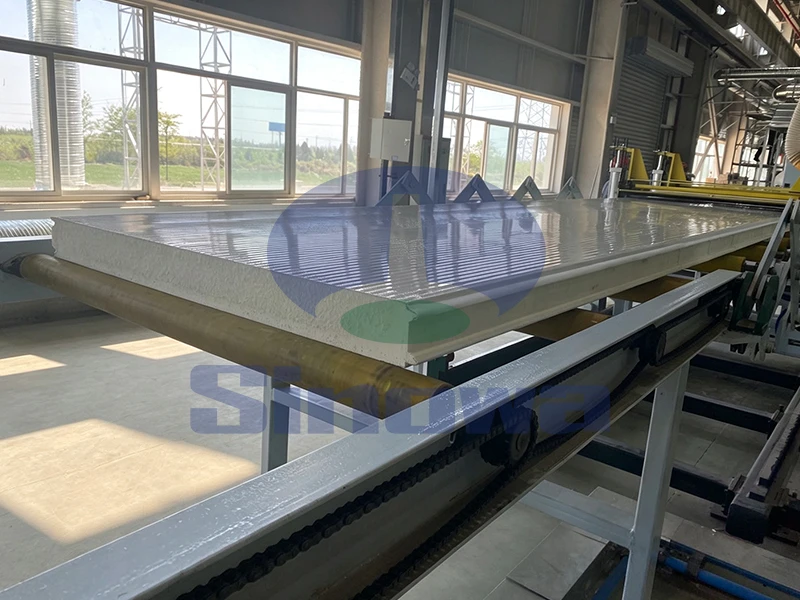
Unstable sheet tension control stands as one of the most frequent triggers of surface waviness during operation of the polyurethane sandwich panel production line. The metal or composite surface skins of sandwich panels rely on consistent tension to maintain flatness throughout feeding and forming processes. When the decoiler unit of the production line fails to deliver balanced tension, uneven stretching occurs on both sides of the panel skin. Excessively tight brake settings on the decoiler often overstretch one edge of the surface material, while insufficient tension leads to loose and sagging areas on the other side. As the material moves forward along the production line, this uneven stress distribution cannot be fully eliminated in subsequent forming and laminating procedures. The residual tensile and compressive stresses gradually manifest as regular or irregular wave patterns on the finished panel surface. Moreover, fluctuating tension caused by unstable decoiler motor operation or worn tension sensors exacerbates the problem. Even minor tension deviations accumulate continuously in long-panel production, resulting in obvious surface waviness that affects the overall flatness and aesthetic consistency of polyurethane sandwich panels.
Misalignment and abnormal operation of roll forming units are critical mechanical factors inducing panel surface waviness in the polyurethane sandwich panel production line. Roll forming stations are designed to calibrate and flatten surface skins before foaming and lamination, requiring precise horizontal and vertical alignment of all roller groups. Long-term continuous operation may cause loose bolt connections, slight displacement of roller brackets, or uneven wear on roller surfaces, leading to inconsistent gaps between upper and lower rollers. When the panel skin passes through misaligned rollers, it bears asymmetric extrusion force, producing localized deformation and micro-waves that are fixed on the panel surface after foaming curing. In addition, unbalanced horizontal levels of different roll forming stations create gradual stress differences along the material feeding direction. Some sections of the surface material are excessively compressed while others are under-processed, forming continuous wavy textures. Vibration generated by aging or poorly maintained roll forming equipment further disturbs material stability, turning subtle deformations into visible surface waviness on finished sandwich panels.
Uneven temperature distribution of laminator belts severely undermines surface flatness and triggers waviness in products from the polyurethane sandwich panel line. The laminator is responsible for bonding surface skins with polyurethane foam core through constant temperature and pressure, and uniform belt temperature is essential for synchronous foaming and curing. In actual production, partial aging of heating components, blocked heat circulation channels, or accumulated dirt on belt surfaces can lead to temperature differences between upper and lower belts or different belt areas. High-temperature zones accelerate polyurethane foaming and curing speed, causing local foam over-expansion, while low-temperature zones slow down the reaction process and result in insufficient foam filling. The inconsistent expansion and contraction of the foam core in different parts generates uneven internal stress, which pushes the surface skin to produce wave-shaped deformation. Meanwhile, temperature fluctuations cause inconsistent thermal expansion coefficients of surface materials and foam cores. The asynchronous deformation of the two materials during heating and cooling processes further aggravates surface waviness, and this defect becomes more prominent in long-term continuous batch production.
Improper polyurethane foaming parameter matching is a core process-induced cause of panel surface waviness in the polyurethane sandwich panel production machine. Polyurethane foam formation relies on precise coordination of reaction time, injection volume, and line running speed. Mismatched cream time and production line speed is a typical problematic condition. If the foam’s cream time is too short while the line runs slowly, the polyurethane mixture cures prematurely before full spreading, forming uneven foam thickness and localized bulges. Conversely, overly long cream time with fast line speed leads to incomplete foam filling and sparse core structures, resulting in sunken areas on the panel surface. Inadequate material mixing in the foaming system also causes inconsistent foam density. Poor mixing leaves partial unreacted raw materials or uneven component ratios, creating soft and hard areas inside the foam core. These density differences produce uneven supporting force on the surface skin, eventually forming regular surface waves after panel curing and molding. Irregular foam injection pressure further worsens the situation by disrupting stable foam forming.
Side seal extrusion and boundary layer effects contribute significantly to edge and overall surface waviness of panels from the polyurethane sandwich panel production line. Side sealing devices are used to fix panel width and prevent foam leakage during production, but unreasonable seal pressure and gap settings easily cause structural deformation. Excessively tight side seals produce strong lateral extrusion on the edge areas of semi-finished panels, compressing the uncured foam core and limiting its normal expansion. The boundary layer effect occurs when foam raw materials flow near the seals, where friction resistance increases sharply and material flow velocity decreases. This leads to accumulation of liquid polyurethane polymers at panel edges, forming higher-density foam zones different from the middle area. The density and structural differences between edge and middle foam generate unbalanced internal stress after curing, pulling the surface skin to form edge waviness that gradually extends to the panel’s middle surface. Regular wear and deformation of side seals without timely maintenance will continuously amplify this defect in repeated production cycles.
Unstable production line operating speed triggers dynamic stress deformation and surface waviness on polyurethane sandwich panels. Continuous production of sandwich panels requires a constant and stable line speed to ensure synchronous progress of feeding, foaming, laminating and curing processes. Frequent speed fluctuations caused by unstable power supply, aging transmission systems or improper parameter adjustment disrupt the coordinated operation of each production unit. When the line speed suddenly increases, the surface skin and uncured foam bear instant tensile force, leading to micro-stretching deformation. Sudden speed reduction causes material accumulation and local compression wrinkles. These dynamic deformations cannot be self-repaired during subsequent curing, and are fixed as visible surface waviness. In addition, inconsistent speed matching between the front feeding unit and rear laminating unit causes relative displacement between surface skins and foam cores. The asynchronous movement produces interfacial shear stress, distorting the flat structure of panels and forming irregular wave textures on the surface.
Defective surface raw materials lay a foundation for surface waviness in panels processed by the polyurethane sandwich panel machine. The inherent flatness and structural stability of surface skins directly determine the final panel quality. Raw material coils with pre-existing camber, uneven thickness or residual rolling stress will retain these defects after entering the production line. Even with standard forming and laminating processes, the inherent stress of raw materials will be released gradually during heating and extrusion, causing surface warping and waviness. In addition, inconsistent hardness and ductility of batch raw materials lead to different stress bearing capacities during processing. Some material sections deform easily under standard extrusion and tension, while other sections remain stable, forming uneven surface undulations. Impurities or oxide layers on the surface of raw materials also affect uniform bonding with foam cores, creating local bonding gaps. These gaps cause inconsistent stress transmission, further inducing surface waviness in finished panels.
Insufficient equipment maintenance and accumulated dirt residues induce latent surface waviness defects in polyurethane sandwich panel production line products. Long-term operation without comprehensive maintenance leads to multiple subtle equipment abnormalities that affect panel flatness. Residual foam debris, dust and oil stains adhere to laminator belts, roller surfaces and guide rails, forming uneven contact surfaces. When panel skins pass through these contaminated components, they bear uneven extrusion and friction forces, resulting in localized indentations and micro-deformations that develop into waviness after curing. Worn roller surfaces with irregular radii cause non-uniform pressure on material surfaces, while aging transmission bearings produce jittery operation and unstable material conveying. Regular maintenance omissions such as uncalibrated pressure systems and uncleaned mixing heads also lead to long-term process instability. These cumulative minor equipment problems eventually evolve into obvious surface waviness defects in mass-produced panels.
Inappropriate laminating pressure control is a key factor causing surface waviness in polyurethane sandwich panels. The laminating pressure must match the foam expansion state and material thickness to ensure uniform fitting between surface skins and foam cores. Excessively high laminating pressure squeezes uncured foam excessively, leading to local foam collapse and thin core layers. The compressed areas cannot provide sufficient support, forming sunken waves on the panel surface. Insufficient laminating pressure results in incomplete fitting between skins and foam, leaving tiny gaps and uneven bonding. The unsupported loose areas of the surface skin bulge slightly under internal foam expansion force, forming raised wave textures. Moreover, uneven pressure distribution across the laminator platform causes inconsistent extrusion force on different panel areas. Partial over-pressure and partial under-pressure coexist, producing staggered wavy structures on the panel surface that are difficult to eliminate after complete curing.
Unreasonable curing environment and post-production stress release lead to secondary surface waviness of panels from the polyurethane sandwich panel production line. The curing stage determines the final structural stability of polyurethane sandwich panels, and unstable curing temperature and time affect internal stress release. Excessively fast curing speed causes rapid surface molding while internal foam reaction is incomplete, retaining a large amount of latent internal stress. After finished panels are discharged from the production line, the residual stress is gradually released under ambient temperature changes, causing slow surface deformation and waviness. Uneven curing temperature in the curing chamber leads to inconsistent curing degrees of different panel parts, resulting in asynchronous shrinkage and expansion. In addition, improper stacking and transportation of semi-finished panels after production cause external extrusion and bending force. The unrelieved internal stress superimposes with external force damage, further aggravating surface waviness and reducing the flatness consistency of finished polyurethane sandwich panels.
Gallery of Polyurethane Sandwich Panel Production Line
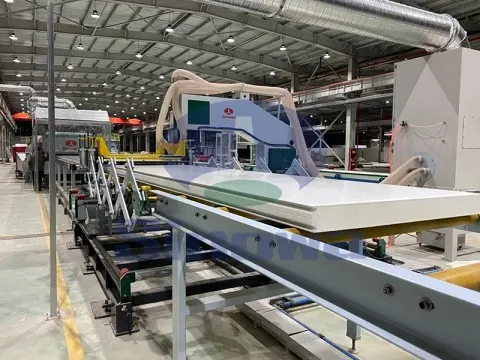
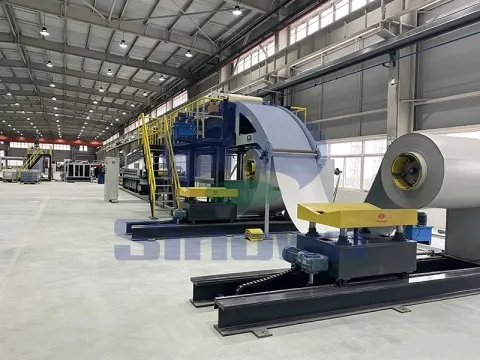
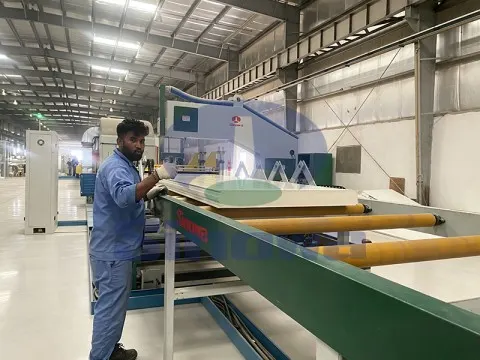
Tags: polyurethane sandwich panel production line, polyurethane sandwich panel production line manufacturer, polyurethane sandwich panel production line supplier, china polyurethane sandwich panel production line, polyurethane sandwich panel production line for sale
-
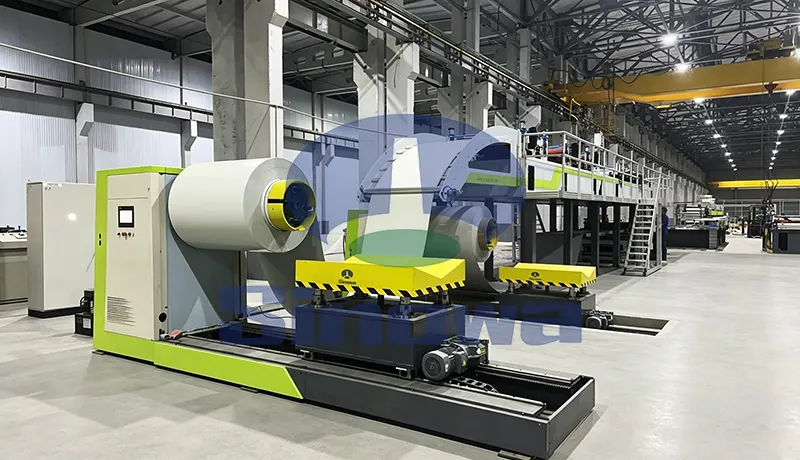
The PU sandwich panel line is a core production setup for making high-performance building insulation panels. This professional PU sandwich panel production line features automated operation to streamline the whole manufacturing process efficiently. Every component of the polyurethane sandwich panel line is precisely calibrated to ensure consistent panel thickness and structural stability. A well-maintained polyurethane sandwich panel production line can greatly boost production efficiency while reducing manual operation errors. The continuous PU sandwich panel line adapts to diverse production demands for different panel sizes and surface styles. With advanced molding technology, the PIR sandwich panel line produces panels with excellent heat preservation and sound insulation properties. Stable running of the PIR sandwich panel production line guarantees reliable product quality for various construction and industrial application scenarios.
-
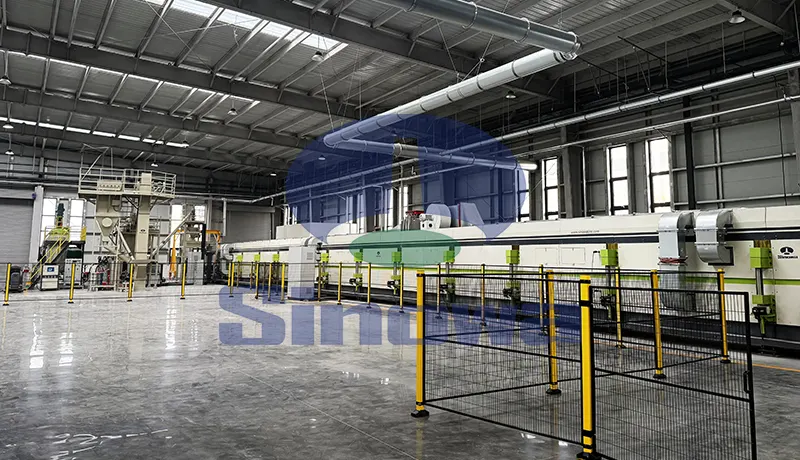
A phenolic insulation board production line serves as the core equipment for manufacturing high-performance thermal insulation building materials. This phenolic insulation panel production line integrates material mixing, foaming, molding and cutting processes to ensure continuous and stable production efficiency. Every operational link of the insulation board production line is precisely calibrated to produce uniform and durable insulation boards. The automated design of the insulation panel production line effectively reduces manual intervention and improves product consistency. Proper maintenance of the phenolic board production line can greatly extend its service life and maintain steady production output. With optimized structural design, the phenolic panel production line adapts to various production demands and delivers high-quality finished products for thermal insulation engineering applications.
-
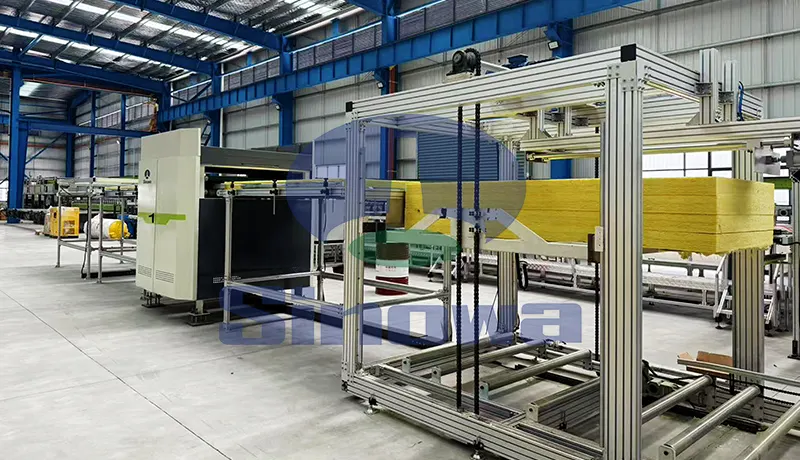
A professional rockwool sandwich panel line serves as the core equipment for producing high-performance building panels. This rockwool sandwich panel production line integrates feeding, laminating and forming processes to ensure stable and efficient production. The well-structured rock wool sandwich panel line can process raw rockwool materials into panels with excellent thermal and sound insulation properties. Operators can adjust the running parameters of the rock wool sandwich panel production line to manufacture panels of different thicknesses and specifications. The automated design of the mineral wool sandwich panel production line greatly reduces manual operation errors and improves product consistency. Regular maintenance of the mineral wool sandwich panel line is essential to sustain long-term operational efficiency and guarantee qualified finished panels for diverse construction applications.