What Leads To Edge Core Density Difference On PU Sandwich Panel Line?
Publication Date: Sep 30, 2026
Edge core density difference is a common quality defect in PU sandwich panel line production, undermining panel uniformity and structural stability.
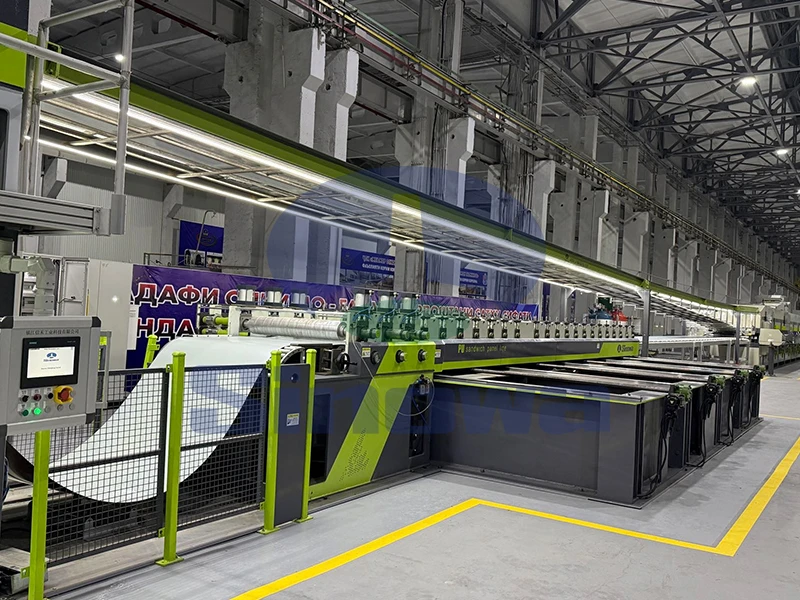
Thermal imbalance stands as the primary factor triggering edge core density discrepancy during operation of the PU sandwich panel line. PU foam forming relies on stable chemical exothermic reactions, where blowing agent vaporization and polymer crosslinking both depend on consistent temperature distribution across the panel surface. In continuous production, the central area of the panel retains heat steadily as foam layers stack and react continuously, creating a stable thermal environment for full and uniform foam expansion. In contrast, panel edges make direct contact with metal side seals and moving conveyor belts on the PU sandwich panel line, which conduct and dissipate heat rapidly. The drastic heat loss at edges lowers the local reaction temperature, slowing down the foaming chemical reaction rate and restricting the full expansion of foam cells. Under such asymmetric thermal conditions, edge foam structures become tighter and denser than the loose, uniform central foam, forming obvious density differences. Even minor ambient temperature fluctuations can amplify this thermal gap, as edge heat dissipation is far more sensitive to external temperature changes than the panel center in daily line operation.
Unstable chemical material ratios further exacerbate edge core density variations on the PU sandwich panel production line. PU sandwich panel production requires precise proportioning of polyol, isocyanate and blowing agents to maintain uniform foam density throughout the panel. When material mixing ratios deviate slightly during continuous feeding, the reaction activity of foam materials changes unevenly across different panel areas. At panel edges where thermal conditions are already unfavorable, inappropriate material proportions will further inhibit foaming expansion. For instance, insufficient blowing agent content reduces gas generation during edge foam reaction, leading to incomplete cell expansion and higher compact density. Meanwhile, slight inconsistencies in material mixing uniformity cause partial reaction differences: central materials mix fully and react completely to form standard low-density foam, while edge materials with uneven mixing produce irregular cell structures with higher density. Long-term minor ratio deviations in the PU sandwich panel line’s feeding system will accumulate and form stable edge-core density gaps, affecting batch product consistency.
Mechanical pressure distribution inconsistency serves as a critical mechanical cause of edge core density differences in PU sandwich panel manufacturing line processing. The laminating and pressing system of the production line applies uniform overall pressure to shape flat and standardized panels, but pressure distribution often varies subtly between the center and edges. In the central panel area, the pressing force acts evenly on the foam layer, allowing foam cells to expand freely and form a uniform porous structure under stable pressure. However, the edge areas of the panel bear indirect and uneven pressure due to the structural limitation of line side fixtures and guide rails. Edge foam is easily squeezed by auxiliary mechanical components during the foaming and curing stage, compressing the originally expanding foam cells. This external mechanical compression reduces the edge foam volume and increases its density, while the unrestricted central foam maintains normal density. Additionally, minor vibration of line conveyor components during operation causes subtle pressure fluctuations at panel edges, further disrupting foam forming uniformity and widening the density difference.
Line speed mismatching seriously affects foam forming consistency and induces edge core density defects on the PU sandwich panel machine. Continuous panel production requires coordinated matching between conveyor moving speed and foam reaction curing speed. When the line running speed is too fast, the foam fails to complete full chemical reaction and cell expansion before entering the pressing and curing stage. Panel edges, which already have delayed reactions due to heat loss, face more insufficient foaming time, resulting in under-expanded, high-density foam structures. Conversely, excessively low line speed leads to over-reaction of central foam with excessive cell expansion and reduced density, while edge foam is restricted by thermal dissipation and cannot expand synchronously, forming a reverse density gap. Unstable line speed caused by mechanical transmission jitter also leads to inconsistent foaming time for different panel parts, making edge core density differences irregular and difficult to control in daily production.
Blowing agent vaporization differences between panel center and edges significantly drive density variation in PU sandwich panel machinery production. Common blowing agents used in PU foam production have high latent heat of vaporization, absorbing substantial heat from the reaction environment during gasification to support foam cell formation. In the panel center, sufficient accumulated heat ensures thorough and synchronous vaporization of blowing agents, generating uniform gas volumes to form regular foam cells with standard density. At panel edges, rapid heat loss reduces local environmental temperature, lowering the vaporization efficiency of blowing agents. Incomplete blowing agent vaporization produces less gas, leading to insufficient expansion of edge foam cells. The unexpanded foam matrix retains more polymer components, increasing edge density compared to the fully expanded central foam. Moreover, residual unvaporized blowing agents at edges affect post-curing shrinkage, making edge foam structure denser and more compact after final shaping.
Uneven material feeding and pendulum spraying deviation cause localized foaming differences on the PU sandwich panel making machine. The line’s spraying system relies on stable pendulum movement to evenly distribute mixed PU materials across the panel width. When the pendulum movement has positional deviation or unstable swing amplitude, material spraying volume becomes inconsistent between center and edges. Usually, the panel center receives sufficient and uniform material coverage, while edge areas suffer from insufficient material supply or uneven material distribution. Insufficient edge materials lead to sparse foam matrix and incomplete cell filling during foaming, resulting in higher density after curing. Meanwhile, intermittent material feeding or unstable flow rate in the feeding system causes periodic material shortage at panel edges. These feeding irregularities disrupt the synchronous foaming process of the entire panel, forming persistent density differences between edge and core areas in finished products.
Curing condition asymmetry is an easily overlooked factor causing edge core density differences in PU sandwich panel line production. The final curing stage determines the finalized foam structure and density of PU sandwich panels. In the curing channel, the central panel area is wrapped in a stable thermal field with uniform heat conduction, enabling complete crosslinking and stable cell shaping. Panel edges, exposed to border air circulation and line fixture heat dissipation, have lower curing temperatures and faster heat loss. Insufficient edge curing temperature leads to incomplete polymer crosslinking, and uncrosslinked foam structures are prone to micro-compression under subsequent line pressure. This micro-compression reduces edge foam porosity and increases overall density. In addition, uneven air circulation in the curing area aggravates edge temperature differences, making edge curing progress lag behind the center and further stabilizing the density gap between different panel parts.
Surface panel material heat conduction characteristics influence core foam density uniformity on the PU sandwich panel prodoction machinery. The upper and lower surface materials of PU sandwich panels have different heat conduction efficiencies, and their edge contact states differ greatly from the center. At panel edges, surface materials closely contact line metal components, accelerating overall heat loss of the composite structure. The rapid heat loss of surface materials directly acts on the edge core foam, inhibiting foaming expansion and crosslinking reactions. In contrast, the central surface materials are isolated by intermediate foam layers, with slow heat dissipation and stable reaction temperatures. The asymmetric heat conduction of surface materials forms a temperature gradient from center to edge, leading to gradient changes in foam density. Different surface material flatness also causes inconsistent fitting degrees with core foam at edges, resulting in uneven stress and density distribution during pressing and curing.
Long-term equipment operation wear and parameter drift induce cumulative edge core density errors on the PU sandwich panel line. After long-term continuous operation, key components such as conveyor belts, guide rails and pressing rollers experience minor wear and deformation. These subtle equipment changes cause uneven gap distances and pressure distribution at panel edges, changing the foaming space of edge foam. Meanwhile, aging of temperature sensing and feeding control components leads to gradual parameter drift, making the system unable to maintain the original optimal production conditions. The drifted parameters cannot adapt to edge thermal and mechanical characteristics, resulting in continuous deviation of edge foam density. Such cumulative defects are not obvious in short-term production but will become prominent in batch production, seriously affecting the overall quality uniformity of PU sandwich panels.
External environmental condition fluctuations amplify edge core density differences in routine PU sandwich panel line production. Production workshop temperature, humidity and air flow all affect the foaming stability of PU core materials. In low-temperature workshop environments, edge heat dissipation is further accelerated, widening the temperature gap between center and edge and restricting edge foam expansion. Excessive workshop humidity interferes with PU material crosslinking reactions, and the impact is more significant at edges with unstable thermal conditions, leading to irregular foam cell structures and increased density. Continuous air flow near line equipment takes away edge heat and volatile substances, disrupting the balanced foaming environment. These external environmental factors do not directly cause density differences but aggravate various inherent process and mechanical defects, making edge core density inconsistency more prominent and difficult to eliminate in actual production.
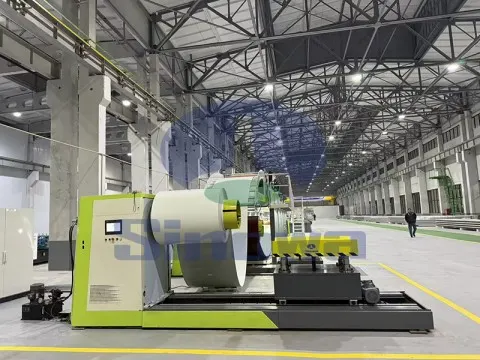
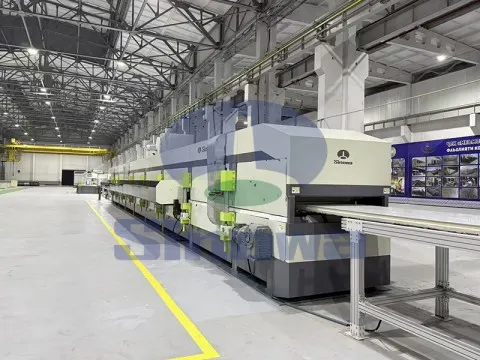
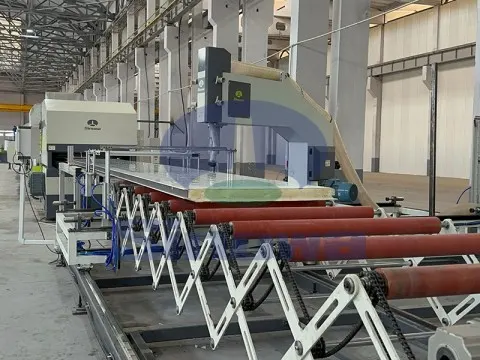
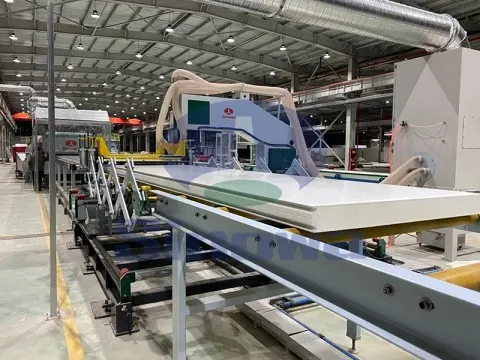
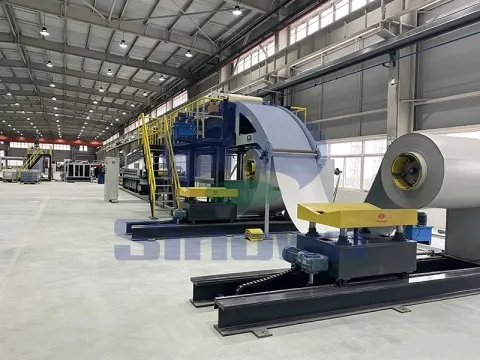
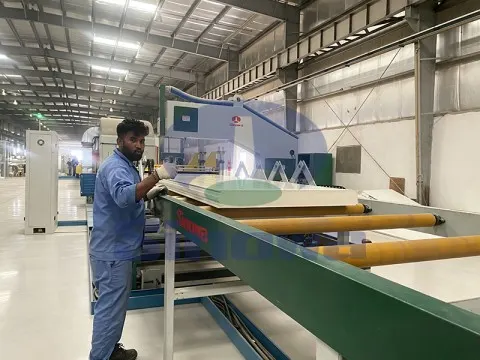
Gallery of PU Sandwich Panel Line
Tags: pu sandwich panel line, pu sandwich panel line manufacturer, pu sandwich panel line supplier, china pu sandwich panel line, pu sandwich panel line for sale
-
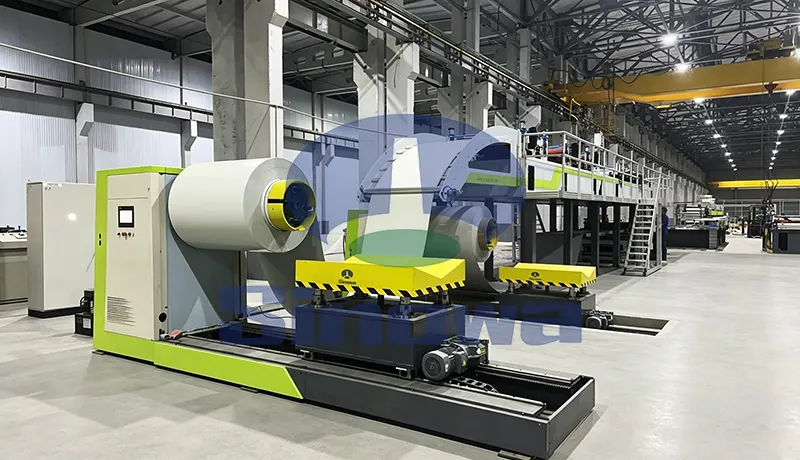
The PU sandwich panel line is a core production setup for making high-performance building insulation panels. This professional PU sandwich panel production line features automated operation to streamline the whole manufacturing process efficiently. Every component of the polyurethane sandwich panel line is precisely calibrated to ensure consistent panel thickness and structural stability. A well-maintained polyurethane sandwich panel production line can greatly boost production efficiency while reducing manual operation errors. The continuous PU sandwich panel line adapts to diverse production demands for different panel sizes and surface styles. With advanced molding technology, the PIR sandwich panel line produces panels with excellent heat preservation and sound insulation properties. Stable running of the PIR sandwich panel production line guarantees reliable product quality for various construction and industrial application scenarios.
-
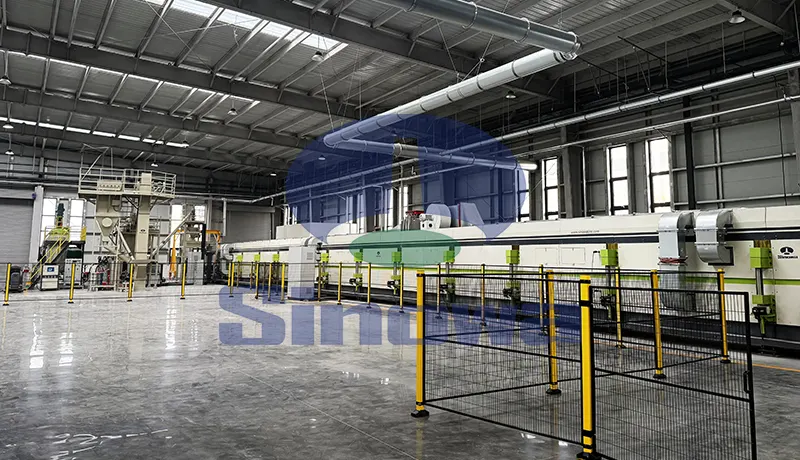
A phenolic insulation board production line serves as the core equipment for manufacturing high-performance thermal insulation building materials. This phenolic insulation panel production line integrates material mixing, foaming, molding and cutting processes to ensure continuous and stable production efficiency. Every operational link of the insulation board production line is precisely calibrated to produce uniform and durable insulation boards. The automated design of the insulation panel production line effectively reduces manual intervention and improves product consistency. Proper maintenance of the phenolic board production line can greatly extend its service life and maintain steady production output. With optimized structural design, the phenolic panel production line adapts to various production demands and delivers high-quality finished products for thermal insulation engineering applications.
-
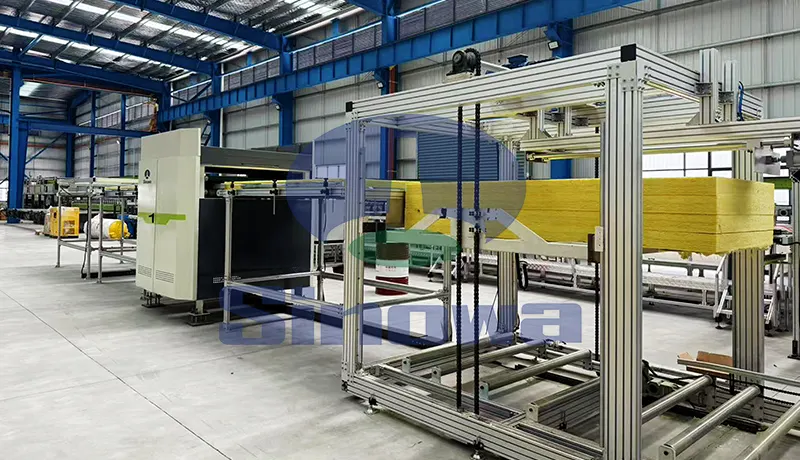
A professional rockwool sandwich panel line serves as the core equipment for producing high-performance building panels. This rockwool sandwich panel production line integrates feeding, laminating and forming processes to ensure stable and efficient production. The well-structured rock wool sandwich panel line can process raw rockwool materials into panels with excellent thermal and sound insulation properties. Operators can adjust the running parameters of the rock wool sandwich panel production line to manufacture panels of different thicknesses and specifications. The automated design of the mineral wool sandwich panel production line greatly reduces manual operation errors and improves product consistency. Regular maintenance of the mineral wool sandwich panel line is essential to sustain long-term operational efficiency and guarantee qualified finished panels for diverse construction applications.