
Installing sandwich panel machinery is a systematic, step-by-step process that determines production stability and equipment service life.
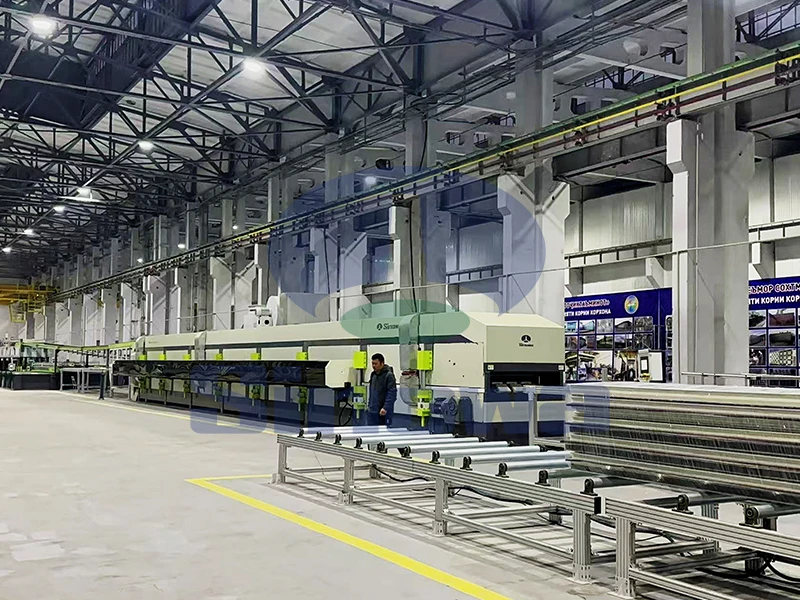
Sufficient pre-installation site preparation lays the foundation for smooth machinery installation and stable long-term operation. First, operators need to clean and level the entire installation area thoroughly, removing all debris, dust and uneven ground areas that may affect equipment placement. The installation site must maintain a flat and solid bearing surface to avoid equipment tilt or vibration during subsequent production. Meanwhile, it is essential to reserve sufficient space around the machinery for daily operation, later maintenance, material handling and equipment disassembly. Operators also need to confirm the basic layout of the production line in advance, reasonably planning the placement position of each functional module to ensure the continuity of the entire production process. In addition, check and confirm the supporting conditions of on-site power and ventilation systems, ensuring the working environment can meet the basic operating needs of sandwich panel machinery and eliminate potential environmental hazards before formal installation.
After completing site preparation, the next key step is accurate equipment unpacking and inspection. Before unpacking, staff should check the integrity of the outer packaging to confirm no damage, extrusion or water soaking occurred during transportation. Then unpack the equipment and accessories in a standardized order, avoiding random knocking or violent disassembly that may damage precision parts. After unpacking, carefully compare the actual equipment components with the complete parts list, checking all mechanical parts, electrical components, connecting accessories and auxiliary tools one by one. Focus on inspecting key parts such as rolling forming components, pressing modules and cutting devices for deformation, scratches or functional abnormalities. Record all inspection results in detail, and sort and store scattered accessories separately to prevent loss or confusion. Timely verify any missing or damaged parts to ensure subsequent installation work can be carried out without interruption.
Equipment base fixing and positioning is a core link to ensure the operating accuracy of sandwich panel machinery. Place the main equipment and each functional sub-module on the predetermined installation position, and initially adjust the horizontal and vertical state of the equipment with professional measuring tools. Fine-tune the equipment base to ensure the overall levelness meets the operating requirements, as unlevel placement will cause uneven equipment operation, abnormal noise and even component wear during long-term work. After positioning, fix the base with special fasteners, ensuring the connection is firm and stable without loose gaps. For split combined equipment, align the connecting interfaces of each module accurately to keep the linearity of the entire production line. After fixing, recheck the overall positioning effect to eliminate slight deviations, so that the equipment can maintain stable operating posture in high-speed and continuous production scenarios.
Mechanical assembly and module connection work follows the base fixing process, focusing on the precise docking of all functional components. Start with installing the auxiliary support structures of the equipment, including supporting frames, guide rails and limiting components, to ensure all auxiliary parts are installed in place and fixed firmly. Then assemble the core working modules such as raw material feeding mechanism, rolling forming unit, composite pressing device and fixed-length cutting structure in accordance with the standard installation sequence. During assembly, ensure all connecting bolts, pins and connectors are installed in place with uniform locking force, avoiding excessive or insufficient tightening that affects structural stability. For movable parts such as transmission belts and rolling shafts, adjust the assembly gap moderately to ensure flexible operation without jamming. After the assembly of each module, conduct a manual jog test to check the flexibility of mechanical movement and the accuracy of structural docking, and eliminate assembly defects in time.
Electrical system wiring and control module installation directly affects the intelligent operation and safety of the machinery. First, arrange and lay all power cables and signal cables in a standardized manner, adopting classified wiring to separate strong current and weak current lines, which can effectively avoid signal interference and circuit failure. Fix the cables with special wire grooves and fixing parts to prevent cable distortion, stretching and exposed suspension. Then connect the cables to the control panel, power distribution box and each electrical component in strict accordance with the circuit layout logic, ensuring accurate interface docking and firm wiring terminals. After wiring is completed, check all circuit connections repeatedly to exclude wrong wiring, missing connection and virtual connection problems. Install and debug the control system program interface, configure basic operating parameters of the equipment, and test the safety interlock circuit and protection function to ensure the electrical system can respond accurately and protect the equipment in real time during operation.
Pipeline system installation and debugging is indispensable for the normal operation of sandwich panel machinery, especially for equipment with heating, bonding and cooling functions. Install gas circuits, liquid circuits and heating pipelines according to the equipment design requirements, ensuring each pipeline interface is tightly connected without leakage hidden dangers. Reasonably adjust the pipeline layout to avoid excessive bending and extrusion, ensuring smooth medium transmission inside the pipeline. After pipeline installation, conduct a pressure test and sealing test for all pipeline systems to check the stability of pipeline connection under working pressure. For heating and thermal insulation pipelines, fix the thermal insulation protective layers to reduce heat loss and avoid external scald risks. Meanwhile, unblock the equipment drainage and exhaust structures to ensure no residual gas or liquid accumulates inside the pipeline, which provides stable power and process support for subsequent equipment operation.
Precision alignment and overall calibration is a key step to optimize equipment operating accuracy after the completion of mechanical and electrical installation. Use professional precision measuring tools to calibrate the parallelism, verticality and horizontal spacing of key components such as rolling rollers, pressing plates and cutting tools. Fine-tune the operating gap between each functional module to ensure the consistency of material processing and composite forming effects. Calibrate the transmission system to ensure the synchronization of the operating speed of each link of feeding, forming, pressing and cutting, avoiding production errors caused by speed mismatch. In addition, calibrate the sensing components and detection devices of the equipment to ensure accurate collection and feedback of operating data. Repeatedly check and adjust all calibration parameters to eliminate cumulative installation errors, so that the equipment can reach the optimal operating accuracy state.
After completing all installation and calibration work, systematic safety inspection and functional debugging must be carried out first. Conduct a comprehensive safety check covering mechanical structure, electrical system, pipeline system and safety protection devices. Check whether all mechanical protective covers and limit devices are installed in place, whether the electrical safety protection function is normal, and whether the pipeline system has leakage risks. Then carry out no-load debugging of the equipment, start the machinery without raw materials, and run each functional module independently and jointly. Observe the operating state of the equipment, check for abnormal noise, vibration, temperature rise and program failure. Test the start-stop, speed regulation, emergency stop and other basic functions of the equipment to ensure all safety protection mechanisms can respond quickly and effectively. Deal with all minor faults and abnormal problems found during debugging one by one to ensure the equipment is in a safe and available state.
Load trial operation is the final verification link to confirm the installation quality of sandwich panel machinery. After the no-load debugging is qualified, carry out graded load trial production according to the conventional production process. Put in conventional raw materials, set standard production parameters, and start the equipment for continuous trial operation. During the trial operation, real-time observe the material forming effect, panel flatness, bonding compactness and cutting precision. Record the operating parameters of the equipment, including operating speed, working temperature and system operation status, to check whether the equipment operates stably under load conditions. Appropriately adjust individual process parameters according to the trial production effect to optimize the product forming quality. After continuous stable trial operation without faults, it proves that the equipment installation is completed and meets formal production conditions.
Daily acceptance maintenance and standardized operation handover ensure the long-term stable operation of the installed machinery. After the trial operation is qualified, sort out all installation and debugging records, form a complete equipment installation acceptance file, and confirm that all installation indexes meet the use requirements. Conduct comprehensive cleaning and maintenance of the equipment, clean up dust and residual impurities inside and outside the machine, lubricate all transmission and movable parts, and check the fastening state of all connecting parts again. Meanwhile, complete operation and maintenance handover work, clarify daily operation specifications, regular maintenance cycle and common fault handling methods. Standardize the daily use and maintenance management of the equipment, help operators master correct operating skills, effectively reduce equipment failure rate, and extend the service life of sandwich panel production machinery.