
The total power consumption of a sandwich panel production line refers to the overall electrical energy used by all core and auxiliary equipment during operation. It varies greatly with line type, automation level, production speed and equipment configuration, forming a flexible energy use range for manufacturing operations.
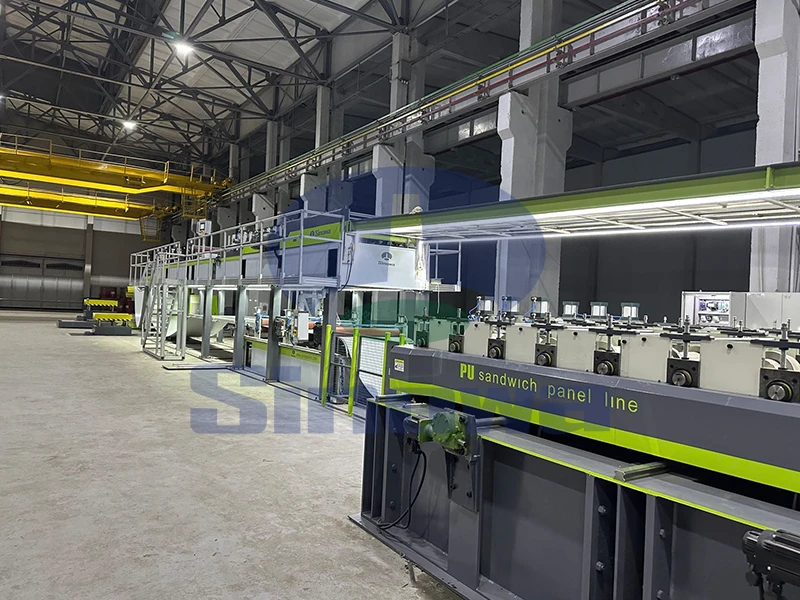
The total power consumption of a sandwich panel production line is primarily determined by its operational mode, with continuous and discontinuous lines showing distinct energy usage characteristics. Continuous production lines, designed for long-hour, uninterrupted manufacturing, feature a complete set of linked equipment that maintains stable operation throughout the production process. These lines generally have higher total installed power due to their full-range automated systems, including long-distance double-belt pressing units, continuous foaming systems, and synchronous material conveying devices. In contrast, discontinuous lines operate in batch modes with intermittent start-stop cycles, resulting in lower baseline power demand. Their energy consumption fluctuates obviously with production batches, as core equipment only runs during specific processing stages and enters standby status during material replacement and interval adjustment. This fundamental operational difference creates the basic power consumption gap between the two mainstream production line types, laying the foundation for overall energy expenditure differences in actual production scenarios.
Core processing units account for the largest proportion of the sandwich panel production line’s total power consumption, dominating daily energy usage. Among all functional modules, the double-belt pressing and curing system stands out as the biggest power consumer. This unit requires sustained power output to maintain stable mechanical pressure and constant temperature environments for panel core material curing and surface bonding. The effective length of the double-belt conveyor directly affects power demand, as longer conveyor structures need more energy to drive stable operation and uniform heat distribution. Additionally, the foaming and filling unit consumes considerable power through precise raw material mixing, quantitative pumping, and continuous material injection processes. High-precision power-driven pumps and mixing devices work continuously to ensure uniform core material filling, and their stable operation constitutes a major part of the core process power load, leaving limited room for energy reduction in basic production links.
Auxiliary functional systems make up a non-negligible part of the total power consumption, supporting stable operation of core production equipment. The metal sheet roll forming system, responsible for shaping raw metal coils into qualified panel surface materials, relies on multiple groups of driving motors and forming rollers that consume steady power during production. Although the single-machine power of roll forming equipment is not extremely high, long-term continuous operation accumulates considerable energy consumption. Meanwhile, the hydraulic power unit, which provides power for equipment positioning, pressing and material fixing, maintains basic power output to ensure stable system pressure. Other auxiliary systems including material conveying platforms, cleaning devices and safety monitoring equipment also generate continuous power consumption. These scattered auxiliary loads collectively increase the overall energy demand, and their cumulative effect cannot be ignored in total power calculation.
Production speed and operational load are key dynamic factors that cause real-time fluctuations in total power consumption. Each sandwich panel production line has an adjustable speed range, and higher production speeds correspond to increased equipment operating frequency and power output. When running at maximum speed, all motors, pumps and heating devices operate at full load, pushing total power consumption to peak levels. In low-speed production or semi-load operation, equipment automatically reduces operating power, resulting in significantly lower overall energy use. Frequent speed adjustments and irregular load changes will also affect power efficiency. Unstable operational states often lead to ineffective energy loss, as equipment needs repeated power adjustment to adapt to changing production rhythms. Steady, rated-load operation can effectively avoid extra power waste and maintain relatively stable total energy consumption levels.
Automation and intelligent control configurations greatly influence the total power consumption of modern production lines. Fully automated lines equipped with complete PLC control systems, automatic material feeding and intelligent temperature adjustment modules have higher installed total power compared with semi-automatic models. These intelligent systems require continuous power supply for sensor operation, data monitoring and program operation, adding basic power load at all times. However, advanced variable frequency drive technology applied in automated lines optimizes energy use efficiency. The system can automatically adjust motor operating power according to real-time production demand, avoiding the constant high-power operation of traditional fixed-frequency equipment. Although intelligent configurations increase basic power consumption, they reduce invalid energy waste in actual operation, realizing a balanced trade-off between total power input and production efficiency.
Heating and thermal management systems are important contributors to total power consumption, especially for polyurethane and foam core panel production. The curing and forming of sandwich panel core materials require stable and accurate temperature support, which relies on electric heating equipment and thermal circulation systems. These thermal devices need long-term continuous operation to maintain the constant temperature required for core material foaming and curing, forming a stable high-power consumption link. Some production lines adopt waste heat recovery modules to optimize energy use. These modules collect waste heat generated by chemical reactions and equipment operation, then redistribute the recycled heat to heating demand links through intelligent management. This optimization reduces the reliance on electric heating, effectively lowering the overall power consumption of thermal systems and cutting down total line energy use.
Equipment aging and daily maintenance status directly affect actual power consumption levels of the production line. Newly commissioned and well-maintained equipment maintains optimal operating efficiency, with all components running in a power-saving state matching design parameters. In contrast, aging equipment with worn transmission parts, blocked heat dissipation structures and degraded motor performance will generate increased power consumption. Worn rollers and bearings increase operational resistance, forcing driving motors to consume more power to maintain normal operating speed. Blocked equipment structures also cause poor heat dissipation and uneven temperature control, leading to repeated heating and extra energy waste. Regular cleaning, lubrication and component replacement can effectively reduce invalid power loss and keep total consumption at a reasonable level.
Standby and no-load power consumption is a easily overlooked component of the total energy expenditure of sandwich panel production lines. In actual factory operation, production lines often enter standby states during material replacement, process adjustment and shift handover. During standby periods, core processing equipment stops high-load operation, but control systems, monitoring sensors, cooling devices and basic power distribution facilities still maintain continuous operation, generating basic standby power consumption. Long-term idle standby will accumulate a large amount of invalid energy waste. Besides, frequent equipment start and stop will cause instantaneous power surge, and repeated start-up processes consume more power than continuous low-load operation. Reasonable production scheduling to reduce standby time and centralized processing of production tasks can effectively reduce this part of power loss.
Different sandwich panel material types lead to obvious differences in production line total power consumption. Production lines for EPS core panels have relatively lower overall power demand, as their foaming and curing processes require less heating power and simpler equipment operation procedures. Lines for PU and PIR core panels need higher total power due to precise high-temperature curing, high-pressure foaming and strict material mixing requirements. The production of metal composite panels with special surface treatments also increases power consumption because of additional surface processing and shaping procedures. Material characteristics determine the opening degree of equipment functional modules and operating parameters, making raw material type a fundamental factor affecting the power consumption range of different production lines in practical application.
Scientific energy optimization strategies can effectively reduce the total power consumption of sandwich panel production lines without compromising product quality. Applying high-efficiency motors and energy-saving pump units can reduce basic power loss of transmission and power components. Equipping variable frequency control systems for all power-driven equipment realizes dynamic power adjustment with production load, avoiding long-term no-load and high-load waste. Optimizing equipment thermal insulation structures reduces heat loss in curing and heating links, lowering the operating pressure of thermal systems. In addition, formulating standardized operation and maintenance management systems can avoid energy waste caused by irregular operation and equipment aging. Comprehensive optimization from equipment configuration, operational mode and daily management can steadily reduce the overall power consumption of the production line and improve energy utilization efficiency.