Sandwich Panel Forming Machine
Publication Date: Oct 8, 2026
A sandwich panel forming machine is an automated integrated production system that fabricates insulated composite panels by bonding metal facings with lightweight core materials for construction and industrial use.
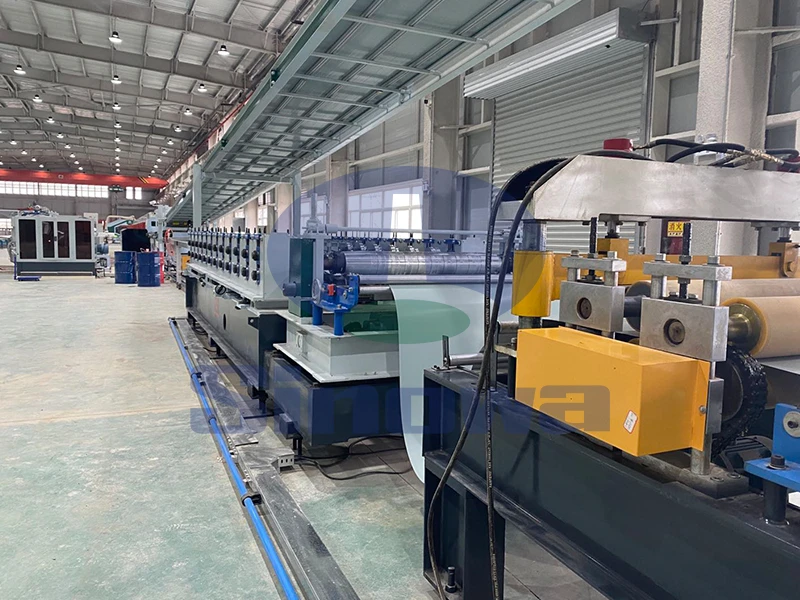
Sandwich panel forming machines serve as the core automated equipment for manufacturing high-performance composite sandwich panels, which are widely utilized in modern construction, industrial facilities, and modular building projects. Unlike traditional standalone processing devices, this equipment integrates multiple independent production procedures into one continuous and streamlined workflow, eliminating the inefficiencies and inconsistencies of manual and semi-automatic production methods. The fundamental working logic of the machine centers on combining two rigid surface layers and a lightweight insulating core layer through precise mechanical coordination, stable pressure control, and constant-temperature curing. Each production step is synchronized accurately to ensure the finished panels feature uniform thickness, stable structural performance, and excellent overall flatness. Designed to adapt to diverse core materials and surface specifications, the machine can flexibly adjust operating parameters to produce panels with different insulation levels and structural strengths, fully catering to the diversified application demands of modern composite building materials. Its automated operation mode greatly reduces manual intervention, laying a solid foundation for large-scale and standardized panel production in the industry.
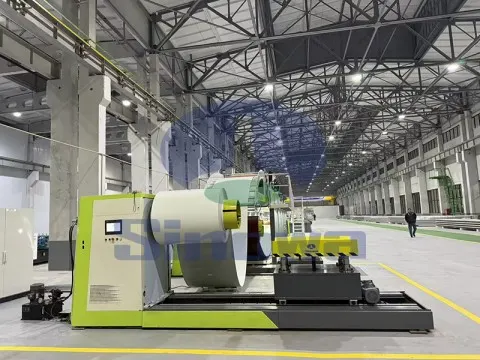
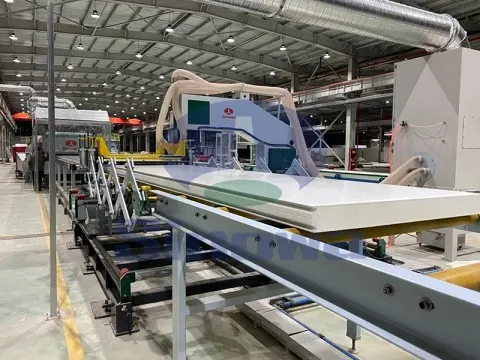
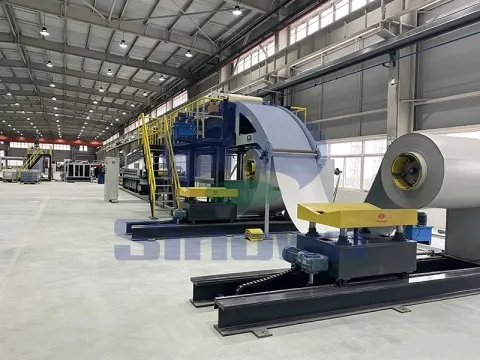
The overall structural composition of a sandwich panel forming machine is highly modular, with each functional unit performing independent and collaborative tasks to complete the full panel production process. The complete production line mainly includes raw material unwinding and tension control units, surface material roll forming units, core material feeding and positioning units, gluing and composite pressing units, constant-temperature curing units, fixed-length cutting units, and finished product conveying systems. The unwinding unit is responsible for stably releasing coiled metal surface materials, with a professional tension control mechanism to avoid material deviation, wrinkling, or stretching during feeding, which is essential for maintaining the flatness of subsequent composite panels. The roll forming unit adopts multi-group roller design to gradually shape the flat metal sheets into standardized profiles, ensuring the edge structure and surface radian of the panels meet consistent molding requirements. All modular units are closely connected through precise transmission systems, realizing seamless docking of each production link and ensuring the continuity and stability of the entire production process.
Raw material pretreatment and feeding are the primary key links that determine the final quality of sandwich panels, and the forming machine is equipped with refined control systems for this stage. For metal surface materials, the machine’s feeding system maintains constant feeding speed and tension throughout the process, effectively avoiding material deformation caused by uneven stress. Some advanced feeding configurations support non-stop coil replacement, enabling continuous production without frequent shutdowns and significantly improving overall production efficiency. For the middle core materials, the professional feeding unit can achieve quantitative and uniform distribution, accurately controlling the thickness and coverage of core materials to prevent local hollowing or uneven density. Meanwhile, the machine is equipped with simple material leveling and cleaning structures to remove surface impurities and fine wrinkles of raw materials before composite molding, ensuring tight bonding between surface layers and core layers. Scientific raw material processing and feeding control effectively avoids common quality defects such as panel delamination and uneven thickness, laying a good foundation for high-quality panel molding.
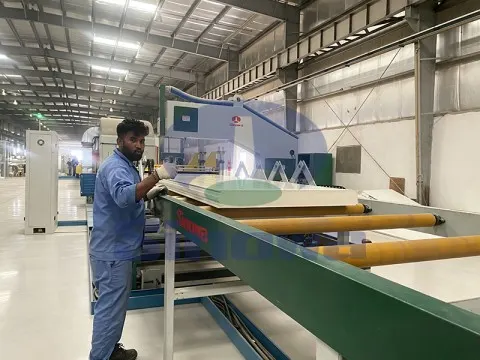
Gluing and composite pressing are the core molding processes of sandwich panel production, and the sandwich panel forming machine achieves high-precision lamination through optimized mechanical and technological design. The machine’s gluing system adopts uniform coating technology to evenly apply high-performance adhesive on the inner side of metal surface materials, with adjustable coating volume and speed to adapt to different raw material characteristics and production requirements. This uniform gluing mode ensures no missing coating or excessive glue accumulation, guaranteeing strong and lasting bonding force between layers. After gluing, the materials enter the double-belt composite pressing unit, which uses stable mechanical pressure to tightly fit the upper and lower metal layers with the middle core material. The pressing unit can precisely adjust pressure values and pressing gaps according to different panel thicknesses and core material types, ensuring consistent pressure bearing on the entire panel surface. The synchronous operation of pressing and transmission avoids relative displacement between layers, effectively improving the overall structural compactness and bonding uniformity of finished panels.
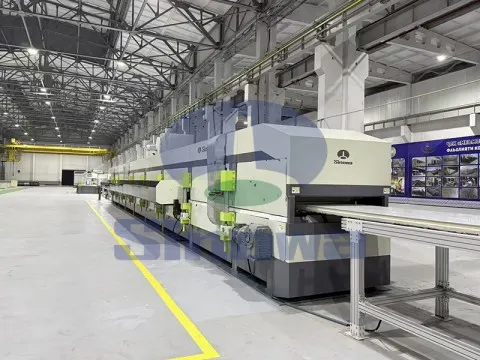
Constant-temperature curing is an indispensable post-composite process to stabilize the structural performance of sandwich panels, and professional forming machines are equipped with intelligent constant-temperature curing systems. After composite pressing, the preliminary molded panels are transported to the curing area, where the closed circulating temperature control system maintains a stable and appropriate curing environment. The system realizes independent temperature adjustment for the upper and lower parts of the curing area, ensuring uniform heat conduction on both sides of the panel and promoting full reaction and solidification of the adhesive. Reasonable curing temperature and time settings can effectively enhance the bonding strength between panel layers, avoiding layer separation, cracking, and other quality problems in subsequent use. In addition, the curing system is matched with adjustable transmission speed, which can coordinate with the front-end molding speed to realize integrated production. It also avoids quality fluctuations caused by inconsistent curing degrees, further improving the overall stability and durability of finished sandwich panels.
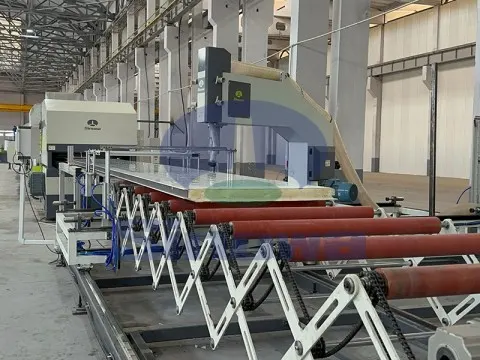
Fixed-length cutting and surface finishing processes endow sandwich panels with standardized dimensions and excellent appearance, and the forming machine realizes precise and efficient processing through intelligent control. The fixed-length cutting unit adopts high-precision numerical control positioning technology, which can set arbitrary cutting lengths according to production requirements, with extremely low dimensional error of finished products. The cutting tool is made of wear-resistant high-strength materials, ensuring smooth and burr-free panel cuts without damaging the surface metal layer or internal core structure. After cutting, the automatic conveying system transports finished panels to the subsequent finishing area for simple edge trimming and surface inspection. The integrated design of cutting and finishing avoids secondary handling and processing of panels, reducing the risk of surface scratches and structural damage. This one-stop processing mode not only improves the dimensional accuracy and appearance quality of panels but also greatly optimizes the production rhythm and improves overall production efficiency.
The intelligent electrical control system serves as the brain of the entire sandwich panel forming machine, realizing unified scheduling and precise control of all functional units. The system adopts integrated programmable control modules, with a simple and intuitive operation interface that allows operators to set and adjust parameters such as feeding speed, pressing pressure, curing temperature, and cutting length in real time. All production parameters are digitally controlled, completely changing the unstable parameter adjustment mode of traditional mechanical equipment, ensuring consistent production standards for each batch of panels. In addition, the control system is equipped with real-time monitoring and fault self-diagnosis functions, which can timely detect abnormal conditions such as material jamming, parameter deviation, and equipment overload during operation. It will automatically issue early warnings and perform protective shutdown, effectively reducing equipment failure rates and production losses caused by abnormal conditions, and improving the safety and stability of long-term equipment operation.
Modern sandwich panel forming machines have significant advantages in production efficiency and product consistency compared with traditional discrete production equipment. The fully continuous automated production process reduces a large number of manual operation links, effectively lowering labor input and eliminating product quality differences caused by human errors. The coordinated operation of all modular units realizes uninterrupted continuous production, greatly improving unit-time output. Meanwhile, the unified and precise parameter control system standardizes every production link, making the thickness, flatness, bonding strength, and dimensional accuracy of finished panels highly consistent. The equipment also has strong production adaptability, which can quickly switch production specifications according to market demand, realizing flexible production of multiple types of sandwich panels. While ensuring high production efficiency, it effectively controls the qualified rate of finished products, reducing material waste and rework costs in the production process.
In terms of operational stability and maintenance convenience, sandwich panel forming machines are designed with practical and durable concepts, adapting to long-term industrial production scenarios. The main mechanical structure of the equipment adopts high-rigidity and wear-resistant materials, with optimized structural design to reduce mechanical vibration and wear during high-speed operation, effectively extending the service life of the equipment. The modular structural design enables independent disassembly, inspection, and replacement of each functional unit, making daily maintenance and fault troubleshooting more convenient and efficient. The key transmission and pressure-bearing parts are equipped with protective structures to avoid dust, debris, and external force impact damage, ensuring stable long-term operation of the equipment. In addition, the equipment is designed with energy-saving operation logic, which can automatically adjust power output according to production load, reducing ineffective energy consumption in the production process and achieving more energy-saving and environmentally friendly production operations.
With the continuous upgrading of modern building and industrial manufacturing technologies, sandwich panel forming machines are constantly evolving towards higher intelligence, higher precision, and stronger versatility. The ongoing technological optimization focuses on improving equipment automation and intelligent recognition capabilities, enabling the equipment to automatically identify raw material specifications and intelligently match production parameters without manual repeated debugging. At the same time, the equipment’s adaptability to new environmental-friendly core materials and high-performance adhesives is continuously enhanced, meeting the industry’s increasing requirements for energy conservation and environmental protection of building materials. The continuous innovation and upgrading of sandwich panel forming machine technology not only promotes the standardized and high-quality development of the sandwich panel manufacturing industry but also provides more efficient and reliable equipment support for the popularization and application of lightweight, heat-insulating, and high-strength composite building materials in various fields.
Gallery of Sandwich Panel Forming Machine
Tags: sandwich panel forming machine, sandwich panel forming machine manufacturer, sandwich panel forming machine supplier, china sandwich panel forming machine, sandwich panel forming machine for sale
https://www.sandwichpanelmachinery.com/tags/sandwich-panel-forming-machine.html
-
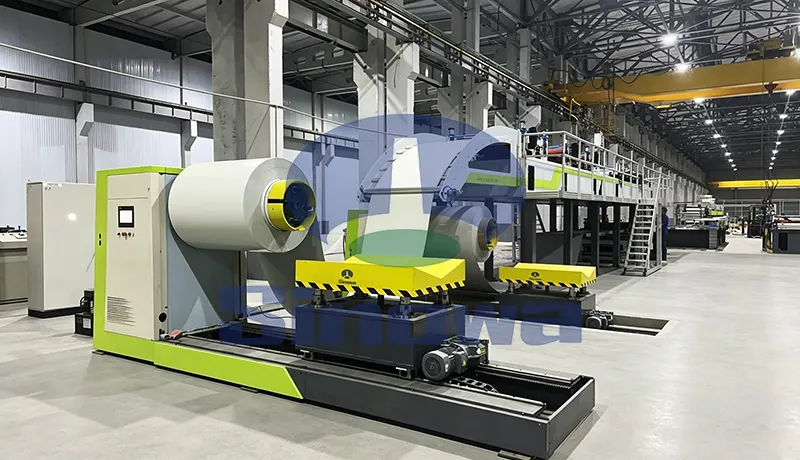
The PU sandwich panel line is a core production setup for making high-performance building insulation panels. This professional PU sandwich panel production line features automated operation to streamline the whole manufacturing process efficiently. Every component of the polyurethane sandwich panel line is precisely calibrated to ensure consistent panel thickness and structural stability. A well-maintained polyurethane sandwich panel production line can greatly boost production efficiency while reducing manual operation errors. The continuous PU sandwich panel line adapts to diverse production demands for different panel sizes and surface styles. With advanced molding technology, the PIR sandwich panel line produces panels with excellent heat preservation and sound insulation properties. Stable running of the PIR sandwich panel production line guarantees reliable product quality for various construction and industrial application scenarios.
-
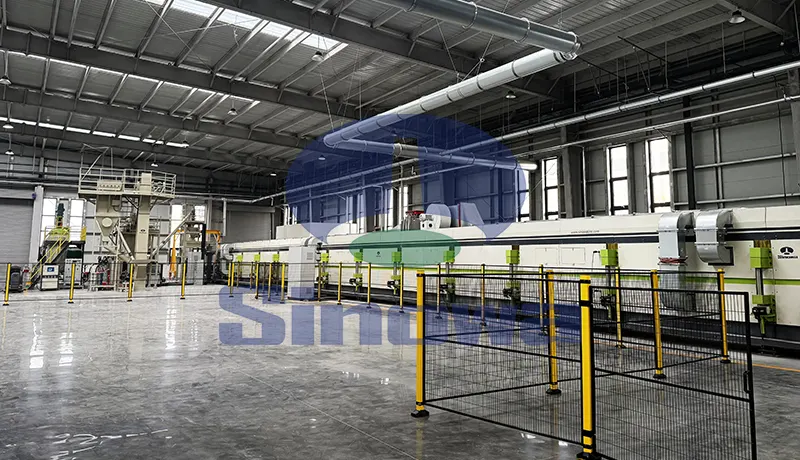
A phenolic insulation board production line serves as the core equipment for manufacturing high-performance thermal insulation building materials. This phenolic insulation panel production line integrates material mixing, foaming, molding and cutting processes to ensure continuous and stable production efficiency. Every operational link of the insulation board production line is precisely calibrated to produce uniform and durable insulation boards. The automated design of the insulation panel production line effectively reduces manual intervention and improves product consistency. Proper maintenance of the phenolic board production line can greatly extend its service life and maintain steady production output. With optimized structural design, the phenolic panel production line adapts to various production demands and delivers high-quality finished products for thermal insulation engineering applications.
-
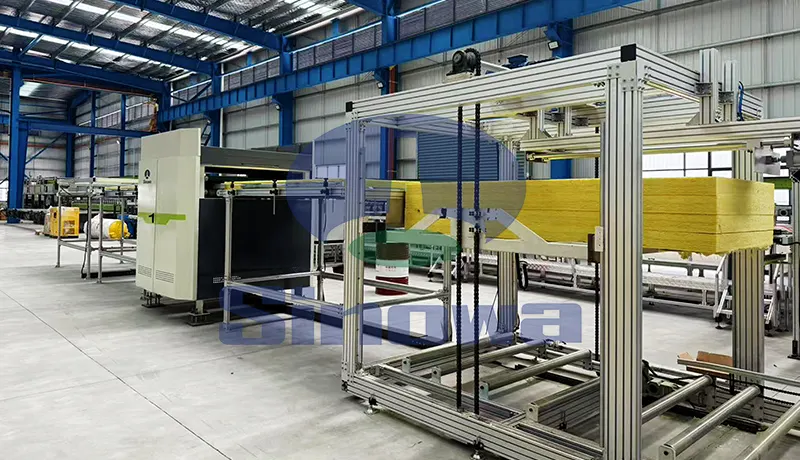
A professional rockwool sandwich panel line serves as the core equipment for producing high-performance building panels. This rockwool sandwich panel production line integrates feeding, laminating and forming processes to ensure stable and efficient production. The well-structured rock wool sandwich panel line can process raw rockwool materials into panels with excellent thermal and sound insulation properties. Operators can adjust the running parameters of the rock wool sandwich panel production line to manufacture panels of different thicknesses and specifications. The automated design of the mineral wool sandwich panel production line greatly reduces manual operation errors and improves product consistency. Regular maintenance of the mineral wool sandwich panel line is essential to sustain long-term operational efficiency and guarantee qualified finished panels for diverse construction applications.