
The double belt conveyor serves as the core functional unit of the PU sandwich panel production line. It integrates material transmission, uniform pressing, thermal curing and shape calibration, directly stabilizing panel quality, ensuring structural uniformity and supporting continuous automated production of qualified PU sandwich panels.
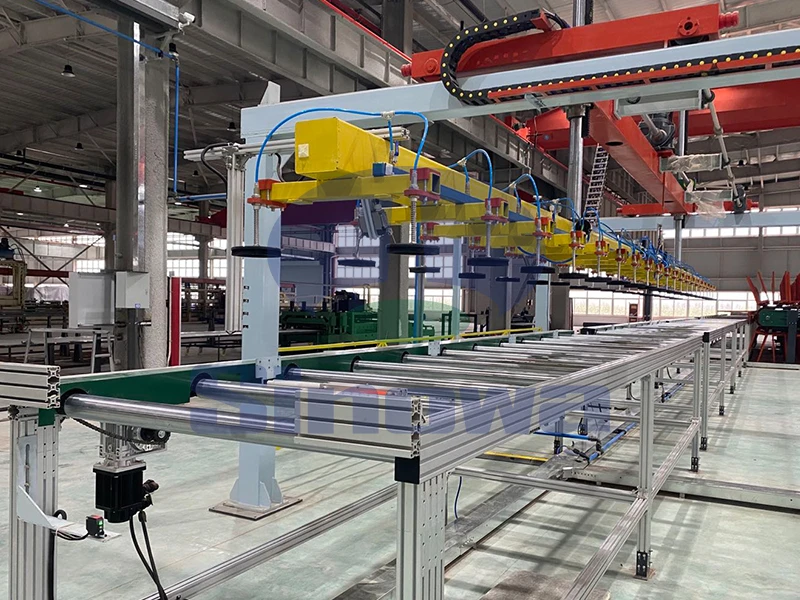
The most fundamental function of the double belt conveyor in the PU sandwich panel production line is synchronous and stable material transportation throughout the forming process. After the PU foaming liquid is injected between the upper and lower metal surface layers, the composite semi-finished product enters the double belt conveyor immediately. The upper and lower circulating belts operate at a consistent and adjustable speed, fully matching the rhythm of the entire production line. This synchronous movement avoids relative displacement between the metal skins and the foaming core layer, which is critical to prevent material deviation and structural misalignment during the foaming and bonding stage. Unlike ordinary single conveyor equipment, its dual-belt clamping structure fixes the composite material stably from both top and bottom, eliminating sliding or warping caused by foaming expansion force. It maintains continuous and linear material advancement, laying a solid foundation for standardized and uninterrupted batch production of PU sandwich panels.
Precise thickness calibration is another indispensable core function of the double belt conveyor for PU sandwich panel manufacturing. The gap between the upper and lower circulating belts can be accurately adjusted according to different panel specifications, forming a fixed forming space for the composite materials. During the PU foam expansion and curing process, the continuous clamping force exerted by the dual belts restricts excessive foam bulging and uneven thickness distribution. The high-precision mechanical positioning structure locks the belt gap steadily, ensuring that the thickness of each panel remains consistent along the entire length and width. This function effectively solves the common quality problems of uneven thickness and dimensional deviation in traditional panel production. It unifies the overall dimensional accuracy of finished panels, meets the basic dimensional requirements of subsequent installation and assembly, and greatly improves the yield rate of finished products in mass production.
The double belt conveyor provides uniform continuous pressing force to optimize the composite bonding effect of PU sandwich panels. In the foaming reaction stage, the PU core layer will produce continuous expansion pressure, which requires balanced external pressure to ensure tight fitting between the foam core and metal surface layers. The upper and lower belts of the equipment can output stable and evenly distributed pressure on the entire surface of the composite panel, avoiding local gaps, delamination or hollowing phenomena. The pressure state remains consistent throughout the material conveying process, enabling the foaming material to fully fill the space between the two surface layers and form a compact integrated structure after curing. Even for large-area long-size panels, the dual-belt pressing structure can eliminate pressure dead zones, ensuring that the bonding strength of each part of the panel is uniform and improving the overall structural firmness of the finished product.
Equipped with a matched heating and heat preservation structure, the double belt conveyor undertakes the key task of continuous thermal curing of PU foam cores. The internal heating components keep the belt surface at a constant and reasonable temperature, forming a stable thermal curing environment inside the equipment. As the composite material moves forward with the belts, the PU foaming reaction proceeds fully and uniformly under constant temperature conditions, realizing complete cross-linking and solidification of the foam structure. The gradient temperature design inside the conveyor avoids insufficient curing caused by low temperature or foam aging and deformation caused by overheating. This integrated conveying and heating mode realizes one-time completion of material transmission and thermal curing, simplifies the production process, shortens the production cycle, and ensures that the PU core layer forms a fine and uniform cellular structure with stable physical properties after curing.
The double belt conveyor effectively controls the lateral expansion of PU foam to standardize the overall width of sandwich panels. In the free foaming state, the PU material will expand irregularly to the sides, resulting in irregular panel edges and inconsistent overall width. The side limiting and guiding structures matched with the dual belts cooperate with the clamping operation of the upper and lower belts to constrain the lateral expansion range of the foaming material. It guides the composite material to advance stably along the fixed track, ensuring neat and straight panel edges and unified overall width dimensions. This function avoids subsequent massive edge trimming work, reduces raw material waste, and improves the neatness and appearance quality of finished panels. At the same time, it prevents foam overflow caused by excessive lateral expansion, keeping the production environment clean and stable.
High-precision flat shaping is a unique advantage of the double belt conveyor in optimizing the surface quality of PU sandwich panels. The circulating belts adopted by the equipment have ultra-flat and wear-resistant surface characteristics, and can fit closely with the upper and lower surfaces of the composite panel during pressing and conveying. The flat constraint of the belts eliminates surface bulges, depressions and wave deformations generated during the foam expansion process. In the whole curing and forming process, the panel surface is always kept flat and smooth without manual secondary shaping. This stable flat shaping function ensures consistent surface flatness of finished panels, improves the appearance grade of products, and also avoids performance differences caused by local structural deformation, making the panel more adaptable to various installation scenarios.
The double belt conveyor realizes flexible production adaptation to diversified PU sandwich panel specifications. By adjusting the running speed, belt gap and pressing force of the dual belts, the equipment can adapt to the production requirements of panels with different thicknesses and densities. For thin lightweight panels, low pressure and fast conveying speed are adopted to avoid structural compression deformation; for thick high-strength panels, increased pressing force and appropriate reduced speed ensure sufficient foaming and curing time. This adjustable working mode enables a single production line to complete the manufacturing of multiple panel specifications, realizing flexible switching of production tasks. It effectively improves the versatility and utilization rate of the production line, and meets the diversified market demand for PU sandwich panels without replacing core equipment.
Improving production continuity and operational efficiency is an important practical function of the double belt conveyor. Different from intermittent pressing equipment, the dual-belt circulating structure supports uninterrupted feeding, forming, curing and discharging of materials. The whole production process is carried out in a continuous linear state, eliminating the waiting time of frequent start-stop and feeding positioning in traditional equipment. The synchronous coordination of transmission, pressing and heating links realizes streamlined operation of panel forming. This continuous working mode greatly improves the hourly output of the production line, reduces manual intervention links, lowers the labor cost of unit products, and provides efficient and stable equipment support for large-scale industrial production of PU sandwich panels.
The double belt conveyor effectively reduces product defect rates and improves the overall stability of production quality. Its integrated control of speed, pressure and temperature avoids unstable product quality caused by manual operation errors. The uniform pressing and constant-temperature curing environment prevents common defects such as local insufficient curing, inconsistent bonding strength, dimensional deviation and surface deformation. The stable clamping and guiding structure ensures that each batch of panels maintains consistent quality indicators. In long-term continuous production, the equipment can always maintain a stable working state, avoid quality fluctuations of finished products, reduce the loss of raw materials and defective products, and greatly improve the overall production qualification rate and economic benefits of the production line.
As the core forming equipment of the production line, the double belt conveyor supports the long-term structural stability and performance durability of finished PU sandwich panels. Through scientific pressure control and uniform curing treatment, the internal foam structure of the panel is more compact and regular, and the bonding interface between the core layer and the surface layer is tighter. This optimized internal structure enhances the wind resistance, compression resistance and thermal insulation performance of the finished panel, and avoids delamination, cracking and shrinkage deformation in subsequent use. The standardized forming process realized by the double belt conveyor endows the PU sandwich panel with stable and reliable comprehensive performance, ensuring that the product can maintain good use effect in long-term service scenarios.