What Leads To Panel Deformation During Polyurethane Sandwich Panel Machine Lamination Process?
Publication Date: Oct 12, 2026
Discover the key causes of panel deformation during polyurethane sandwich panel lamination, including temperature, pressure, material, and process factors.
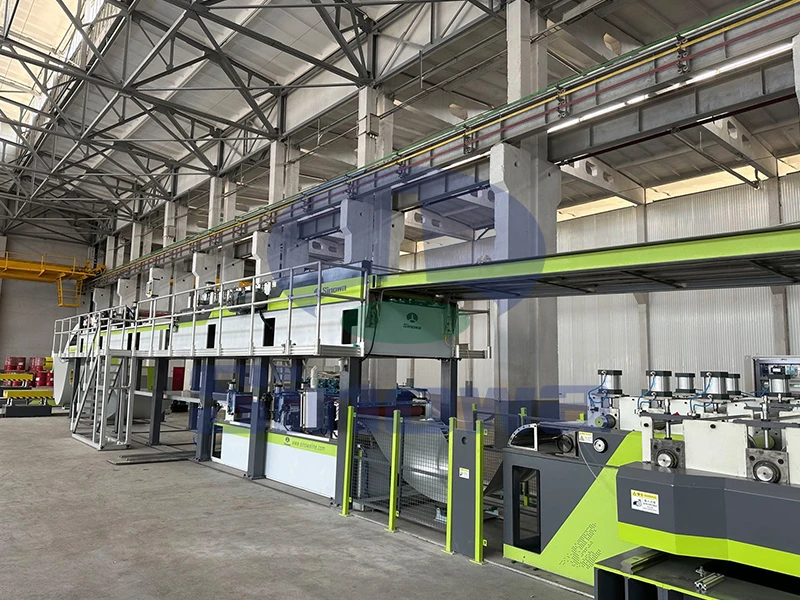
Panel deformation during the lamination of polyurethane sandwich panels is a persistent challenge that arises from a complex interplay of thermal, mechanical, and chemical variables within the production line. At its core, deformation manifests as warping, cupping, bowing, or uneven thickness across the panel face, and it typically becomes visible only after the panel exits the laminating section and cools to ambient temperature. The root causes are rarely isolated to a single parameter; rather, they emerge from imbalances between the rate of chemical expansion of the polyurethane foam, the thermal behavior of the facing materials, and the mechanical constraints imposed by the laminating machine. Understanding these interactions is essential for operators seeking to achieve flat, dimensionally stable panels consistently.
Temperature control stands as one of the most influential factors in panel deformation. The polyurethane core expands chemically within the laminating zone, generating exothermic heat that must be managed carefully through heated platens or roller systems. If the platen temperature is too high, the outer skin of the facing material softens prematurely, allowing the expanding foam to push the facings outward unevenly and creating localized bulges. Conversely, if the temperature is too low, the foam does not cure uniformly, leaving residual internal stresses that release later as the panel cools and contracts. The thermal conductivity mismatch between metal facings (typically steel or aluminum) and the insulating foam core compounds this effect, causing differential expansion rates that introduce bending moments within the sandwich structure.
Pressure distribution across the panel width and length is another critical determinant. The laminating machine applies pressure through a series of rollers or continuous belt systems, and any inconsistency in this pressure field directly translates into thickness variation and subsequent deformation. Uneven pressure may result from worn rollers, misaligned belt tracking, or debris accumulation on the contact surfaces. When one section of the panel receives more pressure than another, the foam density becomes non-uniform along the panel length. Higher density regions contract differently during cooling than lower density regions, establishing internal stress gradients that manifest as warping or twisting once the panel is released from the constraints of the machine.
The characteristics of the raw materials themselves introduce inherent deformation risks. Polyurethane chemical formulations vary in their reaction kinetics, viscosity profiles, and expansion ratios, and any deviation from the intended mixing ratio between the polyol and isocyanate components can dramatically alter the foam's behavior. An excess of one component may produce a softer, less dimensionally stable core with higher post-cure shrinkage. Similarly, the facing materials carry their own residual stresses from manufacturing processes such as roll forming, coating, or surface treatment. If these stresses are not relieved before lamination, they can interact with the newly formed foam core, pulling the panel into a cupped or curved shape as the adhesive bond sets.
The lamination line speed, or the dwell time within the curing zone, directly affects how completely the foam reacts and how securely the facings bond to the core. Running the line too fast means the panel exits the heating section before the foam has achieved its final structural strength, leaving the internal chemical reaction to complete after the panel has been cut and stacked. This delayed reaction generates continued expansion or shrinkage that pushes against already bonded facings, causing post-lamination deformation. On the other hand, excessive dwell time in the heated zone can over-cure the adhesive, reducing its elasticity and making the bond brittle, which leaves the panel vulnerable to stress cracking and dimensional movement as environmental conditions change.
Moisture content in the raw materials and the surrounding environment plays a surprisingly significant role. Polyurethane chemistry is highly sensitive to water, which reacts with isocyanate to produce carbon dioxide gas and altered foam structure. If the polyol component absorbs ambient moisture before mixing, the resulting foam will have inconsistent cell structure and unpredictable expansion behavior. Moisture on the facing surfaces, whether from condensation, storage conditions, or residual cleaning agents, also compromises the adhesive bond between the core and skins. A partial or contaminated bond allows the foam to shift internally during curing, creating asymmetric stress that pulls the panel out of flatness.
Cooling and handling practices immediately after lamination are often overlooked contributors to deformation. A panel that exits the line at elevated temperature must be allowed to cool evenly and without constraint before stacking. If panels are stacked while still warm, the weight of panels above compresses the softer, not-yet-rigid bottom layers, imprinting uneven thickness patterns. Stacking also traps heat between panels, slowing the cooling rate and extending the period during which the foam core is still undergoing molecular rearrangement. Uneven cooling — for example, when one face of a panel is exposed to ambient air while the other face contacts a stack — creates differential contraction that bows the panel before it reaches full dimensional stability.
Mechanical alignment of the laminating equipment directly influences whether the panel exits the machine flat. The parallelism between upper and lower belts, the alignment of roller axes, and the tension balance on the continuous belts all determine whether the panel experiences symmetric pressure throughout its journey through the line. Even a slight misalignment causes one edge of the panel to be squeezed more tightly than the other, producing a wedge-shaped cross-section that warps as the foam cools. Belt tension imbalances can introduce lateral stress into the facing material during the lamination process, and when that stress is combined with uneven adhesive curing, the panel retains a curled or twisted profile long after it leaves the machine.
Adhesive selection and application precision deserve separate consideration because the bond line acts as the structural interface that transmits stresses between the foam core and the facings. An adhesive that is too rigid restricts the natural thermal movement of the panel, concentrating stress at the edges and corners and causing warping at those locations. Conversely, an adhesive that is too soft may not fully transfer the load, allowing the foam core to shift relative to the skins during curing and creating internal shear stresses. Application inconsistencies — such as uneven spray coverage, nozzle clogging, or variations in adhesive thickness across the panel width — produce localized bond strengths that differ from one region to another, setting up the panel for asymmetric deformation as it reaches final cure.
Post-lamination environmental exposure and storage conditions complete the picture. Even a well-laminated panel can deform later if it is stored in conditions that differ substantially from those in which it was manufactured. Polyurethane foam is hygroscopic to a degree, and metal facings expand and contract with temperature swings. If a panel is stored leaning against a wall rather than lying flat, gravity introduces a bending moment that the not-yet-fully-cured core accommodates by developing a permanent curve. Similarly, exposure to direct sunlight on one face heats that side more than the other, creating temporary thermal bow that can become set if the condition persists long enough. Proper storage on flat supports, with even airflow on both faces, allows the panel to reach equilibrium without introducing mechanical distortion.
Addressing panel deformation requires a systematic approach that examines each of these factors in combination rather than in isolation. Operators who record and correlate temperature profiles, pressure readings, line speeds, material batch data, and post-lamination storage conditions over time can identify the specific imbalances driving deformation in their particular setup. Regular maintenance of rollers, belts, and applicators ensures consistent mechanical behavior, while controlled environmental conditions in both the production area and the finished goods storage zone reduce external stress inputs. By treating the lamination process as an integrated thermal-mechanical-chemical system rather than a sequence of independent steps, manufacturers can substantially reduce deformation rates and deliver panels that remain flat and dimensionally stable throughout their service life.
Gallery of Polyurethane Sandwich Panel Machine






Tags: polyurethane sandwich panel machine, polyurethane sandwich panel machine manufacturer, polyurethane sandwich panel machine supplier, china polyurethane sandwich panel machine, polyurethane sandwich panel machine for sale
-

The PU sandwich panel line is a core production setup for making high-performance building insulation panels. This professional PU sandwich panel production line features automated operation to streamline the whole manufacturing process efficiently. Every component of the polyurethane sandwich panel line is precisely calibrated to ensure consistent panel thickness and structural stability. A well-maintained polyurethane sandwich panel production line can greatly boost production efficiency while reducing manual operation errors. The continuous PU sandwich panel line adapts to diverse production demands for different panel sizes and surface styles. With advanced molding technology, the PIR sandwich panel line produces panels with excellent heat preservation and sound insulation properties. Stable running of the PIR sandwich panel production line guarantees reliable product quality for various construction and industrial application scenarios.
-

A phenolic insulation board production line serves as the core equipment for manufacturing high-performance thermal insulation building materials. This phenolic insulation panel production line integrates material mixing, foaming, molding and cutting processes to ensure continuous and stable production efficiency. Every operational link of the insulation board production line is precisely calibrated to produce uniform and durable insulation boards. The automated design of the insulation panel production line effectively reduces manual intervention and improves product consistency. Proper maintenance of the phenolic board production line can greatly extend its service life and maintain steady production output. With optimized structural design, the phenolic panel production line adapts to various production demands and delivers high-quality finished products for thermal insulation engineering applications.
-

A professional rockwool sandwich panel line serves as the core equipment for producing high-performance building panels. This rockwool sandwich panel production line integrates feeding, laminating and forming processes to ensure stable and efficient production. The well-structured rock wool sandwich panel line can process raw rockwool materials into panels with excellent thermal and sound insulation properties. Operators can adjust the running parameters of the rock wool sandwich panel production line to manufacture panels of different thicknesses and specifications. The automated design of the mineral wool sandwich panel production line greatly reduces manual operation errors and improves product consistency. Regular maintenance of the mineral wool sandwich panel line is essential to sustain long-term operational efficiency and guarantee qualified finished panels for diverse construction applications.