
The minimum panel length for PU sandwich panel machines refers to the shortest functional panel these devices can produce stably and precisely. It varies by machine type, structural design, and production workflow, with core constraints from cutting systems, conveyor operation, and foam curing processes.
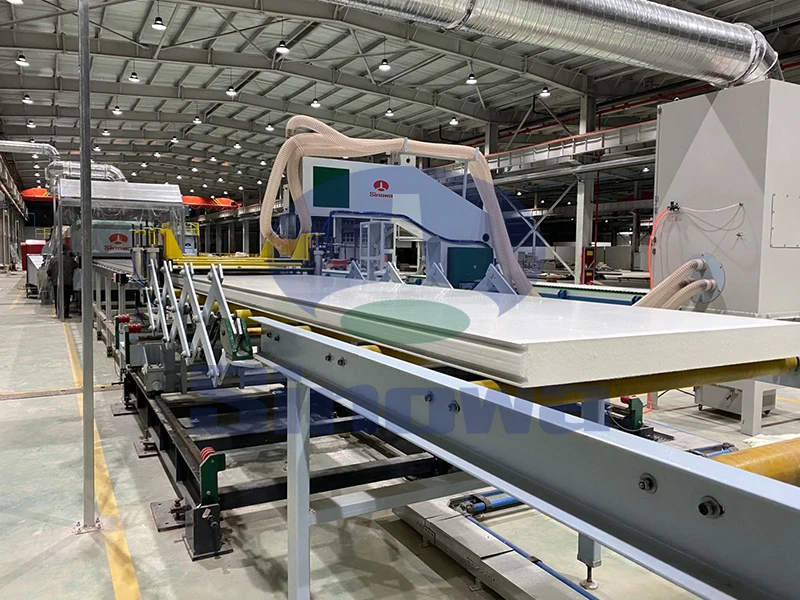
Understanding the minimum panel length of PU sandwich panel machines is essential for manufacturers to optimize production planning and meet diverse project demands. Unlike maximum panel length, which is largely flexible based on production line extension, the minimum length is a fixed operational threshold determined by inherent machine mechanical and processing limits. Most conventional PU sandwich panel production setups feature a practical minimum length range that balances production stability and product quality, avoiding defects caused by overly short panel blanks. This threshold is not arbitrarily set but derived from the coordinated operation of every core component in the production line, from material feeding and lamination to foaming, curing, and final cutting. Many processing failures, such as uneven foam filling and edge deformation, occur when producing panels shorter than the machine’s effective minimum length, making this parameter a key reference for daily production parameter setting.
The classification of PU sandwich panel machines directly shapes their minimum production length standards, mainly divided into continuous and discontinuous production lines. Continuous PU sandwich panel machines, which support uninterrupted automated production, typically have a practical minimum panel length of around 2 meters. This limitation stems from the flying saw cutting system and synchronous conveyor operation structure of continuous lines. The flying saw requires a certain moving stroke to complete stable positioning, cutting, and resetting actions; overly short panels cannot fully exit the pressing and curing area before the next cutting cycle starts, leading to overlapping processing and incomplete forming. In contrast, discontinuous intermittent press machines have a relatively higher minimum length threshold due to independent mold forming structures, as each mold cavity has a fixed effective forming length that restricts the shortest producible panel size.
The cutting system is the most direct factor restricting the minimum panel length of PU sandwich panel machines. Automated cross-cutting saws equipped on standard production lines rely on synchronous tracking technology to cut continuous panel blanks at fixed lengths. These cutting devices have fixed mechanical response cycles and cutting stroke ranges, which define their minimum effective cutting dimension. When processing panels below the threshold length, the saw blade cannot complete a full vertical and horizontal cutting path stably, resulting in uneven cutting edges, burrs, and irregular panel end shapes. Additionally, the automatic trimming devices on both sides of the production line need a minimum panel contact area to achieve accurate edge finishing. Ultra-short panels fail to maintain stable positioning during trimming, causing offset trimming and inconsistent panel width, which severely affects product uniformity and usability.
Conveyor and transmission system design plays a vital role in determining the minimum panel length for stable production. PU sandwich panel production requires multi-stage conveyor devices to transport metal sheets, support foaming lamination, and transfer finished panels. All conveyor rollers and belt groups operate with fixed synchronous speed and spacing parameters. Short panels lack sufficient contact area with the conveyor surface, leading to unstable clamping and slipping during high-speed operation. This unstable transmission causes inconsistent panel moving speed, disrupting the synchronization between foaming injection and lamination processes. Moreover, the transition section between different conveyor units requires a minimum panel length to avoid mid-transport tilting or jamming, which not only damages product quality but also increases the risk of machine equipment failure and production line shutdowns.
PU foam curing and forming characteristics are key internal process constraints on minimum panel length. The polyurethane foam core of sandwich panels needs a specific time and space to complete foaming, expansion, and curing reactions under constant temperature and pressure. The production line’s laminating and curing sections have fixed effective working lengths designed according to standard foaming cycles. Ultra-short panels pass through the curing zone too quickly, resulting in insufficient foam curing, incomplete core expansion, and unstable bonding between the foam core and metal surface layers. Uncured foam cores will shrink and deform after leaving the production line, leading to hollow interiors, delamination, and reduced structural strength of the panels. To ensure consistent foaming quality, machines are set with a minimum length that matches the shortest curing time required for qualified foam forming.
Downstream auxiliary processing mechanisms further define the practical minimum panel length of PU sandwich panel machines. After cutting and forming, finished panels need to go through stacking, conveying, and quality inspection procedures. Automatic stacking equipment relies on stable panel size specifications to complete orderly picking and stacking actions. Panels shorter than the minimum standard cannot be accurately positioned by the stacking manipulator, causing messy stacking and panel collision damage. Meanwhile, manual and automated quality inspection processes require a minimum panel size to detect surface flatness, bonding integrity, and dimensional accuracy effectively. Ultra-short panels cannot adapt to conventional inspection tool calibration standards, making it impossible to screen out unqualified products efficiently in mass production scenarios.
Production speed adjustment interacts with minimum panel length and affects overall production stability. PU sandwich panel machines support adjustable operating speeds to adapt to different production volumes and panel specifications. Higher production speeds require a longer minimum panel length to maintain process stability, as fast line speeds shorten the residence time of panels in each processing section. When the line speed increases, ultra-short panels cannot complete trimming, cutting, and curing processes in place, leading to a sharp rise in defective rates. Conversely, reducing production speed can slightly relax the minimum length limit, but excessive speed reduction will greatly reduce production efficiency and increase unit production costs. Therefore, manufacturers always match the optimal minimum panel length with conventional operating speeds to balance quality and efficiency.
Customized machine configurations can moderately adjust the minimum panel length threshold of standard equipment. Basic standard PU sandwich panel machines follow universal structural designs to meet most conventional building and cold storage panel production needs. For special scenarios requiring ultra-short panel production, targeted mechanical optimization can be carried out, including upgrading high-precision mini-stroke cutting saws, optimizing conveyor roller spacing, and shortening the effective interval of the curing section. These modifications reduce the machine’s minimum producible length while retaining stable processing performance. However, excessive customization to pursue ultra-short panel production will compromise the machine’s adaptability to conventional long panels and affect the versatility of the entire production line.
Failure to follow the machine’s minimum panel length standard will trigger multiple product quality and production risks. Panels produced below the qualified minimum length often suffer from comprehensive defects such as uneven foam density, weak interlayer bonding, irregular dimensional tolerance, and poor surface flatness. These defective panels have reduced thermal insulation performance and structural stability, failing to meet basic application requirements for building enclosure and cold storage insulation. In addition, long-term production of ultra-short unqualified panels will accelerate wear on cutting blades, conveyor systems, and foaming equipment, shorten the service life of core components, and increase daily maintenance costs and equipment failure rates for the production line.
Reasonable application of the minimum panel length parameter helps manufacturers formulate scientific production schemes and improve overall operational benefits. Production personnel need to arrange processing tasks according to the inherent minimum length limit of the machine, avoiding blind production of ultra-short panels that cause quality waste and equipment loss. For orders requiring small-batch short panels, manufacturers can adjust production parameters appropriately within the machine’s allowable range or adopt segmented production and post-processing cutting methods to ensure product qualification. Mastering the matching relationship between minimum panel length, machine performance, and production processes also helps operators optimize line operation parameters, stabilize product quality consistency, and maximize the production efficiency and service value of PU sandwich panel machines.