
Operating a PU sandwich panel production line requires a well-structured team of workers with divided operational and supervisory duties. The total staffing number varies by line automation level, production scale and workflow arrangement, with clear role divisions ensuring stable and efficient manufacturing operations.
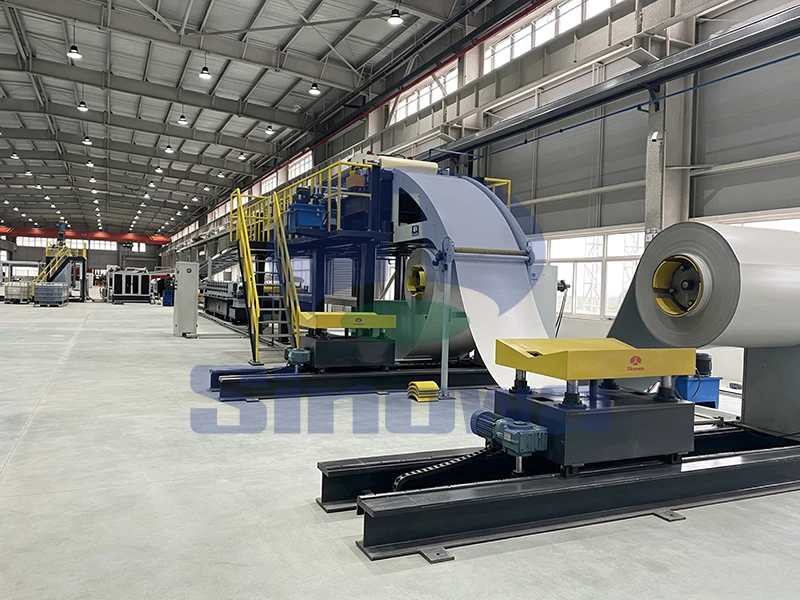
The staffing requirement for a PU sandwich panel production line is primarily determined by the degree of automation integrated into the production system. Fully automated production lines minimize manual intervention, focusing workers on monitoring and quality inspection, while semi-automated and manual-heavy lines demand more on-site operators to complete material handling and process adjustment. Small-scale production lines with low daily output can operate with a lean team, while large-capacity lines pursuing continuous batch production need additional staff to maintain uninterrupted workflow. Beyond basic operation, auxiliary work such as equipment maintenance, material preparation and finished product sorting also occupies a certain number of workers, making overall staffing a comprehensive match of core production and auxiliary positions. Reasonable staffing allocation avoids labor redundancy or shortage, which is critical to balancing production efficiency and operational cost in daily manufacturing.
The core front-line operator is the most fundamental position for running a PU sandwich panel line, undertaking real-time control of key production processes. These workers are mainly responsible for starting and debugging production equipment before formal operation, checking the running status of conveyor belts, foaming systems and pressing machines, and adjusting operational parameters according to production demands. During continuous production, they need to observe the foaming uniformity of PU materials, the bonding tightness of panel layers and the flatness of finished panels, timely correcting minor equipment deviations to avoid product defects. They also need to record daily production data, including production volume, equipment operation status and abnormal situations, to provide basic data for production management. Skilled operators can effectively reduce production downtime and improve product yield, making their proficiency a key factor affecting actual staffing efficiency on the production line.
Material preparation workers play an indispensable supporting role in the smooth operation of the PU sandwich panel line, ensuring continuous and standardized material supply. Their daily work includes sorting, inspecting and placing raw materials such as metal sheets, PU foam raw materials and adhesive materials, removing unqualified raw materials that may affect product quality in advance. They are also responsible for transporting qualified raw materials to designated feeding positions of the production line in an orderly manner, ensuring that the feeding speed matches the production rhythm to avoid production suspension caused by material shortage. In addition, they need to manage raw material storage areas, classify different types of materials, and keep the feeding area clean and tidy to prevent impurities from mixing into production links. Sufficient material preparation staff can eliminate material supply bottlenecks and create stable preconditions for continuous production of the assembly line.
Quality inspection workers are essential to guarantee the finished product qualification rate of PU sandwich panels, undertaking full-process quality monitoring work. They conduct sampling and comprehensive inspection of semi-finished products in key production links, including checking the thickness consistency of panels, the firmness of composite bonding, and the uniformity of PU foaming structure. For finished panels off the production line, they need to detect surface flatness, edge cutting precision and overall structural integrity, screening out defective products in a timely manner to prevent unqualified products from entering the packaging and storage link. Meanwhile, quality inspection workers are required to summarize defective product data regularly, analyze potential quality problems caused by equipment operation or operational errors, and feed back improvement suggestions to production operators. Professional quality inspection staffing effectively controls product quality risks and stabilizes the overall production quality level of the line.
Equipment maintenance workers ensure the long-term stable operation of the entire PU sandwich panel production line and reduce unexpected production downtime. These workers are responsible for daily routine maintenance of all production equipment, including cleaning production devices, lubricating mechanical parts, checking circuit and pipeline safety, and fastening loose components. They also conduct regular equipment debugging and performance testing to ensure that foaming equipment, pressing equipment and cutting equipment maintain optimal operating conditions. When equipment fails during production, maintenance workers need to respond quickly to diagnose problems and complete emergency repairs in the shortest time to minimize production losses. In addition, they will formulate regular maintenance plans according to equipment operating cycles, replace aging parts in advance, and avoid major equipment failures. A dedicated maintenance team is the core guarantee for the continuous and efficient operation of the production line.
Finished product sorting and packaging workers take charge of the post-production processing of PU sandwich panels, completing the final link of standardized product delivery. After qualified panels are inspected, these workers classify panels according to different specifications, sizes and production batches, avoiding batch confusion of products. They are responsible for trimming minor burrs on panel edges, cleaning surface dust and impurities, and carrying out standardized packaging to protect panels from damage during transportation and storage. Meanwhile, they need to count finished products accurately, record packaging quantity and batch information, and stack packaged products in designated storage areas in order. They also cooperate with warehouse management work to ensure clear product classification and convenient subsequent outbound and inventory management. Sufficient staffing in this link can improve post-production processing efficiency and ensure neat and standardized product delivery.
Production line supervisors undertake overall scheduling and management responsibilities, coordinating all links and staff to ensure orderly production progress. Supervisors are responsible for formulating daily production plans, reasonably arranging the work content and shifts of each position, and optimizing staffing allocation according to real-time production tasks. They need to patrol the production site regularly, supervise the standardized operation of front-line workers, correct irregular operational behaviors, and ensure that all production links proceed in accordance with standardized processes. When production abnormalities such as parameter deviation, material shortage or equipment failure occur, supervisors coordinate relevant staff to solve problems quickly and adjust production arrangements timely. They also summarize daily production conditions, optimize production workflows, and balance production efficiency, product quality and labor cost to maximize the overall operational efficiency of the production line.
The shift arrangement mode directly affects the total number of workers required for the PU sandwich panel production line. Most panel production lines adopt continuous production modes to improve equipment utilization rate, requiring multi-shift rotation of workers to achieve 24-hour uninterrupted operation. A single-shift production mode only needs one set of staff for all positions, with the minimum total staffing, suitable for small-batch and intermittent production demands. Double-shift or three-shift operation requires duplicating core and auxiliary position staff according to shift quantity, significantly increasing total labor demand. Reasonable shift staffing needs to avoid excessive staff redundancy while ensuring no position vacancy during production handover. Standardized shift handover management ensures that production state, equipment condition and pending work are fully communicated between shifts, maintaining production consistency and stability.
Production scale and daily output targets are key factors regulating the fine staffing of the PU sandwich panel line. For small-batch customized production with low daily output, the production line can adopt lean staffing, with individual workers taking charge of multiple auxiliary positions on the premise of ensuring operational safety and product quality. For mass continuous production with high daily output, each position needs independent dedicated staff to avoid work overload and efficiency decline caused by excessive single-person workload. Large-scale production scenarios also require additional standby workers to cope with temporary staff leave, sudden production tasks and equipment emergency situations, ensuring that the production progress will not be affected by unexpected factors. Matching staffing quantity with production scale can effectively balance operational efficiency and labor cost, realizing scientific and reasonable production resource allocation.
In summary, the staffing of a PU sandwich panel production line is a flexible allocation system based on automation level, production scale and management mode. A complete operational team covers front-line operation, material support, quality inspection, equipment maintenance, post-processing and management supervision positions, with total staff quantity ranging from a lean team for small-scale production to a complete team for large-scale continuous production. Scientific staffing division and reasonable shift arrangement not only ensure the stable operation of the production line and qualified product quality, but also optimize labor resource utilization, avoiding waste of human resources while meeting different production demands.