
PU sandwich panel production lines generally require professional on-site installation instead of direct plug-and-play use.
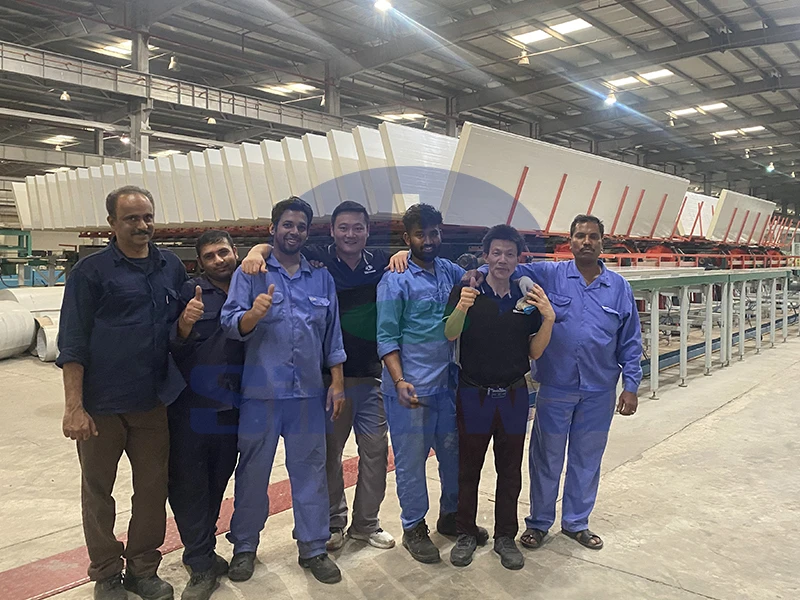
Many industry practitioners and new investors often wonder whether a PU sandwich panel production line can be put into use directly after factory delivery, as small mechanical equipment usually supports simple self-installation and rapid commissioning. In fact, the full-automatic PU sandwich panel production line is a large-scale integrated industrial equipment composed of dozens of functional modules, which involves mechanical transmission, foam injection molding, constant temperature curing, automatic cutting and continuous conveying systems. Unlike standalone machinery, these core modules cannot operate independently and need precise docking and overall assembly on the user’s production site. The pre-assembly work completed in the equipment factory is only partial modular debugging, which cannot meet the overall linkage operation requirements of the production line. Therefore, basic on-site installation and assembly are indispensable prerequisites for the normal operation of the equipment, and self-installation by users will easily lead to module dislocation and operational failure.
The core reason why PU sandwich panel production lines rely on on-site installation lies in the personalized matching of on-site production conditions. Each factory’s production workshop has different spatial dimensions, ground flatness, power supply parameters and ventilation environments, all of which directly affect the installation position and assembly mode of the production line. Professional installation technicians will first conduct on-site surveying and mapping before formal assembly, reasonably plan the equipment layout according to the workshop’s length, width and height, and reserve sufficient space for material feeding, finished product output and daily equipment maintenance. Meanwhile, they will adjust the equipment’s horizontal level and assembly accuracy according to the ground foundation conditions to avoid equipment vibration, material deviation and uneven panel foaming during high-speed operation. This personalized on-site adaptation cannot be completed through factory pre-installation, making on-site construction an irreplaceable link.
On-site installation is critical to ensuring the operational accuracy and product quality of PU sandwich panel production lines. The production of high-quality PU sandwich panels requires extremely high precision in equipment docking, including the alignment of conveying rollers, the calibration of foam injection ports and the synchronization of cutting and molding systems. Slight assembly errors will cause problems such as inconsistent panel thickness, uneven foam density, edge warping and unqualified cutting size, which will greatly reduce the yield of finished products. Professional on-site installation follows a complete assembly process, conducting layer-by-layer calibration and debugging for each functional module during the assembly process. After the overall assembly is completed, technicians will test the linkage operation of the whole line to ensure that all processes from raw material feeding, foaming, curing to finished product cutting operate stably and coordinately, laying a solid foundation for stable product quality in subsequent mass production.
Safety operation specifications also require standardized on-site installation of PU sandwich panel production lines. This type of production line involves high-power electrical systems, high-pressure foam injection devices and continuous mechanical transmission structures, with certain potential safety hazards in the production process. Standard on-site installation includes standardized wiring of electrical circuits, fixed installation of safety protection devices, sealing treatment of foam injection pipelines and grounding protection of the whole equipment. Professional technicians will reasonably arrange the circuit and pipeline layout according to on-site safety requirements to avoid circuit short circuit, pipeline leakage and mechanical collision risks caused by irregular installation. In addition, on-site installation will also complete the debugging of emergency stop devices and safety warning systems, ensuring that the equipment can respond quickly to abnormal situations during operation and guarantee the safety of on-site operators and production equipment.
It is worth noting that the on-site installation of PU sandwich panel production lines is different from simple equipment assembly, and it also includes adaptive debugging for production process parameters. Different users have different production demands, such as different panel thicknesses, surface materials and foaming process requirements. After completing the mechanical assembly of the equipment, on-site technical personnel will adjust the operating speed of the conveying system, the injection volume and pressure of PU foam materials, the temperature of the curing system and the cutting parameters according to the user’s customized production needs. This integrated work of installation and parameter debugging enables the equipment to quickly match the user’s production standards after being put into operation, shorten the trial production cycle, and avoid the problem of low production efficiency and unqualified products caused by mismatched process parameters after simple self-installation.
Some users mistakenly believe that skid-mounted integrated production lines can eliminate on-site installation links, but this understanding is not accurate. Although the optimized skid-mounted PU sandwich panel production line integrates most modules in the factory and reduces on-site assembly workload, it still requires necessary on-site fixing, pipeline connection, circuit debugging and overall level calibration. The integrated design only simplifies the disassembly and transportation process of the equipment, but cannot eliminate the adaptation work matching the on-site environment. Without on-site professional debugging, the integrated equipment may have problems such as unstable operation speed, poor foaming effect and inconsistent product specifications. Therefore, even the highly integrated production line cannot completely get rid of on-site installation and debugging work.
The standard on-site installation process of PU sandwich panel production lines can be divided into multiple standardized links, with rigorous operation logic in each step. The whole process starts with on-site environment inspection and foundation acceptance, followed by equipment positioning and fixing, module docking and assembly, circuit and pipeline connection, single-module debugging, whole-line linkage testing and parameter optimization. Each link has professional operation standards and inspection indicators. For example, the equipment fixing link needs to ensure stable ground installation to resist vibration generated by long-term operation; the module docking link needs to ensure the precise gap between matching parts; the linkage debugging link needs to simulate continuous production to detect potential operational faults. The complete on-site installation process ensures the long-term stable operation of the equipment and extends the service life of the production line.
Neglecting professional on-site installation and adopting self-installation will bring many hidden troubles to the operation of PU sandwich panel production lines. Users who lack professional mechanical and electrical technology often fail to complete precise calibration and parameter debugging during self-installation, resulting in frequent equipment failures in the later stage, such as conveying deviation, foam blockage and inaccurate cutting. These problems will not only reduce production efficiency and increase the scrap rate of raw materials, but also lead to increased maintenance costs and frequent shutdowns for overhaul. In addition, irregular self-installation may cause hidden safety hazards, and unstandardized circuit and pipeline layout may trigger equipment failures or safety accidents during long-term operation, bringing greater economic losses to production enterprises.
The after-sales service system of the industry also takes on-site installation as a standard supporting service for PU sandwich panel production line delivery. Formal equipment suppliers will arrange professional technical teams to follow up the whole process of on-site installation, debugging and training after equipment delivery. While completing equipment assembly and parameter debugging, technicians will also provide on-site operation guidance and daily maintenance training for enterprise operators, helping employees master equipment operation skills and daily fault judgment methods. This one-stop service mode centered on on-site installation can help users quickly complete equipment commissioning and put it into formal production, maximizing the use value of production line equipment.
In conclusion, on-site installation is an essential and indispensable link for the deployment and operation of PU sandwich panel production lines. Whether it is a fully split production line or a highly integrated skid-mounted production line, professional on-site assembly, environmental adaptation and parameter debugging are required. On-site installation guarantees the assembly accuracy, operational stability and production safety of the equipment, and is the key premise to ensure product quality and production efficiency. Enterprises should abandon the idea of self-installation and choose professional on-site installation services to lay a stable foundation for long-term and standardized production.