Sandwich Panel Production Machinery
Publication Date: Oct 13, 2026
Sandwich panel production machinery fabricates insulated composite panels with polyurethane, phenolic, PIR, rock wool, mineral wool, and glass wool cores for roofing, walling, and cold storage applications worldwide.
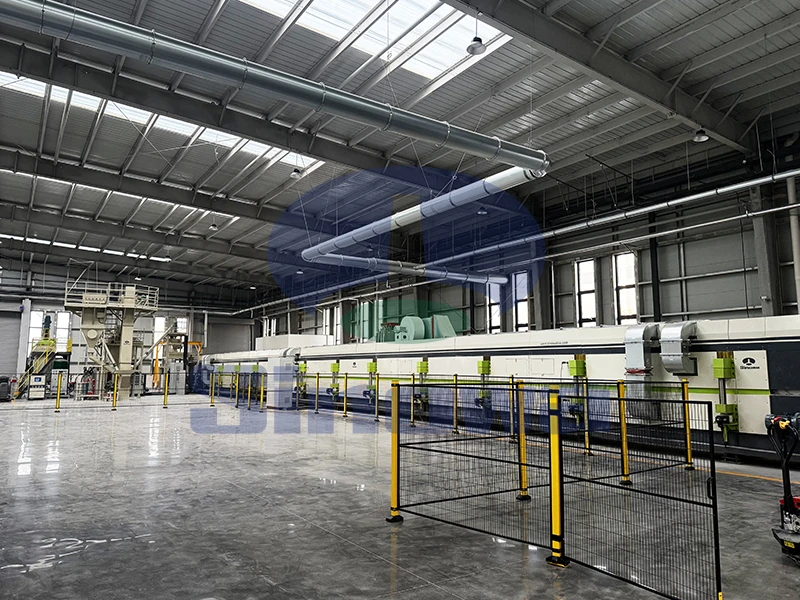
Sandwich panel production lines are continuous or semi-continuous systems that combine two thin metal facings—typically pre-painted steel, galvanized steel, or aluminum—with a rigid insulating core to create a finished building envelope element. The machinery handles uncoiling, feeding, profiling, foaming or core insertion, laminating, curing, cutting, and stacking in a coordinated sequence. Different core materials demand distinct process conditions: organic foams require precise chemical dosing and controlled temperature profiles, while mineral fiber systems need unwinding, density regulation, and adhesive bonding. Modern lines accommodate both horizontal and vertical forming configurations, and many are engineered to switch between core types within a single shift. This flexibility is central to meeting demand across industrial, commercial, agricultural, and cold-chain construction sectors.
Polyurethane sandwich panel production machinery centers on high-pressure foaming technology. A two-component system of polyol and isocyanate is metered through a impingement mixing head, then dispensed onto the lower metal sheet as it travels along the conveyor. The line's heating zones maintain a temperature that promotes rapid reaction, cell formation, and dimensional stability, while the upper facing is laminated on top before the panel enters a continuous curing tunnel. PU cores offer excellent adhesion to metal faces, low thermal conductivity, and fast cycle times, making them a default choice for general-purpose wall and roof panels. Equipment in this segment emphasizes chemical ratio accuracy, head cleanliness, and waste reduction, as over-dispensing or uneven distribution directly affects panel flatness and insulating performance.
Phenolic sandwich panel machinery addresses the unique chemistry of phenolic foam, which exhibits inherently fire-resistant properties and low smoke emission. Unlike PU, phenolic systems rely on resin and catalyst blending with strict humidity control, because the cure reaction is sensitive to ambient moisture and temperature. Production lines for phenolic panels typically include pre-heating stations for both facings, a foam distribution section calibrated for low-pressure pouring, and extended curing ovens that allow the foam to reach its characteristic rigid, closed-cell state. The machinery must also handle the acidic nature of phenolic formulations, which means corrosion-resistant contact parts and frequent cleaning protocols. Phenolic panels are favored where fire safety is a primary concern, such as public buildings, transit stations, and high-rise facades.
PIR, or polyisocyanurate, production equipment shares high-pressure dosing architecture with PU lines but is tuned for higher isocyanate indices and a trimerization catalyst that drives thermal stability beyond standard polyurethane. The result is a foam with higher service temperature resistance and improved fire performance compared to conventional PU. PIR machinery features reinforced temperature control along the curing section, because the exothermic trimer reaction generates significant heat that must be managed to prevent scorching or core delamination. Lines producing PIR panels often accommodate thicker core depths and are specified for commercial roofing systems and industrial cold envelopes where higher insulation value per inch is required. Equipment suppliers design these lines with modular dosing units so that PU and PIR recipes can be interchanged without major mechanical reconfiguration.
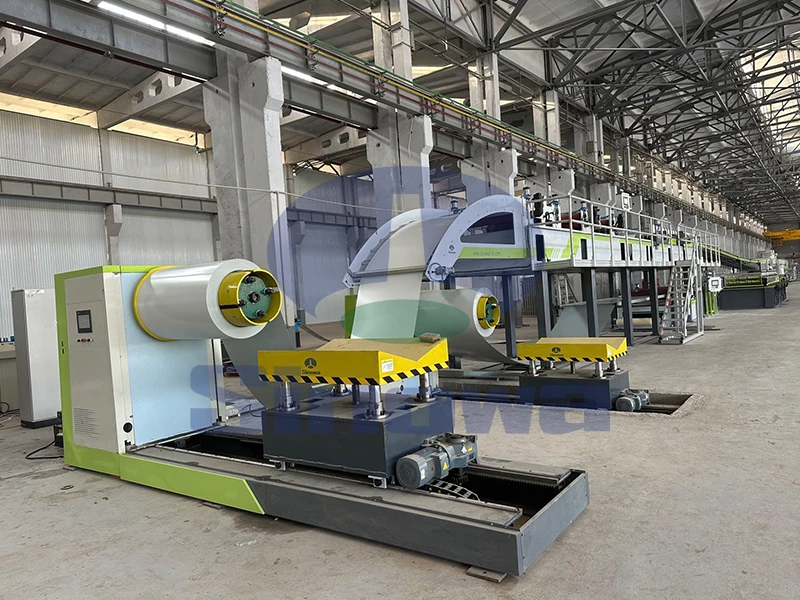
Rock wool sandwich panel machinery is built around mineral fiber rather than liquid foam. The process begins with rock wool blanket unwinding from large rolls, followed by density adjustment via compression rollers, application of thermosetting adhesive, and lamination between metal facings inside a heated press or continuous laminator. Unlike foam lines, rock wool systems do not require chemical mixing heads; instead, their critical elements include blanket alignment, thickness uniformity, and bond strength. Because rock wool is inherently non-combustible, panels produced on this equipment are specified for fire-rated partitions, industrial kitchen walls, and industrial roofing where flame spread control matters. The machinery also includes trimming and cross-cutting stations that handle rigid fiber cores without crumbling or edge delamination.
Mineral wool production lines share many mechanical principles with rock wool equipment but differ in raw material handling. Mineral wool—often manufactured from slag or basalt fibers—arrives in rolls or loose fibers and must be formed into a consistent batting before facing lamination. The machinery incorporates fiber spreading chambers, resin spray stations, and curing ovens that lock the fibers into dimensionally stable boards. Density control is especially important here, as mineral wool panels are used both for acoustic walling and for load-bearing composite applications. Lines producing mineral wool panels are typically built wider than foam lines to accommodate acoustic panel formats, and they include edge sealing systems to prevent fiber erosion at cut surfaces.
Glass wool sandwich panel machinery is engineered for the lightest fiber core of the mineral family. Glass wool is supplied as compressed blankets that expand during production, and the line must manage this spring-back while laminating facings. The process includes an unwinding station with tension control, adhesive coating, a forming belt that sets final thickness, and a low-temperature curing oven. Because glass wool offers excellent thermal and acoustic performance at lower weight, panels from this machinery are commonly used in suspended ceiling systems, lightweight wall partitions, and prefabricated building modules. Equipment design emphasizes gentle handling to preserve fiber loft and uniform adhesive distribution across the blanket.
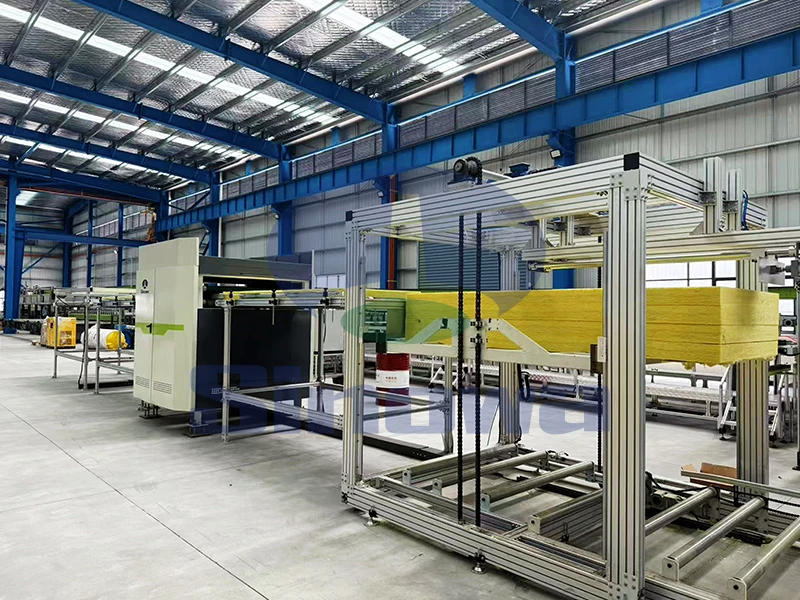
For roof panel applications, all six machine types produce profiles tailored to trapezoidal or corrugated facing sheets. Roll-forming units integrated upstream of the laminating section shape the lower and upper skins into standing-seam or exposed-fastener profiles. Roof-oriented lines often include longitudinal micro-ribbing on the upper sheet for stiffness and run at moderate speeds to maintain core-to-skin bond across wide widths. PU, PIR, and rock wool configurations are particularly common for roof systems because they balance insulation, span capability, and weather resistance. The downstream section includes automated sawing that cuts panels to length while preserving profile alignment, and stacking racks that prevent roof panel deformation during storage.
Wall panel production machinery, by contrast, typically produces flat or micro-ribbed vertical panels with concealed fixing systems. Lines optimized for wall panels include urethane jet systems that create edge side seals (the "junction" or joint profiles) that allow panels to interlock during installation. Wall panel machines frequently run at higher line speeds than roof lines because facings are flatter and core flow is more predictable. Acoustic-wall variants produced on mineral wool or glass wool lines incorporate perforated upper sheets; the machinery must handle perforated coil without tearing and synchronize perforation pattern with panel length. Applications range from cleanroom interiors and office partitions to industrial factory exteriors and agricultural buildings.
Cold storage panel production represents a specialized subset of all six machine platforms. These panels require very low thermal conductivity, airtight joints, and vapor-proof facings. PU and PIR lines dominate this segment because their closed-cell foams offer the best insulation per unit thickness, and the machinery is configured with edge-foaming or gasket-insertion stations that create thermal breaks at panel joints. Rock wool and glass wool cores appear in cold storage applications where fire compartmentation is also required, such as loading docks and freezer-to-chiller transition zones. The production equipment for cold room panels includes strict dimensional tolerance control, because even small gaps in the joint compromise temperature stability inside the room. Final output includes panels ranging from small-scale walk-in coolers to large distribution-center freezer envelopes, all fabricated on continuous or batch systems calibrated for the specific core material and facing combination chosen by the manufacturer.
Gallery of Sandwich Panel Production Machinery






Tags: sandwich panel production machinery, sandwich panel production machinery manufacturer, sandwich panel production machinery supplier, china sandwich panel production machinery, sandwich panel production machinery for sale
https://www.sandwichpanelmachinery.com/tags/sandwich-panel-production-machinery.html
-

The PU sandwich panel line is a core production setup for making high-performance building insulation panels. This professional PU sandwich panel production line features automated operation to streamline the whole manufacturing process efficiently. Every component of the polyurethane sandwich panel line is precisely calibrated to ensure consistent panel thickness and structural stability. A well-maintained polyurethane sandwich panel production line can greatly boost production efficiency while reducing manual operation errors. The continuous PU sandwich panel line adapts to diverse production demands for different panel sizes and surface styles. With advanced molding technology, the PIR sandwich panel line produces panels with excellent heat preservation and sound insulation properties. Stable running of the PIR sandwich panel production line guarantees reliable product quality for various construction and industrial application scenarios.
-

A phenolic insulation board production line serves as the core equipment for manufacturing high-performance thermal insulation building materials. This phenolic insulation panel production line integrates material mixing, foaming, molding and cutting processes to ensure continuous and stable production efficiency. Every operational link of the insulation board production line is precisely calibrated to produce uniform and durable insulation boards. The automated design of the insulation panel production line effectively reduces manual intervention and improves product consistency. Proper maintenance of the phenolic board production line can greatly extend its service life and maintain steady production output. With optimized structural design, the phenolic panel production line adapts to various production demands and delivers high-quality finished products for thermal insulation engineering applications.
-

A professional rockwool sandwich panel line serves as the core equipment for producing high-performance building panels. This rockwool sandwich panel production line integrates feeding, laminating and forming processes to ensure stable and efficient production. The well-structured rock wool sandwich panel line can process raw rockwool materials into panels with excellent thermal and sound insulation properties. Operators can adjust the running parameters of the rock wool sandwich panel production line to manufacture panels of different thicknesses and specifications. The automated design of the mineral wool sandwich panel production line greatly reduces manual operation errors and improves product consistency. Regular maintenance of the mineral wool sandwich panel line is essential to sustain long-term operational efficiency and guarantee qualified finished panels for diverse construction applications.