How To Prevent Material Waste In Glass Wool Sandwich Panel Production Line?
Publication Date: Oct 8, 2026
Explores practical, actionable strategies to minimize glass wool and auxiliary material waste in sandwich panel production, covering process optimization, equipment maintenance, recycling and operational management.
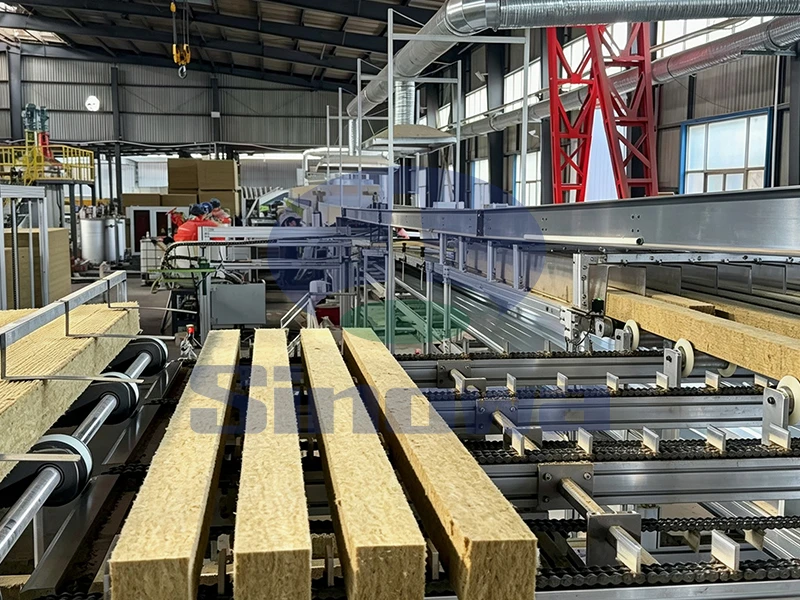
Material waste in glass wool sandwich panel production mainly stems from imprecise raw material feeding, unoptimized cutting processes, equipment residue, and improper operational management, which not only causes resource loss but also reduces overall production efficiency. Many production lines generate excessive waste due to blind material feeding, where workers add excess glass wool and adhesive materials to avoid product defects, leading to massive unnecessary material consumption in every production batch. Additionally, inconsistent production parameter settings during batch switching often result in unqualified semi-finished products that have to be scrapped, further amplifying waste volume. Addressing these root causes requires systematic optimization of the entire production process rather than single-point adjustments, focusing on precise control, standardized operation, and cyclic material utilization throughout the workflow. By refining every production link from raw material input to finished product output, manufacturers can effectively cut down invalid material consumption and improve resource utilization efficiency steadily.
Precise raw material proportioning and quantitative feeding is the foundational step to reduce glass wool waste in sandwich panel production. Traditional manual feeding relies on empirical judgment, which inevitably leads to uneven material dosage and surplus raw materials remaining in production equipment. Modern production lines can adopt intelligent quantitative feeding systems to calibrate material dosage according to different panel specifications, accurately controlling the usage of glass wool substrates, adhesives, and surface layer materials for each product unit. These automated systems maintain stable material output speed and dosage, avoiding material overflow and accumulation caused by unstable feeding pressure. Meanwhile, real-time material monitoring modules can track raw material consumption data dynamically, reminding operators to adjust parameters timely when dosage deviation occurs. This precise feeding mode eliminates the excessive material input caused by manual uncertainty, ensuring that each batch of raw materials is fully converted into qualified products and greatly reducing preliminary material waste in the production stage.
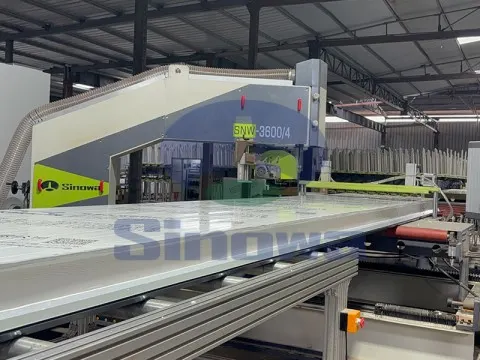
Optimizing cutting and trimming processes plays a vital role in minimizing finished and semi-finished product waste in glass wool sandwich panel production. Conventional manual cutting and mechanical fixed-size cutting often produce large amounts of edge scraps and size-unqualified waste products due to measurement errors and inflexible size adjustment. Upgrading to high-precision automatic cutting equipment can realize customized fixed-length cutting and edge trimming according to actual order requirements, effectively controlling cutting errors within a tiny range. The intelligent cutting system can also carry out unified layout planning for panel cutting according to different product dimensions, maximizing the utilization rate of raw plate materials and reducing the generation of irregular scraps. Moreover, synchronizing cutting speed with the front-end laminating and forming speed avoids panel deformation and damage caused by speed mismatch, which would otherwise lead to product scrapping. Optimized cutting processes not only reduce solid waste generation but also improve the consistency of finished product sizes, lowering rework and scrap rates significantly.
Regular professional equipment maintenance and intelligent self-cleaning management effectively avoid material waste caused by equipment failure and residual material solidification. During continuous production, glass wool residues, residual adhesives, and dust impurities easily adhere to the inner walls of feeding pipelines, forming machines, and laminating equipment. If not cleaned timely, these residues will solidify over time, causing equipment blockage, uneven material transmission, and product quality abnormalities, which force the abandonment of semi-finished products and waste residual raw materials. Equipping production equipment with automatic self-cleaning functions can thoroughly clean internal residual materials after each production batch, preventing material deterioration and equipment failure caused by long-term accumulation. In addition, formulating a regular maintenance schedule to inspect and calibrate key equipment such as feeding systems and cutting devices ensures stable operating accuracy. Well-maintained equipment maintains consistent production quality, reduces defective product rates, and avoids repeated material consumption caused by equipment malfunctions.
Establishing a complete production material recycling system is an efficient way to realize resource reuse and reduce overall waste. A large number of recyclable glass wool off-cuts, edge trims, and uncontaminated leftover materials are generated during the cutting, trimming and forming stages of sandwich panel production. In traditional production modes, these scraps are directly discarded as waste, resulting in serious resource waste. By installing sealed centralized collection devices at key waste-generating positions, manufacturers can classify and collect clean production scraps uniformly. The collected qualified glass wool scraps can be reprocessed and put back into the raw material mixing and feeding link after simple screening and treatment, realizing cyclic utilization of resources. Even a small amount of slightly contaminated waste materials can be professionally treated and reused in auxiliary production links instead of being directly discarded. Perfect recycling mechanisms convert production waste into reusable resources, greatly reducing the overall raw material demand and waste discharge of the production line.
Standardizing staff operation specifications and strengthening professional skill training can effectively reduce human-induced material waste. Improper manual operations are one of the important causes of unnecessary waste in glass wool sandwich panel production. Unskilled operators may make mistakes in parameter setting, material handling, and equipment operation, leading to unqualified products, material overflow, and improper material storage loss. Formulating unified and detailed standard operating procedures for all production links clarifies operational standards for material feeding, equipment adjustment, product processing, and waste disposal. Regular professional training and on-site skill assessment for production staff can improve their proficiency in equipment operation and parameter adjustment, enabling them to accurately handle various production conditions. Meanwhile, strengthening staff’s waste reduction awareness makes them pay more attention to material saving and standardized operation in daily work, effectively reducing human error-induced scrap and material loss.
Dynamic production parameter adjustment and batch production optimization help cut down invalid waste caused by parameter mismatch. Different specifications of glass wool sandwich panels require matched production parameters such as feeding speed, laminating pressure, and curing time. Fixed parameter settings for all production batches will lead to unadapted production conditions, resulting in incomplete bonding, uneven material distribution, and product defects. Setting flexible adjustable parameter modes for the production line allows operators to adjust production parameters in real time according to product specifications, batch size, and raw material characteristics. Before switching production batches, conducting pre-production debugging and trial production can identify parameter deviations in advance, avoiding large-scale defective product waste caused by parameter errors. In addition, optimizing batch production scheduling to concentrate production of products with similar specifications reduces frequent parameter adjustment and equipment switching, lowering the waste generated during production transition periods.
Scientific raw material storage and batch management prevent material deterioration and loss before production. Glass wool raw materials and supporting adhesives are susceptible to moisture, dust pollution, and improper stacking during storage, which leads to material performance degradation and inability to be used normally, forming inventory waste. Building a dry, dust-proof and constant-temperature raw material storage area can effectively protect the performance of glass wool and auxiliary materials, avoiding material deterioration caused by adverse storage environments. Implementing first-in-first-out inventory management ensures that early-stored raw materials are prioritized for use, preventing long-term stockpiling leading to material aging and failure. Meanwhile, conducting regular inventory sorting and quality inspection of stored raw materials can screen out deteriorated materials in advance and make reasonable use of slightly defective materials through formula adjustment, reducing direct discard of raw materials and improving inventory material utilization rate.
Real-time production data monitoring and intelligent early warning systems realize timely intervention of waste risks. Traditional production management relies on manual post-inspection of product quality and waste volume, which can only count waste loss after waste is generated, failing to realize pre-control. Introducing an intelligent production monitoring system can collect real-time data of raw material consumption, equipment operation status, product qualification rate and waste generation volume during the whole production process. The system can automatically identify abnormal data such as excessive material consumption, increased defective products and equipment operation deviations, and send early warning signals to operators in a timely manner. Staff can quickly locate abnormal links and adjust production operations, preventing small-scale abnormal problems from evolving into large-scale material waste. Data-based production management realizes precise control of the whole production process, fundamentally reducing controllable waste generated by unmonitored production abnormalities.
Continuous process iteration and waste statistical analysis help form a long-term waste reduction mechanism. Waste reduction in glass wool sandwich panel production is not a one-time optimization work but a continuous improvement process. Enterprises can conduct regular statistical analysis on production waste data, classify and count the waste volume generated in each production link, and identify key waste-generating links and root causes. Based on data analysis results, targeted process optimization and equipment upgrading can be carried out for high-waste links to continuously reduce waste generation. Meanwhile, summarizing effective waste reduction experience and incorporating it into production operation standards can form a standardized and normalized waste management system. Continuous process improvement and data-driven optimization enable the production line to maintain efficient resource utilization status for a long time, realizing sustainable reduction of production waste.
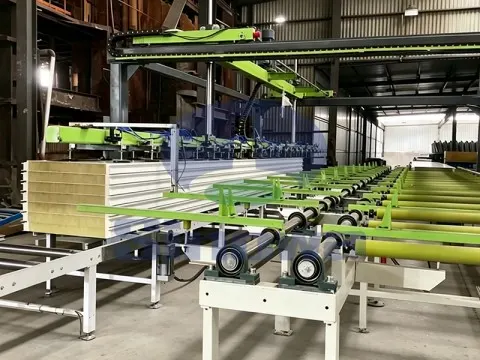
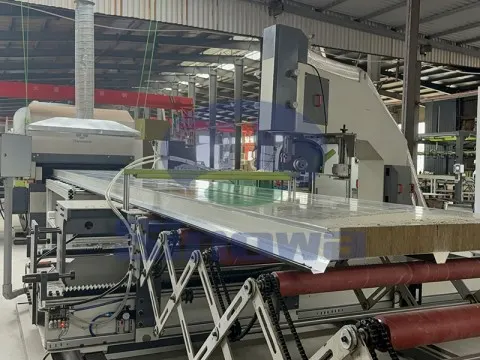
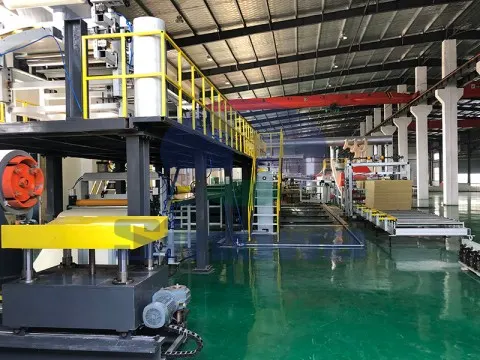
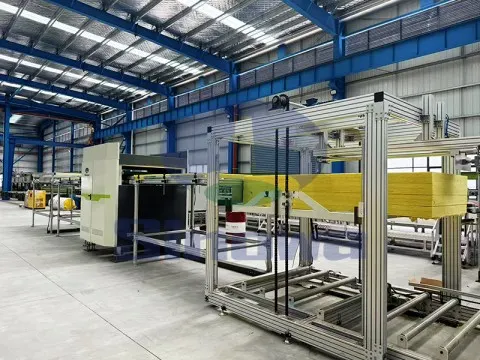
Gallery of Glass Wool Sandwich Panel Production Line
Tags: glass wool sandwich panel production line, glass wool sandwich panel production line manufacturer, glass wool sandwich panel production line supplier, china glass wool sandwich panel production line, glass wool sandwich panel production line for sale
-
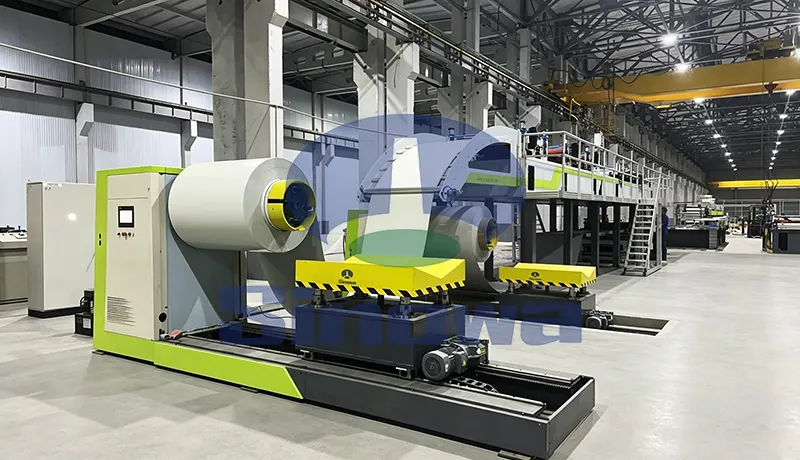
The PU sandwich panel line is a core production setup for making high-performance building insulation panels. This professional PU sandwich panel production line features automated operation to streamline the whole manufacturing process efficiently. Every component of the polyurethane sandwich panel line is precisely calibrated to ensure consistent panel thickness and structural stability. A well-maintained polyurethane sandwich panel production line can greatly boost production efficiency while reducing manual operation errors. The continuous PU sandwich panel line adapts to diverse production demands for different panel sizes and surface styles. With advanced molding technology, the PIR sandwich panel line produces panels with excellent heat preservation and sound insulation properties. Stable running of the PIR sandwich panel production line guarantees reliable product quality for various construction and industrial application scenarios.
-
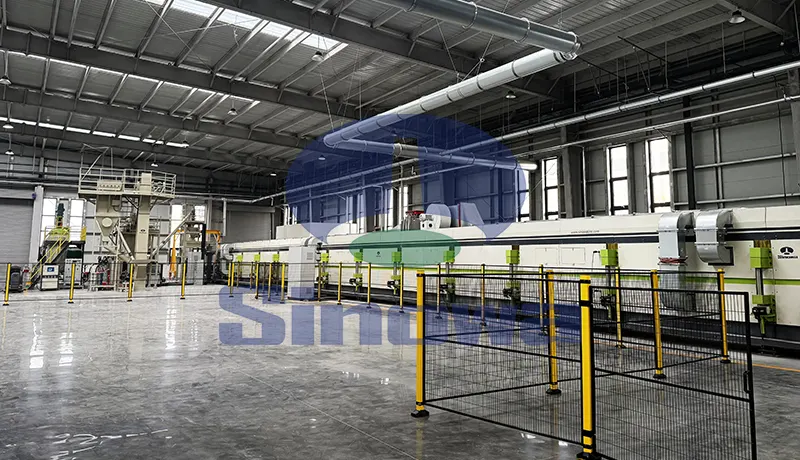
A phenolic insulation board production line serves as the core equipment for manufacturing high-performance thermal insulation building materials. This phenolic insulation panel production line integrates material mixing, foaming, molding and cutting processes to ensure continuous and stable production efficiency. Every operational link of the insulation board production line is precisely calibrated to produce uniform and durable insulation boards. The automated design of the insulation panel production line effectively reduces manual intervention and improves product consistency. Proper maintenance of the phenolic board production line can greatly extend its service life and maintain steady production output. With optimized structural design, the phenolic panel production line adapts to various production demands and delivers high-quality finished products for thermal insulation engineering applications.
-
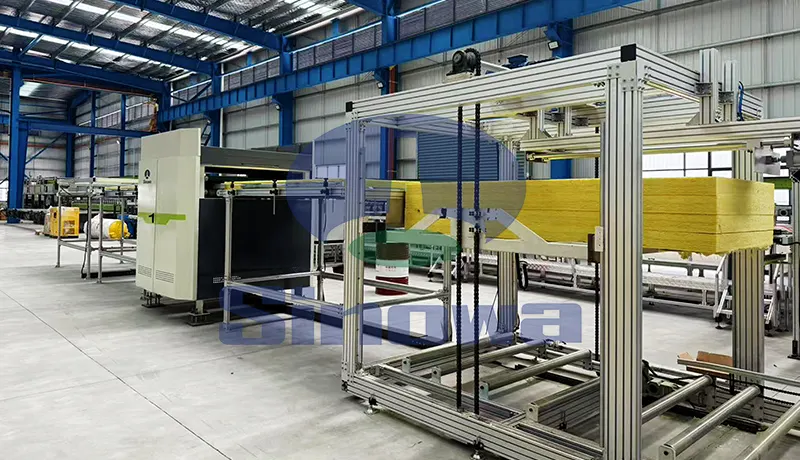
A professional rockwool sandwich panel line serves as the core equipment for producing high-performance building panels. This rockwool sandwich panel production line integrates feeding, laminating and forming processes to ensure stable and efficient production. The well-structured rock wool sandwich panel line can process raw rockwool materials into panels with excellent thermal and sound insulation properties. Operators can adjust the running parameters of the rock wool sandwich panel production line to manufacture panels of different thicknesses and specifications. The automated design of the mineral wool sandwich panel production line greatly reduces manual operation errors and improves product consistency. Regular maintenance of the mineral wool sandwich panel line is essential to sustain long-term operational efficiency and guarantee qualified finished panels for diverse construction applications.