Sandwich Panel Processing Machine
Publication Date: Oct 13, 2026
Sandwich panel processing machines manufacture insulated roof, wall, and cold storage panels using PU, phenolic, PIR, rock wool, mineral wool, and glass wool cores with consistent quality.
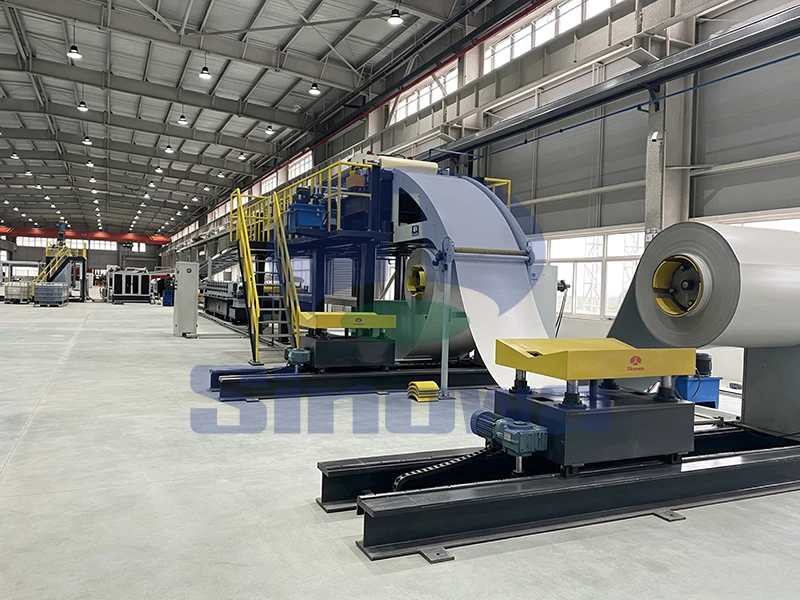
A sandwich panel processing machine is a continuous production line that bonds two thin metal facing sheets—typically pre-painted steel or aluminum coils—to a rigid insulating core material, producing a finished panel in one uninterrupted pass. The line unwinds the coils on automatic decoilers, feeds them through a roll-forming station where the side profiles and joint geometry are pressed into the sheet, and then moves both faces into the laminating zone where the core material is introduced and adhesively bonded under controlled heat and pressure. After curing, the panel travels through a cut-off saw that trims it to the customer-specified length, and finally exits onto a stacking table where it is automatically piled and strapped for shipment. The entire process is governed by a PLC with a touchscreen interface, allowing operators to set panel width, thickness, line speed, and cutting length from a single console. These lines are valued for their high output—often several meters per minute—which makes them suitable for large-scale construction projects where thousands of square meters of panel are required within a tight schedule.
The polyurethane (PU) sandwich panel machine is the most widely used configuration on the market. PU, also known as PUR, is a closed-cell foam injected between the metal faces as a liquid chemical mixture of polyol and isocyanate. The machine precisely meters and mixes the two components in a high-pressure mixing head, deposits the chemical stream onto the lower facing, and immediately sandwiches it with the upper facing before the foam expands and cures in the laminating tunnel. Because PU foam expands to fill every corner and cavity of the panel profile, it creates an excellent air seal and a very low thermal conductivity, making PU panels ideal for cold storage rooms, walk-in freezers, refrigerated warehouses, and clean rooms where temperature stability is critical. The same PU line can also produce wall panels and roof panels for commercial buildings, warehouses, and industrial sheds. PU core panels are lightweight, rigid, and fast to install, and the continuous line ensures that the foam density and bond strength remain uniform from the first panel to the last.
Closely related to PU is the PIR (polyisocyanurate) sandwich panel machine. PIR is formed from a related chemical formulation with a higher isocyanate index, which produces a foam with improved fire performance compared with standard PUR. The mechanical layout of a PIR line is nearly identical to a PU line—decoilers, roll formers, high-pressure mixing head, laminating tunnel, cut-off, and stacker—so many manufacturers operate a single line that can switch between PUR and PIR by changing the chemical recipe and adjusting the mixing ratio and temperature settings. PIR panels are commonly specified for wall and roof applications in office buildings, shopping malls, schools, hospitals, and public facilities where building codes call for better flame resistance. The material has a slightly higher thermal conductivity than PU but offers superior dimensional stability at elevated temperatures, which is beneficial for roof panels exposed to direct sunlight. PIR processing requires careful control of the chemical temperature and line speed, because the PIR reaction begins faster and releases heat more vigorously than standard PUR; the machine's PLC automatically compensates by adjusting the head output and tunnel length.
The phenolic sandwich panel machine represents a more specialized niche. Phenolic foam is produced from a phenolic resin combined with a blowing agent, and it is prized for its very low flame spread and low smoke emission when exposed to fire. The processing line for phenolic panels uses a low-pressure or foam-impregnation application system rather than the high-pressure head common in PU lines, because the phenolic resin has different rheological properties and requires gentler mixing to avoid scorching. Phenolic panels are frequently used in mass-transit stations, stadiums, convention centers, and high-rise interior wall partitions where smoke safety is the dominant concern. They are also well suited to clean room ceilings and pharmaceutical manufacturing areas because the foam has low outgassing and good resistance to chemical cleaning agents. Phenolic core panels tend to be thinner than equivalent PU panels for the same insulation value, which saves interior floor space, but the raw material cost is higher and the line speed is somewhat slower, which is why phenolic machines are usually operated by specialized producers rather than general-purpose panel factories.
Turning to the mineral wool family, the rock wool sandwich panel machine is designed around a completely different core-handling system. Instead of injecting a liquid foam, the line receives a pre-manufactured rock wool blanket—produced by melting basalt or diabase rock and spinning it into fibers—and laminates it between the metal faces using a two-component polyurethane adhesive sprayed onto the lower sheet. The rock wool mat is fed from a large roll through a cutting and orienting station where the fibers can be placed either perpendicular or parallel to the panel plane depending on the desired mechanical strength. The sandwich then passes through a long curing press heated by hot water or thermal oil, which activates the adhesive and compresses the wool to the specified panel thickness. Rock wool panels are the industry standard for non-combustible external wall cladding, fire-rated partitions, and roof panels in industrial plants, power stations, and steel-framed buildings. Because rock wool is inorganic, it does not burn, does not release toxic smoke, and retains its insulation value for decades, making it the preferred core for projects with strict fire safety requirements.
Mineral wool, sometimes distinguished from rock wool by its use of slag as the primary raw material, is processed on a very similar machine. Slag wool is made from the by-product of iron and steel production, melted and fiberized in the same manner as rock wool, and then formed into a mat that is laminated between metal faces with adhesive. The line configuration—decoilers, roll formers, adhesive spray station, wool feed, laminating press, cut-off, and stacker—is essentially the same as the rock wool line, and many producers use one machine to handle both rock wool and slag wool by swapping the incoming wool rolls. The main differences between the two cores lie in fiber diameter, density, and cost, rather than in the machine itself. Mineral wool panels are commonly used for economical external wall panels and acoustic ceiling panels in multi-story housing, office blocks, and factory buildings where fire resistance and sound absorption are required but the higher cost of pure rock wool is not justified. The machine can also be set to produce composite panels with a thin PU or PIR layer on one side and mineral wool on the other, combining the insulation performance of foam with the fire performance of wool.
The glass wool sandwich panel machine rounds out the mineral fiber family. Glass wool is made from molten glass spun into very fine fibers, and it is lighter and more flexible than rock or slag wool. The glass wool mat is fed from a roll, sprayed with adhesive, and laminated between the metal faces in a press that is usually shorter and less heavily built than a rock wool press because the material compresses more easily. Glass wool panels are especially popular for interior wall linings, suspended ceilings, and roof panels in residential and light commercial buildings, because the material offers excellent thermal and acoustic insulation at a lower weight and lower cost than rock wool. The fine glass fibers also give the panels a softer feel and lower dust emission during handling. Many glass wool lines are equipped with a separate station that can apply a foil or non-woven facing to the back of the panel, which acts as a vapor barrier in cold and damp climates. Like the other wool lines, the glass wool machine is fully automated from coil loading to final stacking, and the PLC records production data for each shift.
Cold storage panels represent one of the most demanding applications for these machines. A cold room panel must provide a continuous vapor seal, a very low thermal conductivity, and tight joint geometry to prevent frost buildup and energy waste. Most cold storage panels are produced on PU or PIR lines, because the liquid foam injection process fills the panel's side joint cavities completely and creates a hermetic bond between the core and the metal faces. The machine is configured with special side-form tooling that produces a tongue-and-groove or secret-fix joint, and often includes an integrated cam-lock or groove on the panel edge for fast assembly on site. Panel thickness for cold rooms can range from 50 millimeters for chilled rooms up to 200 millimeters or more for frozen rooms, and the line must be able to switch between these thickness settings by changing the press gap and the height of the forming stations. Because even a small thermal bridge can cause condensation and ice formation, the machine is built to tight tolerances, and every panel is inspected for flatness, edge straightness, and bond quality before it leaves the line.
Roof panels and wall panels, by contrast, are usually produced on the mineral wool or PIR lines, because external applications demand weather resistance, wind uplift strength, and fire performance. Roof panels are typically formed with a trapezoidal or corrugated profile on the upper face, and the machine's roll-forming station is designed with a series of rollers that progressively shape the sheet into the desired rib pattern. Wall panels are usually flatter with a concealed or visible fixing system, and the roll former is configured accordingly. The same line can often switch between roof and wall profiles by changing the roll-forming cassette, which is a modular set of rollers that slides in and out of the machine. Modern lines also include a laminating press with independent zone temperature control, so the operator can adjust curing conditions to suit different core materials and panel thicknesses. The end-of-line cut-off saw is a flying saw that tracks the moving panel while cutting, ensuring a square and burr-free edge even at full line speed.
Beyond the core machine itself, a complete sandwich panel processing installation includes supporting equipment that is essential for consistent production. These include automatic coil cars that transport the heavy steel coils from the storage area to the decoilers, edge trimming and waste reclamation systems that collect the scrap metal and trim pieces, and a panel stacking and strapping robot that picks finished panels off the exit conveyor and piles them into bundles ready for delivery. Many lines also integrate an inline printer that marks each panel with production date, batch number, and panel type, and a vision inspection system that scans the facing surface for scratches, coating defects, and color variation. Energy-saving features such as variable-frequency drives on all main motors, waste-heat recovery from the curing press, and insulated tunnel covers are increasingly standard, because the press consumes significant heat and the line runs for long shifts. Operators are usually trained on the PLC interface, the chemical mixing system for foam lines, and the wool handling equipment for mineral fiber lines, and the machine supplier provides commissioning, spare parts, and ongoing technical support to keep production running at peak efficiency.
Gallery of Sandwich Panel Processing Machine






Tags: sandwich panel processing machine, sandwich panel processing machine manufacturer, sandwich panel processing machine supplier, china sandwich panel processing machine, sandwich panel processing machine for sale
https://www.sandwichpanelmachinery.com/tags/sandwich-panel-processing-machine.html
-

The PU sandwich panel line is a core production setup for making high-performance building insulation panels. This professional PU sandwich panel production line features automated operation to streamline the whole manufacturing process efficiently. Every component of the polyurethane sandwich panel line is precisely calibrated to ensure consistent panel thickness and structural stability. A well-maintained polyurethane sandwich panel production line can greatly boost production efficiency while reducing manual operation errors. The continuous PU sandwich panel line adapts to diverse production demands for different panel sizes and surface styles. With advanced molding technology, the PIR sandwich panel line produces panels with excellent heat preservation and sound insulation properties. Stable running of the PIR sandwich panel production line guarantees reliable product quality for various construction and industrial application scenarios.
-

A phenolic insulation board production line serves as the core equipment for manufacturing high-performance thermal insulation building materials. This phenolic insulation panel production line integrates material mixing, foaming, molding and cutting processes to ensure continuous and stable production efficiency. Every operational link of the insulation board production line is precisely calibrated to produce uniform and durable insulation boards. The automated design of the insulation panel production line effectively reduces manual intervention and improves product consistency. Proper maintenance of the phenolic board production line can greatly extend its service life and maintain steady production output. With optimized structural design, the phenolic panel production line adapts to various production demands and delivers high-quality finished products for thermal insulation engineering applications.
-

A professional rockwool sandwich panel line serves as the core equipment for producing high-performance building panels. This rockwool sandwich panel production line integrates feeding, laminating and forming processes to ensure stable and efficient production. The well-structured rock wool sandwich panel line can process raw rockwool materials into panels with excellent thermal and sound insulation properties. Operators can adjust the running parameters of the rock wool sandwich panel production line to manufacture panels of different thicknesses and specifications. The automated design of the mineral wool sandwich panel production line greatly reduces manual operation errors and improves product consistency. Regular maintenance of the mineral wool sandwich panel line is essential to sustain long-term operational efficiency and guarantee qualified finished panels for diverse construction applications.