
The daily output of a sandwich panel production line varies greatly based on equipment configuration, operational efficiency, panel specifications and working hours.
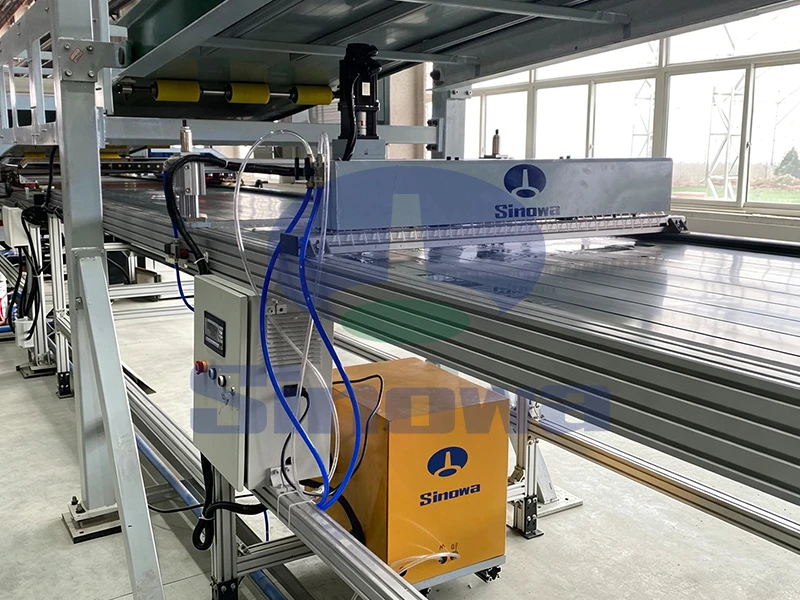
The daily output capacity of a sandwich panel production line is fundamentally defined by its core mechanical operating speed and continuous running stability. Modern automated production lines are designed with streamlined operational procedures that integrate material feeding, laminating, pressing, cutting and finishing into one unified process, which lays the foundation for stable daily production volume. Unlike semi-manual production equipment that relies heavily on manual intervention, fully automated lines minimize operational pauses caused by human error or manual adjustment. The basic running speed of the production line directly affects the number of panels that can be processed within a single working day. Even minor fluctuations in mechanical running speed will accumulate into noticeable differences in total daily output after hours of continuous operation. Meanwhile, the structural rationality of the production line avoids frequent equipment jams or shutdowns, ensuring that the theoretical production speed can be basically converted into actual daily output in regular production scenarios.
Different specifications of sandwich panels are one of the most critical factors causing fluctuations in daily production output. Sandwich panels differ greatly in thickness, core material type and surface layer material, all of which change the production cycle of each finished panel. Thin and lightweight panels with simple structural configurations require shorter pressing time, faster cutting processes and simpler surface treatment, allowing the production line to process more products per hour and boost overall daily output. In contrast, thick panels with dense core materials need longer thermal pressing and curing time to ensure structural firmness, which slows down the overall production rhythm and reduces daily output volume. Additionally, customized panel sizes with non-standard dimensions require temporary parameter adjustment of cutting and positioning devices, bringing short-term production delays and further affecting the stable daily output of the production line.
Daily working hours and shift arrangements play an indispensable role in determining the final actual output of the sandwich panel production line. Most industrial production workshops adopt fixed shift systems, including single-shift, double-shift and three-shift working modes, which create huge gaps in daily production capacity. A single-shift operation with limited daily working hours can only complete a small amount of standardized panel production, failing to give full play to the equipment’s maximum capacity. Double-shift working arrangements extend the effective running time of the production line greatly, making the daily output nearly double that of single-shift production. The three-shift uninterrupted operation mode realizes round-the-clock production with only short equipment inspection intervals, achieving the highest daily output level. Reasonable shift scheduling also includes reserved time for equipment maintenance and cleaning, which avoids excessive operation fatigue of the production line and balances daily output stability and long-term equipment service life.
Equipment automation level and operational intelligence directly optimize the daily output efficiency of sandwich panel production lines. Low-automation lines require manual participation in material feeding, parameter debugging, finished product inspection and material transfer, which consumes a lot of production time and leads to low hourly output and limited daily total volume. Medium and high-automation production lines are equipped with automatic feeding systems, intelligent constant-temperature pressing modules and automatic cutting and stacking devices, which greatly reduce manual operation links and shorten the production cycle of single panels. Intelligent monitoring systems can real-timely detect minor equipment abnormalities, material deviation and production parameter errors, solving potential faults in advance and avoiding long-time production shutdowns. This intelligent optimization ensures that the production line maintains a high-efficiency running state for most of the working time, effectively improving the sustainable daily output capacity.
Raw material quality and feeding continuity have a subtle but crucial impact on the daily output of sandwich panel production lines. Stable and qualified raw materials including surface metal sheets, core insulation materials and bonding adhesives can match the production line’s operational parameters perfectly, enabling smooth progress of each production link without material matching errors or processing failures. Unqualified raw materials with uneven thickness, poor flatness or unstable viscosity will cause frequent production defects, requiring repeated processing, defective product removal and temporary line stops for parameter adjustment. Moreover, discontinuous raw material supply caused by insufficient material preparation or untimely material replacement will lead to idle operation of production equipment, resulting in wasted production time and reduced daily finished product output. Sufficient and standardized raw material preparation is therefore a basic guarantee for maintaining stable and high daily production volume.
Equipment maintenance status and daily inspection routines determine the stability of the production line’s daily output performance. Newly commissioned or well-maintained production lines have smooth mechanical operation, accurate parameter response and low failure rates, which can maintain continuous and efficient production throughout the working day and reach the designed daily output level. In contrast, production lines lacking regular maintenance are prone to aging parts, unsmooth transmission structures and inaccurate pressing and cutting precision. Minor equipment failures such as component jitter and transmission delay will slow down the production rhythm, while major faults will directly cause production shutdowns. Daily pre-production inspection, mid-shift patrol maintenance and post-production cleaning and lubrication can effectively eliminate hidden equipment troubles, ensure the production line runs at a constant efficient speed every day, and avoid output reduction caused by sudden equipment failures.
Worker operation proficiency and standardized production management affect the actual conversion rate of the production line’s theoretical daily output. Skilled operators can flexibly adjust production parameters according to different panel specifications, quickly handle minor on-site production problems, and standardize material feeding and finished product collection procedures, maximizing the production efficiency of the equipment. Inexperienced workers often need extra time for parameter debugging, are prone to operational errors that cause product defects, and cannot respond to small equipment abnormalities in a timely manner, resulting in reduced effective production time and lower daily output. Scientific production management systems, including standardized operation processes, reasonable personnel division and strict production progress supervision, can standardize all production links, reduce human-caused production delays, and ensure the daily output reaches the optimal level matching the equipment configuration.
Post-production processing and finished product handling efficiency also influence the statistical daily output of sandwich panel production lines. The production of sandwich panels includes not only front-end molding and processing but also subsequent trimming, quality inspection, packaging and stacking processes. If the post-processing link is inefficient, finished panels will accumulate at the end of the production line, blocking the subsequent production progress and forcing the front-end production process to slow down or pause. Efficient post-production teams with standardized operating procedures can quickly complete inspection, trimming and packaging of finished products, timely transfer finished goods to the storage area, and ensure the production line maintains a continuous production state. Smooth connection between front-end production and back-end processing eliminates production bottlenecks and guarantees the full release of the daily production capacity of the entire line.
Seasonal production environments and workshop conditions bring variable impacts on the daily output of sandwich panel production lines. Temperature and humidity changes in different seasons will affect the curing speed of bonding adhesives and the processing performance of core materials. In suitable temperature and humidity environments, the adhesive cures rapidly and stably, and the panel molding quality is stable, supporting high-speed continuous production and high daily output. In extreme high or low temperature and humid environments, the curing cycle of materials will be prolonged, and product defect rates will rise, requiring the production line to reduce operating speed to ensure product quality, thus lowering daily output. In addition, clean and tidy workshop environments with reasonable space layout facilitate smooth material transportation and equipment operation, while cluttered workshops are prone to operational obstacles and reduce daily production efficiency.
The comprehensive optimization of multiple factors is the key to stabilizing and improving the daily output of sandwich panel production lines. A single factor such as equipment performance or working hours cannot determine the final daily production volume, and the coordinated operation of equipment, personnel, materials, management and environment is required to maximize production capacity. Enterprises can improve daily output by upgrading automated equipment, formulating scientific shift systems, standardizing raw material management, strengthening equipment maintenance and optimizing production operation processes. Balancing production efficiency and product quality while eliminating various production bottlenecks can make the daily output of the sandwich panel production line maintain a stable and efficient state, adapting to different batch and specification production demands in industrial manufacturing.