What Is The Difference Between Continuous And Discontinuous Sandwich Panel Machine?
Publication Date: Oct 9, 2026
Continuous sandwich panel manufacturing lines for high-volume stable output; discontinuous batch press lines offer flexible custom panels with lower investment. Compare specs & pick your panel production machine.
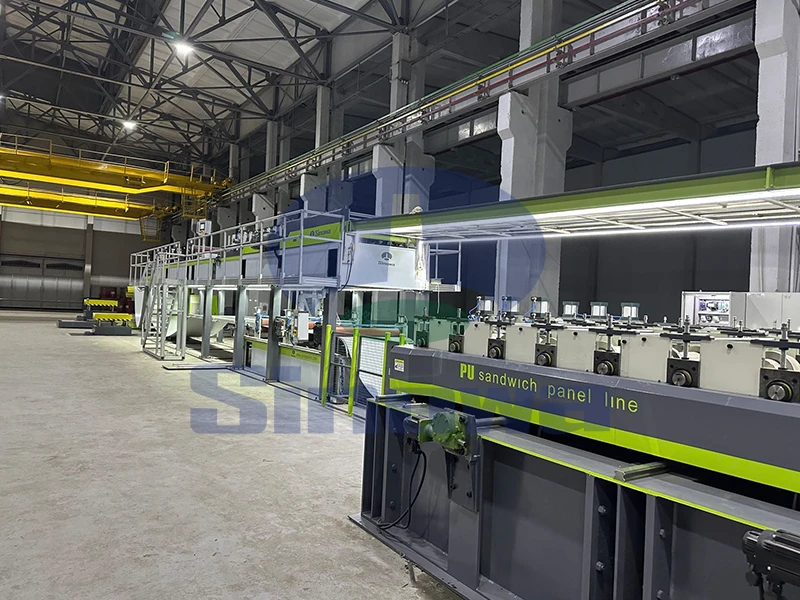
The most fundamental distinction between continuous and discontinuous sandwich panel machines lies in their core production operating modes, which shape nearly all their functional and operational differences. Continuous sandwich panel machines feature an uninterrupted, streamlined production workflow that runs non-stop once fully started. Raw materials including metal facing sheets and insulating core materials are automatically fed, laminated, cured, and trimmed in a single connected production line without manual intervention or process pauses. In contrast, discontinuous sandwich panel machines adopt a batch-based intermittent working mechanism. The equipment operates in independent production cycles, where each panel or group of panels undergoes separate feeding, pressing, curing, and unloading processes, with the entire line suspending operation between each production cycle to prepare for the next batch. This essential operational difference directly determines their gaps in production rhythm, workflow integrity, and overall operational logic, laying the foundation for their divergent performance characteristics in actual industrial production.
Production efficiency and output capacity form another prominent gap between the two types of sandwich panel machines. Continuous machines are engineered for high-volume, mass production scenarios, boasting extremely fast production speeds and stable long-term output. With fully automated inline processing, they eliminate idle time between production batches, enabling consistent and continuous manufacturing of standard-length sandwich panels. The integrated curing and forming system ensures every processing link connects seamlessly, greatly boosting hourly and daily production yields. Discontinuous machines, however, deliver relatively lower overall production efficiency due to their periodic start-stop operation. Each production cycle involves manual or semi-automatic material placement, mold positioning, pressure holding, and finished product removal, all of which consume extra auxiliary time. Although the single-panel forming quality and speed are stable, the frequent production pauses inevitably reduce effective working hours, making their maximum daily output far lower than that of continuous models, which makes them unsuitable for large-scale mass production demands.
Automation levels and labor requirements vary significantly between continuous and discontinuous sandwich panel machines, bringing distinct operational cost differences. Continuous production lines achieve full-process automated operation from raw material feeding to finished product cutting and stacking. The entire production process requires minimal manual operation, with workers only responsible for equipment monitoring, parameter adjustment, and routine fault inspection. This high level of automation not only reduces human error in production but also cuts long-term labor investment. Discontinuous sandwich panel machines belong to semi-automatic production equipment by comparison. Key links such as raw material feeding, batch replacement, and finished product discharging rely heavily on manual assistance. Operators need to repeatedly participate in each production cycle to complete auxiliary work, leading to higher labor dependence. The difference in automation also results in different operational stability, as continuous lines maintain consistent processing parameters throughout operation, while discontinuous lines are more susceptible to manual operation differences.
Production flexibility and customization capabilities are key advantages of discontinuous sandwich panel machines over continuous counterparts. Discontinuous batch production allows for flexible adjustment of panel specifications, including thickness, length, and core material combinations, with extremely low setup costs. Manufacturers can quickly switch between different product models after completing a single batch, making the equipment highly adaptable to personalized, small-batch, and diversified production orders. It can also produce ultra-thick or special-shaped sandwich panels that are difficult to process with continuous equipment, meeting customized needs for special engineering scenarios. Continuous sandwich panel machines, by contrast, are optimized for standardized, fixed-specification production. Once the production parameters are set, frequent specification adjustments will lead to prolonged equipment debugging time and material waste. Their structural design prioritizes production continuity, which sacrifices part of product flexibility to ensure high-volume production stability.
Product quality consistency and processing precision differ greatly between the two machine types due to their distinct production principles. Continuous sandwich panel machines adopt integrated inline heating, pressing, and curing technology, with unified and stable temperature, pressure, and speed parameters throughout the production process. The uninterrupted forming process ensures uniform bonding strength, flatness, and overall structural consistency of each section of the long sandwich panels. The automated precise parameter control effectively avoids quality fluctuations caused by intermittent production, delivering highly uniform finished product quality. Discontinuous sandwich panel machines conduct independent pressure curing for each batch of panels in separate molds. Although the equipment maintains fixed process parameters, the intermittent production mode leads to subtle differences in temperature distribution and pressure holding time between different batches and individual panels. These minor differences result in slight quality deviations in flatness, bonding tightness, and dimensional accuracy of finished products, leading to relatively lower overall quality consistency compared with continuous production.
Equipment structure and space occupation present obvious differences between continuous and discontinuous sandwich panel machines. Continuous production lines feature a long, integrated linear structural layout, integrating material unwinding, gluing, laminating, curing, trimming, cutting, and stacking modules into a complete connected system. The overall equipment length is large, requiring a spacious and standardized factory workshop for installation and operation. The highly integrated structural design ensures production continuity but demands higher requirements for factory site planning and space layout. Discontinuous sandwich panel machines have a relatively compact and modular structural layout, with independent functional modules that occupy far less factory space. Their decentralized structure does not require long linear production tracks, enabling flexible installation in small and medium-sized workshops. The simple structural composition also makes equipment layout and movement more convenient, adapting to the limited site conditions of small-scale production plants.
Investment cost and operational threshold form a critical practical difference for manufacturers choosing between the two machines. Continuous sandwich panel machines involve higher upfront investment due to their high automation, integrated structure, and sophisticated supporting systems. The complete production line contains numerous precision automated components and intelligent control systems, resulting in higher equipment procurement and installation costs. Meanwhile, their complex structure requires professional technical personnel for daily maintenance and fault repair, raising the overall operational threshold. Discontinuous sandwich panel machines have a lower initial investment cost with simpler mechanical structures and fewer automated components. Their installation and debugging processes are relatively simple, and daily maintenance is convenient with low technical requirements. The lower investment and operational thresholds make them more accessible for small and medium-sized manufacturers or newly established production projects with limited budgets.
Maintenance difficulty and equipment stability differ substantially between continuous and discontinuous sandwich panel machines. Continuous production lines consist of a large number of interconnected automated transmission, sensing, and control components, with complex internal mechanical and electrical systems. Long-term uninterrupted operation imposes high wear on key components, and failures in any single module may cause the entire production line to stop running. Daily maintenance requires systematic inspection of multiple links, and fault diagnosis and repair demand professional technical capabilities, leading to relatively high maintenance difficulty and costs. Discontinuous machines have simple mechanical structures with independent operating modules, where faults in a single cycle or individual component rarely affect the overall equipment operation. The low component wear rate and simple working principle reduce daily maintenance workload, and routine upkeep and fault handling can be completed with basic operational skills, delivering higher overall equipment stability for small-batch intermittent production.
Applicable production scales and business scenarios clearly distinguish the two types of sandwich panel machines. Continuous sandwich panel machines are perfectly suited for large-scale, long-term, and standardized mass production scenarios. They are the preferred choice for manufacturers focusing on large-batch orders and standardized product supply, capable of meeting the high-output demands of large construction projects and bulk market supply. Their stable high efficiency and consistent product quality help large enterprises reduce unit production costs and improve market competitiveness. Discontinuous sandwich panel machines are ideal for small and medium-scale production, project-based customized orders, and diversified small-batch production. They adapt flexibly to frequent product specification adjustments and special customized production needs, making them suitable for manufacturers undertaking personalized engineering orders and small-batch diversified production businesses.
Long-term production cost and economic benefits vary distinctly between continuous and discontinuous sandwich panel machines in different production modes. For long-term large-scale standardized production, continuous machines show prominent economic advantages. Their high automation reduces labor costs per unit product, high production efficiency lowers time costs, and excellent product quality consistency reduces defective rates and material waste, effectively cutting comprehensive production costs. Although the upfront investment is high, the cost advantages become increasingly obvious with the accumulation of large output. For small-batch and customized production, discontinuous machines deliver better economic benefits. Their low upfront investment, flexible production switching, and no need for large-scale fixed asset investment avoid resource waste caused by single-product mass production, matching the profit model of small-batch diversified operation and bringing stable returns for small and medium-sized production projects.
Gallery of Continuous Sandwich Panel Machine
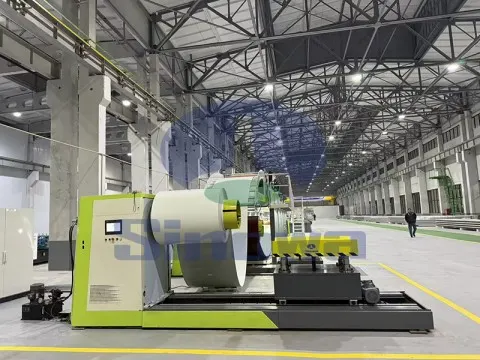
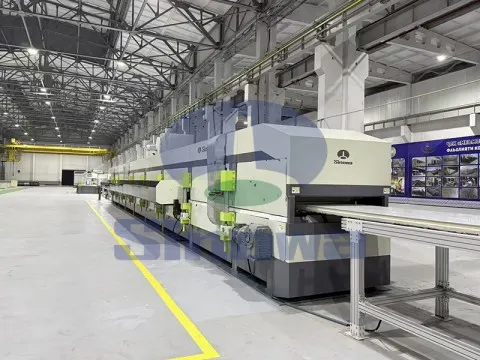
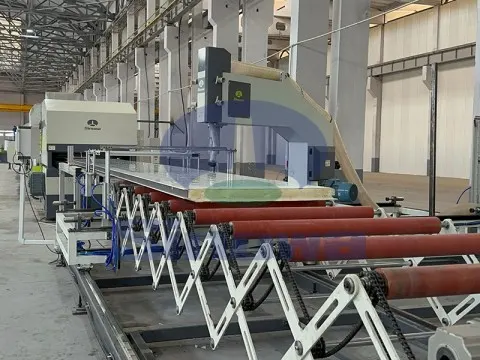
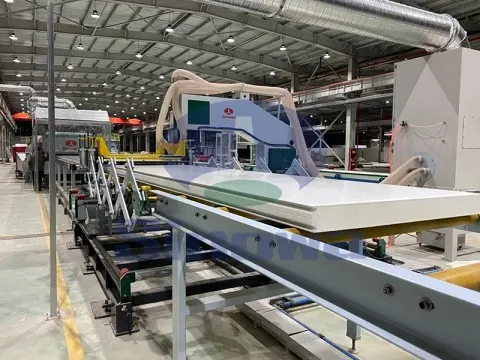
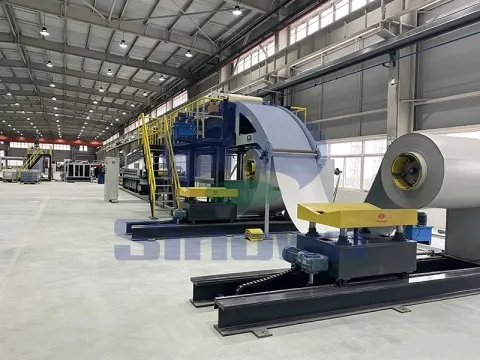
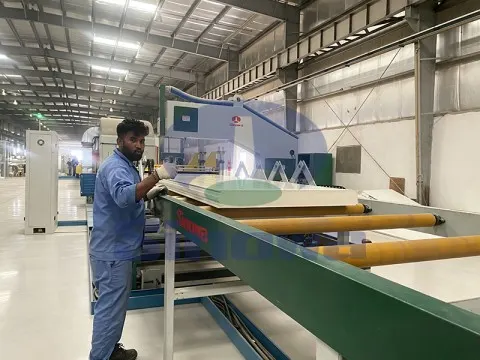
Tags: continuous sandwich panel machine, continuous sandwich panel machine manufacturer, continuous sandwich panel machine supplier, china continuous sandwich panel machine, continuous sandwich panel machine for sale
-
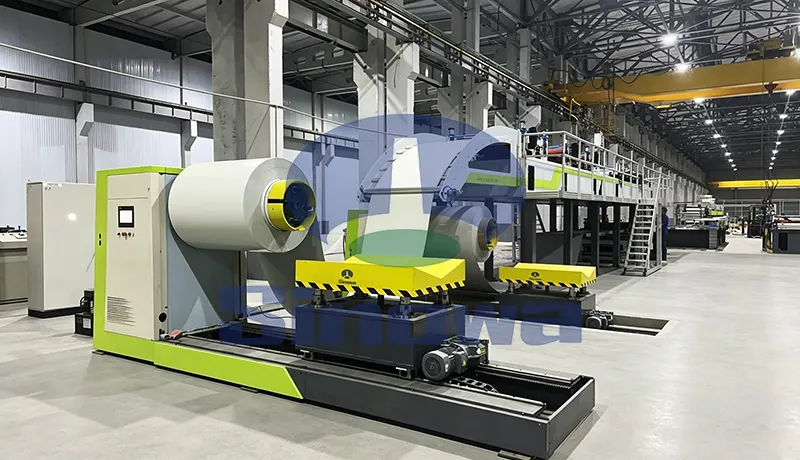
The PU sandwich panel line is a core production setup for making high-performance building insulation panels. This professional PU sandwich panel production line features automated operation to streamline the whole manufacturing process efficiently. Every component of the polyurethane sandwich panel line is precisely calibrated to ensure consistent panel thickness and structural stability. A well-maintained polyurethane sandwich panel production line can greatly boost production efficiency while reducing manual operation errors. The continuous PU sandwich panel line adapts to diverse production demands for different panel sizes and surface styles. With advanced molding technology, the PIR sandwich panel line produces panels with excellent heat preservation and sound insulation properties. Stable running of the PIR sandwich panel production line guarantees reliable product quality for various construction and industrial application scenarios.
-
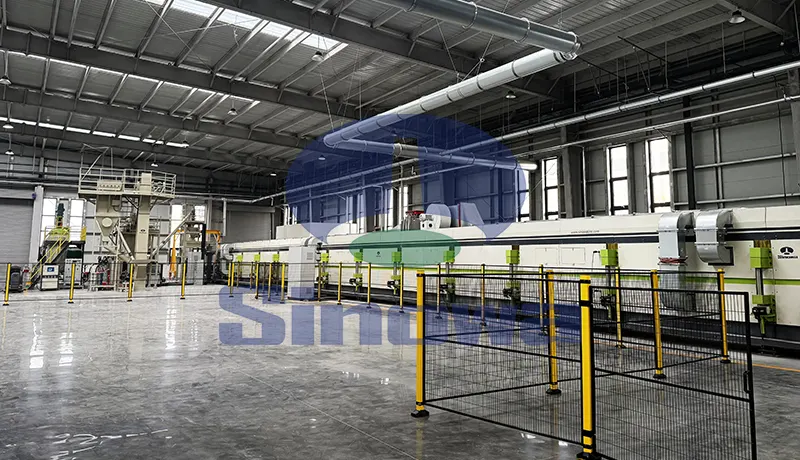
A phenolic insulation board production line serves as the core equipment for manufacturing high-performance thermal insulation building materials. This phenolic insulation panel production line integrates material mixing, foaming, molding and cutting processes to ensure continuous and stable production efficiency. Every operational link of the insulation board production line is precisely calibrated to produce uniform and durable insulation boards. The automated design of the insulation panel production line effectively reduces manual intervention and improves product consistency. Proper maintenance of the phenolic board production line can greatly extend its service life and maintain steady production output. With optimized structural design, the phenolic panel production line adapts to various production demands and delivers high-quality finished products for thermal insulation engineering applications.
-
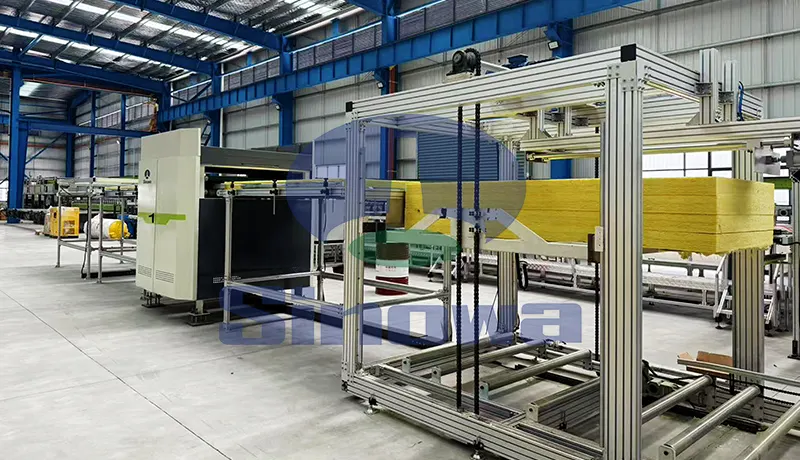
A professional rockwool sandwich panel line serves as the core equipment for producing high-performance building panels. This rockwool sandwich panel production line integrates feeding, laminating and forming processes to ensure stable and efficient production. The well-structured rock wool sandwich panel line can process raw rockwool materials into panels with excellent thermal and sound insulation properties. Operators can adjust the running parameters of the rock wool sandwich panel production line to manufacture panels of different thicknesses and specifications. The automated design of the mineral wool sandwich panel production line greatly reduces manual operation errors and improves product consistency. Regular maintenance of the mineral wool sandwich panel line is essential to sustain long-term operational efficiency and guarantee qualified finished panels for diverse construction applications.