
PU sandwich panel production lines mainly adopt continuous operation modes in mainstream industrial manufacturing, while discontinuous batch modes exist for small-scale production.
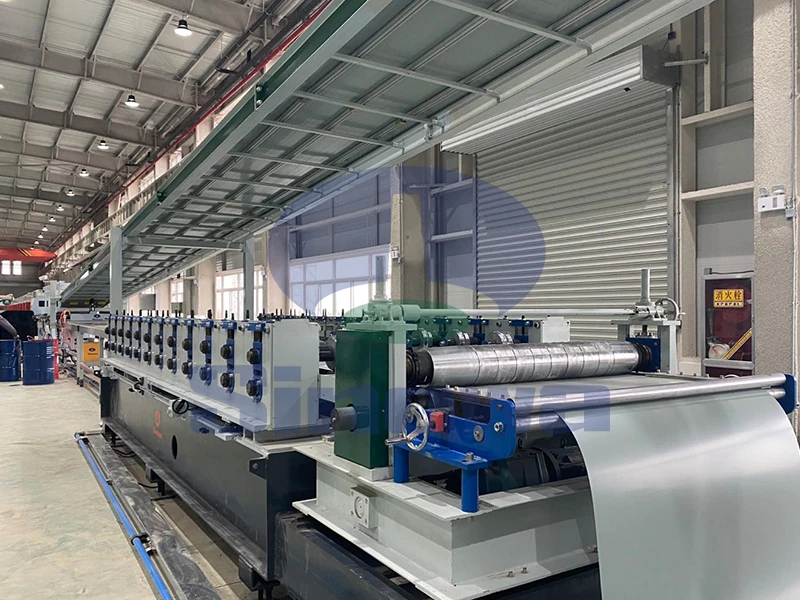
The core operational attribute of modern PU sandwich panel production lines is continuous automated operation, which distinguishes it fundamentally from traditional discontinuous batch production equipment. A complete continuous production system integrates all manufacturing procedures into a seamless streamlined process, covering raw material unwinding, surface material shaping, PU raw material mixing and pouring, core layer foaming and curing, composite pressing, fixed-length cutting, cooling shaping and finished product collection. Every production link is closely connected without manual pause or segmented intervention, and materials move steadily on the assembly line at a constant speed. This uninterrupted operation mode eliminates the idle time and process gaps caused by segmented production, forming a closed-loop manufacturing process from raw material input to finished product output. In contrast, discontinuous production requires separate operation of each process, with frequent material handling and equipment startup and shutdown between procedures, leading to intermittent production progress.
The operational logic of continuous PU sandwich panel production lines is built on synchronized mechanical and automated control systems. The entire line is driven by a unified power and control system, where the running speed of unwinding equipment, rolling forming devices, foaming stations and pressing equipment is precisely matched and synchronized. When surface materials are unwound and shaped, the high-pressure PU foaming system automatically mixes and sprays raw materials according to the real-time feeding speed of plates, ensuring uniform pouring of foam raw materials on the plate surface. The double-belt pressing equipment maintains constant temperature and pressure throughout the operation process, enabling continuous foaming, bonding and curing of the PU core layer during the plate conveying process. All parameter adjustments and operational coordination are completed through intelligent control modules, avoiding human errors in manual scheduling. This highly synchronized linkage ensures that the production process maintains stable continuity for a long time.
Discontinuous PU sandwich panel production is a segmented batch production mode suitable for small-batch and customized production demands. In this mode, each production procedure is relatively independent, and plates need to be manually transferred from one equipment to another after completing a single process. For example, surface material forming, PU material pouring, plate pressing and curing are completed on separate standalone devices, with mandatory pauses between each step to wait for material curing, equipment reset or manual handling. Each production batch is completed independently, and the equipment will stop running after finishing one batch until the next batch of raw materials is placed. This intermittent operation leads to discontinuous production rhythm, with obvious intervals between products. Although flexible for small-order production, it cannot form streamlined continuous output, resulting in low overall production efficiency.
There are significant differences in production efficiency between continuous and discontinuous PU sandwich panel production modes. Continuous production lines can operate stably for a long time without frequent shutdowns, realizing uninterrupted output of finished panels. The streamlined process eliminates process waiting time and material handling loss, and the unit time output is far higher than that of discontinuous equipment. The automated linkage operation also reduces manual auxiliary time, making the production rhythm stable and efficient. On the other hand, discontinuous production involves repeated equipment startup, parameter debugging and material handling, which consumes a lot of auxiliary time. The single-batch production capacity is limited, and the long interval between batches greatly reduces the effective production time of equipment. For large-scale mass production scenarios, the efficiency advantage of continuous production is extremely prominent and irreplaceable.
Product quality consistency is another key difference between the two production modes. In continuous production, the running speed, foaming amount, pressing temperature and pressure of the entire line are kept in a stable fixed state, and the forming environment of each panel is completely consistent. The PU core layer foams evenly and bonds tightly with the surface material, with stable dimensional accuracy and uniform appearance of finished products. The whole-process closed continuous processing avoids external interference in the midway of production. For discontinuous batch production, the working parameters of each equipment may have slight deviations in different batches, and the manual handling and intermediate waiting process may affect the foaming and curing effect of the PU core layer. This easily leads to differences in product thickness, bonding firmness and surface flatness among different batches.
The equipment composition and layout of continuous production lines are more integrated and systematic compared with discontinuous equipment. Continuous production equipment is arranged in a linear streamlined layout, with each functional module closely connected in sequence, realizing one-piece conveying and processing of materials. All functional units including unwinding, forming, foaming, pressing, cutting and cooling are integrated into a complete production system, sharing a unified control platform. Discontinuous production equipment is composed of independent single machines with scattered layout, and there is no automatic connection between devices. Each standalone equipment needs independent parameter setting and operation control, and the connection between processes completely relies on manual cooperation. This decentralized equipment structure determines the intermittent characteristics of discontinuous production.
In terms of labor demand and operational difficulty, continuous production lines have obvious advantages in automated production. The highly integrated continuous line realizes full-process automated operation from feeding to finished product output, requiring only a small number of operators to monitor equipment operation parameters and handle occasional abnormal conditions. The operation process is simple and standardized, with low dependence on manual experience. Discontinuous production requires a large number of workers to complete material handling, equipment debugging, batch switching and process connection work. Each production link needs manual participation and supervision, with complex operational procedures and high labor intensity. The frequent batch switching also increases the difficulty of equipment operation and parameter adjustment.
The two production modes have distinct applicable market scenarios due to their respective characteristics. Continuous PU sandwich panel production lines are mainly used for large-scale, long-term and standardized mass production, which can meet the demand for high-volume supply of standardized insulation and building panels. It is the mainstream production mode for large manufacturers in the industry. Discontinuous production modes are more suitable for small-batch, multi-variety and customized order production, such as special-sized panels and small-batch special-purpose boards. Its flexible batch switching capability can adapt to scattered and personalized market demands that continuous lines cannot flexibly cope with.
In terms of production loss and cost control, continuous production shows better long-term economic benefits. The stable and continuous operation avoids material waste caused by frequent equipment startup and shutdown and parameter adjustment. The consistent processing parameters reduce the defective rate of products, and the high-efficiency output dilutes the fixed production cost. Discontinuous production has more material loss in batch switching and equipment debugging, and the unstable processing environment increases the probability of defective products. Meanwhile, high labor input and low equipment operation efficiency lead to higher unit production costs, making it uneconomical for large-scale long-term production.
To sum up, the mainstream and standardized PU sandwich panel production lines in the industry adopt continuous operation modes, while discontinuous batch production is only a supplementary production method for special scenarios. Continuous production dominates the market by virtue of high efficiency, stable quality and low comprehensive cost, meeting the large-scale production needs of the modern building insulation material industry. Discontinuous production complements the market with flexible customized production capacity, and the two modes jointly cover the diversified production demands of the industry.