
Modern sandwich panel machines support simultaneous production of roof and wall panels with optimized structural designs. This flexible manufacturing mode boosts production efficiency, cuts operational costs, and meets diverse construction building envelope needs for various project scenarios.
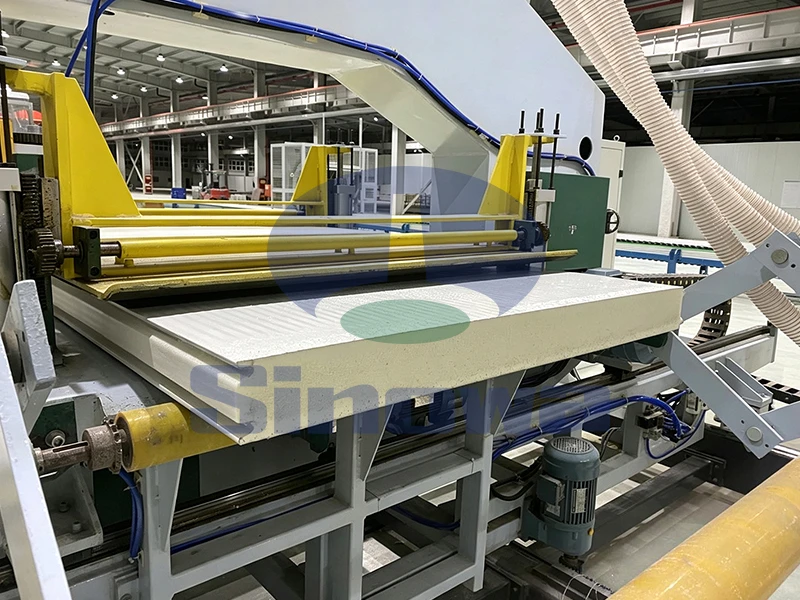
The core working principle of advanced sandwich panel manufacturing equipment lays the foundation for its dual-production capability for roof and wall panels. Unlike traditional single-function machines that are limited to one panel type per production run, modern integrated models adopt a modular and adjustable production structure. The equipment’s forming system, including rolling mills, pressing units and cutting mechanisms, is designed with adjustable parameters that can switch and adapt to the different dimensional and structural requirements of roof and wall sandwich panels. Roof panels usually feature special wave shapes, slope designs and enhanced waterproof structures, while wall panels prioritize flat surfaces, uniform thickness and sound insulation performance. Through intelligent parameter adjustment, the machine can allocate different processing modules to two independent production lines, enabling synchronous molding, foaming, bonding and cutting of the two panel types without mutual process interference. This structural optimization eliminates the need for repeated equipment debugging and line switching that plague traditional single-purpose machines.
Synchronous production of roof and wall panels relies heavily on the equipment’s independent material feeding and foaming control systems. Sandwich panels consist of outer metal sheets and inner insulation core materials, and roof and wall panels differ greatly in material thickness matching and foaming density requirements. Modern dual-function machines are equipped with two sets of separate feeding devices for metal sheets and insulation materials, which can deliver raw materials of different specifications to corresponding production areas simultaneously. The independent foaming and curing control system can adjust temperature, pressure and foaming speed in real time according to the characteristics of roof and wall panels respectively. For roof panels, the system strengthens the compactness of the core material to improve wind and rain resistance, while for wall panels, it optimizes foaming uniformity to enhance thermal and sound insulation effects. The independent material control design ensures that the quality standards of the two types of panels are strictly maintained during synchronous production, avoiding quality defects caused by mixed parameter settings.
Intelligent program control is the key technology that realizes simultaneous production of roof and wall sandwich panels. Contemporary panel making machines are embedded with intelligent PLC programming systems that store independent production programs for roof panels and wall panels. Operators can activate the dual-production mode through simple parameter setting on the control panel, allowing the machine to run two sets of production logic in parallel. The system can automatically coordinate the operating speed of each processing unit, synchronize the cutting cycle of different panels, and monitor the production status of the two lines in real time. When minor parameter deviations occur in either production line, the intelligent system can make automatic fine adjustments without affecting the normal operation of the other line. This automated intelligent control greatly reduces manual intervention, avoids operational errors caused by manual switching, and ensures the stability and consistency of synchronous production of roof and wall panels throughout the working process.
Many people hold the misconception that simultaneous production will reduce the finished quality of sandwich panels, but practical production practices prove the opposite. Professional dual-production sandwich panel machines undergo rigorous structural optimization and process testing in the design stage. Their dual-line production structure is scientifically partitioned, with independent transmission, processing and shaping spaces for roof and wall panel production, which completely isolates the processing procedures of the two products. The precision processing components of the equipment, including leveling rollers, pressing molds and cutting blades, are all calibrated for different panel types, ensuring that the dimensional accuracy, surface flatness and structural firmness of roof and wall panels meet practical construction requirements. In actual industrial production, the quality indicators of panels produced by synchronous dual-line mode are completely consistent with those produced by single-line independent production, with no deterioration in insulation performance, structural strength or appearance quality.
The simultaneous production function of roof and wall panels brings remarkable economic benefits to manufacturing enterprises. In the traditional production mode, factories need to configure separate equipment for roof panel production and wall panel production, which occupies a large amount of factory space and increases equipment procurement and maintenance costs. The integrated dual-function machine integrates two sets of production functions into one device, greatly saving plant layout space and reducing daily equipment maintenance workload and cost. More importantly, synchronous production can effectively shorten the overall production cycle of construction envelope supporting panels. For a complete construction project that requires both roof and wall sandwich panels, the factory can complete the production of two types of products at the same time, instead of finishing one type first and then switching equipment to produce the other. This greatly improves order delivery efficiency and enhances the market competitiveness of manufacturing enterprises.
The dual-production capability also improves the flexibility and adaptability of sandwich panel production. Construction projects have diverse demands for roof and wall panels in terms of quantity, specification and delivery cycle. Some projects require a large number of wall panels with conventional specifications and a small number of special-shaped roof panels, while others have opposite demand ratios. The machine’s synchronous production mode can flexibly adjust the operating speed and output ratio of the two production lines according to actual order demands. It can realize balanced production of equal output of roof and wall panels, and can also support high-output production of one panel type and low-output fine processing of the other. This flexible production mode can well adapt to the personalized and differentiated order needs of different construction projects, avoiding product backlog or order delay caused by single fixed production mode.
It is worth noting that the realization of simultaneous production of roof and wall panels depends on standardized equipment operation and reasonable process configuration. Although the equipment has powerful dual-line synchronous production performance, operators need to master professional operating skills to ensure stable production. Before starting dual-line production, it is necessary to check the operating status of each independent module of the equipment, confirm the accurate setting of production parameters corresponding to roof and wall panels, and ensure that the raw material supply of the two production lines is sufficient and matched. During the production process, regular real-time inspection of the operating parameters and finished product quality of the two lines is required to eliminate potential equipment failures and quality risks. Standardized operation specifications can maximize the advantages of dual synchronous production and maintain long-term stable and efficient operation of the equipment.
With the continuous upgrading of construction industry demands, the dual synchronous production technology of sandwich panel machines is also constantly optimized and iterated. Early dual-function equipment had problems such as unbalanced operating speed of the two lines and single adjustable specifications. With the progress of mechanical manufacturing and intelligent control technology, modern equipment has realized multi-specification and multi-type synchronous production. It can not only produce conventional flat wall panels and corrugated roof panels, but also support the synchronous processing of special heat-insulating wall panels and weather-resistant roof panels with enhanced performance. The continuous technological optimization further expands the application scope of the equipment, making it applicable to various construction fields such as industrial plants, logistics warehouses, and civil prefabricated buildings.
Compared with traditional single-function sandwich panel production equipment, the new-generation machine with dual synchronous production capability has obvious comprehensive advantages in production efficiency, space utilization, cost control and demand adaptation. It breaks through the production limitation of traditional equipment that can only process a single panel type, realizes integrated and efficient production of building roof and wall envelope materials, and provides more efficient and economical production solutions for the prefabricated building material industry. As the prefabricated construction industry develops rapidly and market demand diversifies, this dual-production intelligent equipment will gradually become the mainstream choice in the industry.
In conclusion, professional modern sandwich panel machines can completely realize the simultaneous production of roof and wall panels through modular structural design, independent material and process control and intelligent program scheduling. This production mode is not only feasible and stable in technology, but also has outstanding advantages in improving production efficiency and reducing production costs. It perfectly adapts to the supporting production needs of building envelope panels and brings new development momentum to the intelligent and efficient upgrading of the sandwich panel manufacturing industry.