
PU sandwich panel machinery is an automated integrated production system that combines chemical foaming and mechanical composite molding. It processes raw materials through feeding, mixing, laminating, curing and cutting, turning raw PU materials and surface sheets into finished insulated sandwich panels steadily and efficiently.
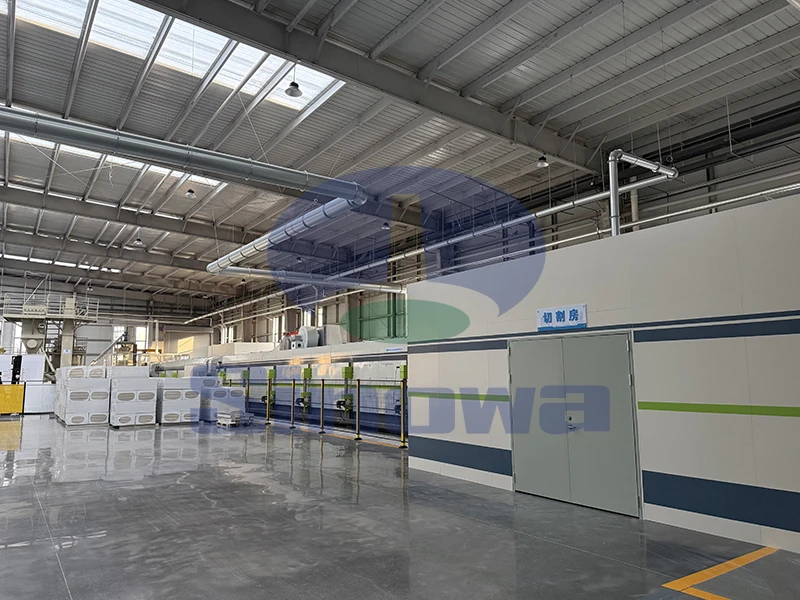
The entire operation of PU sandwich panel machinery relies on a fully continuous and coordinated production workflow with minimal manual intervention, laying a solid foundation for standardized composite panel manufacturing. The working logic starts with the raw material feeding module, which is responsible for stably conveying upper and lower surface base materials and polyurethane core raw materials into the production line. The surface materials, usually rigid sheet substrates, are released and transported in a continuous flat state through professional conveying structures. Equipped with precision deviation correction and guiding components, the feeding system effectively avoids material dislocation and offset during operation, ensuring the consistent alignment of upper and lower layers throughout the follow-up process. Meanwhile, the PU raw material supply unit stably delivers two core chemical components needed for foaming, maintaining stable material flow to prepare for subsequent precise mixing and injection procedures.
After stable feeding, the surface material pretreatment process serves as a key preliminary step to enhance panel bonding performance. In this stage, the machinery’s dedicated preheating and cleaning module treats the surface of base materials to remove tiny dust, oil stains and other impurities that may hinder bonding. Constant-temperature preheating is implemented uniformly on the material surface, which optimizes the surface activity of the substrates and creates favorable conditions for tight integration with PU foam core materials. This pretreatment process is precisely controlled by the equipment’s automatic system, with consistent temperature and treatment strength for each batch of materials. Without this step, the adhesion between the surface layer and core layer would be weakened, easily causing delamination and quality defects in finished panels, so this link is indispensable for ensuring long-term structural stability of sandwich panels.
Raw material proportioning and mixing is the core chemical preparation stage of PU sandwich panel production, determining the foaming quality and core layer performance fundamentally. The machinery adopts a high-precision automatic proportioning system to quantitatively extract two different PU raw materials according to fixed matching ratios. The system features real-time flow monitoring and dynamic adjustment functions, which can automatically correct tiny flow deviations to ensure accurate proportioning every time. After quantitative extraction, the raw materials enter a high-speed stirring mixing chamber, where internal stirring structures fully blend the two components in an instant. Uniformly mixed liquid PU materials possess stable chemical activity and fluidity, laying a good foundation for uniform foaming, dense structure and consistent density of the subsequent core layer.
The PU liquid injection process realizes the uniform distribution of core materials between double-layer surface substrates, acting as a bridge connecting chemical mixing and physical composite molding. The machinery is equipped with a reciprocating sweeping injection nozzle structure, which moves evenly along the entire width of the surface materials to spray mixed PU liquid. This dynamic injection mode completely avoids local material accumulation or missing injection problems that often occur in fixed-point injection. The injection speed and material output are synchronized with the running speed of the surface material conveyor, ensuring that the PU liquid covers the entire intermediate gap stably and continuously. Immediately after injection, the liquid PU begins a mild preliminary reaction, forming a thin adhesive layer that initially bonds with the upper and lower substrates to prevent material displacement in subsequent processes.
Foaming expansion is a critical chemical reaction process that shapes the core structure of PU sandwich panels. After being injected between the surface materials, the mixed PU liquid undergoes a rapid and controllable chemical foaming reaction under set temperature and environmental conditions. The liquid material gradually expands, fills the entire gap between the double-layer substrates uniformly, and transforms from liquid state to porous solid foam state. The machinery’s automatic control system precisely regulates foaming speed, expansion ratio and reaction time to avoid excessive expansion that causes panel deformation or insufficient expansion that leads to loose core layers. The orderly foaming process forms a fine and uniform porous structure inside the core layer, endowing the finished panel with excellent heat insulation, sound insulation and shock resistance properties.
Double-belt lamination is the key physical molding process to integrate surface layers and PU core layers into a whole. After preliminary foaming, the semi-finished panel enters the double-belt lamination unit composed of upper and lower circulating conveyor belts and adjustable pressure components. The two sets of synchronous operating belts clamp the panel tightly and apply uniform and stable pressure on the entire panel surface. This balanced pressure action discharges tiny air bubbles generated during foaming, eliminates gaps between the core layer and surface layers, and promotes tight composite bonding of all layers. The synchronous transmission design of the belts ensures no relative sliding between materials and belts, maintaining the flatness and dimensional accuracy of the panel surface during lamination.
Constant-temperature curing process solidifies the composite structure and stabilizes the comprehensive performance of sandwich panels. The lamination unit is equipped with a closed constant-temperature heat preservation system, which provides a stable reaction environment for the continuous curing of PU foam. Under persistent and uniform temperature conditions, the unfinished PU core layer completes the final chemical cross-linking reaction, gradually hardening and forming a solid and stable integral structure. The curing time and temperature are automatically matched according to production speed and panel specifications, ensuring thorough curing of each panel. Sufficient curing effectively improves the structural strength, compression resistance and bonding firmness of the panel, avoiding later deformation, cracking or delamination in use.
Fixed-length cutting is the precision finishing process to standardize panel dimensions after integral molding. After complete curing and molding, the continuous long strip composite panel is transported to the automatic cutting unit. The machinery’s intelligent sensing system identifies the set length parameters in real time and triggers the cutting device to operate accurately. The high-speed cutting tool features smooth cutting edges, which can complete flat and burr-free cutting of metal or composite surface layers and internal foam core layers at one time. The cutting speed is perfectly synchronized with the production line operating speed, realizing uninterrupted continuous production. This automatic cutting mode effectively ensures consistent dimensional accuracy of each finished panel and improves production uniformity.
Panel cooling and shaping further optimizes the finished product quality and structural stability. Newly cut panels still retain residual curing temperature, and internal stress may exist inside the foam core layer. The machinery’s cooling conveyor system transports the cut panels for natural and uniform heat dissipation. Gradual cooling can effectively release internal stress generated during high-temperature curing and lamination, preventing panel warping, bending and shape deformation caused by rapid temperature change. In this process, the core layer structure is further stabilized, and the bonding force between layers reaches the optimal state, ensuring the flat appearance and stable performance of finished panels for long-term use.
Automatic stacking and discharging is the final link of the entire production cycle, realizing efficient finished product collection and line turnover. After cooling and shaping, qualified panels are automatically conveyed to the stacking unit, which uses mechanical grabbing and stacking structures to neatly arrange panels in order according to set specifications. The automatic stacking mode replaces tedious manual handling, greatly improving production efficiency while avoiding surface scratches and panel damage caused by human operation. After stacking is completed, the equipment sends out prompt signals for subsequent packaging and storage. The whole production process forms a closed-loop automatic system, realizing continuous, stable and high-efficiency manufacturing of PU sandwich panels.