
Sandwich panel machinery is an integrated automated production system for manufacturing composite sandwich panels. It integrates multiple processing procedures to bond surface sheets and lightweight core materials, delivering high-efficiency, standardized composite panels for diverse construction and industrial applications.
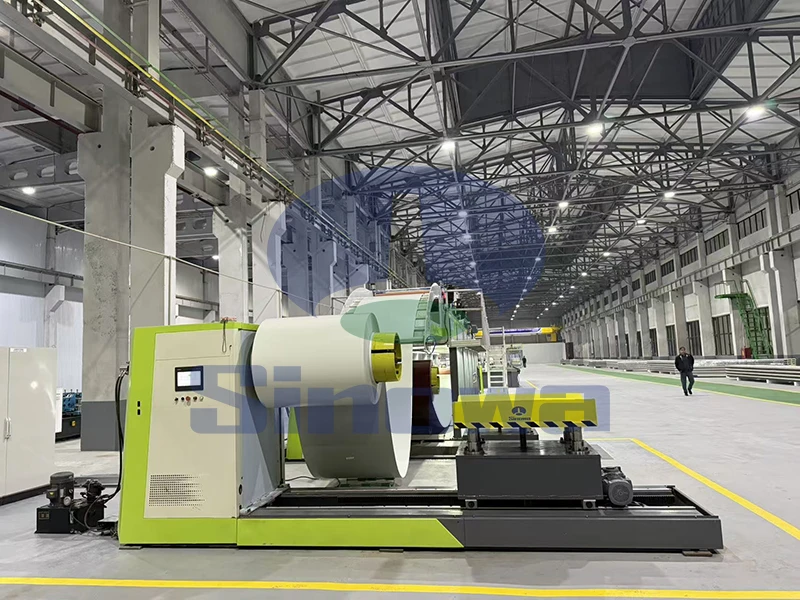
Sandwich panel machinery refers to a complete set of interconnected mechanical and automated devices dedicated to the integrated molding of composite sandwich panels, which feature a typical three-layer structure with two rigid outer surface layers and a lightweight insulating core layer in the middle. Unlike discrete processing equipment that handles single production steps, this machinery is designed to streamline the entire panel manufacturing workflow from raw material feeding to finished product output. It adapts to different core materials and surface substrates, enabling consistent composite molding through coordinated mechanical movements and intelligent control. The core design concept focuses on achieving tight, durable bonding between surface materials and core fillers while maintaining uniform panel thickness, flatness, and structural stability. This type of machinery has become a core equipment choice for modern lightweight building material production, replacing inefficient manual and semi-mechanical manufacturing methods to meet the growing market demand for prefabricated building components.
The basic working principle of sandwich panel machinery revolves around synchronous material transmission, precise composite processing, and stable curing molding. The entire production process starts with the automatic feeding of outer surface materials, which are usually metal coils or composite plates. The equipment first levels and shapes these surface materials to eliminate wrinkles and irregularities, ensuring a flat base for subsequent lamination. Meanwhile, the core material feeding unit quantitatively transports lightweight core materials such as foam, rock wool, or other insulating fillers to the designated processing position. Some models are equipped with automatic glue spraying or foaming systems to evenly apply adhesive materials between the surface layers and core layers, creating a strong bonding interface. After material alignment and combination, the pressing unit applies uniform and stable pressure to integrate the three-layer structure tightly. Finally, the composite semi-finished panels undergo curing and shaping to form integral structural panels with stable performance.
Modern sandwich panel machinery adopts a modular structural design, with each functional module working independently while maintaining seamless collaborative operation. The core functional modules include an uncoiling and feeding module, a surface material leveling and forming module, a core material laying and distributing module, a composite pressing module, a fixed-length cutting module, and a finished product conveying and stacking module. The uncoiling module automatically releases raw material coils to ensure continuous material supply without manual interruption. The leveling and forming module corrects material deformation and processes surface profiles according to production requirements. The core material distribution module precisely controls the feeding amount and uniformity of insulating fillers to avoid hollow or uneven core layers. The pressing module is the key to panel molding, ensuring consistent pressure across the entire panel surface to guarantee bonding quality. All modules are coordinated by a central control system to realize continuous and automated production.
Sandwich panel machinery is mainly divided into continuous and discontinuous production lines according to production modes, with distinct application scenarios for each type. Continuous production lines are designed for large-scale, high-volume batch production, integrating all processing steps into one uninterrupted workflow. This type of equipment can operate stably for a long time, realizing seamless transition from raw material input to finished panel output, and is suitable for mass production of standardized panels. Discontinuous production lines feature flexible operation and are more adaptable to customized production demands. They can adjust production parameters and processing procedures freely to manufacture panels with different sizes, thicknesses, and special structural designs. Although their production efficiency is lower than continuous lines, they have obvious advantages in small-batch, diversified, and customized panel production, meeting personalized needs of different projects.
The performance and application scope of sandwich panel machinery vary greatly depending on the applicable core materials, forming different specialized production equipment. PU and PIR foam core sandwich panel machinery is widely used for manufacturing high-efficiency thermal insulation panels, featuring automatic high-precision foaming and injection systems. It can realize integral foaming and bonding between foam core and surface materials, producing panels with excellent thermal insulation and waterproof performance. Rock wool and mineral wool core sandwich panel machinery focuses on the stable laying and compaction of fibrous core materials, with specialized structures to prevent core material displacement and delamination during pressing. This equipment produces panels with outstanding fireproof and sound insulation effects. In addition, there is specialized machinery for EPS core panels, which optimizes processing parameters for lightweight foam particles to ensure the overall firmness and flatness of finished panels.
Automation and intelligent control are the most prominent technological features of modern sandwich panel machinery. Traditional panel production relies heavily on manual adjustment and monitoring, leading to unstable product quality and low production efficiency. In contrast, advanced sandwich panel machinery is equipped with intelligent operating systems that support one-key parameter setting, automatic material tracking, and real-time production data monitoring. Operators only need to set parameters such as panel thickness, length, and production speed on the control terminal, and the equipment can complete the entire production process automatically. The system also has automatic error detection and alarm functions, which can identify abnormal conditions such as material blockage, pressure deviation, and uneven feeding in a timely manner, effectively reducing product defective rates and equipment failure risks. Intelligent linkage between modules greatly improves production accuracy and operational stability.
The finished panels produced by sandwich panel machinery have versatile applications across multiple industries, driving the development of prefabricated construction and special industrial facilities. In industrial construction, these panels are widely used for roof and wall cladding of workshops, warehouses, and steel structure buildings, providing lightweight, heat-insulating, and weather-resistant building envelopes. In cold chain and temperature-controlled facilities, the high-insulation panels manufactured by professional machinery are ideal for cold storage warehouses and constant-temperature storage spaces, effectively reducing energy consumption for temperature regulation. They are also commonly used in clean room engineering for food processing, pharmaceutical production, and medical facilities, as the standardized panels feature smooth surfaces, dust resistance, and easy cleaning. Additionally, the machinery produces panels for temporary prefabricated buildings, offering fast and reliable construction solutions for temporary engineering projects.
The advantages of sandwich panel machinery in modern manufacturing are mainly reflected in production efficiency, product quality consistency, and cost control. In terms of efficiency, automated continuous production greatly shortens the single-panel processing cycle and realizes uninterrupted batch production, far exceeding the output of traditional manual processing methods. For product quality, the equipment’s precise mechanical calibration and unified parameter control ensure that each panel has consistent thickness, bonding strength, and surface flatness, avoiding quality differences caused by manual operation. In terms of cost, centralized automated production reduces manual labor investment and material waste, while stable product quality lowers after-sales maintenance and replacement costs. These comprehensive advantages make the machinery an indispensable core equipment for the lightweight building materials industry.
In actual operation and maintenance, sandwich panel machinery has standardized operational norms to ensure long-term stable service life and production safety. Daily operation requires regular inspection of material transmission parts, pressing systems, and control systems to check for component wear, loose connections, or parameter drift. The feeding and pressing components, which are in long-term contact with raw materials, need regular cleaning and lubrication to prevent material residue from affecting processing accuracy and equipment operation. Operators need to master professional operating skills to adjust production parameters according to different raw material characteristics and product requirements. Regular systematic maintenance can effectively extend equipment service life, reduce failure downtime, and ensure continuous and stable production output.
With the continuous development of the prefabricated construction industry and new material technology, sandwich panel machinery is evolving toward higher automation, higher precision, and multi-functional integration. Future equipment will further optimize intelligent control systems, realizing more accurate parameter adjustment and intelligent production scheduling to adapt to more diversified customized production needs. The structural design of the equipment will be more compact and energy-saving, reducing energy consumption and space occupation while improving production efficiency. In addition, new-generation machinery will strengthen compatibility with new environmental protection core materials and surface materials, continuously expanding product application scenarios. This technological upgrade will further enhance the value of sandwich panel machinery in green building and industrial manufacturing fields.