
Sandwich panel production machines support flexible panel width adjustment to meet diverse construction and industrial needs.
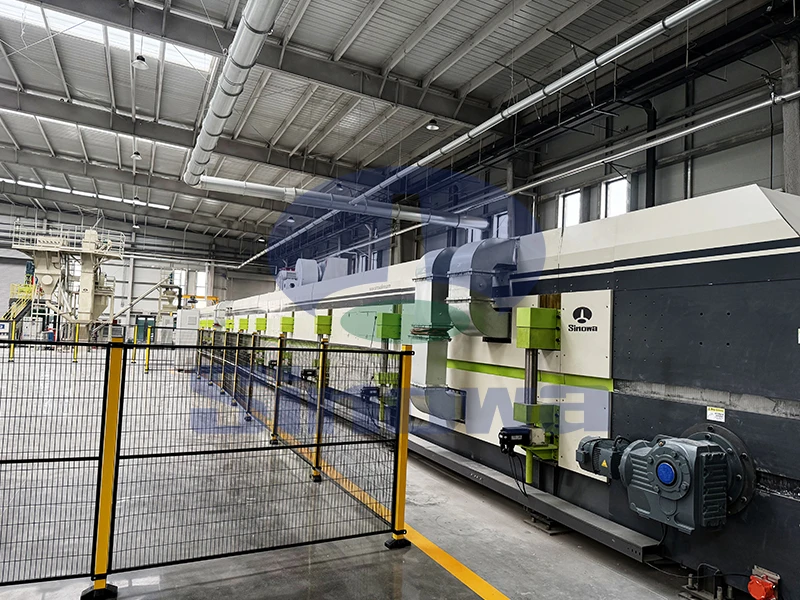
Most modern sandwich panel production machines are designed with flexible width adjustment functions, which have become a core basic feature to adapt to diversified market demands. In actual industrial production, construction projects, cold storage manufacturing and architectural decoration scenarios require sandwich panels of different widths to fit different installation spaces and structural designs. Fixed-width production equipment can no longer meet the flexible production requirements of manufacturers, so width adjustability is integrated into the overall mechanical design of mainstream equipment. The width adjustment system is closely combined with the equipment’s feeding, forming, pressing and cutting structures, realizing synchronous parameter modification of each link. This linkage design ensures that after adjusting the panel width, all production procedures can operate in a matched manner, avoiding dimensional deviations and structural defects of finished panels caused by inconsistent parameter settings of individual components. Whether producing narrow panels for partition walls or wide panels for large-area enclosure structures, the equipment can complete accurate width conversion through simple parameter debugging.
The core principle of sandwich panel width adjustment lies in the modular and adjustable structural design of the production line. The equipment is equipped with movable guide rails, adjustable positioning baffles and synchronous transmission mechanisms on the raw material feeding and forming sections. When adjusting the panel width, workers only need to change the horizontal spacing parameters of the left and right positioning components of the equipment, so that the upper and lower metal sheets and the middle core material can be limited and formed within the set width range. The transmission system adopts a servo-linked control mode, which can automatically calibrate the running track of raw materials according to the set width data, preventing material deviation during high-speed production. In addition, the rolling forming group of the machine has adjustable spacing, which can adapt to different width specifications without replacing the forming mold. This mechanical and electrical integrated adjustment principle ensures both the flexibility of width change and the stability of production size, making the finished panel width uniform and consistent in batch production.
The specific operation process of width adjustment is standardized and simple, suitable for long-term repetitive operation in industrial production. First, the equipment needs to be switched to the parameter setting state after stopping the running production cycle to avoid mechanical collision and parameter confusion during operation. Operators input the target width data through the central control panel of the production line, and the system will automatically calculate and feed back the adjustable range to prevent the setting of unreasonable size parameters. After confirming the parameters, the servo motor drives the positioning baffles and guide rail components on both sides of the production line to move synchronously to the designated position, and the equipment will automatically complete position locking. Subsequently, a small number of trial production samples need to be made, and the actual width of the finished samples is measured with professional measuring tools. If there is a tiny deviation, fine calibration can be carried out through the control system to ensure the production accuracy meets the use requirements before starting formal batch production.
The width adjustment range of sandwich panel production machines has certain flexibility limits, which are determined by the inherent mechanical structure of the equipment. Each type of production machine has a fixed minimum and maximum adjustable width, which is formed by the effective forming range of the rolling system and the moving stroke of the positioning mechanism. In actual use, the panel width cannot be set beyond the equipment’s adjustable limit, otherwise it will cause abnormal operation of mechanical parts, material jamming, or unqualified forming of sandwich panels. Within the effective adjustable range, the equipment can realize stepless width adjustment, supporting the production of panels with any width specification between the maximum and minimum values. This stepless adjustment feature greatly enriches the product specifications of manufacturers, enabling them to customize products according to the personalized needs of different customers and improve the market adaptability of sandwich panel products.
Width adjustment function effectively improves the production efficiency and economic benefits of sandwich panel manufacturers. In the traditional fixed-width production mode, if enterprises need to produce panels of different widths, they have to configure multiple sets of production equipment or frequently replace molds, which not only increases equipment investment costs and site occupation, but also consumes a lot of time for mold replacement and equipment debugging. The adjustable-width production machine integrates multiple production specifications into one device, realizing rapid switching of different width products within a short time. It greatly shortens the production preparation cycle, reduces the downtime caused by product specification conversion, and significantly improves the continuous production capacity of the production line. At the same time, it avoids the repeated purchase of equipment for different width production needs, reduces the operation and maintenance cost of enterprise production equipment, and optimizes the overall production resource allocation.
The adjustment accuracy of panel width is affected by multiple mechanical and operational factors, and targeted control is required in production. The wear degree of the equipment’s guide rails and positioning baffles will directly affect the adjustment accuracy; long-term high-intensity operation may cause slight wear of moving parts, leading to tiny width errors of finished panels. The calibration state of the servo control system is also a key factor, and system parameter drift after long-term operation will reduce the adjustment precision. In addition, the manual operation standardization also has an impact, such as incomplete parameter confirmation and insufficient sample detection during adjustment, which may lead to unqualified product size. Regular inspection and calibration of mechanical parts and control systems can effectively eliminate these adverse factors and maintain high-precision width adjustment of the equipment.
Different types of sandwich panel production machines have slight differences in width adjustment modes and effects. Continuous integrated production lines adopt fully automatic electric adjustment, with high adjustment speed and high precision, and are suitable for large-batch and multi-specification continuous production. Semi-automatic production equipment combines electric adjustment and manual fine-tuning, with a relatively simple structure and lower cost, which is more suitable for small and medium-sized production scenarios with small specification changes. Discontinuous single-panel forming machines have a smaller adjustable width range, and the adjustment process is more cumbersome, but they have advantages in producing special-shaped and small-batch customized panels. Manufacturers can choose equipment with matching adjustment functions according to their own production scale and product positioning to meet targeted production needs.
Daily maintenance and debugging are crucial to maintain the stable width adjustment performance of the machine. It is necessary to regularly clean the dust, debris and residual materials on the equipment guide rails and positioning moving parts to ensure the flexible operation of the mechanical adjustment structure and avoid material accumulation affecting positioning accuracy. Regularly check the tightness of the connecting parts of the adjustment mechanism to prevent component loosening caused by vibration during production, which leads to width deviation. The control system parameters should be calibrated regularly to correct the system errors generated by long-term operation. At the same time, operators should form standardized operation habits, record the parameter setting data and debugging results of each width adjustment, and form production files to provide reference for subsequent specification conversion and equipment maintenance.
The width adjustment function also promotes the innovative application of sandwich panels in multiple industries. With the flexible width adjustment capability of production machines, sandwich panels can be customized into various width specifications to adapt to different application scenarios. Narrow-specification panels are suitable for indoor partition walls, small equipment heat insulation and local decoration, while wide-specification panels can meet the needs of large-scale factory buildings, cold storage enclosures and outdoor wall thermal insulation projects. The diversified product specifications brought by width adjustment expand the application boundary of sandwich panels, making this energy-saving and environmental protection building material more widely used in construction, logistics, new energy and other fields, and driving the continuous upgrading of the sandwich panel manufacturing industry.
In the future, the width adjustment technology of sandwich panel production machines will develop towards higher automation, higher precision and smarter control. With the continuous progress of mechanical intelligence technology, the equipment will realize automatic identification of production orders and independent matching of optimal width parameters, further reducing manual intervention and improving adjustment efficiency and accuracy. The adjustable range of the equipment will be further optimized to cover more ultra-wide and ultra-narrow panel production needs. The intelligent linkage system will also realize real-time monitoring and automatic correction of width errors during production, fundamentally ensuring the dimensional stability of batch products and injecting continuous power into the high-quality development of the sandwich panel industry.