What Cutting Mode Does Continuous PU Sandwich Panel Line Adopt?
Publication Date: Sep 23, 2026
The cutting mode adopted by continuous PU sandwich panel production lines, focusing on its core working principles, structural advantages, operational features, and functional values. It also explains how this dynamic cutting mode differs from traditional cutting methods to suit continuous panel production.
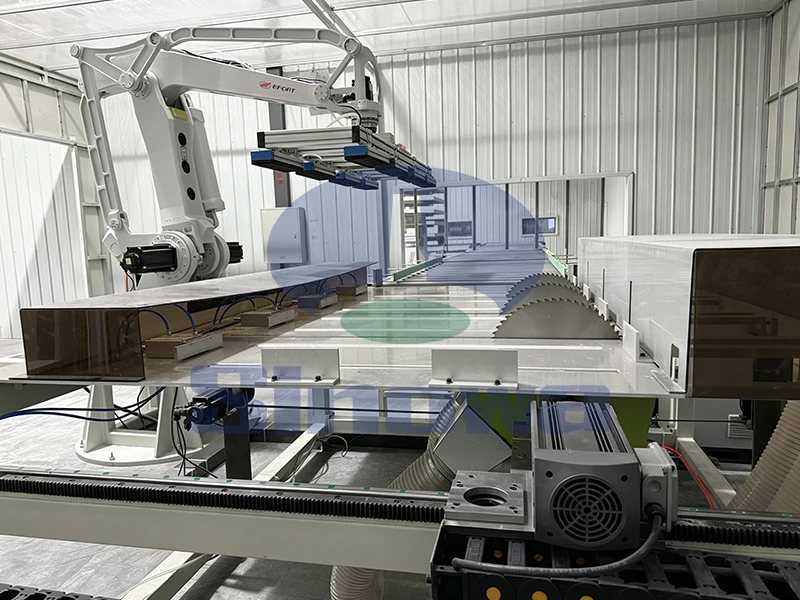
The continuous PU sandwich panel production line mainly adopts the intelligent flying saw synchronous cutting mode, a dynamic non-stop cutting technology tailored for uninterrupted panel forming and conveying processes. Unlike conventional static cutting that requires halting production for sizing and slicing, this cutting mode enables real-time cutting operation while the long strip-shaped PU sandwich panels keep moving forward on the production line. The core logic of this mode lies in synchronous speed matching, where the cutting equipment automatically tracks and synchronizes with the linear conveying speed of the panels. Through high-precision sensing and servo driving systems, the cutting mechanism accelerates to fully align with the panel movement speed before executing cutting actions, ensuring no relative displacement between the tool and the panel during the entire cutting process. This fundamental design eliminates the production pause caused by cutting procedures, laying the core foundation for the high-efficiency continuous operation of the entire PU sandwich panel production line and effectively solving the efficiency bottleneck of traditional intermittent cutting processes.
The flying saw synchronous cutting mode is built on a complete set of integrated intelligent control and mechanical transmission systems, which constitutes the core operating framework of the entire cutting process. At the sensing and positioning level, the system is equipped with high-sensitivity real-time detection components that continuously monitor the conveying distance and moving speed of the formed continuous PU panels. These components transmit real-time data to the central control system, which automatically compares the detected data with the preset finished panel length parameters set for production. Once the panel conveying distance reaches the customized fixed-length standard, the system instantly outputs cutting instructions to the servo drive unit. The servo motor drives the cutting carriage and blade assembly to complete rapid acceleration, synchronous follow-up, fixed-position cutting and reset deceleration in a closed-loop cycle. The whole process is fully automated without manual intervention, realizing intelligent linkage between panel conveying and cutting processing.
Speed synchronization accuracy is the core technical advantage of the flying saw cutting mode for continuous PU sandwich panel lines, directly determining the dimensional accuracy and surface quality of finished panels. In actual production operation, the slight speed deviation between cutting equipment and panel conveying will lead to dimensional errors, edge burrs or surface scratches on panels. The adopted cutting mode solves this problem through high-precision servo closed-loop speed regulation technology. The system can dynamically adjust the running speed of the cutting carriage in real time according to the slight fluctuation of the production line conveying speed, always maintaining a zero-difference synchronous state between the cutting tool and the moving panel. This precise speed matching ensures that each fixed-length cutting is completed in a stable dynamic state, making the incision of PU sandwich panels flat and smooth without irregular notches, and keeping the dimensional error of each finished panel within an extremely small controllable range.
This continuous synchronous cutting mode supports flexible customized sizing, which adapts to the diversified production demands of PU sandwich panels for different application scenarios. In practical production, the required length of finished PU sandwich panels varies greatly according to different usage environments and construction requirements. The intelligent control system of the cutting equipment allows operators to freely set target cutting lengths through the operating terminal within the conventional production specification range. After completing parameter setting, the system can automatically identify and execute fixed-length cutting of different sizes without replacing cutting molds or adjusting mechanical structures. Whether producing short-size panels for local building decoration or long-size panels for large-scale industrial workshop enclosure, the cutting mode can complete accurate and efficient slicing. This flexible sizing feature greatly improves the production adaptability of the continuous line and avoids the equipment adjustment and production waste caused by single cutting specification.
Compared with traditional static cutting modes used in discontinuous panel production equipment, the flying saw synchronous cutting mode shows obvious advantages in production continuity and overall efficiency. Traditional cutting processes need to stop the conveying equipment after the panel reaches the fixed length, then complete manual positioning and mechanical cutting, and restart the equipment after cutting is finished. This intermittent operation mode generates frequent production gaps, seriously restricting the overall production rhythm and output. In contrast, the cutting mode of continuous PU sandwich panel lines realizes zero-interval docking between panel forming, conveying and cutting. The cutting action is completed in the dynamic conveying process, and the production line maintains a stable continuous operating state all the time. It completely eliminates the time loss caused by equipment start-stop and positioning waiting, greatly improves the unit time production capacity of the production line, and realizes streamlined and high-volume production of PU sandwich panels.
The mechanical structure design matching the synchronous cutting mode ensures stable operation and long-term service life of the cutting system in high-intensity continuous production. The cutting core adopts high-hardness wear-resistant cutting blades, which are specially optimized for the composite structure of PU sandwich panels with metal surface and foam inner core. The blade can smoothly cut through the metal outer layer and PU foam inner core at one time without crushing the foam core or deforming the metal edge. The cutting carriage adopts a precision linear guide rail transmission structure, which ensures stable and low-resistance operation during high-speed acceleration and deceleration. Meanwhile, the system is equipped with a buffer reset mechanism, which can quickly and accurately reset the cutting device to the initial position after each cutting action to wait for the next cutting cycle. The optimized mechanical structure reduces equipment vibration and operational failure rate in continuous working state, ensuring long-term stable and reliable cutting performance.
The intelligent error correction and anti-deviation function is an important auxiliary feature of the continuous PU sandwich panel line’s cutting mode, which further guarantees finished product qualification rate. In the long-term continuous production process, minor deviations may occur in panel conveying due to mechanical vibration and material tension changes. The cutting system is equipped with real-time deviation detection modules, which can capture tiny position offset data of panels during operation. Once deviation is detected, the central control system will automatically adjust the cutting track and positioning parameters in real time to correct the cutting position synchronously. This real-time error correction mechanism avoids defective products such as skewed cuts and uneven panel lengths caused by conveying deviation. It effectively reduces the product rejection rate in mass production and improves the overall processing consistency of batch PU sandwich panels.
The non-stop synchronous cutting mode also optimizes the surface protection and overall appearance quality of PU sandwich panels during processing. Traditional static cutting often produces extrusion marks, scratches or edge deformation on the panel surface due to fixed clamping and static cutting pressure. The flying saw synchronous cutting mode abandons rigid fixed clamping design, and completes cutting in the synchronous moving state of the panel and tool. The whole cutting process has no rigid extrusion and static friction on the panel surface, which well protects the integrity of the metal coating on the panel surface and the tightness of the internal PU foam structure. At the same time, the one-time high-speed cutting process avoids repeated cutting and trimming operations, effectively preventing edge burrs, foam shedding and other quality problems, making the finished panel have neat edges and smooth overall appearance.
The energy-saving and low-consumption performance of this cutting mode conforms to the efficient and environmentally friendly production concept of modern panel processing industry. The traditional intermittent cutting mode requires frequent start and stop of motors and mechanical equipment, which will generate additional power consumption and mechanical loss. The continuous synchronous cutting system maintains a stable and continuous operating state, avoiding the energy waste caused by frequent equipment start-stop and load fluctuation. The servo drive technology adopted by the cutting equipment can automatically adjust power output according to the cutting load, realizing precise energy supply and reducing invalid energy consumption. In addition, the stable cutting process reduces defective products and reprocessing links, indirectly saving raw material consumption and production energy consumption, achieving a balance between high production efficiency and low operating cost.
In summary, the continuous PU sandwich panel line’s flying saw synchronous non-stop cutting mode is a systematic and intelligent cutting solution developed for the characteristics of continuous panel production. Its core advantages of synchronous speed tracking, flexible fixed-length cutting, uninterrupted production and high-precision processing perfectly match the streamlined production needs of PU sandwich panels. This cutting mode not only improves production efficiency and product dimensional accuracy, but also optimizes product surface quality and production stability, becoming the core key technology to ensure the superior performance and batch production capacity of continuous PU sandwich panel production lines.
Gallery of Continuous PU Sandwich Panel Line
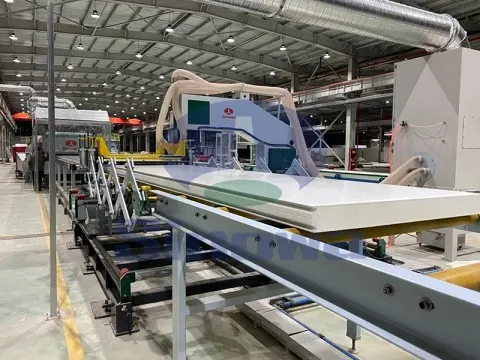
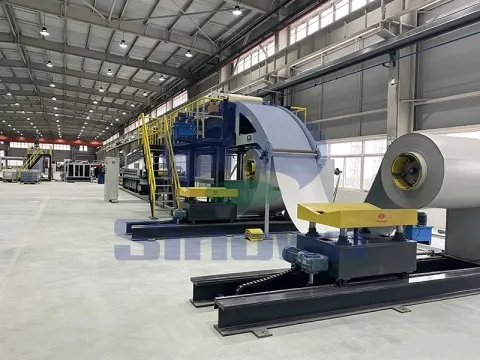
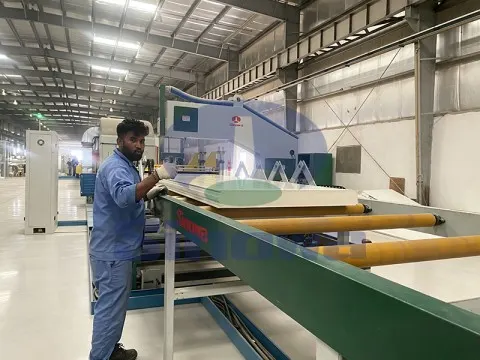
Tags: continuous pu sandwich panel line, continuous pu sandwich panel line manufacturer, continuous pu sandwich panel line supplier, china continuous pu sandwich panel line, continuous pu sandwich panel line for sale
-
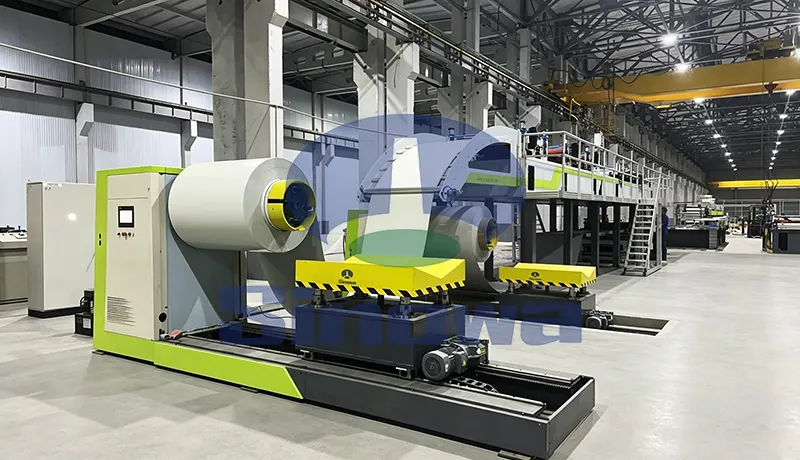
The PU sandwich panel line is a core production setup for making high-performance building insulation panels. This professional PU sandwich panel production line features automated operation to streamline the whole manufacturing process efficiently. Every component of the polyurethane sandwich panel line is precisely calibrated to ensure consistent panel thickness and structural stability. A well-maintained polyurethane sandwich panel production line can greatly boost production efficiency while reducing manual operation errors. The continuous PU sandwich panel line adapts to diverse production demands for different panel sizes and surface styles. With advanced molding technology, the PIR sandwich panel line produces panels with excellent heat preservation and sound insulation properties. Stable running of the PIR sandwich panel production line guarantees reliable product quality for various construction and industrial application scenarios.
-
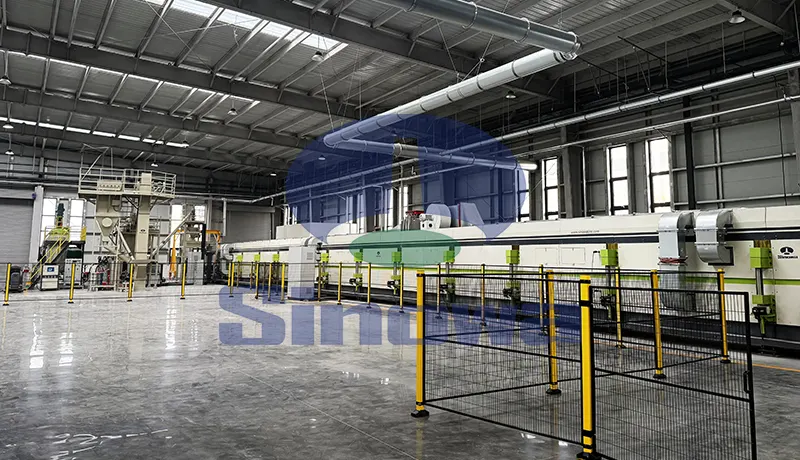
A phenolic insulation board production line serves as the core equipment for manufacturing high-performance thermal insulation building materials. This phenolic insulation panel production line integrates material mixing, foaming, molding and cutting processes to ensure continuous and stable production efficiency. Every operational link of the insulation board production line is precisely calibrated to produce uniform and durable insulation boards. The automated design of the insulation panel production line effectively reduces manual intervention and improves product consistency. Proper maintenance of the phenolic board production line can greatly extend its service life and maintain steady production output. With optimized structural design, the phenolic panel production line adapts to various production demands and delivers high-quality finished products for thermal insulation engineering applications.
-
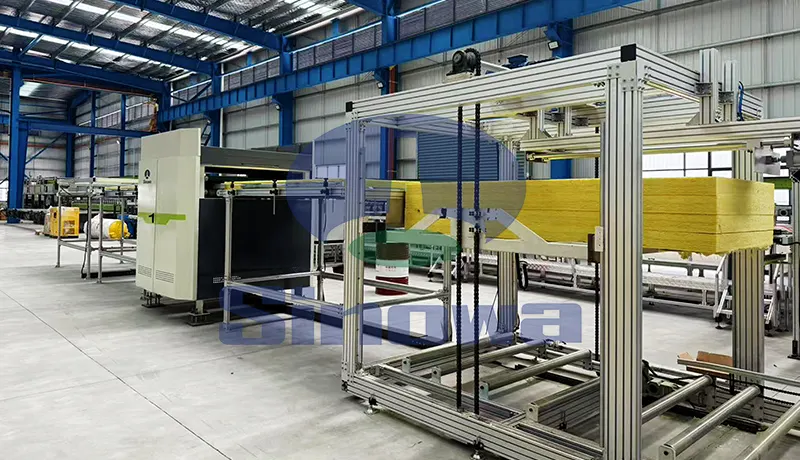
A professional rockwool sandwich panel line serves as the core equipment for producing high-performance building panels. This rockwool sandwich panel production line integrates feeding, laminating and forming processes to ensure stable and efficient production. The well-structured rock wool sandwich panel line can process raw rockwool materials into panels with excellent thermal and sound insulation properties. Operators can adjust the running parameters of the rock wool sandwich panel production line to manufacture panels of different thicknesses and specifications. The automated design of the mineral wool sandwich panel production line greatly reduces manual operation errors and improves product consistency. Regular maintenance of the mineral wool sandwich panel line is essential to sustain long-term operational efficiency and guarantee qualified finished panels for diverse construction applications.