What Causes Color Difference On Continuous PUF Sandwich Panel Manufacturing Machine Metal Surface Panels?
Publication Date: Oct 13, 2026
Color defects on continuous PUF sandwich panel metal skins trace to raw-coating variation, thermal imbalance, line speed drift, and surface contamination across the lamination process.
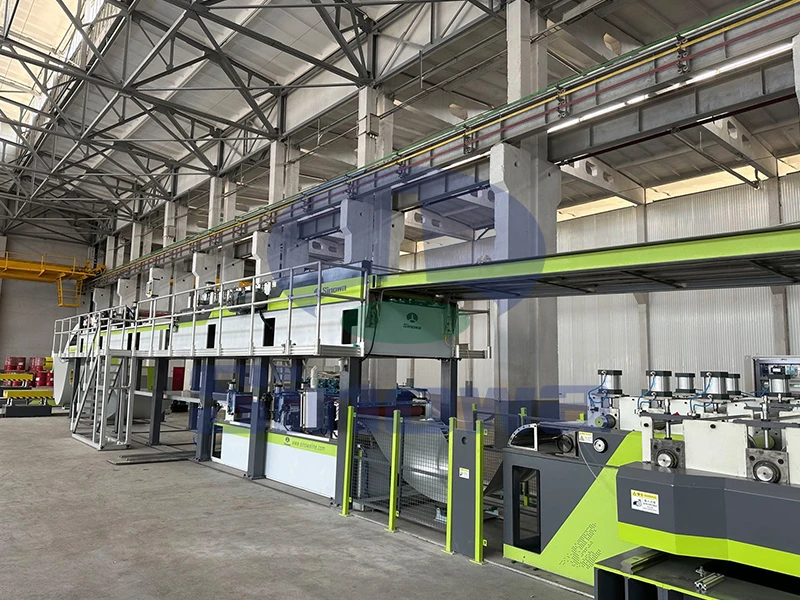
Continuous PUF sandwich panel production bonds two pre-coated metal skins — typically hot-dip galvanized or aluminum coils — to a polyurethane foam core as the entire assembly travels through a double-band laminator at speeds often exceeding ten meters per minute. The metal sheet enters the line already carrying a factory-applied organic coating, usually a polyester or modified-polyester paint film on top of a chemical conversion pretreatment layer. Any visible color shift on the finished panel therefore originates not from the foam itself, but from how that pre-coated metal surface behaves, is thermally stressed, gets contacted, or is contaminated while it is being conveyed through the forming, foam-injection, curing, and cut-to-length stations. Because the panel is sold as a finished architectural exterior component, even a subtle hue mismatch between adjacent panels stacked side by side on a building wall is perceived as a quality failure by the end customer, which makes root-cause analysis of color variation one of the most frequently discussed topics among line operators and quality engineers in this industry.
The first and most common source of visible color difference lies in the incoming metal coil itself. Pre-painted coils are produced on separate coating lines where paint viscosity, oven temperature profile, film thickness, and cure dwell time are tightly controlled, but batch-to-batch variation is unavoidable. Two coils from the same nominal color specification can exhibit measurable delta-E values if the paint lot was reformulated, if the pigment dispersion differed, or if the galvanized substrate's spangle pattern changed between steel mills. When a running coil on the PUF line is spliced to a new coil, the splice joint itself is usually cropped out, but the region immediately after the splice can show a perceptible tone shift that reveals the underlying coil-to-coil difference rather than a process fault. Operators often mistake this for a line problem when in fact the blame belongs upstream in the coil preparation or in the incoming material inspection protocol. Keeping a batch number log and performing a side-by-side wet-film comparison before loading a new coil onto the decoiler is a practical defense against this kind of mismatch.
Thermal stress is the second major contributor. The polyurethane core reacts exothermically after injection between the two moving skins, and the peak temperature reached at the bond line can easily exceed one hundred and fifty degrees Celsius for a fraction of a minute before the sandwich exits the heating and cooling zones of the double-band. Most pre-coated metal paints are rated for long-term exterior exposure, but they are not all designed to withstand a short, sharp burst of elevated heat while simultaneously being pressed against a release film. If the band temperature is set too high, or if the line speed slows down unexpectedly for several minutes, the paint film on the lower skin — which sits directly against the heated steel belt — can experience localized yellowing, gloss loss, or a subtle shift toward a creamier undertone. The upper skin, facing the cooler upper belt or the foam-side surface, may show almost no change. The result is a panel whose top and bottom skins do not match each other, or whose leading and trailing ends differ because the machine spent extra time at temperature during a startup or a stop. Recording band-zone temperatures against actual line speed on a continuous chart makes this effect visible during troubleshooting.
Surface contamination during conveying is the third cause. The metal skin passes through a series of rollers, guide arms, film applicators, and sealing-edge devices before reaching the foam injection head. Any residue on contact surfaces — leftover foam overspray, oil from a nearby hydraulic fitting, dust accumulated on the protective film that gets transferred when the film is peeled, or even fingerprints from handling a cut panel — can alter the apparent color by either physically smearing the paint or by altering the surface reflectance. A panel that looks slightly duller or hazier than its neighbors is often simply carrying a thin layer of invisible hydrocarbon film, which changes the way light scatters off the coating rather than changing the pigment itself. This is why maintenance crews are instructed to keep all contact rollers clean, why protective film is applied as early in the process as practical, and why finished panels are wiped down before final packaging in more demanding customer specifications. Contamination-related color differences are typically patchy or streaky rather than uniform across the whole coil width, which gives them a distinctive visual signature during inspection.
Coating thickness and film-weight variation on the incoming coil is the fourth factor. Even when the paint color is nominally identical, a metal skin with a heavier dry-film build will appear deeper and more saturated than a skin with a thinner build, because more pigment particles are present per unit area. On a continuous PUF line, the coil thickness itself can vary slightly as the strip transitions from the mill edge toward the center, and if the decoiler's tension control drifts, the strip can micro-stretch in places, locally thinning the paint film along with the metal. The eye picks this up as a band of lighter color running parallel to the line direction. Measuring coating weight with a beta-gauge or a magnetic induction gauge at the coil stand, and cross-checking it against the observed color on the finished panel, is a standard diagnostic step when longitudinal streaks appear.
Mechanical abrasion and scratch-related discoloration are the fifth cause. As the metal strip travels at high speed, any misaligned guide roller, any sharp burr on a side-cutting knife, or any piece of debris trapped between the strip and the band can produce fine scratch marks that catch light differently from the surrounding painted surface. Under diffuse indoor lighting these marks are barely visible, but under direct sunlight on a building facade they create bright or dark lines that read as color defects. Over time, a repeatedly scratched area can also wear through the topcoat, exposing the primer layer underneath, which almost always has a different hue — usually grayer or whiter — than the finish coat. Inspecting the strip path at idle, replacing worn felt wipers, and deburring every knife edge that touches the metal are straightforward preventive measures that keep scratch-related color complaints off the customer punch list.
Foam chemical drift and overspray deposition form the sixth source of visible discoloration. Polyurethane chemistry is sensitive to ambient temperature, isocyanate index, and raw-material temperature in the mixing head. If the polyol or isocyanate temperature drifts, the reaction can become hotter or less controlled, and tiny amounts of unreacted material or foam splatter can mist onto the face skin before it cures. These micro-droplets, when baked by the band heat, leave faint brownish or yellowish speckles that look like a diffuse color shift rather than discrete dirt. The effect is usually worse on the upper skin because droplets fall or drift upward from the mixing head under the influence of line airflow. Calibrating the mixing head temperature, checking the nozzle pattern, and ensuring adequate ventilation around the injection zone reduces this kind of contamination-related color change. It is also worth noting that when the foam core itself discolors — typically turning slightly amber with age — that color can faintly show through a thin light-colored paint film, making a white panel look cream-tinted long after installation.
Protective film handling and adhesive transfer represent the seventh cause. Most pre-painted metal coils ship with a temporary polyethylene protective film applied at the coating mill, intended to be peeled off after installation. On a PUF line, this film is sometimes left on through lamination to protect the face skin during handling. If the adhesive on that film is incompatible with the topcoat chemistry, or if the film is left on during a period of elevated line temperature, the adhesive can partially transfer onto the paint surface when the film is removed. The transferred adhesive is usually clear and invisible at first, but over a few days it oxidizes and turns a faint yellow, producing a patchy color change that customers notice only after the panels have been up on the wall. Running a small peel-test sample at operating temperature before committing a full coil, and specifying film adhesives that are compatible with the specific paint system in use, prevents this delayed-onset defect from reaching the field.
Line-speed variation and cooling-zone imbalance are the eighth contributor. The double-band laminator is divided into heating zones that accelerate foam rise and cooling zones that lock the panel dimensions before cutting. If a sensor in the cooling zone drifts, or if a setpoint is changed without accounting for ambient shop-temperature changes, the panel may exit the line at a higher or lower temperature than intended. A panel that exits too warm continues to cure while resting on the exit conveyor, and the residual heat can slightly age the paint film on whichever side contacts the conveyor rollers first. Because this effect is cumulative over minutes of downtime, panels produced during a short stop can look subtly different from panels produced during steady running. Keeping the exit conveyor at a controlled temperature and logging every slowdown and stop in the shift log makes it possible to correlate a specific batch of panels with a known thermal excursion.
Packaging, storage, and downstream handling round out the ninth cluster of causes. Finished panels are usually stacked face-to-face with interleaved separators, then strapped and shipped. If the separators themselves contain plasticizers, or if the panels are stored in a sealed container under hot sun for several weeks, the adjacent surfaces can pick up faint color transfer from the interleaving material or from condensation that forms and then evaporates, leaving water spots that look like a cloudy color change. Panels stacked in direct sunlight during outdoor storage can also develop a mild heat-age yellowing on the face that is indistinguishable at inspection but becomes visible when compared against a panel stored indoors. Keeping finished panels in a shaded, ventilated area and minimizing the time between production and installation is the final practical lever that line managers have over the perceived color consistency of their product.
Taken together, these nine causes — coil batch variation, thermal overexposure, surface contamination, coating-weight drift, mechanical abrasion, foam overspray, protective-film adhesive transfer, cooling-zone imbalance, and packaging-related transfer — account for nearly all the color-difference complaints that reach a PUF sandwich panel manufacturer's quality desk. The most effective troubleshooting approach is not to assume a single root cause, but to walk the panel backward from the customer complaint: inspect the defect under controlled lighting, classify its pattern as uniform, streaky, patchy, or speckled, and then match that pattern against the known signature of each cause above. Because the metal skin is a purchased, pre-finished material rather than a coating applied on the PUF line itself, many of the most frustrating color defects are ultimately resolved by tighter incoming-material controls and clearer supplier communication, rather than by any change made on the laminator itself.






Tags: continuous puf sandwich panel manufacturing machine, continuous puf sandwich panel manufacturing machine manufacturer, continuous puf sandwich panel manufacturing machine supplier, china continuous puf sandwich panel manufacturing machine, continuous puf sandwich panel manufacturing machine for sale
-

The PU sandwich panel line is a core production setup for making high-performance building insulation panels. This professional PU sandwich panel production line features automated operation to streamline the whole manufacturing process efficiently. Every component of the polyurethane sandwich panel line is precisely calibrated to ensure consistent panel thickness and structural stability. A well-maintained polyurethane sandwich panel production line can greatly boost production efficiency while reducing manual operation errors. The continuous PU sandwich panel line adapts to diverse production demands for different panel sizes and surface styles. With advanced molding technology, the PIR sandwich panel line produces panels with excellent heat preservation and sound insulation properties. Stable running of the PIR sandwich panel production line guarantees reliable product quality for various construction and industrial application scenarios.
-

A phenolic insulation board production line serves as the core equipment for manufacturing high-performance thermal insulation building materials. This phenolic insulation panel production line integrates material mixing, foaming, molding and cutting processes to ensure continuous and stable production efficiency. Every operational link of the insulation board production line is precisely calibrated to produce uniform and durable insulation boards. The automated design of the insulation panel production line effectively reduces manual intervention and improves product consistency. Proper maintenance of the phenolic board production line can greatly extend its service life and maintain steady production output. With optimized structural design, the phenolic panel production line adapts to various production demands and delivers high-quality finished products for thermal insulation engineering applications.
-

A professional rockwool sandwich panel line serves as the core equipment for producing high-performance building panels. This rockwool sandwich panel production line integrates feeding, laminating and forming processes to ensure stable and efficient production. The well-structured rock wool sandwich panel line can process raw rockwool materials into panels with excellent thermal and sound insulation properties. Operators can adjust the running parameters of the rock wool sandwich panel production line to manufacture panels of different thicknesses and specifications. The automated design of the mineral wool sandwich panel production line greatly reduces manual operation errors and improves product consistency. Regular maintenance of the mineral wool sandwich panel line is essential to sustain long-term operational efficiency and guarantee qualified finished panels for diverse construction applications.