How To Calibrate Dosing System Of Continuous PUR Sandwich Panel Production Machine?
Publication Date: Oct 13, 2026
Proper calibration of the dosing system ensures consistent foam density, uniform core bonding, and stable panel quality in continuous PUR sandwich panel production.
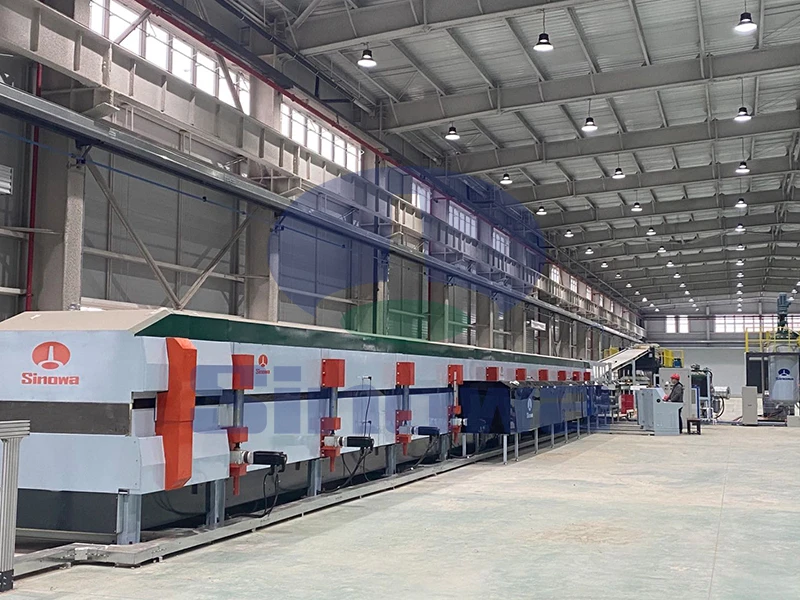
The dosing system lies at the heart of every continuous PUR sandwich panel line, because the polyol blend and isocyanate must meet in precise proportion, at controlled temperature and pressure, the instant they hit the moving facing skins. Even a small drift in ratio or flow rate shows up as uneven cell structure, weak adhesion, surface voids, or density variation across the panel width. Calibration is therefore not a one-off startup task but a recurring procedure that should be carried out whenever a raw material batch changes, after a pump seal or filter replacement, when panel specifications shift, or whenever the finished panel begins to show unexplained defects. Operators who treat dosing as a set-and-forget parameter often lose far more material to scrap than the few hours spent on a thorough calibration.
Before any adjustment begins, the line should be brought to its normal operating condition. Hydraulic oil, metering pump housings, heat exchangers, and material tanks need to reach the temperatures the process sheet calls for, and the circulation loops should be opened long enough for both components to stabilize. Filter condition matters as well: clogged suction or discharge filters create pressure fluctuations that look like pump errors but are really restrictions in the supply path. A quick check of pump case drain readings, relief valve response, and agitator function on the polyol side prevents chasing phantom calibration problems. It is also wise to verify that the correct material grades are actually in the correct tanks, since cross-connected supply lines are a surprisingly common source of ratio mismatch that no calibration can fix.
Once the system is warm and clean, the first calibration step is to confirm the actual displacement of each metering pump. Positive-ratio gear or piston pumps wear at the seals and gear clearances over time, so the nominal rotation-to-output figure on the nameplate gradually drifts away from reality. The standard method is to run each pump individually into a calibrated measuring vessel for a fixed number of revolutions or a timed interval, weigh the collected material, and convert the mass into volume using the measured density at that temperature. This gives a real displacement figure in milliliters per revolution, which is then fed back into the line controller as the correction factor for that pump. Repeating the exercise at several speeds, from minimum production rate to maximum, reveals whether wear is speed-dependent and whether the pump needs mechanical service rather than a software offset.
With corrected pump displacements entered, the chemical mix ratio can be set. PUR panel foaming depends on a tightly controlled index between the isocyanate and the polyol component, and the dosing controller is usually programmed by specifying the desired ratio in parts by weight. Rather than trusting the theoretical number, operators should run a short shot into a disposable container at the operating pressure and temperature, then weigh the output of each component over the same timed window. The ratio derived from these two measured masses is the effective ratio the spray head is actually delivering. Small adjustments are made by tweaking the speed ratio between the two pump drive motors, and the check is repeated until the measured ratio lands within the narrow band the material supplier recommends. Sampling under real head pressure is essential, because bypass flow or recirculation during low-pressure tests can mask the true delivery.
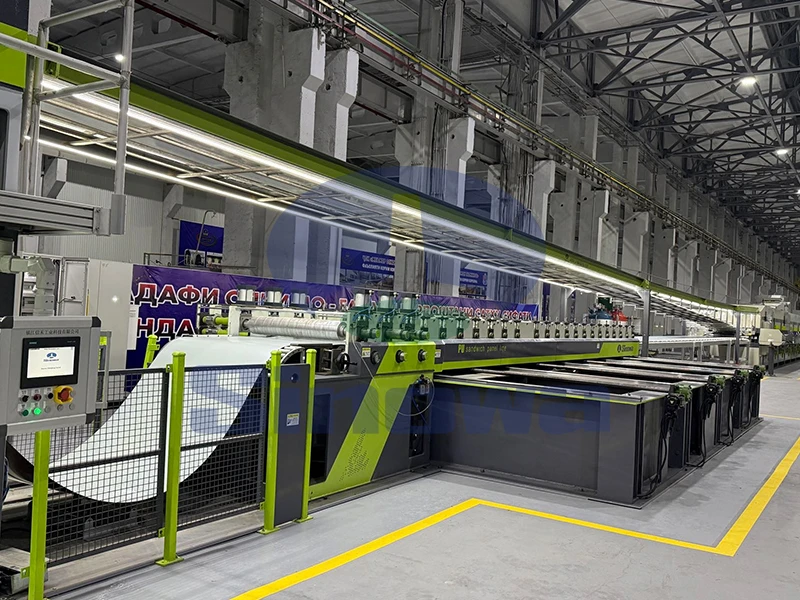
Flow rate and shot pattern calibration go hand in hand with ratio adjustment. The dosing head on a continuous panel line oscillates back and forth across the width of the lower facing, laying down a serpentine bead of mixed foam. The total mass laid down per meter of panel length determines the core density, and the travel speed of the oscillator, combined with its overlap distance, determines how evenly that mass is distributed. Operators should run a test board at line speed, collect a cross-section cut from the finished panel, and measure the weight per unit area at several points across the width. Any visible bands of higher or lower density point to an oscillator timing or overlap problem rather than a pump problem. Adjusting the stroke length, reversing point, or oscillation frequency flattens out these bands until the weight readings across the width are consistent.
Temperature and pressure compensation are the often-overlooked half of dosing calibration. Polyol viscosity changes sharply with temperature, and isocyanate reacts faster as it warms up, so the mixing head chamber, the heat exchangers on both lines, and the temperature of the material just before the mix chamber should all be logged during a calibration run. If the measured temperatures drift from the set points, the ratio check must be repeated after stabilization, because viscosity affects how much material actually passes through the pump per revolution even when the displacement figure is correct. Discharge pressure is equally informative: a sudden rise on one side while the other side stays flat points to a blocked filter or a partially closed valve, while a steady but declining pressure can indicate air leakage on the suction side. Neither condition is cured by changing the pump speed.
A practical in-line verification routine closes the loop on the calibration. After the ratio and flow are set, a short production run of typical panel thickness should be allowed to cure, and then the board is cross-checked for skin-to-core adhesion, rise height, surface appearance, and any internal voids or compressed zones. A density profile taken by slicing the cured core into thin layers confirms that the foam has risen symmetrically against both facings. If the top skin bonds weakly or the foam shows a laminated appearance near the lower skin, the shot timing or head distance from the facing may need correction. This physical check catches errors that mass-balance calculations alone cannot, because chemistry and rheology on the moving line behave differently than in a beaker.
Once the line is producing acceptable panels, the calibration data should be recorded in a clear log. Each entry should note the date, operator, material batch numbers, measured pump displacements, corrected speed ratio, effective ratio from the container test, measured flow rate per linear meter, line speed, and head temperatures. Over weeks and months, this log reveals drift trends: a pump whose measured displacement is gradually falling means the seals are wearing and a rebuild is coming, not a reason to keep nudging the correction factor. Comparison across material batches also shows whether a particular polyol lot behaves differently and needs a small ratio offset. Without this record, every calibration becomes a guess based on last week's feel rather than on measured change.
Several common mistakes undermine even careful calibration. Running ratio checks at low pressure or with the head in recirculation bypass gives reassuring numbers that vanish as soon as the head opens to the mixing chamber. Failing to account for temperature when weighing collected samples means the density conversion is wrong. Adjusting only one component's speed without re-measuring the other can push the ratio further off target. Ignoring the oscillator pattern leads to uniform but incorrectly distributed foam that looks right on the balance and wrong on the finished panel. And skipping the post-calibration physical test means a perfectly tuned delivery system can still produce scrap because the chemistry or head distance is off. Treating calibration as a measured, repeatable, logged process rather than an art keeps the panel line stable and the dosing system trustworthy over long production runs.






Tags: continuous pur sandwich panel production machine, continuous pur sandwich panel production machine manufacturer, continuous pur sandwich panel production machine supplier, china continuous pur sandwich panel production machine, continuous pur sandwich panel production machine for sale
-

The PU sandwich panel line is a core production setup for making high-performance building insulation panels. This professional PU sandwich panel production line features automated operation to streamline the whole manufacturing process efficiently. Every component of the polyurethane sandwich panel line is precisely calibrated to ensure consistent panel thickness and structural stability. A well-maintained polyurethane sandwich panel production line can greatly boost production efficiency while reducing manual operation errors. The continuous PU sandwich panel line adapts to diverse production demands for different panel sizes and surface styles. With advanced molding technology, the PIR sandwich panel line produces panels with excellent heat preservation and sound insulation properties. Stable running of the PIR sandwich panel production line guarantees reliable product quality for various construction and industrial application scenarios.
-

A phenolic insulation board production line serves as the core equipment for manufacturing high-performance thermal insulation building materials. This phenolic insulation panel production line integrates material mixing, foaming, molding and cutting processes to ensure continuous and stable production efficiency. Every operational link of the insulation board production line is precisely calibrated to produce uniform and durable insulation boards. The automated design of the insulation panel production line effectively reduces manual intervention and improves product consistency. Proper maintenance of the phenolic board production line can greatly extend its service life and maintain steady production output. With optimized structural design, the phenolic panel production line adapts to various production demands and delivers high-quality finished products for thermal insulation engineering applications.
-

A professional rockwool sandwich panel line serves as the core equipment for producing high-performance building panels. This rockwool sandwich panel production line integrates feeding, laminating and forming processes to ensure stable and efficient production. The well-structured rock wool sandwich panel line can process raw rockwool materials into panels with excellent thermal and sound insulation properties. Operators can adjust the running parameters of the rock wool sandwich panel production line to manufacture panels of different thicknesses and specifications. The automated design of the mineral wool sandwich panel production line greatly reduces manual operation errors and improves product consistency. Regular maintenance of the mineral wool sandwich panel line is essential to sustain long-term operational efficiency and guarantee qualified finished panels for diverse construction applications.