Why Is The Output Efficiency Low Of Continuous PU Sandwich Panel Production Machinery?
Publication Date: Oct 13, 2026
Discover the main reasons output efficiency drops on continuous PU sandwich panel lines, from raw material consistency and mixing behavior to belt speed, die cooling, and maintenance habits.
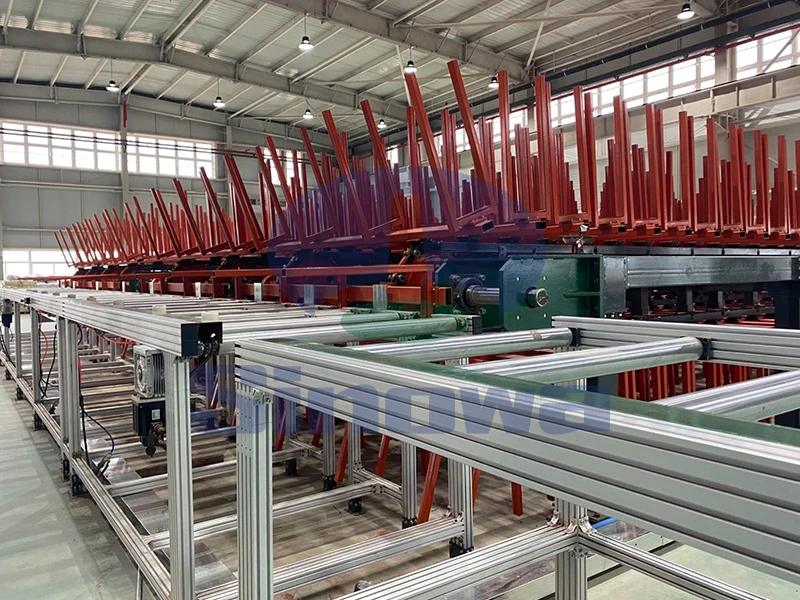
The quality and consistency of raw materials entering a continuous PU sandwich panel line directly dictate how fast the line can actually run. Polyurethane chemistry is unforgiving when component temperatures, viscosities, or blend ratios drift outside the window the equipment was tuned for. Polyol systems containing blowing agents, catalysts, surfactants, and flame-retardant additives must be held at a stable viscosity so the high-pressure mixing head can atomize the two components into a fine, uniform spray. If the polyol blend is too cold, its viscosity rises, flow through the metering pumps becomes uneven, and the pour pattern widens or narrows unpredictably as the line moves forward. If it is too warm, the cream time shortens and the mixture begins to react before it reaches the lower facing, causing premature skin formation, weak bond lines, and uneven core density. Isocyanate has its own sensitivities: moisture picked up from improperly sealed drums, bulk tanks, or humid ambient air introduces side reactions that generate extra gas and solid urea residues, which gradually deposit on the mixing head, the conveyor belt, and the inner walls of the die. Over a single shift these deposits build up into crumbly crusts that interfere with release and smooth movement, forcing operators to slow the line and eventually stop for cleaning. Facing materials matter just as much. The amount of rolling oil on the steel, residue from the protective film, the flatness of the coil edges, and the tension control of the de-coiler all affect whether the facing feeds without wrinkling, wandering, or tearing. A coil that shifts sideways, a film that delaminates at the edge, or a scratch that catches on the pre-heater can trigger a scrap length and a restart that cost more time than any saved seconds on the run.
The high-pressure mixing head and the metering system are the heart of output stability, and small deviations there produce surprisingly large efficiency losses. Even when the component pumps are calibrated, wear on the piston seals, ball valves, and hydraulic intensifiers changes the effective output over weeks of running. A head that was originally set for a precise blend ratio will, after thousands of cycles, deliver slightly more of one component than the other, shifting the reactivity of the foam and making it harder to find a steady line speed. The nozzle itself is a common culprit: tips eroded by circulating abrasive additives produce a fan that is no longer symmetrical, so the spray lands in streaks on the lower facing. Those streaks translate into density lines and weak areas in the finished panel that have to be cut out, reducing good output even when the line never actually stops. Mixing head cleaning cycles also eat into available time. If the self-cleaning piston does not fully purge the chamber at the end of each pour, residual foam hardens and interferes with the next shot; if the purge solvent is overused, it contaminates the recovered chemical and alters reactivity downstream. Operators who notice a faint quality drift often compensate by lowering line speed rather than stopping to recalibrate, which protects panel appearance but quietly reduces the daily meter count. Over a week of production, this cautious slowdown can become the single largest hidden source of lost output, because it never shows up as a formal stoppage record.
Temperature control across the whole line is another area where inefficiency accumulates almost invisibly. Both the chemical components and the two facing layers need to sit within a deliberate temperature band for the foam to rise evenly and bond strongly. If the lower facing enters the die too cold, the polyurethane near the skin reacts slowly, creating a soft underside that deforms when the panel leaves the conveyor. If the upper facing is too hot, the skin cures too fast and the core cannot expand fully, producing a lower-density core that fails later. The oven and cooling zones on a continuous line must therefore track the line speed: faster runs need more heat input in the pre-heat and gelling zones and more cooling later, while slower runs need less. Many production lines are operated with the zone temperatures fixed at values chosen months earlier, because changing them feels risky. When product mix or ambient season changes, that fixed profile no longer matches the chemistry, and the operator is forced to run slower to compensate. Water-cooled plates under the conveyor can also develop scale or blocked channels over time, reducing heat exchange capacity so that the panel leaves the die still soft. Trying to cut a soft panel means the saw blade drags, the cut edge deforms, and more scrap is generated. Conversely, if the cooling fans in the exit section are set too high for winter air, the facing contracts unevenly and the panel bows, again requiring slowdowns and re-work. Each of these thermal mismatches looks like a minor adjustment on the panel itself, but multiplied across a day of running, they shave off meaningful output.
Speed synchronization between the double belt conveyor, the pouring station, and the flying saw is where many lines lose the most visible output. A continuous PU sandwich panel line is, in essence, a moving mold: the two facings come together at the entry of the double belt, the foam is poured and expands between them, and the sandwich travels through a long, pressurized heating and cooling section before being cut to length. Every part of this train must move at the same surface speed. If the upper belt and lower belt drift apart by even a fraction, the facing wrinkles or stretches, and the panel must be cut out. If the pour carriage oscillates at a different frequency than the belt, the lay-down pattern of foam becomes uneven, producing heavy and light bands across the width. The flying saw at the exit must accelerate to match the line speed exactly, cut through the panel, and return; a saw that is slightly slow means either a ragged cut that has to be trimmed or a forced reduction in line speed so the saw can keep up. Encoder drift, worn drive belts, and hydraulic accumulators that no longer hold pressure all contribute to this synchronization problem. When operators are unsure whether the system will hold a constant speed for the next hundred meters, they tend to run at the lower end of the rated range rather than push the upper limit. This conservative setting is rational from a quality perspective, but it means the line is producing well below its mechanical potential, and the gap rarely appears in maintenance logs because no component has technically failed.
The die geometry, lip condition, and side-sealing system also exert a strong influence on how fast the line can run without defects. The die sets the final thickness and width of the panel as the foam reaches its peak rise. If the die opening is not correctly matched to the amount of chemical being poured, the foam either back-pours into the entry zone or stays under-filled at the exit. Worn die lips, nicks from previous scrap panels, and residue buildup along the side guides create lines on the facing surface that customers reject. Side-sealing mechanisms, which prevent foam from leaking out the edges as it expands, wear out with heat and chemical contact; once the seals begin to leak, operators must slow the line so the foam has time to gel before it reaches the gap. Panel profile design matters too: deep-ribbed corrugated profiles require the upper facing to be pre-formed accurately and fed into the die without spring-back, while flat smooth panels tolerate higher speeds but are more sensitive to thickness variation. Switching between product profiles during a shift is itself a major source of efficiency loss, because the die lips, side guides, and pre-forming rollers all need re-adjustment. If the changeover is done without jigs and measuring tools, it can take much longer than necessary, and the first few meters of every new profile are usually scrapped. Lines that run a narrow product mix consistently tend to show higher output, not because the machinery is better, but because the setup rarely leaves the calibrated sweet spot.
Maintenance discipline, or the lack of it, is often the root cause when a line that once ran fast now seems unable to reach those speeds. Small, predictable wear items — mixing head seals, filter cartridges in the chemical circulators, belt scraping blades, heating element contact surfaces, and saw blade teeth — degrade gradually rather than suddenly. A line whose filters are not changed on schedule will show rising pressure drops in the chemical lines, which the dosing pumps interpret as resistance and which subtly alter the delivered ratio. A conveyor belt whose scraping blades are worn allows cured foam residue to stick to the belt surface and transfer onto the underside of every panel afterward. Heater contacts that are corroded cause intermittent temperature drops that the control system smooths over, so operators never see the fault but feel it as a need to slow down. The most telling sign of deferred maintenance is a creeping baseline: the line that used to hold a steady speed for an entire eight-hour shift now begins to shudder, leak, or wobble after three hours, and the afternoon output is noticeably lower than the morning. Many factories respond by adding more operators or longer shifts instead of investing in the planned stoppages that would let the line run at full speed for the whole shift. This trade-off feels unavoidable under delivery pressure, but over months it compounds into an output level that is far below the line's nameplate capacity, and the gap is written off as "normal" for that machine.
Operator skill, setup habits, and shift-to-shift consistency are frequently underestimated variables in output efficiency. Running a continuous PU sandwich panel line is partly chemistry and partly mechanical feel: the operator watches the pour pattern, listens to the head, checks the edge seals, and glances at the panels coming off the saw. An experienced operator can detect a slight viscosity change by how the spray sounds and adjust component temperature before a defect appears. A less experienced operator reacts only after the defect is visible, which means several meters of scrap have already been produced. Setup routines between product changes are another lever. When each shift measures die gap and belt tension by feel rather than with calibrated gauges, the line starts up at a slightly different point every time, and the first half hour of running is spent hunting for stable parameters. Poor handover between shifts — not writing down the final speeds, temperatures, and pour settings — means the next operator effectively restarts the tuning process from memory, and memory is rarely exact. Factories that keep a visible production parameter board, that walk through a standardized checklist at every changeover, and that cross-train operators across both the chemical side and the mechanical side typically recover a meaningful percentage of lost output simply because the line spends less time in transient states and more time at steady, known-good running speeds.
Curing behavior and the post-die cooling section are the last stage where efficiency is quietly lost. A panel leaves the die when its shape is set, but the polyurethane reaction continues for many minutes afterward as exothermic heat works through the core. If the panel is cut, stacked, or packaged before it has cooled enough, the residual heat softens the bottom layer, and the panel bows or sticks to the panel beneath it. Once bowed, those panels cannot be used for wall or roof cladding and have to be downgraded or scrapped. In warm weather, the cooling fans and water-misting stations after the saw become critical, and lines that under-cool the product either run slower to allow more time in the cooling tunnel or accept a higher rejection rate. Stacking racks that are too tight, straps that are applied too early, and a storage area that is not ventilated can all turn a good panel into a defective one before it reaches the customer. Output efficiency should not be measured as meters produced off the saw, but as meters that ship without complaint. A line that runs fast but generates bowed, dented, or delaminated panels in the cooling and handling zone is, in real economic terms, producing far less than its meter count suggests. Improving this last stage — by extending cooling distance, adding measured temperature checks, and delaying packaging — often delivers a jump in effective output that no amount of speeding up the pouring section can match.
Finally, the way a production line is managed and optimized day to day determines whether small losses accumulate into a permanent efficiency gap. Many factories rely on operator intuition rather than on simple, logged data: line speed, chemical consumption per meter, scrap length per shift, changeover time, and the reasons for each stop. Without these numbers, it is impossible to tell whether a slowdown came from raw material, temperature, belt wear, or operator choice, and so the same issues recur every week. A small amount of structured tracking — a clipboard log, a basic dashboard, or even a daily review of the stop reasons — usually reveals that two or three root causes account for the majority of lost time, and addressing those few causes yields the largest gains. Regular benchmarking against the line's own best shift, rather than against an ideal theoretical number, helps operators feel that the target is reachable. Involving maintenance staff in production meetings, so that worn parts are replaced during scheduled pauses rather than during urgent runs, also reduces unplanned stops. Over time, a line that is treated as a system of interdependent chemistry, mechanics, temperature, and human skill — rather than as a simple pouring conveyor — will reveal where its true speed ceiling lies, and that ceiling is almost always higher than the rate at which it has been running. The most efficient continuous PU sandwich panel lines in practice are not the newest or the most expensive; they are the ones whose operators understand every small interaction along the belt and protect it deliberately.






Tags: continuous pu sandwich panel production machinery, continuous pu sandwich panel production machinery manufacturer, continuous pu sandwich panel production machinery supplier, china continuous pu sandwich panel production machinery, continuous pu sandwich panel production machinery for sale
-

The PU sandwich panel line is a core production setup for making high-performance building insulation panels. This professional PU sandwich panel production line features automated operation to streamline the whole manufacturing process efficiently. Every component of the polyurethane sandwich panel line is precisely calibrated to ensure consistent panel thickness and structural stability. A well-maintained polyurethane sandwich panel production line can greatly boost production efficiency while reducing manual operation errors. The continuous PU sandwich panel line adapts to diverse production demands for different panel sizes and surface styles. With advanced molding technology, the PIR sandwich panel line produces panels with excellent heat preservation and sound insulation properties. Stable running of the PIR sandwich panel production line guarantees reliable product quality for various construction and industrial application scenarios.
-

A phenolic insulation board production line serves as the core equipment for manufacturing high-performance thermal insulation building materials. This phenolic insulation panel production line integrates material mixing, foaming, molding and cutting processes to ensure continuous and stable production efficiency. Every operational link of the insulation board production line is precisely calibrated to produce uniform and durable insulation boards. The automated design of the insulation panel production line effectively reduces manual intervention and improves product consistency. Proper maintenance of the phenolic board production line can greatly extend its service life and maintain steady production output. With optimized structural design, the phenolic panel production line adapts to various production demands and delivers high-quality finished products for thermal insulation engineering applications.
-

A professional rockwool sandwich panel line serves as the core equipment for producing high-performance building panels. This rockwool sandwich panel production line integrates feeding, laminating and forming processes to ensure stable and efficient production. The well-structured rock wool sandwich panel line can process raw rockwool materials into panels with excellent thermal and sound insulation properties. Operators can adjust the running parameters of the rock wool sandwich panel production line to manufacture panels of different thicknesses and specifications. The automated design of the mineral wool sandwich panel production line greatly reduces manual operation errors and improves product consistency. Regular maintenance of the mineral wool sandwich panel line is essential to sustain long-term operational efficiency and guarantee qualified finished panels for diverse construction applications.