Flat Sandwich Panel Machine
Publication Date: Oct 9, 2026
A flat sandwich panel machine delivers automated continuous production of flat composite panels, integrating feeding, laminating, curing and cutting for consistent, high-quality building insulation panels.
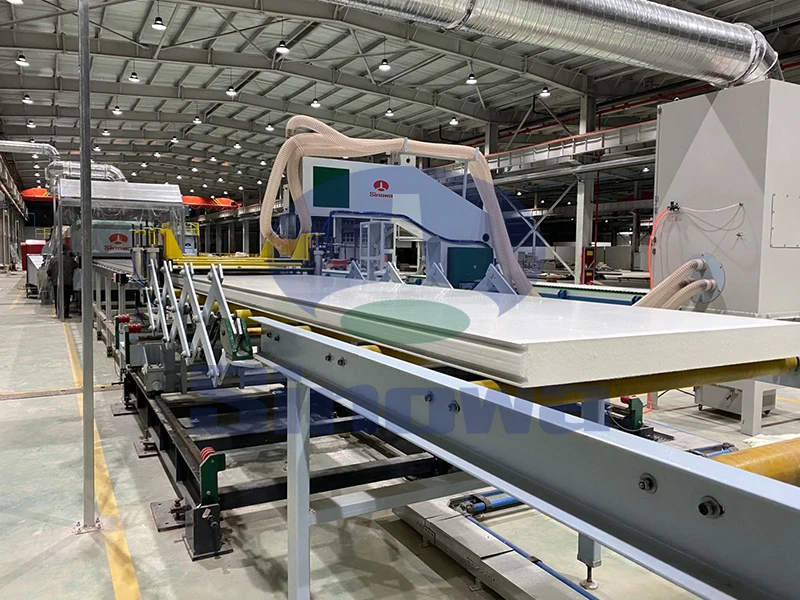
Flat sandwich panel machines are specialized integrated production lines designed to manufacture flat composite sandwich panels with layered structural configurations, serving as core equipment for modern lightweight building material production. Unlike irregular panel processing equipment, this machine focuses entirely on flat panel forming, ensuring uniform surface flatness, consistent thickness and stable structural performance of finished products. The entire production workflow operates in a continuous linear mode, eliminating intermittent operation gaps that affect production efficiency and product uniformity. It mainly processes composite panels composed of double-sided surface sheets and lightweight insulating core materials, realizing one-step integrated molding from raw material input to finished product output. The equipment is designed to adapt to diversified core materials and surface sheet types, meeting the customized production demands of different application scenarios while maintaining stable long-term operation. Its highly integrated structural design simplifies the production process of traditional sandwich panel manufacturing, reduces intermediate manual intervention links, and lays a foundation for standardized and large-scale production of flat sandwich panels.
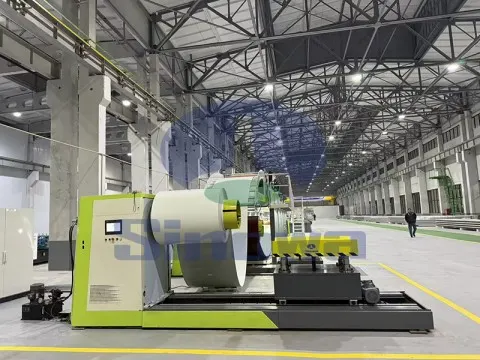
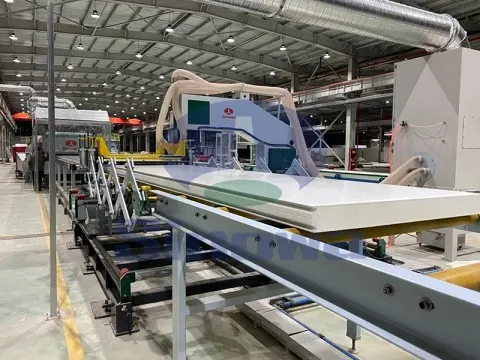
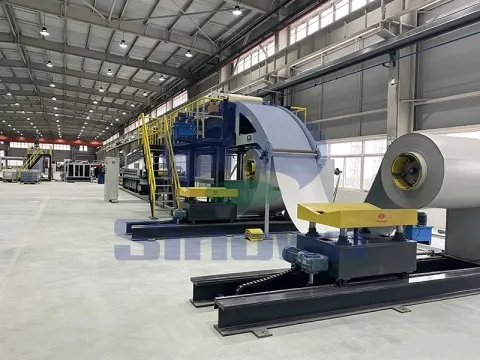
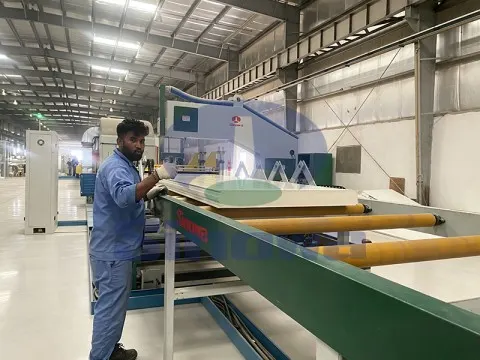
The overall structural composition of a flat sandwich panel machine adopts a modular integrated layout, with each functional unit independently designed and seamlessly connected to form a complete closed-loop production system. The main body includes raw material unwinding and conveying modules, surface sheet leveling and forming modules, core material feeding and processing modules, gluing and composite pressing modules, constant temperature curing modules, fixed-length cutting modules and finished product conveying modules. The high-strength integral frame serves as the bearing base of the entire equipment, which can withstand continuous mechanical pressure and thermal stress during long-term operation, ensuring structural stability and operational durability. Each functional module is equipped with independent transmission and adjustment structures, allowing flexible parameter adjustment according to production requirements. The orderly linear arrangement of modules avoids production link conflicts, realizes synchronous coordination of multiple processes, and ensures that each production link such as feeding, compounding and forming can be completed efficiently and accurately. This modular structure also facilitates daily equipment maintenance and later functional upgrading, improving the overall service life and application flexibility of the production line.
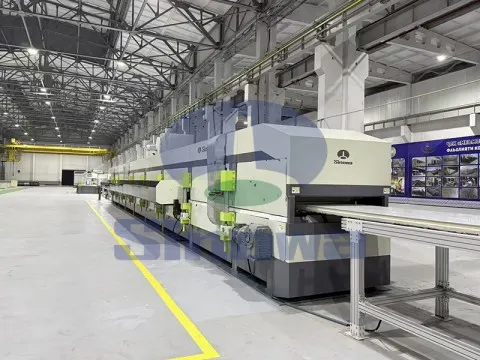
The constant temperature curing system is an indispensable functional module for stabilizing the performance of flat sandwich panels after composite molding. After pressing and compounding, the preliminary molded panels enter the intelligent curing channel, where a constant temperature environment is provided to accelerate the curing and solidification of adhesives and core materials. The internal temperature of the curing channel is uniformly distributed, avoiding local overheating or under-curing problems that may cause inconsistent panel performance. The equipment can flexibly adjust curing temperature and curing time according to different adhesive types and core material characteristics, ensuring that each panel completes full curing reaction. The closed curing structure reduces heat loss, improves thermal utilization efficiency, and avoids external environmental interference on the curing effect. Sufficient constant temperature curing enables the adhesive to form a stable bonding layer, greatly enhancing the peeling resistance and overall structural strength of the panel. Meanwhile, it optimizes the internal compactness of the core material, improving the thermal insulation and sound insulation performance of the finished flat panel.
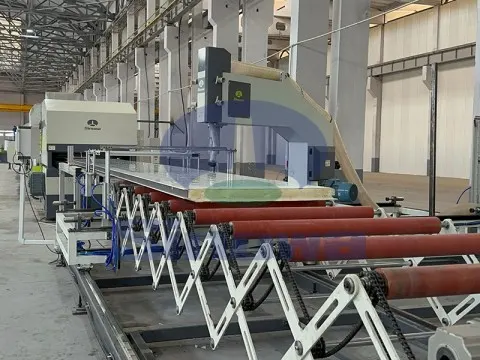
The precision cutting and post-processing system realizes the final shaping and finishing of flat sandwich panels, ensuring that finished products meet dimensional and surface quality requirements. After curing and molding, the continuous long strip panels are transported to the fixed-length cutting unit, which adopts high-precision automatic cutting technology to complete fixed-size cutting according to preset parameters. The cutting tool runs stably with smooth and flat cutting sections, no burrs or edge warping, effectively ensuring the dimensional accuracy of each finished panel. Before cutting, the intelligent positioning system automatically calibrates the panel position to eliminate errors caused by material transmission deviation. After cutting, the equipment completes simple edge trimming and surface finishing treatments to remove tiny impurities and irregular edges generated during production. The entire cutting and post-processing process is fully automated, with fast cutting speed and high precision, which not only improves production efficiency but also unifies the appearance and dimensional standards of batch-produced panels, realizing standardized finished product output.
The intelligent electrical control system acts as the core brain of the entire flat sandwich panel machine, coordinating the synchronous operation of all functional modules. The system is composed of programmable controllers, human-machine interaction interfaces, frequency converters and various precision sensors, realizing full-process intelligent monitoring and automatic adjustment of production. Operators can set production parameters such as panel thickness, length, operating speed and curing temperature through the intuitive human-machine interface, and the system will automatically execute corresponding production procedures. Sensors installed in each production link real-timely collect operating data such as feeding speed, pressing pressure and curing temperature, and feed back to the controller for real-time parameter optimization. When abnormal operating conditions occur, the system will automatically trigger early warning and protection mechanisms to avoid equipment failure and defective product generation. The centralized control mode simplifies equipment operation, reduces manual operation difficulty, and ensures the coordination and stability of the entire production line operation.
Flat sandwich panel machines have significant advantages in production efficiency and product consistency compared with traditional intermittent production equipment. Adopting fully continuous non-stop production mode, the equipment realizes seamless connection of feeding, compounding, curing, cutting and discharging links, without idle waiting time in the production process, greatly improving unit time output. The highly automated production mode minimizes manual participation, effectively reducing human-induced quality fluctuations and production errors. All production parameters are precisely controlled by the intelligent system, making the thickness, flatness, bonding strength and dimensional accuracy of each batch of panels highly consistent. The equipment can operate stably for a long time in continuous working state, realizing large-scale batch production while maintaining stable product quality. In addition, the adjustable production parameters endow the equipment with strong production flexibility, which can switch production specifications quickly to meet the diversified order production needs of different flat panel types and sizes.
In terms of operational economy and environmental protection, flat sandwich panel machines show excellent comprehensive performance in industrial production. The precision feeding and quantitative gluing design effectively reduces raw material waste, improves the utilization rate of surface sheets, core materials and adhesives, and reduces production material costs. The optimized transmission and structural design reduces equipment operation energy consumption and mechanical wear, lowering daily operation and maintenance costs. The closed production structure effectively avoids dust and material splashing during the production process, reducing production pollution and improving the on-site production environment. The stable and efficient production mode reduces the generation of defective products, further improving the comprehensive economic benefits of production. Meanwhile, the equipment runs stably with low noise, meeting the environmental protection operation requirements of modern industrial production workshops, and is suitable for long-term large-scale industrial production layout.
With the continuous upgrading of lightweight building material technology, flat sandwich panel machines are evolving towards higher automation, smarter operation and more diversified production. Modern equipment continuously optimizes sensor monitoring and intelligent control technology, realizing more precise parameter control and remote operation and maintenance functions. The structural design is constantly optimized to adapt to more new composite materials, expanding the application range of finished flat panels. The equipment’s integration and compactness are further improved, saving production workshop space while improving production efficiency. As the demand for energy-saving, lightweight and high-strength building materials continues to rise in the construction industry, flat sandwich panel machines will become more widely used, providing efficient and reliable production support for the standardized manufacturing of modern composite building panels.
Gallery of Flat Sandwich Panel Machine
Tags: flat sandwich panel machine, flat sandwich panel machine manufacturer, flat sandwich panel machine supplier, china flat sandwich panel machine, flat sandwich panel machine for sale
https://www.sandwichpanelmachinery.com/blog/flat-sandwich-panel-machine.html
-
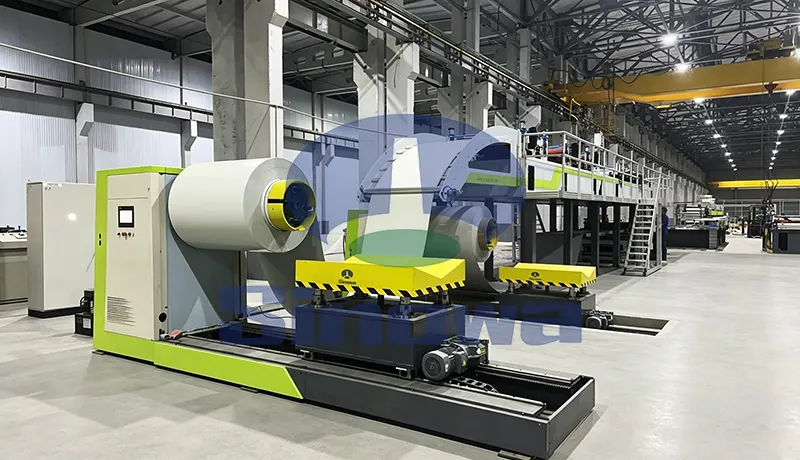
The PU sandwich panel line is a core production setup for making high-performance building insulation panels. This professional PU sandwich panel production line features automated operation to streamline the whole manufacturing process efficiently. Every component of the polyurethane sandwich panel line is precisely calibrated to ensure consistent panel thickness and structural stability. A well-maintained polyurethane sandwich panel production line can greatly boost production efficiency while reducing manual operation errors. The continuous PU sandwich panel line adapts to diverse production demands for different panel sizes and surface styles. With advanced molding technology, the PIR sandwich panel line produces panels with excellent heat preservation and sound insulation properties. Stable running of the PIR sandwich panel production line guarantees reliable product quality for various construction and industrial application scenarios.
-
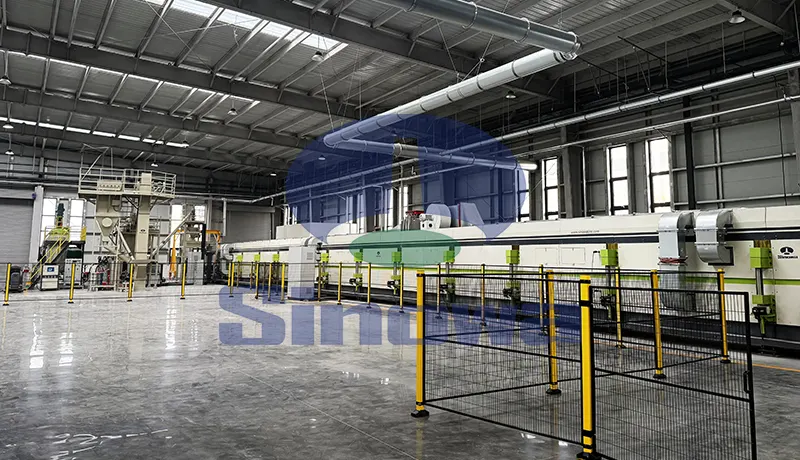
A phenolic insulation board production line serves as the core equipment for manufacturing high-performance thermal insulation building materials. This phenolic insulation panel production line integrates material mixing, foaming, molding and cutting processes to ensure continuous and stable production efficiency. Every operational link of the insulation board production line is precisely calibrated to produce uniform and durable insulation boards. The automated design of the insulation panel production line effectively reduces manual intervention and improves product consistency. Proper maintenance of the phenolic board production line can greatly extend its service life and maintain steady production output. With optimized structural design, the phenolic panel production line adapts to various production demands and delivers high-quality finished products for thermal insulation engineering applications.
-
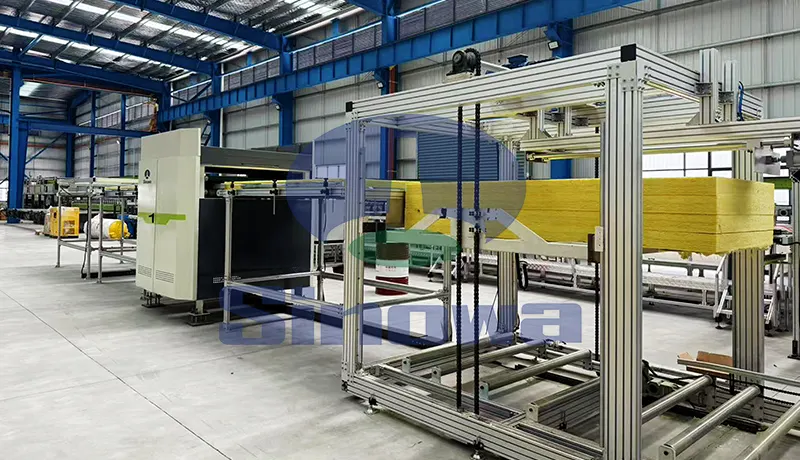
A professional rockwool sandwich panel line serves as the core equipment for producing high-performance building panels. This rockwool sandwich panel production line integrates feeding, laminating and forming processes to ensure stable and efficient production. The well-structured rock wool sandwich panel line can process raw rockwool materials into panels with excellent thermal and sound insulation properties. Operators can adjust the running parameters of the rock wool sandwich panel production line to manufacture panels of different thicknesses and specifications. The automated design of the mineral wool sandwich panel production line greatly reduces manual operation errors and improves product consistency. Regular maintenance of the mineral wool sandwich panel line is essential to sustain long-term operational efficiency and guarantee qualified finished panels for diverse construction applications.