Exterior Wall Sandwich Panel Machine
Publication Date: Oct 12, 2026
An exterior wall sandwich panel machine turns metal coils and insulating foam into insulated facade cladding, combining roll forming, foaming, pressing, and cutting in one continuous production line.
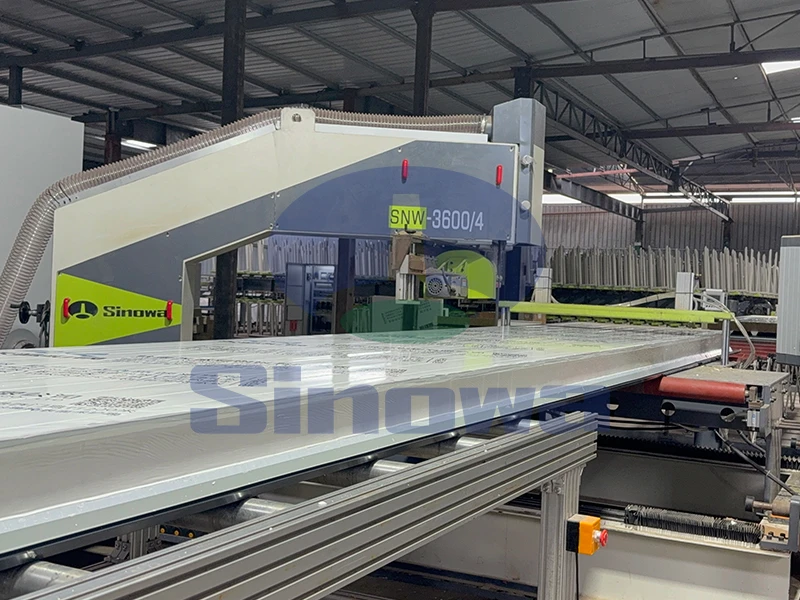
An exterior wall sandwich panel machine is the central piece of equipment in a factory dedicated to making insulated wall panels that attach to the outside of commercial, industrial, and residential buildings. Rather than assembling layers by hand, the machine takes thin metal sheets off coils, bonds them to a rigid insulating core, and trims the result to a finished panel in a single, automated flow. Its value lies in consistency: every panel that comes off the line has the same thickness, the same flatness, and the same insulation performance as the one before it. For a builder, that means faster on-site installation, fewer call-backs, and a facade that behaves the same across an entire project. For a manufacturer, it means higher output per shift and less waste than batch methods. The machine also makes it practical to offer different panel profiles, widths, and core thicknesses on the same line, which lets a factory adapt to orders without retooling from scratch.
At the start of the line sits the material handling section, where flat metal coils are loaded onto decoilers. Most exterior panels use pre-painted steel or aluminum for the outer skin, and a matching liner sheet for the inner face. The decoiler feeds the coil smoothly into a series of rollers that straighten the metal and remove coil set, so the sheet lies flat before any shaping begins. Tension control is important here: too much pull and the coating stretches or tears; too little and the sheet wanders off the centerline. Sensors along the straightener track edge position and signal small corrections to keep the strip aligned. After straightening, the sheet passes through a pre-treatment stage that may include cleaning, drying, and a primer or adhesive activation step, depending on the core material being used. This preparation is quietly critical, because the bond between metal and foam depends on a clean, chemically prepared surface more than on any single component of the adhesive.
Next comes the roll-forming section, where the flat sheet is gradually bent into the profile that gives the finished wall panel its strength and visual character. A long row of contoured rollers shapes the metal in small increments rather than forcing it into a single die, which avoids wrinkling and springback. The profile may be a subtle ribbed line, a deep corrugation, or a flat face with a hidden joint design, all determined by the roller set installed. Forming must be done before the core is added, because once insulation is sandwiched in, the panel can no longer be bent without cracking the foam or delaminating the skins. The inner liner sheet usually receives a simpler, flatter profile, since it is not exposed to weather and is hidden inside the building. Between the two forming stations, the machine coordinates speed so that outer skin, inner skin, and core all arrive at the lamination point at exactly the same moment and at the same tension.
The heart of the line is the sandwiching and foaming section, where the insulation core is created between the two prepared metal skins. For panels made with injected polyurethane or polyisocyanurate foam, chemical components are metered and mixed at high pressure and dispensed in a controlled pattern onto the moving lower skin. As the foam rises and expands, the upper skin closes in from above, and the whole sandwich enters a long heated press tunnel that holds the panel at a set thickness while the foam cures and adheres to both faces. For mineral wool core panels, pre-cut insulation slabs are fed in from a side feeder, aligned edge to edge, and bonded to the skins with adhesive rather than in-situ foaming. Each core type has its own personality: foam cores fill every corner and give seamless insulation, while mineral wool cores deliver better fire behavior and acoustic damping. The machine's control system adjusts pour rate, belt speed, and tunnel temperature to match the chosen core and target thickness, so switching between materials is a matter of recalling a recipe rather than rebuilding the line.
Continuity is what separates a modern sandwich panel line from older batch presses. In a continuous line, skins, foam, and cut-off move together at a steady pace, and the press tunnel acts like an oven on a conveyor, never opening and closing for each panel. This steady motion produces long, uninterrupted panels that can later be cut to any length the project requires. Discontinuous or semi-continuous systems, by contrast, lay up skins and core in a mold and press them in batches; they are often more flexible for very thick panels or unusual geometries, but they trade speed for versatility. Most high-volume exterior wall lines choose the continuous route because facade work tends to repeat a narrow range of standard widths and lengths, and the economics of uninterrupted output win out. The trade-off is that continuous lines demand tighter coordination between stations, since a jam at one point stops the whole flow.
Inside the curing tunnel, a set of parallel conveyor belts grips the panel from above and below and holds it to a precise dimension while the core sets. The belts are usually lined with a release surface so the sticky foam does not bond to the equipment, and heating elements along the tunnel wall accelerate the chemical reaction without overheating the painted finish. Belt speed is tuned to the cure time of the chosen foam; too fast and the core remains soft when it exits, leading to sagging or uneven thickness; too slow and the line wastes energy and output. Side guides along the tunnel keep the panel edges straight, which matters because exterior panels must interlock with each other on the wall. Once the panel leaves the tunnel, it travels along a cooling rack where the core reaches handling strength before any cutting or stacking takes place. Skipping this cooling step is a common cause of deformed panels that look fine on the line but warp after delivery.
At the end of the line, a flying cut-off saw or guillotine slices the continuous panel to the exact length specified by the order. Because the panel is still moving, the cutter must synchronize with the belt, accelerating and moving with the panel during the cut and then returning to the starting position. This synchronized cutting avoids pinch marks and keeps the square edge that installers rely on. After cutting, the panel may pass through a notching or end-milling station that shapes the joint profile at each end, creating the male and female edges that click panels together on site. Some lines also punch holes for fasteners, electrical conduits, or window openings, though those custom features are often left to a secondary work cell so they do not slow the main line. Finally, an automatic stacker lays finished panels on a pallet, interleaving protective film or cardboard between them to prevent the painted surfaces from rubbing during transport.
The quality of a finished exterior wall panel depends less on any single dramatic component than on how tightly the whole line holds its tolerances. Skin thickness, core density, bond strength, overall flatness, and edge squareness all drift if the line is not watched. Good machines bake these checks into the process: sensors measure skin thickness as the strip enters, load cells monitor foam metering, distance lasers verify panel height inside the press, and vision systems inspect the painted surface for scratches or coating defects as the panel exits. When a reading drifts outside the accepted band, the controller can either alert the operator or automatically nudge a parameter back into range. Over a long shift, this closed-loop control is what turns a skilled operator's experience into repeatable production, rather than relying on someone to catch every deviation by eye.
Operating the line well is as much about discipline as about the equipment itself. An operator's daily routine starts with verifying that the correct coil, core chemistry, and profile recipe are loaded, then running a short test panel that is measured by hand before full production begins. Routine checks include belt cleanliness, nozzle condition on the foam dispenser, hydraulic pressure on the cut-off, and alignment of the edge guides. Safety systems are built around moving rollers, hot surfaces, and chemical dispensing: guards interlocked so the line stops when opened, emergency stops at every station, extraction over the foaming area, and dedicated personal protective equipment for handling chemical components. Maintenance is scheduled around consumable wear parts, like press belt liners, saw blades, and mixing heads, so that replacements happen during planned stops rather than mid-order. A well-run line treats unplanned downtime as the main enemy, because lost continuous time cannot be made up later.
The benefits of investing in a purpose-built exterior wall sandwich panel machine extend well beyond the factory floor. Panels come to the site pre-insulated and pre-finished, so installers can wrap a building envelope in days rather than weeks, and there is no wet-trade curing window to wait through. The finished facade is light in weight compared to masonry, which reduces structural loads and foundation costs, and the insulation is integrated directly into the cladding, eliminating the gaps and thermal bridges that plague field-applied insulation. Because the panels are factory-made, their performance stays consistent across the whole building, which helps designers meet energy targets with confidence. As construction trends toward off-site fabrication and faster enclosure schedules, the role of these machines only grows: they are quietly the engine behind the insulated metal facades seen on warehouses, offices, cold storage buildings, and modern residential developments around the world.
Looking ahead, the machines themselves keep evolving. Lines are becoming more digitally connected, with each shift's production data logged so that plant managers can compare output, scrap rate, and energy use over time and tune recipes for better yield. Quick-change tooling and servo-driven adjustments reduce the time it takes to switch between panel widths and profiles, making smaller custom orders economically viable. Core materials are also diversifying, with recycled-content foams, thinner high-performance insulation, and bio-based chemistries finding their way onto lines that can accommodate them. Meanwhile, demand for thinner, flatter profiles and smoother architectural finishes pushes roller designers and surface-coating suppliers to work more closely together. For a manufacturer, the winning move is not just buying a faster machine, but choosing one that stays flexible enough to absorb these shifts in materials, finishes, and customer expectations over the years the line will run.
Gallery of Exterior Wall Sandwich Panel Machine






Tags: exterior wall sandwich panel machine, exterior wall sandwich panel machine manufacturer, exterior wall sandwich panel machine supplier, china exterior wall sandwich panel machine, exterior wall sandwich panel machine for sale
https://www.sandwichpanelmachinery.com/blog/exterior-wall-sandwich-panel-machine.html
-

The PU sandwich panel line is a core production setup for making high-performance building insulation panels. This professional PU sandwich panel production line features automated operation to streamline the whole manufacturing process efficiently. Every component of the polyurethane sandwich panel line is precisely calibrated to ensure consistent panel thickness and structural stability. A well-maintained polyurethane sandwich panel production line can greatly boost production efficiency while reducing manual operation errors. The continuous PU sandwich panel line adapts to diverse production demands for different panel sizes and surface styles. With advanced molding technology, the PIR sandwich panel line produces panels with excellent heat preservation and sound insulation properties. Stable running of the PIR sandwich panel production line guarantees reliable product quality for various construction and industrial application scenarios.
-

A phenolic insulation board production line serves as the core equipment for manufacturing high-performance thermal insulation building materials. This phenolic insulation panel production line integrates material mixing, foaming, molding and cutting processes to ensure continuous and stable production efficiency. Every operational link of the insulation board production line is precisely calibrated to produce uniform and durable insulation boards. The automated design of the insulation panel production line effectively reduces manual intervention and improves product consistency. Proper maintenance of the phenolic board production line can greatly extend its service life and maintain steady production output. With optimized structural design, the phenolic panel production line adapts to various production demands and delivers high-quality finished products for thermal insulation engineering applications.
-

A professional rockwool sandwich panel line serves as the core equipment for producing high-performance building panels. This rockwool sandwich panel production line integrates feeding, laminating and forming processes to ensure stable and efficient production. The well-structured rock wool sandwich panel line can process raw rockwool materials into panels with excellent thermal and sound insulation properties. Operators can adjust the running parameters of the rock wool sandwich panel production line to manufacture panels of different thicknesses and specifications. The automated design of the mineral wool sandwich panel production line greatly reduces manual operation errors and improves product consistency. Regular maintenance of the mineral wool sandwich panel line is essential to sustain long-term operational efficiency and guarantee qualified finished panels for diverse construction applications.