Intelligent Sandwich Panel Machine
Publication Date: Oct 12, 2026
An intelligent sandwich panel machine automates continuous panel production with precision control, fast changeovers, and real-time monitoring for consistent, high-quality output.
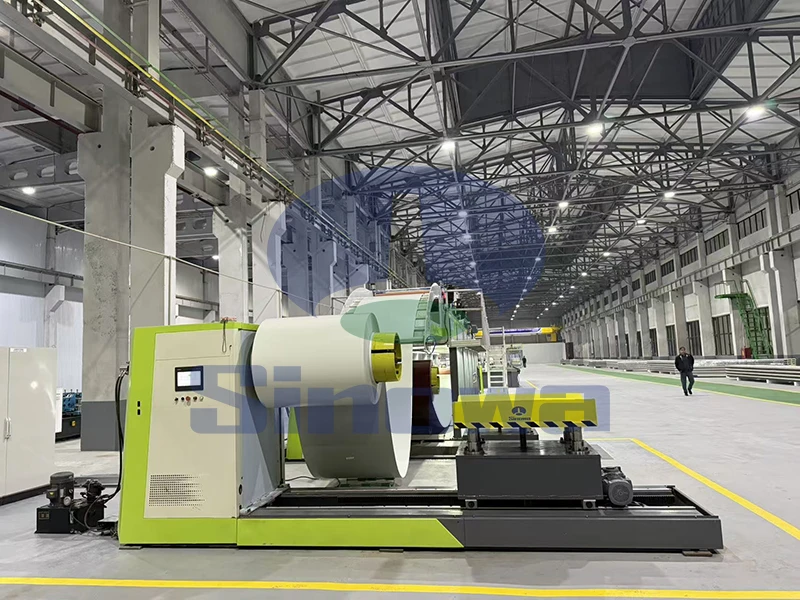
At its core, an intelligent sandwich panel machine is a highly integrated production system designed to manufacture insulated composite panels by bonding two rigid facing sheets—typically metal coils—around a core layer of foam or mineral wool. What distinguishes it from earlier generations of equipment is the layer of digital intelligence that wraps around every mechanical stage: unwinding, forming, foaming or injection, curing, cutting, and stacking. Rather than relying on manual gauging, trial-and-error adjustments, and periodic inspection, the intelligent version senses material behavior in real time and compensates automatically. The result is a line that can switch between panel thicknesses, widths, and core materials with minimal downtime, hold tighter tolerances over long runs, and alert operators before small deviations become costly defects. This shift matters because sandwich panels are used in demanding environments—cold storage, clean rooms, industrial façades, logistics warehouses, and modular buildings—where even a few millimeters of skew or an uneven foam bead can compromise insulation value, seal integrity, or structural fit. An intelligent machine treats panel quality as a continuous, measurable variable rather than a post-production guess.
The physical architecture of the line is organized around a continuous moving web. It usually begins with one or more decoilers that feed the top and bottom facing coils, often pre-painted steel or aluminum, into roll-forming stations where the flat strip is progressively shaped into the desired profile—trapezoidal, ribbed, flat, or concealed-clip joints. These forming stands are driven by individual servo or geared motors, each synchronized to a master encoder that tracks line speed down to fractions of a millimeter. Because the facing is thin and sensitive, tension must be held constant across the width; too much tension causes bowing or coating damage, too little causes wrinkling as the sheet enters the laminating area. Intelligent lines measure web tension with load cells or dancer arms and feed that signal back to the decoiler brakes, making micro-adjustments dozens of times per minute. Behind the formers, pre-heating or pre-rolling stations condition the sheet surface so that adhesive and foam adhere predictably. Each station is mounted on a rigid welded frame, leveled at installation, and aligned with laser precision, because any misalignment compounds downstream as the panel builds up thickness.
The heart of the process is the laminating and curing section, where the core material is introduced between the two facings. For foam cores such as polyurethane or polyisocyanurate, a high-pressure mixing head sprays a chemically reactive mixture onto the bottom facing as it passes beneath. The chemistry begins to expand immediately, filling the cavity between the two sheets while a moving curing conveyor, often enclosed in a heated tunnel, holds the panel at a controlled thickness and width. Intelligence here lives in the dosing system: gear or piston metering pumps deliver exact ratios of polyol and isocyanate, temperature sensors monitor component tanks and mixing heads, and flow meters close the loop so that density stays uniform along the panel length. For mineral wool cores, rock or glass wool boards are fed from a stack, oriented, glued, and compressed between the facings in a similar curing tunnel. In both cases, the machine tracks panel thickness with ultrasonic or laser gauges mounted above and below the conveyor, comparing actual build-up against the target recipe and adjusting conveyor height, foam output, or tunnel temperature on the fly. This closed-loop control is what allows a single line to produce thin decorative panels one hour and thick insulated wall panels the next, simply by loading a new recipe.
Recipes are central to how these machines are operated. Instead of turning individual handwheels and dialing in temperatures by experience, an operator selects a panel configuration from a touchscreen: facing thickness, panel width, core type, desired thickness, length, color, and joint profile. The controller then pushes the correct setpoints to every driven station—forming roll gaps, edge-driver speeds, foam pump pressures, conveyor height, oven zone temperatures, and cut-off timing. Modern systems store hundreds of such recipes, attach them to production orders, and can recall them in seconds. Advanced installations tie the recipe database directly to order management software, so that when a new order is released, the line is already prepared: the correct program is loaded, the next coil is staged, and the expected output length is queued. This recipe-driven approach reduces the skill gap between veteran and new operators, minimizes setup scrap, and makes production planning far more predictable. It also captures institutional knowledge: every adjustment an engineer makes during a run can be saved as a recipe variant, gradually tuning the line toward optimal settings for each panel type rather than starting from scratch every shift.
Material handling and changeover mechanics have also become smarter. Decoilers are frequently double-station, allowing a fresh coil to be prepared and joined to the trailing end of the running coil with an automatic stitch or butt-weld before the old coil runs out. Sensors detect coil diameter, remaining weight, and loop length in the accumulator tower, so the line never stops while a splice is made. At the exit end, a traveling cut-off saw or shear trims the panel to length with extreme precision, often using flying knife technology that moves with the panel during cutting so that the cut remains perpendicular and burr-free. After cutting, a discharge conveyor carries the panel to a stacking area where a robotic or pneumatic stacker collects panels in layers, interleaves protective sheets, and builds pallets ready for banding. Vision systems may scan the finished panel for surface defects, coating scratches, or print misalignment, and can mark or reject non-conforming pieces automatically. These handling subsystems are no longer isolated helpers; they are nodes on the same network, sharing speed, position, and quality data with the main controller.
Sensors are the sensory organs of an intelligent sandwich panel line. Encoders report exact position and speed; load cells measure tension and panel weight; thermocouples and infrared pyrometers monitor chemical temperatures and oven zones; ultrasonic and laser gauges track thickness in real time; accelerometers listen for unusual vibration in motors and gearboxes; air-pressure transducers watch pneumatic circuits; and flow meters verify adhesive and foam delivery. All of these signals stream into a control platform—usually a programmable logic controller backed by a human-machine interface and, in newer lines, an edge computing gateway. The controller does more than display numbers: it runs alarms, trends, and interlocks. If foam pressure drifts, it alerts the operator and can slow the line to protect panel quality. If a conveyor bearing begins to vibrate outside its normal band, it flags a maintenance ticket before a catastrophic failure. If oven temperature overshoots, it adjusts burners or heaters independently in each zone. Over weeks and months, the system accumulates data that reveals patterns: which coil batches cause more scrap, which shift produces more dimensional variation, which season changes foam cure behavior. That historical view is where the long-term value of intelligence compounds, turning a production asset into a learning asset.
Energy and resource efficiency have become major design priorities, driven both by operating cost pressure and by sustainability expectations. A sandwich panel line runs continuously for hours or days, so even small gains in per-panel energy use add up substantially. Intelligent machines address this in several ways. Oven zones are insulated and zoned independently, so that only the sections actually passing panels are held at temperature; when the line idles, setbacks drop automatically. Variable-frequency drives on every major motor mean that energy is delivered proportional to actual demand, rather than throttled by dampers or bypasses. Foam dosing precision reduces over-use of chemical components, cutting both material cost and excess trim. Compressed air is monitored for leaks, and standby routines shut off non-critical subsystems during breaks. Heat recovery from exhaust air can pre-heat incoming combustion air or worker air. Some installations also recover trim and scrap, feeding edge offcuts and rejected panels into granulators that return mineral wool or metal to recycling streams. By measuring energy per linear meter or per square meter of finished panel, managers can benchmark shifts, suppliers, and recipes, and identify which configurations are genuinely lean rather than merely assumed to be.
Safety has also been reimagined alongside automation. Guards, interlocks, light curtains, and emergency-stop circuits are now integrated into the same control network that runs production, which allows safer operational logic. For example, a guard door cannot be opened during a dangerous motion unless the relevant drive is stopped and torque is removed. Maintenance modes lock out energy sources while an engineer works on a station, and the controller enforces a defined start sequence before the line can resume. Human-machine interfaces guide operators through lockout steps and require confirmation, reducing the chance of accidental bypass. Because high-pressure chemical systems and hot ovens are involved, fume extraction, eye-wash stations, and chemical containment are part of the intelligent enclosure design. Sensors detect smoke, excessive temperature, or gas buildup and trigger both local alarms and remote notifications. Training has shifted from mechanical dexterity to monitoring and decision-making, and well-designed lines provide on-screen prompts, fault diagnostics with plain-language explanations, and guided recovery procedures. The result is a workplace where fewer people are exposed to moving and hot equipment, and where the people who remain are better informed.
Maintenance strategy has moved from reactive fix-it-after-breakdown to predictive and condition-based care. Vibration signatures, motor current draw, bearing temperature, and lubrication intervals are tracked continuously; the machine itself recommends when to inspect, replace, or service components. Long-life wear parts—forming rolls, knives, seals, heater elements—are logged by usage hours, and replacement reminders are tied to actual run time rather than the calendar. Remote diagnostics allow the machine builder or an internal engineering team to dial in securely, review alarms, compare the line to similar installations worldwide, and even push a parameter update when a known improvement is available. Spare parts can be staged proactively based on wear predictions, avoiding long stoppages waiting for a delivery. This approach reduces both unplanned downtime and over-maintenance, where perfectly good parts are replaced on a schedule out of caution. When paired with digital twin-style simulation, engineers can test recipe changes on a virtual representation of the line before committing materials on the real one, further reducing trial scrap.
The business impact of moving to an intelligent sandwich panel machine shows up in throughput, yield, and versatility. Yield—the share of panels that pass first-time quality inspection—typically improves because defects are caught and corrected as they happen rather than after a long run of non-conforming product. Setup time between orders shrinks from hours to minutes, which makes small-batch and custom orders economically viable, opening markets that older, slow-to-change lines could not serve. Consistency across shifts and plants strengthens brand reputation in projects where developers and contractors expect every panel to fit the first time. Throughput rises not always because the line runs faster, but because it stops less, scrap less, and reworks less. Workers spend less time chasing defects and more time overseeing the process. Over the life of the equipment—often measured in decades—the cumulative effect of tighter tolerances, lower energy use, fewer breakdowns, and faster changeovers fundamentally changes the unit economics of panel production. Intelligent sandwich panel machinery is therefore best understood not as a faster version of a conventional line, but as a different category of asset: one that senses, adapts, and improves over time, and that turns production data into a lasting competitive advantage for whoever operates it.
Gallery of Intelligent Sandwich Panel Machine






Tags: intelligent sandwich panel machine, intelligent sandwich panel machine manufacturer, intelligent sandwich panel machine supplier, china intelligent sandwich panel machine, intelligent sandwich panel machine for sale
https://www.sandwichpanelmachinery.com/blog/intelligent-sandwich-panel-machine.html
-

The PU sandwich panel line is a core production setup for making high-performance building insulation panels. This professional PU sandwich panel production line features automated operation to streamline the whole manufacturing process efficiently. Every component of the polyurethane sandwich panel line is precisely calibrated to ensure consistent panel thickness and structural stability. A well-maintained polyurethane sandwich panel production line can greatly boost production efficiency while reducing manual operation errors. The continuous PU sandwich panel line adapts to diverse production demands for different panel sizes and surface styles. With advanced molding technology, the PIR sandwich panel line produces panels with excellent heat preservation and sound insulation properties. Stable running of the PIR sandwich panel production line guarantees reliable product quality for various construction and industrial application scenarios.
-

A phenolic insulation board production line serves as the core equipment for manufacturing high-performance thermal insulation building materials. This phenolic insulation panel production line integrates material mixing, foaming, molding and cutting processes to ensure continuous and stable production efficiency. Every operational link of the insulation board production line is precisely calibrated to produce uniform and durable insulation boards. The automated design of the insulation panel production line effectively reduces manual intervention and improves product consistency. Proper maintenance of the phenolic board production line can greatly extend its service life and maintain steady production output. With optimized structural design, the phenolic panel production line adapts to various production demands and delivers high-quality finished products for thermal insulation engineering applications.
-

A professional rockwool sandwich panel line serves as the core equipment for producing high-performance building panels. This rockwool sandwich panel production line integrates feeding, laminating and forming processes to ensure stable and efficient production. The well-structured rock wool sandwich panel line can process raw rockwool materials into panels with excellent thermal and sound insulation properties. Operators can adjust the running parameters of the rock wool sandwich panel production line to manufacture panels of different thicknesses and specifications. The automated design of the mineral wool sandwich panel production line greatly reduces manual operation errors and improves product consistency. Regular maintenance of the mineral wool sandwich panel line is essential to sustain long-term operational efficiency and guarantee qualified finished panels for diverse construction applications.