What Causes Intermittent Operation Of Continuous PU Sandwich Panel Production Line?
Publication Date: Oct 15, 2026
Intermittent operation of continuous PU sandwich panel production lines mainly comes from unstable PU foaming metering, sensor/PLC electrical faults, hydraulic pressure fluctuation, metal sheet feeding jamming, raw material ratio deviation and belt wear. Check these common causes & troubleshooting tips to reduce unexpected stops and improve line uptime.
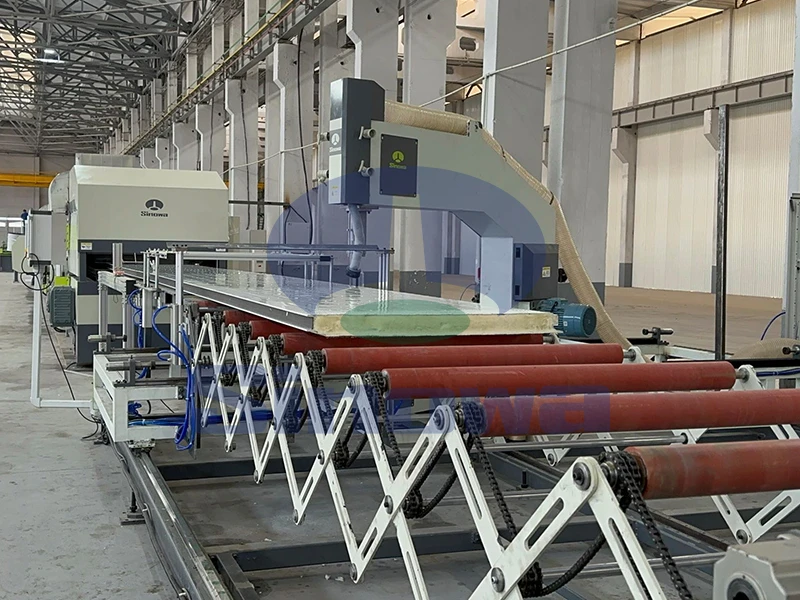
A continuous PU sandwich panel production line is designed to maintain steady, nonstop movement of facing sheets, foaming injection, lamination, curing and cutting, so intermittent operation represents a breakdown of this carefully synchronized workflow. Intermittent running means the line randomly pauses, slows down or restarts without manual shutdown commands, disrupting the whole production rhythm and creating unstable finished panels. Many operators struggle with this issue because the failure does not occur every time, making it hard to capture and reproduce during inspection. The root causes span mechanical, hydraulic, raw material, electrical and environmental factors, and they often interact with each other instead of appearing independently. Even minor hidden defects may only trigger intermittent stops under specific load conditions, temperature fluctuations or material batch variations. Operators may initially overlook these subtle signals and only notice losses when frequent brief halts reduce hourly output, increase waste and raise the risk of panel delamination, uneven foam density and surface distortion. Recognizing the multi-source nature of intermittent faults is the first step toward systematic troubleshooting rather than repeatedly resetting the equipment without finding real problems.
Mechanical transmission defects are among the most frequent triggers of intermittent operation on continuous PU sandwich panel lines. The whole line relies on linked drive rollers, chains, couplings and conveyor belts to keep upper and lower facing materials moving at matched speeds. When bearings wear partially, lubrication becomes insufficient or debris accumulates inside roller assemblies, resistance increases irregularly. The equipment may run smoothly for a period before sudden friction spikes slow or stop the conveyor temporarily, then resume when vibration redistributes contaminants. Loose coupling connections and minor shaft misalignment also create intermittent torque loss. Under light load, the system can still transfer power normally, but once the curing section bears heavier panel pressure, slippage appears and triggers temporary stops. Surface material feeding rollers that lose friction will occasionally slip, causing sheet deviation and activating safety protection sensors. These mechanical faults do not fully disable the line, so they generate unpredictable start-stop cycles that confuse on-site teams and damage the dimensional consistency of panels passing through the foaming and composite zone.
Electrical and control signal instability is another major source of intermittent production interruptions. A continuous line depends on encoders, proximity sensors, pressure transducers and programmable controllers to coordinate every working station. Vibration from long-running equipment can loosen wiring terminals, creating occasional open circuits or poor contact. The control system may receive missing or distorted feedback signals, which the main program interprets as abnormal operating status and automatically pauses the line for protection before signal recovery allows restarting. Encoder slipping is a typical example; the speed measuring wheel may maintain contact most of the time but lose grip intermittently, sending wrong position and speed data to the controller. Dust and foam residue buildup on sensor surfaces can block signal transmission in variable ways, especially when humidity changes inside the workshop. Electrical power supply fluctuation also contributes, as momentary voltage drops can cause drive inverters to trip briefly and reset automatically. Such signal-related faults usually appear randomly, and all readings may return to normal once the line stops completely, making offline checks ineffective.
Unstable PU raw material supply and foaming system anomalies can force the continuous sandwich panel line into intermittent cycles. The foaming unit must deliver two-component raw materials at stable pressure, temperature and mixing ratio onto the moving facing sheet. Partially blocked pipelines, filter clogging or fluctuating pump output will create periodic changes in material flow. For a short time, the mixing head can spray the correct amount of PU mixture, but accumulated blockage reduces injection volume, and the control system detects abnormal foaming parameters and triggers protective shutdown. After a brief pause, pressure inside the pipeline releases slightly, and flow recovers temporarily, letting production resume. Temperature drift of raw material storage tanks also alters reaction speed; when the chemical reaction becomes too fast or too slow, foam rising behavior mismatches conveyor speed, generating defective areas. The system may stop automatically to prevent large quantities of waste panels. Minor leakage at valve seals can further destabilize pressure. Since partial blockages and seal degradation develop gradually, problems emerge intermittently rather than causing permanent shutdown, and operators often focus only on finished foam defects while ignoring the connection between material supply and line start-stop behavior.
Hydraulic and pneumatic system malfunctions can also lead to intermittent operation of continuous PU sandwich panel equipment. Many key units including roller gap adjustment, side sealing devices and cutting mechanisms rely on hydraulic or pneumatic power. Slow internal leakage inside hydraulic cylinders or worn valve spools will not cause complete failure at first, but working pressure drops irregularly under dynamic load. The pressure may stay sufficient during light-duty phases and decline when the composite section needs constant clamping force, prompting safety interlocks to halt the line. Moisture and impurities in compressed air can stick pneumatic valve cores occasionally; most of the time the valve moves freely, but stuck particles block air flow and prevent actuators from reaching designated positions. Once vibration shakes the debris loose, function returns and the line restarts. Pressure switch calibration drift worsens this situation, as the sensor sometimes misreads normal pressure as an abnormal value. These hydraulic and pneumatic faults are sensitive to temperature changes, because low ambient temperature increases fluid viscosity and aggravates internal leakage, making intermittent stops more likely during cold shifts and less obvious in warmer workshop conditions.
Safety protection interlock misactivation is a frequently overlooked reason for intermittent line stoppages. Continuous PU sandwich panel production lines are equipped with multiple safety interlock sensors to detect sheet deviation, jamming, excessive tension, guard door status and emergency stop circuits. When these protective devices work correctly, they prevent catastrophic equipment damage, but slight misalignment, residual foam contamination or improper installation can cause false triggering. For example, a sheet deviation sensor may sit right at the threshold value; minor wandering of the facing sheet will occasionally cross the detection limit and stop the line, while small adjustment of material position allows restart. Loose safety guard switches can disconnect intermittently under vibration, sending a false open-guard signal to the control system. Tension sensors for unwinding stations may output unstable readings when coil material tension fluctuates naturally during unwinding. Operators sometimes attempt to bypass interlocks to maintain production, which removes genuine protection and creates serious hazards. Instead of disabling safety systems, teams should identify which interlock triggers randomly and calibrate sensors, clean detection surfaces and reinforce mounting structures to eliminate false alarms.
Workshop environmental factors and improper operational parameters can induce intermittent operation by amplifying existing minor equipment weaknesses. Temperature and humidity variations inside the production hall affect every subsystem of the PU sandwich panel line. Low temperature increases the viscosity of PU raw materials and thickens hydraulic oil, raising pipeline resistance and mechanical friction. High humidity promotes condensation on electrical components, creating temporary leakage paths and signal interference. Dust and fine foam fragments continuously accumulate on rollers, sensors and electrical cabinets, and uneven buildup creates intermittent friction or signal blockage. Improper matching between line speed, foaming formulation and curing temperature profile also creates unstable operating states. If operators adjust running parameters drastically for different panel thicknesses without full system tuning, partial stations fall out of synchronization. The line may run acceptably for a while until cumulative deviations trigger protective stops. Even unstable tension control from unwinding coils can introduce periodic disturbances. Environmental factors rarely stop the line by themselves, but they turn latent mechanical, electrical or material weaknesses into visible intermittent faults that appear and disappear with changing workshop conditions.
Effective diagnosis and mitigation of intermittent operation require systematic inspection rather than isolated component replacement. Since these faults are non-constant, maintenance teams should record every pause event, noting time, workshop temperature, raw material batch, line speed and panel specification to identify recurring patterns. Data logging from the control system helps capture fleeting signal fluctuations and inverter warning codes that vanish after restart. Inspection should follow a logical sequence, checking safety interlocks and electrical signals first, then moving to mechanical transmission, hydraulic and pneumatic components, and finally the PU foaming and raw material delivery system. Regular cleaning of sensors, rollers and pipelines, scheduled lubrication and terminal tightening can reduce many intermittent faults before they develop. Standardized pre-production checks of material temperature, pressure and tension also help keep the whole line synchronized. Resolving intermittent operation not only cuts unexpected downtime and material waste, but also stabilizes panel quality, reduces rework and extends the service life of the whole continuous PU sandwich panel production line. Building stable operating conditions and preventive maintenance routines is more valuable than emergency repairs after repeated random shutdowns.
Gallery of Continuous PU Sandwich Panel Production Line






Tags: continuous pu sandwich panel production line, continuous pu sandwich panel production line manufacturer, continuous pu sandwich panel production line supplier, china continuous pu sandwich panel production line, continuous pu sandwich panel production line for sale
-

The PU sandwich panel line is a core production setup for making high-performance building insulation panels. This professional PU sandwich panel production line features automated operation to streamline the whole manufacturing process efficiently. Every component of the polyurethane sandwich panel line is precisely calibrated to ensure consistent panel thickness and structural stability. A well-maintained polyurethane sandwich panel production line can greatly boost production efficiency while reducing manual operation errors. The continuous PU sandwich panel line adapts to diverse production demands for different panel sizes and surface styles. With advanced molding technology, the PIR sandwich panel line produces panels with excellent heat preservation and sound insulation properties. Stable running of the PIR sandwich panel production line guarantees reliable product quality for various construction and industrial application scenarios.
-

A phenolic insulation board production line serves as the core equipment for manufacturing high-performance thermal insulation building materials. This phenolic insulation panel production line integrates material mixing, foaming, molding and cutting processes to ensure continuous and stable production efficiency. Every operational link of the insulation board production line is precisely calibrated to produce uniform and durable insulation boards. The automated design of the insulation panel production line effectively reduces manual intervention and improves product consistency. Proper maintenance of the phenolic board production line can greatly extend its service life and maintain steady production output. With optimized structural design, the phenolic panel production line adapts to various production demands and delivers high-quality finished products for thermal insulation engineering applications.
-

A professional rockwool sandwich panel line serves as the core equipment for producing high-performance building panels. This rockwool sandwich panel production line integrates feeding, laminating and forming processes to ensure stable and efficient production. The well-structured rock wool sandwich panel line can process raw rockwool materials into panels with excellent thermal and sound insulation properties. Operators can adjust the running parameters of the rock wool sandwich panel production line to manufacture panels of different thicknesses and specifications. The automated design of the mineral wool sandwich panel production line greatly reduces manual operation errors and improves product consistency. Regular maintenance of the mineral wool sandwich panel line is essential to sustain long-term operational efficiency and guarantee qualified finished panels for diverse construction applications.