Can PIR Sandwich Panel Production Line Be Customized For Different Panel Widths?
Publication Date: Oct 15, 2026
Yes. PIR sandwich panel production line supports customization for various panel widths. The equipment can be adjusted to produce different width specifications of PIR insulated panels by modifying forming rollers, cutting systems and guiding structures. Custom width options cater to construction, cold storage and roof & wall cladding projects. It ensures stable panel forming, precise cutting and consistent product quality while meeting diverse client dimension demands.
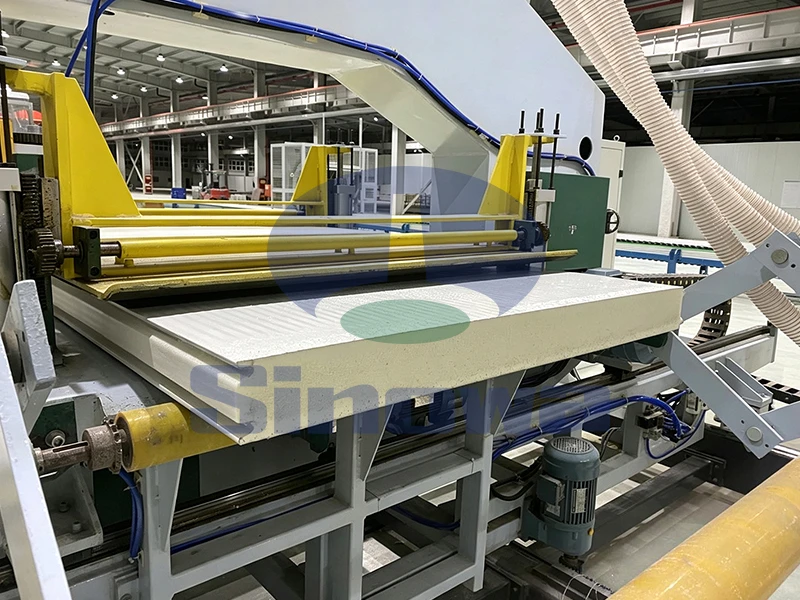
Many manufacturers of PIR sandwich panel production lines offer flexible customization to accommodate varying panel width requirements, addressing the diverse needs of construction and insulation projects. The core mechanical structure of the line can be adjusted through modifications to guide rollers, cutting assemblies, and forming frames, which are engineered to adapt to different raw material widths entering the production process. When designing for non-standard panel widths, engineers first assess the physical limitations of the continuous forming system, ensuring that changes in width do not compromise the alignment between the PIR foam layer and the metal facings. Adjustments also cover the feeding stations for steel or aluminum sheets, where adjustable unwinding equipment holds and feeds coils of different widths without causing material skew or wrinkling during processing. Operators receive corresponding configuration updates for the feeding speed synchronization, as wider panels require balanced material tension across the entire surface to maintain uniform foam distribution. This kind of customization starts with confirming the target panel dimensions, and every modified component is matched to keep continuous production stable throughout long operating cycles. Even minor shifts in panel width demand careful calibration of spacing between guiding parts, preventing gaps or overlaps between the core foam and outer facings that would weaken the finished panels.
Customization for different panel widths extends beyond simple mechanical adjustments, touching on the foaming and dispensing system that delivers the PIR raw materials onto the metal facings. The PIR foam dispensing unit can be fitted with movable nozzles and adjustable distribution rails, allowing the foam mixture to spread evenly across narrower or wider sheet surfaces. If the target panel width increases, the dispensing range expands accordingly, while the flow rate of the liquid PIR blend is fine-tuned to maintain consistent core thickness across the full width of the panel. Narrower panel configurations require restricting the foam spray zone to avoid waste of raw materials and prevent excess foam from spilling over the edges of the metal facings. Mixing parameters also need revision, as wider panels may need longer reaction times for the PIR material to cure uniformly before entering the double-belt curing section. Engineers test the adjusted foaming setup during pre-production trials, checking for uneven density or voids within the foam core that could appear when adapting to new panel widths. This integration of adjustable foaming hardware ensures that customized width specifications do not degrade the thermal and structural performance inherent to PIR sandwich panels.
The double-belt conveyor section, a critical part of the PIR sandwich panel line, can be reconfigured to suit customized panel widths by modifying belt width and side restraint mechanisms. The continuous double belts compress the composite structure of metal facings and PIR foam during curing, and side guides can be repositioned to hold materials securely regardless of whether panels are made wider or narrower. For wider panels, the supporting framework under the belts is reinforced to bear the extra weight and distribute pressure evenly across the full panel surface, eliminating uneven compression that could create thickness inconsistencies. When producing narrower panels, movable side stops prevent the sheet and foam assembly from shifting sideways as it moves along the conveyor path. Belt tension control systems are also updated during customization, since different panel widths change the load placed on the belt surfaces. All these changes work together to maintain steady pressure on the PIR core while the chemical curing reaction takes place, ensuring that the finished panel remains flat and dimensionally accurate even after switching between multiple width specifications in production runs.
Cutting and trimming stations are fully customizable to match varied panel width requirements, allowing the production line to cut continuous formed panels into finished products with precise edge dimensions. The flying saw unit, which cuts panels to required lengths after curing, comes with adjustable transverse movement so it can trim edges to fit the target panel width. Side trimming saws can be repositioned along the production direction to remove uneven edges of metal facings and excess cured PIR foam, delivering clean, straight edges for panels of different widths. When switching production from a wide panel size to a narrow one, the trimming positions are reset without replacing the entire cutting assembly in most cases. Sensors linked to the cutting system detect the actual material width in real time, automatically adjusting the cutting path to reduce human error during production changeovers. The cutting speed is coordinated with the line running speed, so trimming operations do not slow down continuous manufacturing. This modular design of cutting equipment removes the need for entirely separate production lines for each panel width, saving space and simplifying workshop layout planning.
Automation and control systems are adapted as part of width customization, ensuring all separate sections of the PIR sandwich panel line work in sync when producing panels of different widths. The central control interface stores multiple parameter profiles for different panel widths, letting operators recall saved settings instead of manually resetting every component each time dimensions change. The system regulates unwinding tension, foam dispensing volume, conveyor speed, cutting position and trimming limits all at once, matching each parameter to the selected panel width. Width detection sensors installed along the line feed real-time data back to the controller, triggering small automatic corrections if material drifts out of alignment during production. Safety interlocks are also adjusted during customization, as wider panels create different risk zones around moving rollers and cutting blades. Operators can monitor dimensional data on the control screen, checking whether the produced panel width stays within the target range. Updating the control software alongside mechanical modifications guarantees that customized width operation remains reliable, reducing downtime caused by mismatched equipment parameters.
Material handling and stacking modules at the end of the production line also undergo customization to accommodate finished panels of varying widths. After cutting and trimming, panels move to the output conveyor, which can be fitted with adjustable side supports to carry wide panels without sagging or tipping during transport. The stacking mechanism uses movable grippers and support arms that reposition to grip panels across different widths, lifting finished products steadily for stacking. For very wide panels, extra supporting rollers are added to the exit path to distribute weight and avoid bending the panel edges before stacking. Narrow panels can be grouped together on the stacking platform as programmed, optimizing space during storage. Adjustments are also made to the panel counting and marking functions, so product labels and tracking marks align correctly regardless of panel width. This end-of-line customization completes the full adaptation of the production line, ensuring that finished panels of custom widths can be safely handled, stacked and prepared for further transport without surface damage or edge deformation.
While PIR sandwich panel production lines support width customization, there are practical boundaries that define the feasible range of panel dimensions for any given line design. The maximum achievable panel width is limited by the structural load capacity of the double belt frame, the maximum span of foam dispensing equipment, and the maximum coil width of metal facings that the unwinders can handle. Minimum panel width is restricted by the smallest effective range of side guides, trimming saw travel limits, and the ability to maintain stable foam formation over a narrow material strip. Each customization project includes an evaluation of these physical limits, so customers understand which width ranges can be reliably produced. Changing panel widths too far beyond the originally designed scope may require more extensive upgrades rather than simple adjustment of movable parts. Regular maintenance becomes slightly more important on heavily customized lines, as repositioned moving components need periodic inspection to preserve dimensional accuracy. Even with these practical limits, most projects can achieve multiple different panel widths on a single customized line, supporting flexible manufacturing schedules.
Customization for different panel widths delivers tangible operational advantages for businesses producing PIR sandwich panels for diverse building applications. A single adaptable line can manufacture panels for wall cladding, roofing, partition systems and special enclosure structures, each often requiring distinct panel widths. This flexibility reduces the requirement to invest in multiple standalone production lines for separate panel sizes, making workshop asset allocation more efficient. Changeover times between different panel widths can be minimized through pre-saved parameter sets and modular adjustable parts, allowing manufacturers to respond quickly to shifting order requirements. The consistent quality maintained across different panel widths also helps meet the dimensional expectations of downstream installation teams. As project requirements evolve over time, many customized lines can receive further minor adjustments to add new panel width specifications later. This adaptability makes width customization a valuable feature of modern PIR sandwich panel production lines, supporting versatile continuous manufacturing for varied construction insulation demands.
Gallery of PIR Sandwich Panel Production Line






Tags: pir sandwich panel production line, pir sandwich panel production line manufacturer, pir sandwich panel production line supplier, china pir sandwich panel production line, pir sandwich panel production line for sale
-

The PU sandwich panel line is a core production setup for making high-performance building insulation panels. This professional PU sandwich panel production line features automated operation to streamline the whole manufacturing process efficiently. Every component of the polyurethane sandwich panel line is precisely calibrated to ensure consistent panel thickness and structural stability. A well-maintained polyurethane sandwich panel production line can greatly boost production efficiency while reducing manual operation errors. The continuous PU sandwich panel line adapts to diverse production demands for different panel sizes and surface styles. With advanced molding technology, the PIR sandwich panel line produces panels with excellent heat preservation and sound insulation properties. Stable running of the PIR sandwich panel production line guarantees reliable product quality for various construction and industrial application scenarios.
-

A phenolic insulation board production line serves as the core equipment for manufacturing high-performance thermal insulation building materials. This phenolic insulation panel production line integrates material mixing, foaming, molding and cutting processes to ensure continuous and stable production efficiency. Every operational link of the insulation board production line is precisely calibrated to produce uniform and durable insulation boards. The automated design of the insulation panel production line effectively reduces manual intervention and improves product consistency. Proper maintenance of the phenolic board production line can greatly extend its service life and maintain steady production output. With optimized structural design, the phenolic panel production line adapts to various production demands and delivers high-quality finished products for thermal insulation engineering applications.
-

A professional rockwool sandwich panel line serves as the core equipment for producing high-performance building panels. This rockwool sandwich panel production line integrates feeding, laminating and forming processes to ensure stable and efficient production. The well-structured rock wool sandwich panel line can process raw rockwool materials into panels with excellent thermal and sound insulation properties. Operators can adjust the running parameters of the rock wool sandwich panel production line to manufacture panels of different thicknesses and specifications. The automated design of the mineral wool sandwich panel production line greatly reduces manual operation errors and improves product consistency. Regular maintenance of the mineral wool sandwich panel line is essential to sustain long-term operational efficiency and guarantee qualified finished panels for diverse construction applications.