Custom Sandwich Panel Production Line
Publication Date: Oct 13, 2026
A custom sandwich panel production line is a configurable manufacturing system designed to fabricate insulated composite panels tailored to specific project requirements, offering flexibility in materials, dimensions, and performance characteristics.
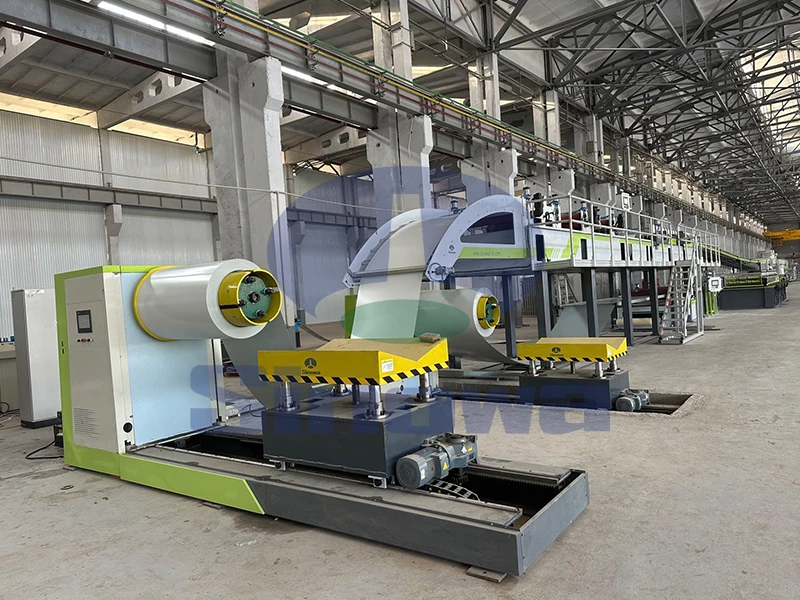
Sandwich panels are composite building materials constructed by bonding two rigid outer facing sheets to a lightweight insulating core layer, creating a finished product that combines structural strength with thermal efficiency. A custom production line allows manufacturers to adjust parameters such as panel thickness, width, length, core material type, and facing profile to meet diverse architectural and industrial needs. Unlike fixed-purpose lines that produce only a single panel specification, a configurable setup can switch between different core materials — including expanded polystyrene, rock wool, polyurethane, and polyisocyanurate — and accommodate various facings such as pre-painted steel, aluminum, stainless steel, or even fiberglass-reinforced plastic. This adaptability makes the line valuable for suppliers serving multiple market segments, from commercial roofing and wall cladding to cold storage clean rooms and industrial enclosure systems.
The core of any custom sandwich panel line lies in its continuous laminating process, which typically operates along an extended horizontal conveyor path where several sequential stations work in unison. It begins with decoiling stations that feed the metal facing coils, which then pass through roll-forming machines that shape the sheet edges into interlocking joint profiles. The shaped facings move into a heating and preheating zone where temperature is precisely controlled to ensure optimal adhesive bonding. Simultaneously, the core material — whether pre-expanded beads, mineral wool batts, or a two-component chemical mixture for foam systems — is dispensed or deposited onto the lower facing at a uniform thickness. An upper facing is then laid over the core, and the entire sandwich structure enters a continuous press or curing tunnel where pressure and temperature are maintained until the bond fully cures.
One of the defining features of a custom line is its modular design philosophy, where individual processing stations can be added, removed, or reconfigured without rebuilding the entire system. For example, a line focused on cold-room panels might include specialized edge-foaming stations and grooving devices that create tongue-and-groove joints for airtight sealing, while a line geared toward architectural wall panels could incorporate embossing rollers or micro-joint profiling stations that create decorative seams. Additional modules might include a film-laminating unit that applies protective polyethylene film to the painted surface, a notching station that cuts drainage grooves into roof panels, or a perforation line that creates sound-absorbing holes for acoustic panel variants. This modular approach means the production line can grow alongside a business, with upgrades added incrementally as new product lines are developed.
Material handling and feeding systems are engineered to accommodate the specific core materials a manufacturer intends to process. For foam-core panels, the line integrates high-pressure metering and mixing heads that precisely proportion the polyol and isocyanate components, adjusting output volume on the fly to change panel thickness or density. For mineral wool panels, a feeding system arranges wool batts uniformly across the panel width, often with a spinning or orienting mechanism that aligns fibers perpendicular to the facings for improved compressive strength. Expanded bead cores require a pre-expansion and curing silo system before the beads are dispensed into the mold cavity on the production belt. Each of these feeding approaches demands different equipment configurations, and a truly custom line is designed with the future switchover in mind, providing sufficient space, utility connections, and control system capacity to add a new core-feeding module later.
Control systems form the nervous system of a modern custom production line, enabling operators to manage a wide range of product recipes from a central human-machine interface. When a new panel specification is required — say, a panel with different thickness, density, and facing color — the operator selects the corresponding recipe, and the line automatically adjusts belt speed, core dispensing rate, heating zone temperatures, cutting lengths, and press pressure. Recipe-based control reduces human error and shortens changeover time, which is critical when a factory must produce short runs of many different panel types rather than long runs of a single product. Data logging features record production parameters for each batch, providing traceability that is useful for quality control and for fine-tuning processes over time. The control architecture also typically includes safety interlocks, fault diagnostics, and remote monitoring capabilities that allow equipment providers to assist with troubleshooting without being physically on site.
The end-of-line section determines how finished panels are cut, stacked, and prepared for shipment. A flying cut-off saw or guillotine shear trims panels to the programmed length while the line is still moving, maintaining continuous throughput. After cutting, panels are conveyed to a stacking area where an automatic stacker places them in neat bundles, interleaving protective sheets between layers if needed. Some lines include a film-wrapping station that encases each bundle in shrink wrap to protect the panels during transport and storage. The output capacity of a custom line is defined not just by its maximum speed but by how efficiently it handles product transitions — a line that can change from one panel type to another in minutes rather than hours gives the manufacturer a significant competitive advantage when serving customers with small, varied orders.
The value proposition of investing in a custom sandwich panel production line extends beyond mere equipment cost. Manufacturers gain the ability to respond directly to customer drawings and specifications, producing panels that match unique project geometries, performance requirements, and aesthetic preferences. This capability is increasingly important as modern architecture demands bespoke facade systems, curved roof profiles, and panels with integrated fenestration openings that cannot be sourced from standardized product catalogs. By controlling the production process in-house, a manufacturer can also iterate quickly on designs, testing new core materials, facing finishes, and joint details without being dependent on an external supplier's development schedule. Over time, this flexibility becomes a strategic asset that opens doors to niche markets and long-term client relationships built on reliability and customization.
Operational planning for a custom line requires careful consideration of factory layout, utility infrastructure, and workforce training. The production line itself is a substantial piece of machinery, often extending 50 meters or more in length, and it requires a clear, level floor space with sufficient clearance on both sides for maintenance access. Utility demands include three-phase electrical power, compressed air supply, cooling water for foam processing equipment, and in some cases natural gas or thermal oil for heating systems. Ventilation and dust collection are particularly important when working with mineral wool cores or when applying adhesives, as these processes generate particulate matter and fumes that must be extracted to maintain a safe working environment. Training operators to run a configurable line is more involved than training them on a single-product line, as they must understand how each module interacts and how to interpret recipe settings correctly. Many equipment providers offer structured training programs as part of the delivery package.
Sustainability and energy efficiency are increasingly shaping decisions about production line design. Manufacturers are looking for ways to reduce waste during panel production, such as optimizing trim margins so that scrap from cutting ends is minimized. Foam-based lines can recover and reuse excess foam, while metal scrap from edge trimming is collected and recycled. Energy consumption in the heating and curing zones represents a significant operational cost, and modern lines incorporate better insulation on oven enclosures, more efficient burners, and heat recovery systems that recapture waste heat to pre-heak incoming materials. Water-based adhesives and low-VOC blowing agents for foam cores are becoming more common as regulatory pressure on emissions grows, and a custom line can be specified from the outset to accommodate these environmentally preferred chemistries rather than retrofitting later.
When selecting equipment for a custom sandwich panel line, manufacturers should evaluate not just the mechanical specifications but the depth of engineering support behind the system. The most capable line in the world underperforms if it cannot be properly commissioned, if spare parts are difficult to source, or if the control software is unintuitive to operate. A thoughtful equipment provider will work with the buyer to understand the intended product portfolio, identify which customization features are essential today versus desirable in the future, and design a line that balances current affordability with upgradability. The relationship often extends for years, as the manufacturer introduces new panel designs, changes core suppliers, or expands production capacity — and having a partner who understands the original line design becomes invaluable throughout that lifecycle. Ultimately, a well-executed custom production line is more than a capital investment; it is the foundation on which a flexible, responsive, and customer-focused panel manufacturing business is built.
Gallery of Sandwich Panel Production Line






Tags: sandwich panel production line, sandwich panel production line manufacturer, sandwich panel production line supplier, china sandwich panel production line, sandwich panel production line for sale
https://www.sandwichpanelmachinery.com/blog/custom-sandwich-panel-production-line.html
-

The PU sandwich panel line is a core production setup for making high-performance building insulation panels. This professional PU sandwich panel production line features automated operation to streamline the whole manufacturing process efficiently. Every component of the polyurethane sandwich panel line is precisely calibrated to ensure consistent panel thickness and structural stability. A well-maintained polyurethane sandwich panel production line can greatly boost production efficiency while reducing manual operation errors. The continuous PU sandwich panel line adapts to diverse production demands for different panel sizes and surface styles. With advanced molding technology, the PIR sandwich panel line produces panels with excellent heat preservation and sound insulation properties. Stable running of the PIR sandwich panel production line guarantees reliable product quality for various construction and industrial application scenarios.
-

A phenolic insulation board production line serves as the core equipment for manufacturing high-performance thermal insulation building materials. This phenolic insulation panel production line integrates material mixing, foaming, molding and cutting processes to ensure continuous and stable production efficiency. Every operational link of the insulation board production line is precisely calibrated to produce uniform and durable insulation boards. The automated design of the insulation panel production line effectively reduces manual intervention and improves product consistency. Proper maintenance of the phenolic board production line can greatly extend its service life and maintain steady production output. With optimized structural design, the phenolic panel production line adapts to various production demands and delivers high-quality finished products for thermal insulation engineering applications.
-

A professional rockwool sandwich panel line serves as the core equipment for producing high-performance building panels. This rockwool sandwich panel production line integrates feeding, laminating and forming processes to ensure stable and efficient production. The well-structured rock wool sandwich panel line can process raw rockwool materials into panels with excellent thermal and sound insulation properties. Operators can adjust the running parameters of the rock wool sandwich panel production line to manufacture panels of different thicknesses and specifications. The automated design of the mineral wool sandwich panel production line greatly reduces manual operation errors and improves product consistency. Regular maintenance of the mineral wool sandwich panel line is essential to sustain long-term operational efficiency and guarantee qualified finished panels for diverse construction applications.