Continuous Mineral Wool Panel Line
Publication Date: Oct 13, 2026
A continuous mineral wool panel line produces uniform insulation boards through melting, fiber spinning, curing, and cutting in one integrated automated process.
Raw materials such as basalt, dolomite, and recycled slag are carefully weighed and fed into a furnace at temperatures reaching around 1,500 degrees Celsius. The molten rock flows onto spinning wheels, where centrifugal force draws it into fine fibers just a few micrometers in diameter. A phenolic resin binder is sprayed evenly onto the fibers as they form, ensuring they adhere together as they settle onto a moving conveyor belt below.
The collected fiber blanket moves through forming and compression stations that control both thickness and density across the full width of the panel. The soft, resin-coated mat then enters a multi-zone curing oven, where hot air is pulled vertically through the material to activate the binder and set the final board structure. This staged curing approach prevents surface blistering, eliminates uneven density, and locks in the thermal and mechanical properties the finished panel will retain throughout its service life.
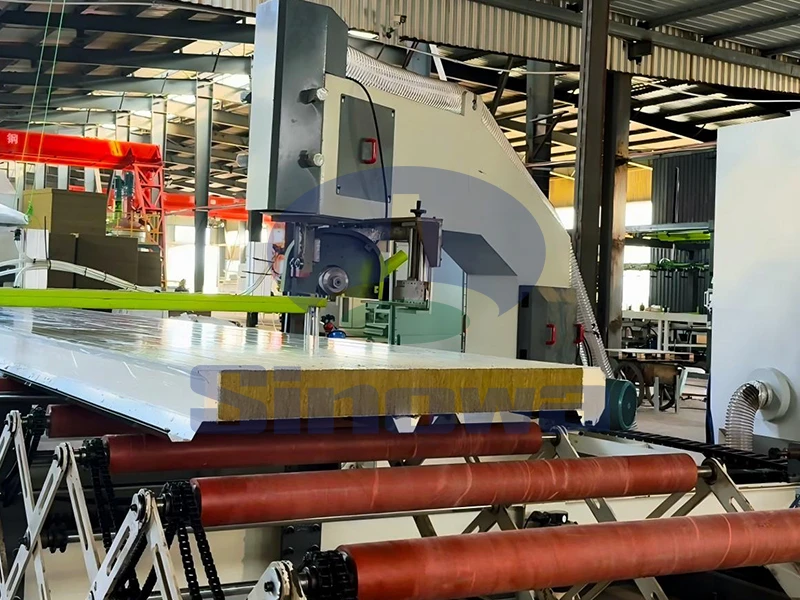
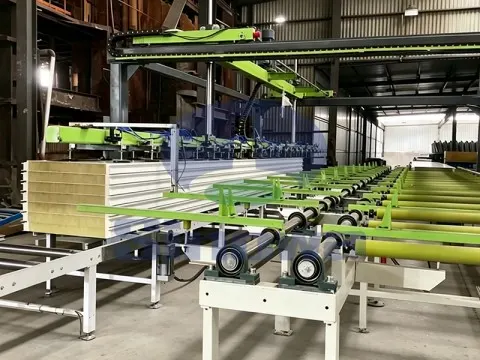
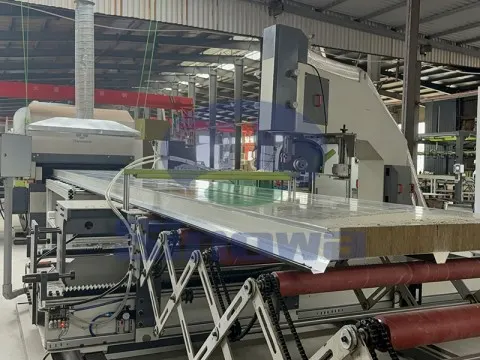
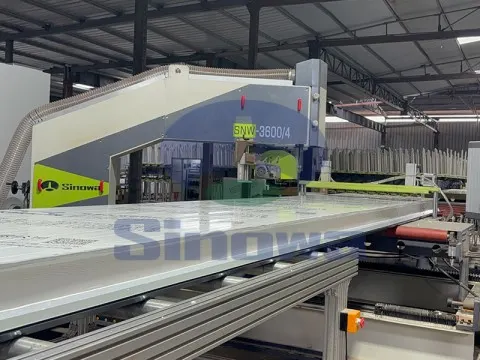
After exiting the oven, the panels pass through a cooling section that brings their temperature down to near ambient before they reach the cutting station. Rotating saws and guillotine blades trim the edges to exact width and cut the continuous board into predetermined lengths, while any off-cuts are automatically conveyed back to the recycling system and reintroduced into the raw material feed. This closed-loop trimming step minimizes waste and keeps material yield consistently high across extended production runs.
Surface finishing is another critical stage on a modern continuous line. Depending on the intended application, panels may be faced with aluminum foil, glass tissue, or woven glass cloth that is laminated under heat and pressure immediately after cutting. These facings serve as vapor barriers, improve fire resistance, and give the board a clean, finished appearance suitable for ductwork, roofing systems, and industrial equipment enclosures. The lamination rollers apply uniform pressure to prevent air pockets or delamination.
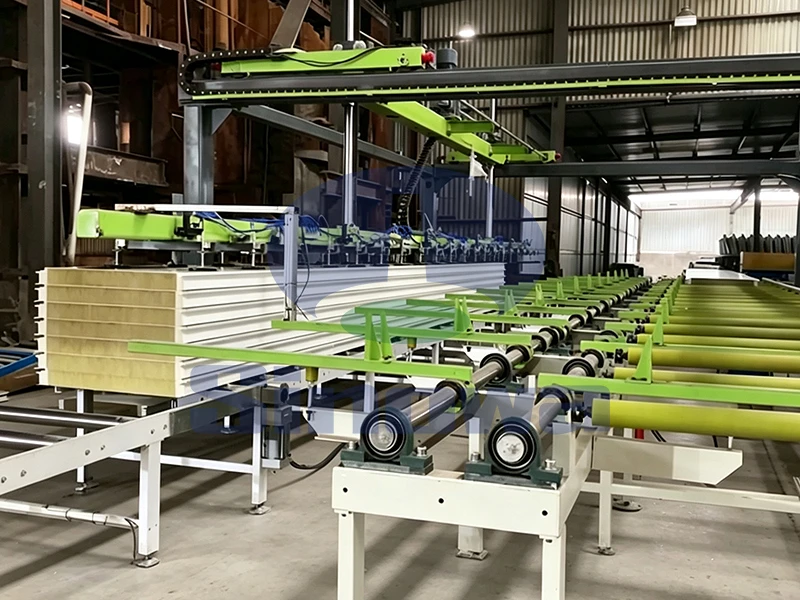
Automation and real-time monitoring are woven throughout every stage of the line. Sensors measure fiber diameter, oven temperature, belt speed, panel thickness, and moisture content, feeding data into a central control system that makes instant adjustments. Operators can review historical trends, set production recipes for different board densities, and receive alerts before a parameter drifts outside acceptable bounds. This level of process control reduces the need for manual inspection and ensures that panels coming off the end of the line match the target specification run after run.
Energy efficiency has become a major focus in the design of continuous mineral wool panel lines. Waste heat from the furnace exhaust and cooling zones is recovered and redirected to preheat incoming combustion air or to warm the curing oven, cutting overall gas consumption per ton of product. Modern burners also operate with precise oxygen trim, and insulation on the furnace shell has been upgraded to reduce radiant heat loss. These improvements lower operating costs and support manufacturers in meeting stricter environmental expectations without compromising throughput.
Maintenance planning is built into the layout of a well-engineered line. Key wear parts such as spinner wheels, conveyor belts, and oven rollers are designed for quick change-out during scheduled stops, and condition-monitoring sensors on motors and bearings allow teams to predict failures before they cause unplanned downtime. Easy access platforms and lubrication points keep routine servicing safe and fast. Over time, a well-maintained line can operate at high availability, producing thousands of square meters of finished panels every shift.
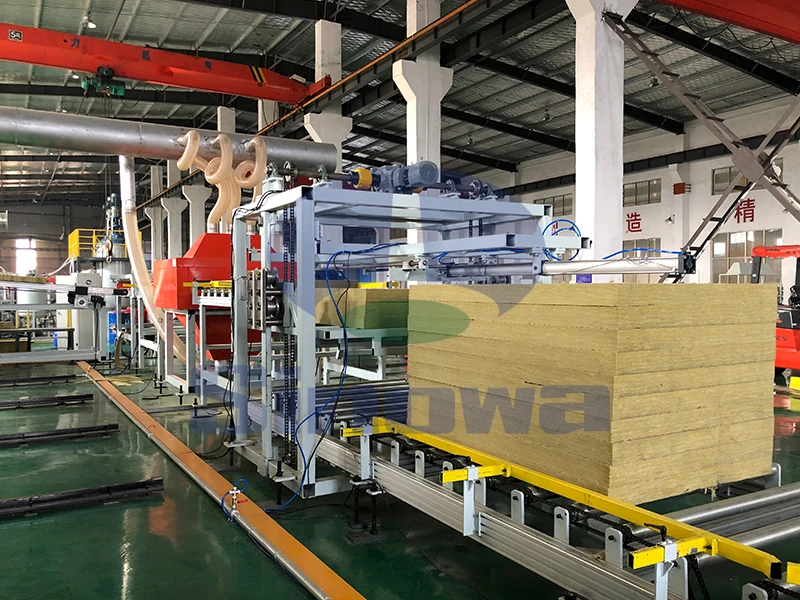
The flexibility of a continuous line allows it to switch between different panel thicknesses, densities, and facing configurations with relatively short changeover windows. By adjusting conveyor speed, oven temperature profile, and cutter settings, the same equipment can produce thin boards for wall cavities, thick rigid boards for industrial pipe insulation, and high-density boards for roof and floor applications. This versatility means producers can respond quickly to changing market demand without investing in entirely separate production equipment.
Quality assurance does not stop at the end of the line. Sampled panels are periodically taken for checks on density, compressive strength, thermal conductivity, and fire behavior, with results linked back to the production recipe that made each batch. Any deviation triggers an investigation into the relevant furnace, binder, or curing parameters. This feedback loop between laboratory and line is what allows manufacturers to steadily refine their process, improve consistency, and build long-term trust with customers who rely on mineral wool for demanding thermal and acoustic insulation applications.
The finished mineral wool panels emerging from the line are non-combustible, moisture-resistant, and fully recyclable, making them a preferred insulation choice across commercial, residential, and industrial construction. Their fibrous structure traps still air, providing effective thermal resistance, while also absorbing sound waves to improve acoustic comfort in buildings. Because the panels do not rot, warp, or promote mold growth, they deliver long-term performance that protects both the structure and the occupants inside.
Gallery of Continuous Mineral Wool Panel Line
Tags: continuous mineral wool panel line, continuous mineral wool panel line manufacturer, continuous mineral wool panel line supplier, china continuous mineral wool panel line, continuous mineral wool panel line for sale
https://www.sandwichpanelmachinery.com/blog/continuous-mineral-wool-panel-line.html
-

The PU sandwich panel line is a core production setup for making high-performance building insulation panels. This professional PU sandwich panel production line features automated operation to streamline the whole manufacturing process efficiently. Every component of the polyurethane sandwich panel line is precisely calibrated to ensure consistent panel thickness and structural stability. A well-maintained polyurethane sandwich panel production line can greatly boost production efficiency while reducing manual operation errors. The continuous PU sandwich panel line adapts to diverse production demands for different panel sizes and surface styles. With advanced molding technology, the PIR sandwich panel line produces panels with excellent heat preservation and sound insulation properties. Stable running of the PIR sandwich panel production line guarantees reliable product quality for various construction and industrial application scenarios.
-

A phenolic insulation board production line serves as the core equipment for manufacturing high-performance thermal insulation building materials. This phenolic insulation panel production line integrates material mixing, foaming, molding and cutting processes to ensure continuous and stable production efficiency. Every operational link of the insulation board production line is precisely calibrated to produce uniform and durable insulation boards. The automated design of the insulation panel production line effectively reduces manual intervention and improves product consistency. Proper maintenance of the phenolic board production line can greatly extend its service life and maintain steady production output. With optimized structural design, the phenolic panel production line adapts to various production demands and delivers high-quality finished products for thermal insulation engineering applications.
-

A professional rockwool sandwich panel line serves as the core equipment for producing high-performance building panels. This rockwool sandwich panel production line integrates feeding, laminating and forming processes to ensure stable and efficient production. The well-structured rock wool sandwich panel line can process raw rockwool materials into panels with excellent thermal and sound insulation properties. Operators can adjust the running parameters of the rock wool sandwich panel production line to manufacture panels of different thicknesses and specifications. The automated design of the mineral wool sandwich panel production line greatly reduces manual operation errors and improves product consistency. Regular maintenance of the mineral wool sandwich panel line is essential to sustain long-term operational efficiency and guarantee qualified finished panels for diverse construction applications.